
IRW-340 · Lesson 5 of 12 · 25 min
Review: reinforcing steel
▶ Video coming soon A video version of this lesson is on the way.
Tobias Reyes took the second half of the October 25 session. He had run the Monday-evening rod school all fall and had brought a cut-off length of each bar size from 10M to 35M, a bag of tie wire, a pair of nippers and a page of a placing drawing with the bar marks circled. "Ornamental guys always think rebar is just heavy lifting," he said to Benno, smiling. "Then they read a bar list for the first time." Jules, who would be writing the reinforcing exam himself in a year, sat beside him and answered half the questions before Benno could.
Reinforcing steel is a large part of the ironworker's trade and of most apprenticeship final tests, even for apprentices who have worked mostly on structural steel. The basics, such as bar sizes, laps and cover, are common knowledge across the trade. This lesson reviews IRW-130 and IRW-220.
What rebar does
Concrete is strong in compression and weak in tension. Steel bars cast into it carry the tension, control the width of cracks that form as concrete shrinks and moves with temperature, and help the concrete carry compression in columns. The bars only work if they are where the engineer put them: the right size, the right number, at the right spacing and with the right cover of concrete around them. A bar too close to the surface rusts and spalls the concrete; a bar too deep in a slab does less of the work it was designed for. That is why placing tolerances and inspection before the pour matter so much.
Sizes, grades and markings
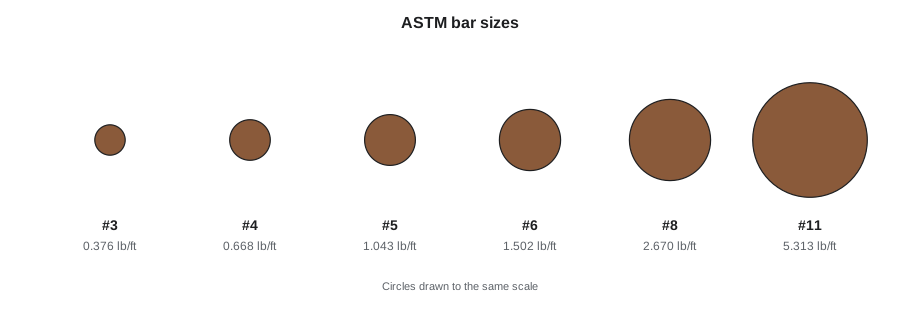
U.S. bars are made to ASTM A615 or, for weldable bars, ASTM A706, in sizes numbered by eighths of an inch of diameter: #3 is 3/8 in, #4 is 1/2 in, and so on to #11, with #14 and #18 for heavy work. Grade 60 is the common strength, in thousands of pounds per square inch of yield strength, with Grade 80 increasingly used. Each bar is rolled with marks that identify the mill, the size, the type of steel and the grade, and the mill certificate is the final word. The weights per foot are worth knowing for the most common sizes.
| Bar | Nominal diameter (in) | Weight (lb/ft) |
|---|---|---|
| #3 | 0.375 | 0.376 |
| #4 | 0.500 | 0.668 |
| #5 | 0.625 | 1.043 |
| #6 | 0.750 | 1.502 |
| #8 | 1.000 | 2.670 |
| #11 | 1.410 | 5.313 |
Worked problem
A bundle for the crane
A bundle holds 40 bars of #5, each 40 ft long. What does it weigh, and is it within Crossbeam's bundle pick limit of about 4,000 lb?
Show solution
- Total length: 40 × 40 = 1,600 ft.
- Weight: 1,600 × 1.043 = 1,668.8 lb.
Answer: About 1,669 lb, well within the limit. The common error is to use the mass of the next size down, which gives a weight about half as large.
Reading placing drawings and bar lists
A placing drawing shows where every bar goes, with a bar mark that ties it to the bar list. The bar list gives each mark's size, number, length and bend shape, so the fabricator can cut and bend the steel and the rod gang can find it in the yard. Bent bars are shown by a shape code and the dimensions of each leg. A candidate should be able to read a mark, find it on the list, identify the shape and check that the bundle tag matches.
IRW-130's footing F-4 is a typical exam setting: a square footing with 9 bars each way, and dowels sticking up for the column. The dowel F4D was a #6 bar with an "A" leg of 4 ft 2 in and a "B" hook leg of 1 ft 0 in, projecting 30 1/4 in above the footing. A question might give the bar list line and ask for the total length, the projection or the number of bars.
Bends, hooks and laps
Standard hooks and minimum bend diameters are set by ACI 318, and the detailer applies them: for example, a 90-degree hook on a #3 to #8 bar has an inside bend diameter of six bar diameters and an extension of 12 bar diameters. The rod gang checks that bent bars match the list and are not rebent cold in the field without the engineer's approval. Laps join bars end to end by overlapping them. ACI 318 uses Class A and Class B tension laps of 1.0 and 1.3 times the development length; the lap length is shown on the drawings or in the general notes. A candidate should never guess a lap length; the drawings govern.
Worked problem
Laps in a long run
A run of bottom bars is 100 ft long. Stock bars are 40 ft long and each lap is 26 in. How long must the third bar be?
Show solution
- First bar covers 40 ft.
- Second bar adds its length less one lap: 40 − 2.17 = 37.83 ft.
- Covered so far: 40 + 37.83 = 77.83 ft.
- Remaining: 100 − 77.83 = 22.17 ft.
- Third bar: remaining plus one lap: 22.17 + 2.17 = 24.33 ft, about 24 ft 4 in.
Answer: 24 ft 4 in. The trap is forgetting that each joint needs a lap, which makes the third bar a lap length too short.
Supports, cover and tying
Cover is the concrete between the bar and the surface. It protects the steel from fire and corrosion and lets the bar bond to the concrete. ACI 318 requires 3 in of cover for concrete cast against and permanently exposed to earth, and the drawings give the cover everywhere else. Bars are held at the right height by chairs, bolsters and precast blocks; IRW-130 worked out chair heights from the slab thickness, the cover and the bar sizes. Ties hold bars together during the pour. Crossbeam's tie pattern ties every crossing at the edges of a mat and every second crossing in the field, unless the drawings require more.
Common ties are the snap tie, the wrap and snap, the saddle tie and the figure-eight, and each has its use: snap ties are fast for slabs, saddle and figure-eight ties hold walls and cages that will be lifted or stood on. Tied mats and cages are not ladders or platforms unless they are designed and secured for it. Vertical bars and wall mats must be braced or guyed so they cannot fall; IRW-130 used Crossbeam's rule to guy cages taller than about 6 ft.
Welded wire, coated and special bars
Welded wire reinforcement comes in sheets designated by spacing and wire size, such as 6×6 W2.9×W2.9, under ASTM A1064. Epoxy-coated bars are handled with padded slings and nylon ties and their damaged coating is touched up; galvanized and stainless bars are kept apart from black steel to avoid contamination. Glass fiber reinforced polymer bars, made to ASTM D7957, cannot be bent in the field and are cut with abrasive blades, not torches.
Mechanical splices, or couplers, join bars where laps would be too long or congested. ACI 318 defines Type 1 couplers, which develop 125 in 100 of the bar's specified yield strength, and Type 2, which also develop its specified tensile strength. At Harrow Square, IRW-130's parkade case, RFI 14 led the engineer to replace congested laps in a transfer beam with couplers.
Post-tensioning
Post-tensioned concrete uses high-strength steel strand stressed after the concrete has hardened, pulling the concrete into compression so it can span farther with less depth. Unbonded tendons are single greased strands in plastic sheathing, common in parking structures and slabs; bonded systems run several strands in a duct that is grouted after stressing, common in bridges and heavy structures. Ironworkers place the tendons to the profile on the drawings, set the anchors, and in many jobs stress them.
The tendon profile is set by chair heights at control points along the span. In IRW-220's slab, the center of gravity of the strand dropped from 7 1/4 in above the soffit at the high points to 1 3/8 in at midspan, and the rod gang used tendon chairs set to those heights. A tendon placed too high or too low changes the forces in the slab, so the profile is checked before the pour.
Stressing is dangerous. A strand under load stores enormous energy, and an anchor or wedge failure can throw the jack or the strand out of the slab edge with lethal force. Nobody stands behind the jack or in line with the tendon during stressing. Stratline, the post-tensioning supplier in IRW-220, keeps everyone out of a zone about 20 ft behind the jack, as a company rule.
OSHA 1926.701(c) requires that no one other than those essential to the operation be permitted behind the jack during tensioning, and that signs and barriers be put up to limit access to the area during tensioning.
Worked problem
Checking an elongation
A tendon is jacked to 30 kips over a length of 100 ft. The strand area is 0.153 in² and its modulus is about 28,500 ksi (typical; use the supplier's value). What elongation is expected, and what range is acceptable at the usual ±7 in 100 tolerance?
Show solution
- \[\Delta = \frac{PL}{AE} = \frac{30 \times 1200}{0.153 \times 28\,500} = 8.26\ \text{in}\]
- Range: 8.26 × 0.93 = 7.68 in to 8.26 × 1.07 = 8.84 in.
Answer: About 8.3 in, acceptable from 7.7 to 8.8 in. Units are the usual trap: the length must be in inches if the force is in kips and the modulus in kips per square inch.
Inspection before the pour
Before concrete is placed, the rod gang checks its own work against the drawings: bar sizes and counts, spacing, laps and their locations, cover and supports, ties, dowels and embeds, openings and tendon profiles. The special inspector from the testing agency then inspects the steel as the building code requires, and the pour does not start until any deficiencies are corrected. Crossbeam's foreperson walks every pour with a checklist and signs it.
Practice questions
Question 1. A bundle tag says #6, but the bars in the bundle measure the next size down. What should the foreperson do? Options: (a) use them anyway; (b) set the bundle aside, report it and get the right bars before placing; (c) add one extra bar to make up the area; (d) use them only in the top mat.
Answer and reasoning: (b). Placing the wrong size changes the design; the fabricator replaces it and the engineer decides on any substitution.
Question 2. A wall mat 13 ft high is tied and standing in the forms before the second mat goes in. What must be done? Options: (a) nothing until the pour; (b) brace or guy it so it cannot fall; (c) climb it to tie the top bars; (d) remove the bottom ties.
Answer and reasoning: (b). Tall mats and cages fall with great force; they are braced or guyed, and nobody climbs them unless they are designed and secured for it.
Question 3. Epoxy-coated bars have scraped spots after unloading. What is the right response? Options: (a) ignore small spots; (b) touch up the damaged coating as the specification requires; (c) paint them with ordinary primer; (d) replace every bar.
Answer and reasoning: (b). Damaged coating is touched up with the approved repair material; handling with padded slings prevents most damage.
Question 4. A tendon's measured elongation is more than 7 in 100 above the calculated value. What does it suggest? Options: (a) a perfect result; (b) a possible problem such as an error in the calculation, friction, a slipping wedge or a gauge error, to be reported to the engineer; (c) the concrete is too strong; (d) the tendon should be cut.
Answer and reasoning: (b). An elongation outside the tolerance is reported and investigated before the tendon is accepted; IRW-220's stressing record showed one tendon over the limit that was rechecked.
Question 5. Why are tendon chairs set to different heights along a span? Options: (a) to save chairs; (b) to give the tendon the profile the design needs, high over supports and low at midspan; (c) to make the slab thicker; (d) to drain water.
Answer and reasoning: (b). The profile lets the tendon push up where the slab sags; the chair heights at each control point come from the drawings.
Question 6. Which inspection happens before concrete is placed on a reinforced slab? Options: (a) only a count of bundles delivered; (b) the rod gang's own check of sizes, counts, spacing, laps, cover, supports and ties, followed by the engineer's or inspector's review; (c) a check of the formwork only; (d) none, because the concrete covers it.
Answer and reasoning: (b). After the pour nothing can be fixed, so every item is checked first.
Common mistakes
MistakeUsing the mass of the wrong bar size.
InsteadCheck the size on the tag and use the correct mass per unit length.
MistakeGuessing a lap length.
InsteadThe drawings and general notes give lap lengths; never estimate them.
MistakeLeaving out a lap when working out bar lengths in a run.
InsteadEvery joint needs a lap; add it to the last bar.
MistakeStanding behind a stressing jack.
InsteadStay out of the zone behind the jack and in line with the tendon.
MistakeWalking on an unsecured mat or cage as if it were a platform.
InsteadUse proper access; mats and cages are not designed to be walked on unless secured for it.
Summary and key terms
- U.S. bars are #3 to #18 to ASTM A615 or A706, mostly Grade 60.
- Bundle weight is the total length times the mass per unit length.
- Placing drawings and bar lists are tied together by bar marks; laps and hooks follow the drawings and the concrete standard.
- Cover protects the steel; 3 in is required against earth.
- Post-tensioning tendons are placed to a profile and stressed; elongation is checked with PL ÷ AE within about ±7 in 100.
- No one stands behind the jack; inspection before the pour is the rod gang's last chance to get it right.
- Bar mark
- The code on a placing drawing that identifies a bar on the bar list.
- Lap splice
- A joint where two bars overlap so that force passes from one to the other through the concrete.
- Cover
- The thickness of concrete between a bar and the nearest surface.
- Chair
- A support that holds bars at the right height above the form or ground.
- Coupler
- A mechanical device that joins two bars end to end.
- Tendon
- A post-tensioning strand or group of strands with its anchors and sheathing.
- Elongation
- The stretch of a tendon during stressing, measured to confirm the force.
Practice problems
Work each problem on paper first, then reveal the answer to check.
What is the weight per foot of a #5 bar?
Show answer
1.043 lb/ft.
What is the most common bar grade in U.S. construction?
Show answer
Grade 60.
How much cover does ACI 318 require for concrete cast against and permanently exposed to earth?
Show answer
3 in.
A bundle has 30 bars of #6 at 30 ft. What does it weigh?
Show answer
30 × 30 × 1.502 = 1,351.8 lb.
What strength must a Type 1 coupler develop under ACI 318?
Show answer
125 in 100 of the specified yield strength.
Lesson quiz · 5 questions
Score 60% or more to complete this lesson.
Create a free account to save your progress, take quizzes and earn a certificate.