
INS-420 · Lesson 6 of 12 · 23 min
Scaffold and access planning
▶ Video coming soon A video version of this lesson is on the way.
On Tuesday morning, November 10, Bernie Valois spent two hours in Coldstream's office with Raj, going through the Ridgemount drawings page by page. Raj called it a constructability review: an experienced foreperson reads the job the way the crew will meet it, and points out what the drawings do not say. Most of Bernie's notes were about access. "The gym supply ducts are at eight and a half meters," she said, pointing at the section. "That's a lift, not a ladder, and the gym floor goes in before we get there, so it'll need floor protection. And the mechanical room headers are stacked three high over the boilers. Somebody has to plan how we reach the top one."
Access is one of the most underestimated costs in insulation work. A crew that spends a quarter of its day moving ladders, waiting for a lift or rebuilding a scaffold is installing insulation only three quarters of the time. This lesson covers the common access methods, the main OSHA rules for scaffolds and aerial lifts, how to choose access for each area of a job, and how to price it.
Access methods
Insulators reach their work in five main ways, each suited to a range of heights and conditions:
| Method | Typical use | Limits |
|---|---|---|
| Step ladders and platform ladders | Ceilings up to about 12 ft, short tasks, light materials | Frequent moves; one person per ladder; little room for material |
| Rolling scaffold towers | Ceilings of 10 to 20 ft on level floors, longer runs in one area | Height limited by base size; floors must be level and clear; moved by hand |
| Frame or system scaffold | Long work at one location: tall equipment, shafts, boiler fronts | Erected and inspected by competent workers; takes time to build and move |
| Scissor lifts | Large open areas such as gyms and warehouses, with a level slab | Vertical reach only; floor loading and protection |
| Boom lifts | Reaching over obstacles, outdoor racks, uneven ground | Larger, heavier and costlier; fall protection required in the basket |
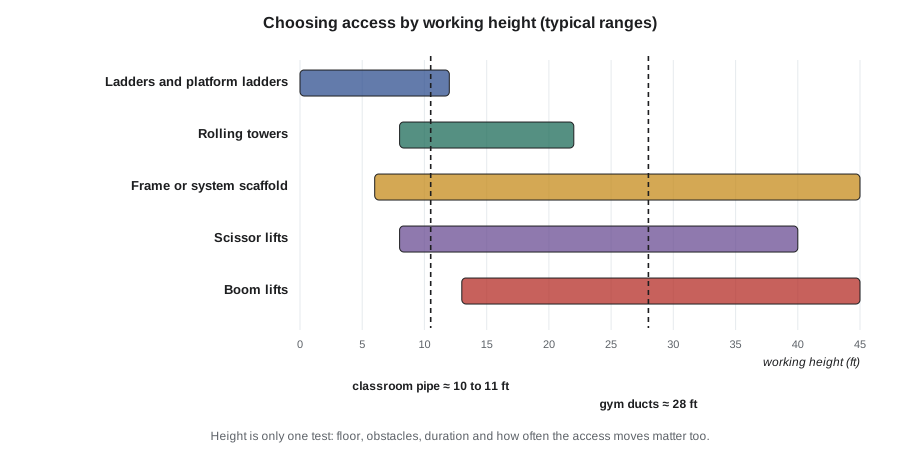
Height is only one factor. A rolling tower needs a level, clear floor, so it is no use in a mechanical room full of pumps. A scissor lift needs a slab that can carry it and a route to get there, and it cannot reach over a row of equipment. A boom lift can reach over obstacles but needs room to swing. A frame scaffold suits work that stays in one place for days, such as a boiler front or a tall tank, but costs too much time to move for work spread along a corridor.
The rules for scaffolds
In the United States, OSHA's construction standard, 29 CFR 1926 Subpart L, sets the rules for scaffolds. In summary, in our own words:
- Each scaffold must be able to support its own weight and at least four times the maximum intended load. A competent person must inspect scaffolds for visible defects before each work shift and after anything that could affect their structural integrity.
- Supported scaffolds taller than four times their minimum base width must be restrained from tipping by guys, ties or braces, or have outriggers that widen the base.
- Workers on scaffolds more than 10 ft above a lower level must be protected by guardrails or personal fall arrest systems. Mobile scaffolds must have their casters locked while in use, and workers may ride them only under strict conditions.
- Scaffolds must be erected, moved, altered or dismantled only under the supervision of a competent person, by trained workers. Each employee who works on a scaffold must be trained by a qualified person in its hazards.
The fall protection rules from INS-110 still apply on every platform and ladder: guardrails where they are required, a fall arrest system where they are not practical, and a rescue plan for anyone working in a harness. Mei Zhou keeps Coldstream's scaffold and fall protection training records, and the site supervisor or general contractor usually requires a copy before anyone works at height.
Worked problem
How tall can the tower go?
Coldstream's rolling towers have a base of 5 ft by 8 ft. OSHA requires a supported scaffold taller than four times its minimum base width to be restrained from tipping. How tall can the tower be before it needs ties, guys or outriggers?
Show solution
- Minimum base width: 5 ft.
- Limit: 4 × 5 = 20 ft before restraint is needed.
- The maker's instructions may set a lower limit, which then governs.
Answer: A 20 ft tower reaches work at about 24 ft, which covers the classroom ceilings but not the gym. Always follow the maker's instructions for the tower in use.
Elevating work platforms
Scissor lifts and boom lifts are mobile elevating work platforms (MEWPs), called aerial lifts and scaffolds in the OSHA standards. OSHA treats scissor lifts as mobile scaffolds and boom lifts as aerial lifts under 1926.453, and the ANSI/SAIA A92 standards cover their design, safe use and training. Operators must be trained on the type of machine they use, and the platform's rated load and the maker's instructions must be followed. Workers in a boom lift basket wear a full body harness attached to the anchor in the basket. A scissor lift's guardrails are its fall protection, unless the maker or the site rules require more.
For estimating, lifts bring three extra considerations. The floor must carry the lift's weight, so a lift on an upper floor or a suspended slab needs the general contractor's or engineer's approval. The finished floor may need protection: Ridgemount's gym floor would be installed before the duct insulation, so Bernie's note asked for plywood runways or non-marking tires and a floor protection plan. And lifts must be charged, delivered and picked up, which takes time and money.
Choosing access area by area
Bernie's constructability notes for Ridgemount gave access for each part of the building:
- Classroom wings: ceilings about 12 ft with the pipe and duct about 10 to 11 ft up. Platform ladders for short branches and rolling towers for the mains, with the height factor from lesson 5.
- Corridors: mains in a narrow corridor ceiling, about 8 ft wide. A narrow tower, moved often.
- Gymnasium: supply ducts at about 28 ft. A scissor lift with floor protection, for about two weeks.
- Mechanical room: headers stacked over boilers and pumps. Platform ladders for the low headers, a small system scaffold over the boilers for the top header, built by the scaffold supplier and inspected before use.
- Roof: short outdoor runs to the rooftop units, inside the roof guardrails provided by the general contractor.
Choosing access area by area matters because the cost is not only the rental. Each move of a tower, ladder or lift takes crew time, and an access method that does not fit the work makes every task slower. Some estimators price access entirely in the labor factors; Coldstream prices the equipment as a separate line and the moves in the hours, so that both can be checked.
Pricing access
Access costs fall into three parts: equipment, set-up and moves, and lost productivity. Equipment owned by the company, such as Coldstream's rolling towers and ladders, is charged at an internal rate per week. Rented equipment is priced from the rental company's rates plus delivery and pickup. Scaffold built by a scaffold contractor is priced from that contractor's quotation, which includes erection, inspection, rental time and dismantling.
Worked problem
The gymnasium lift
Bernie expects the gymnasium duct to need a scissor lift for two weeks. A sample rental rate is 1,050 dollars a week, with 275 dollars for delivery and pickup. The gym duct has about 800 ft² of surface, at the duct wrap unit of 0.017 h/ft² plus a lift factor of 20 in 100, and the crew expects about six lift moves of half an hour each for two people. What does access add to the gym work?
Show solution
- Equipment: 2 × 1,050 + 275 = 2,375 dollars.
- Base hours: 800 × 0.017 = 13.6 h; with the lift factor: 800 × 0.017 × 1.2 = 16.3 h, so the factor adds 2.7 h.
- Moves: 6 × 0.5 × 2 = 6.0 h.
- Access labor: 2.7 + 6.0 = 8.7 h, or 8.7 × 88 = 766 dollars at the sample rate.
Answer: Access adds about 3,141 dollars to work whose base labor is only about 1,200 dollars. That is normal for a small amount of high work, and it is why high areas are priced separately.
On a general contractor's site, some access may be provided by others. Some contracts make the general contractor responsible for all scaffold, or let trades share a lift. The tender documents usually say who supplies what, and an estimator who assumes the general contractor will provide something should state it in the qualifications. Raj's Ridgemount quotation said: "Includes rolling towers, ladders and one scissor lift for the gymnasium. Excludes scaffold over 10 ft in the mechanical room, assumed by others; add price available."
Access on site
Planning does not end with the estimate. On site, the foreperson checks every access item before use, follows the maker's instructions and the site rules, and keeps the area under work clear. A tower that has a missing brace, a lift whose daily check was skipped or a ladder set on a pump base is how insulators get hurt. Mei's inspection of Coldstream's rolling towers at Mountview on Monday, October 19, before the penthouse work started, found one tower with a cracked caster; it went back to the shop and was replaced the same day.
Ladders: the most common access, and the most misused
Ladders are the access insulators use most, and they cause a large share of falls in construction. The rules are simple and well known, yet broken every day: the right ladder for the height and the task; inspected before use; set on firm, level footing; extension ladders at the correct angle, about one out for every four up, and secured or held; three points of contact while climbing; tools and material raised by line or carried in a pouch, not in the hands; and nobody standing on the top cap or top step of a step ladder. OSHA's ladder standard, 1926.1053, and the maker's instructions set the details. A ladder is for short tasks; work that keeps a person on a ladder for long periods, or needs both hands and heavy material, belongs on a platform.
Platform ladders, with a small standing platform and a guardrail at the top, are a good compromise for insulation work at classroom ceiling heights. They let an insulator work with both hands at a steady height, and they move quickly. Coldstream bought more of them in 2025 after its job reviews showed that crews on ordinary step ladders were slower and more tired by the afternoon.
Access on plant work
In a plant such as Kellerton, access has extra constraints. Scaffold over live equipment must be planned with the owner, often with a permit. Lifts may be banned from certain floors or need a spotter in forklift traffic. Racks over roadways may need traffic control. And during an outage, the scaffold contractor, the insulators, the pipefitters and the plant's maintenance staff all want the same scaffold at the same time. The access plan for an outage is agreed weeks in advance, scaffold is built before the shutdown starts wherever possible, and each trade's time on it is scheduled. The yard rack job in INS-220 used two lifts over a truck lane; the plan included the hours when trucks could not use it.
Who supplies and inspects
On a large site, several kinds of access may be in use by different trades at once, and responsibility must be clear. The trade that rents or owns a lift is responsible for its maintenance and its operators' training; a scaffold built by a scaffold contractor is that contractor's to inspect and tag, but each worker on it must check the tag and the platform before use. Coldstream's rule is that nobody uses another trade's access without that trade's permission and a check of its condition, because a borrowed ladder with a cracked rail injures the borrower just as surely.
Common mistakes
MistakeChoosing access by height alone.
InsteadConsider floor conditions, obstacles, duration and how often the access must move.
MistakeIgnoring the maker's height limits on a rolling tower.
InsteadFollow the instructions and fit outriggers or ties where required.
MistakePutting a lift on a finished or suspended floor without checking.
InsteadGet approval for floor loading and plan floor protection.
MistakePricing the rental but not the moves.
InsteadAdd the crew time for set-up and moves, and the productivity factor for work at height.
MistakeAssuming the general contractor will supply scaffold.
InsteadCheck the documents and state the assumption in the qualifications.
Summary and key terms
- Insulators work from ladders, rolling towers, frame or system scaffold, scissor lifts and boom lifts, each suited to different heights and conditions.
- OSHA Subpart L governs scaffolds: four times the intended load, inspection before each shift, restraint above a 4:1 height-to-base ratio, fall protection above 10 ft, and trained workers.
- Lifts need trained operators, harnesses in boom baskets, floor loading approval and floor protection.
- Access is chosen area by area, and priced as equipment, set-up and moves, and lost productivity.
- Qualifications state what access is included and what is assumed to be supplied by others.
- Constructability review
- A review of drawings by an experienced field person to find practical problems before work starts.
- Rolling scaffold
- A scaffold tower on locking wheels, moved by hand on level floors.
- Elevating work platform
- A machine with a platform that raises workers, such as a scissor or boom lift (MEWP or aerial lift).
- Outrigger
- An arm that widens the base of a scaffold to improve its stability.
- Floor protection
- Boards, mats or runways that protect a finished floor from equipment.
- Competent worker
- A worker trained and experienced in a task and its hazards, as defined in the safety rules.
Practice problems
Work each problem on paper first, then reveal the answer to check.
Why is a rolling tower a poor choice in a crowded mechanical room?
Show answer
It needs a level, clear floor and room to move.
When must an OSHA scaffold be restrained against tipping?
Show answer
When it is taller than four times its minimum base width.
What two things must be checked before a scissor lift goes onto a finished gym floor?
Show answer
The floor's ability to carry it and the floor protection.
A lift rents for 1,050 dollars a week plus 275 for delivery. What do three weeks cost?
Show answer
3,425 dollars.
What did Raj's quotation say about mechanical room scaffold?
Show answer
That scaffold over 10 ft there was excluded and assumed by others, with an add price available.
Lesson quiz · 5 questions
Score 60% or more to complete this lesson.
Create a free account to save your progress, take quizzes and earn a certificate.