
INS-420 · Lesson 3 of 12 · 25 min
Measuring pipe, fittings and equipment
▶ Video coming soon A video version of this lesson is on the way.
Bernie Valois has a saying that every apprentice at Coldstream hears in the first week: "Measure the pipe, not the drawing." On new construction the drawings are the only thing to measure, and lesson 2 showed how. But much of Coldstream's work is in buildings and plants that already exist, where the drawings are old, wrong or missing, and the only reliable quantities are the ones taken on site. Even on new work, insulators measure in the field before ordering fitting covers, cutting jacket or fabricating removable covers.
This lesson covers how to measure existing piping, fittings and equipment for an estimate, how to find pipe size and insulation thickness from a tape measurement, and how to calculate the surface areas of tanks, vessels and ducts. It uses two examples from Coldstream's fall: the bare-fitting survey Marcel Ouellet and Devon Marsh made in the Kellerton boiler house on Friday, November 6, described in INS-210, and the equipment and duct quantities Raj took from the Ridgemount schedules.
Tools for measuring on site
A site survey needs few tools, but they should be the right ones:
- Tape measure, long enough for the runs, and a short steel tape or a flexible sewing-style tape for circumferences.
- Pi tape (a diameter tape), graduated so that wrapping it round a pipe reads the diameter directly. A plain tape and a calculator do the same job.
- Laser distance meter, for lengths across rooms and heights to the ceiling or the pipe, where climbing would otherwise be needed.
- Measuring wheel, for long outdoor runs on racks and in yards.
- Camera or phone, with photo numbers written on the survey sheet next to each item, so that anyone reading the survey later can see what was measured.
- Clipboard, survey sheets and a pencil, for sketches and numbers. A sketch with dimensions beats a list of numbers every time.
Before any survey, check the hazards. In an older plant the most important one is existing insulation that may contain asbestos. INS-230 explained the rule: check the owner's designated substance or asbestos survey before touching or disturbing anything, and stop if you find material that is not on it. Other hazards are hot surfaces, live steam, confined spaces (Kellerton's condensate tunnel is a permit space, as INS-410 noted), height, and moving equipment such as forklifts.
Walking and sketching a system
A good survey follows the system the way the fluid flows, from the source outward, so that every branch is met in order. For each run, the surveyor records:
- Pipe size and material, measured, not assumed.
- Length, measured along the centerline of the pipe, with changes of direction noted.
- Fittings, valves, flanges and specialties, by size and type, with their positions on the sketch.
- Height above the floor and the access needed: ladder, rolling scaffold or lift (lesson 6).
- Existing insulation and its condition: thickness, jacket, damage, wet areas, and whether it appears on the asbestos survey.
- Operating temperature, if known, and any items that must stay accessible (nameplates, test points, unions).
The sketch is usually an isometric, a three-dimensional line drawing in which vertical lines stay vertical and horizontal runs are drawn at 30 degrees, as INS-130 introduced. It does not have to be to scale, but every run must carry its length and every fitting its symbol and size.
Marcel's survey sheet for the Kellerton boiler house on November 6 had one line per item: a number, a photo number, the item ("NPS 4 gate valve, flanged, bare"), the size, the temperature and the access. He and Devon listed 23 bare fittings that day, the list that became package A of Raj's draft savings table in INS-410. When Raj priced the removable covers, every number he needed was on that sheet.
Pipe size from a tape measurement
On an existing system the nominal size is not written on the pipe in a way that can be read under paint and dirt, so insulators find it from the outside diameter. Wrap a flexible tape round the bare pipe, read the circumference, and divide by π to get the outside diameter. Then look up the outside diameter in a pipe or tube size table, as INS-130 explained, to find the nominal size and whether it is steel pipe or copper tube.
Worked problem
Identifying a pipe size
Devon wrapped a tape round a bare line in the boiler house and read a circumference of 7 15/32 in. What size is the pipe?
Show solution
- Outside diameter: 7.469 ÷ π = 2.377 in, about 2 3/8 in.
- A steel pipe with an outside diameter of 2.375 in is 2 in nominal.
- Copper tube of a similar outside diameter would be 2 1/8 in, so this is steel pipe.
Answer: 2 in steel pipe. Measuring and calculating is faster and more reliable than guessing from a distance.
The same method finds the thickness of existing insulation. Measure the circumference of the insulated pipe, divide by π to get its outside diameter, subtract the pipe outside diameter and halve the result. On a jacketed pipe, the jacket adds only a fraction of a millimeter and can be ignored for an estimate. Lesson 9 uses this as a quick quality check on new work.
Fittings and valves
For an estimate, fittings and valves are counted by size and type. For fabrication of fitting covers or removable blankets, they also need dimensions. INS-210 and INS-340 covered the measurements a cover maker needs: for a valve, the face-to-face length, the body diameter, the bonnet and stem, and the handwheel or operator; for a flange pair, the flange outside diameter and the length over both flanges and their bolts. On a survey for an estimate, Raj asks the crew for the count and the type, plus a photo of each different kind. Detailed measuring for fabrication comes after the order is placed, as it did at Kellerton on November 9, when Marcel and Devon measured the PRV station covers with the canvas bag kit described in INS-340.
Two counts are easy to miss on a survey: flange pairs that are not at a valve, such as at a strainer or an instrument, and fittings hidden behind supports, walls or other pipes. Thea Okerlund's audit counted four flange pairs in the condensate tunnel; when Raj walked the tunnel himself he found five, one hidden behind a support, as INS-410 recorded.
Equipment surface areas
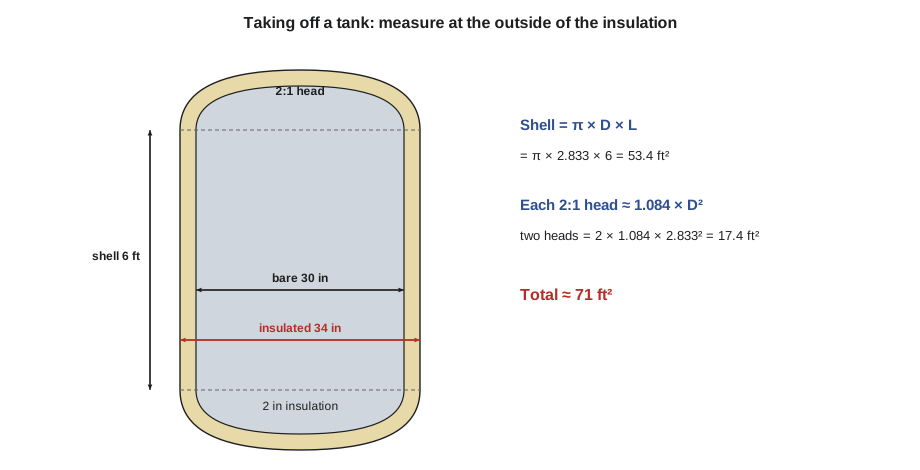
Tanks, vessels and heat exchangers are taken off by the surface area of the insulation, which is measured at its outside diameter, not the bare metal. The common shapes are a cylinder with flat or dished heads. For a cylindrical shell, the area is π times the diameter times the length. For a 2:1 elliptical head, the most common shape on pressure vessels, the area of each head is about 1.084 times the diameter squared, the same rule INS-320 used for the Carrow Park chiller.
Worked problem
A domestic hot water storage tank
Ridgemount's equipment schedule lists a vertical domestic hot water storage tank with an outside diameter of 30 in and a shell 6 ft long between 2:1 heads. The specification calls for 2 in of insulation. What area does the insulation cover?
Show solution
- Insulated diameter: 30 + 2 × 2 = 34 in = 2.833 ft.
- Shell: π × 2.833 × 6 = 53.41 ft².
- Two heads: 2 × 1.084 × 2.833² = 17.40 ft².
- Total: 53.41 + 17.40 = 70.8 ft².
Answer: About 71 ft². The legs, the openings and any nameplate cut-out are dealt with as separate items or a small allowance.
Rectangular equipment, such as a hot water heat exchanger skid or a pump base, is taken off as the sum of its insulated faces. Irregular equipment, such as a pump casing, is usually not taken off by area at all but counted as a removable cover with its own labor unit, as Carrow Park's brine pump covers were in INS-320.
Duct surface areas
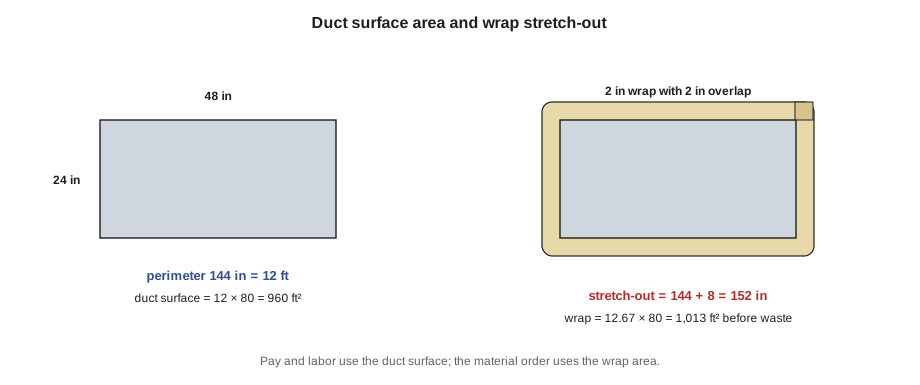
Duct insulation is taken off by area too, but there are two areas to know. The duct surface area is the perimeter of the duct times its length, and it is the area a contractor is usually paid for and the one most labor units use. The wrap area is larger, because a flexible wrap is wrapped round the outside of the duct, with an overlap, and its stretch-out is longer than the bare perimeter. INS-310 gave the manufacturer's rule for 2 in wrap on rectangular duct: add about 8 in to the perimeter, which includes a 2 in overlap.
Worked problem
A supply main
A rectangular supply main at Ridgemount is 48 × 24 in and 80 ft long, to be wrapped with 2 in duct wrap. What are the duct surface area and the area of wrap?
Show solution
- Perimeter: 2 × (48 + 24) = 144 in = 12 ft.
- Duct surface: 12 × 80 = 960 ft².
- Stretch-out: 144 + 8 = 152 in = 12.67 ft.
- Wrap: 12.67 × 80 = 1,013 ft².
Answer: 960 ft² of duct surface for labor and payment, 1,013 ft² of wrap before waste for the material order (lesson 4).
Duct fittings (elbows, transitions, branch takeoffs and offsets) are measured along the centerline and included in the length, because duct wrap goes round fittings with no special covers. Access doors, dampers, flexible connectors and instrument test points are counted separately, because each needs a cut-out, a finish or a removable section.
Recording and checking a survey
A survey is only useful if someone else can read it. Coldstream's survey sheets record the date, the surveyor, the area, and for each item a number, a photo number, a description, the size, the measured quantity, the access, the condition and notes. At the end, the surveyor totals the quantities by item type and signs the sheet.
Raj checks a survey the same way he checks a takeoff: complete coverage, sensible ratios, and a sample remeasured. He also compares it with any drawings that exist, because a large difference in either direction means one of them is wrong. When Thea's audit and Coldstream's survey disagreed about the tunnel flanges, the walk to check took twenty minutes and corrected a heat loss estimate by one fifth.
Flat surfaces, irregular items and allowances
Not everything is a pipe, a cylinder or a duct. Flat surfaces such as the sides of a rectangular tank, a breeching or an air handling unit casing are taken off as length times width for each face, at the outside of the insulation. Where two faces meet, the insulation at the corner belongs to one face only, so the estimator adds the faces using their insulated dimensions on one pair of sides and their bare dimensions on the other, or simply uses the insulated dimensions throughout and accepts a small overstatement.
Some items are easier to count than to measure. A pump casing, a strainer basket housing, a control valve with its actuator or a pump suction diffuser has a shape that no formula fits well. Coldstream counts these as items with their own labor units and either a fabricated removable cover or an allowance of material. The count, the type and a photo are what the estimate needs.
Allowances cover the small things that are real but not worth measuring one by one: nameplate cut-outs, the ends of insulation at flanges, collars at supports, short pieces between closely spaced fittings. An allowance should be stated on the survey sheet or takeoff, with its size and reason, so that it can be checked. Raj uses about 2 in 100 on pipe length for short pieces in congested areas, as a company figure, and nothing in open runs.
When the survey and the drawings disagree
On a renovation or a retrofit, there are often old drawings as well as the survey. They rarely agree. Pipes have been rerouted, equipment replaced, branches added or cut off, and insulation removed for repairs and never replaced. The survey wins, because it measures what is there, but the drawings are still useful: they show what is hidden behind walls and above fixed ceilings, and they help organize the survey by system. Where the two disagree on something that cannot be seen, such as a riser in a closed shaft, the estimator states the assumption in the quotation.
Thea Okerlund's survey inventory in INS-410 lesson 11 used equivalent lengths to turn fittings into heat loss. For estimating, Coldstream keeps the fittings as items. The two methods answer different questions, so a survey for both purposes records the fitting count, from which either can be calculated.
Common mistakes
MistakeMeasuring an existing pipe's size by eye.
InsteadMeasure the circumference, divide by π and look up the outside diameter.
MistakeTaking equipment areas at the bare metal diameter.
InsteadMeasure insulation areas at the insulated outside diameter.
MistakeOrdering duct wrap by duct surface area.
InsteadUse the stretch-out, which adds the overlap and the wrap thickness.
MistakeStarting a survey without checking the asbestos survey.
InsteadCheck the owner's survey first and stop at any material not on it.
MistakeRecording numbers without a sketch or photos.
InsteadSketch the run with lengths and symbols and number the photos on the sheet.
Summary and key terms
- Existing work is measured on site; even on new work, fabrication and cover sizes come from field measurements.
- A survey records size, length, fittings, height and access, existing insulation and condition, with a sketch and numbered photos.
- Pipe size comes from circumference ÷ π; insulation thickness from the insulated and bare diameters.
- Equipment areas use the insulated diameter: πDL for shells and about 1.084D² for each 2:1 head.
- Duct surface area is perimeter × length; wrap stretch-out adds about 8 in for 2 in wrap on rectangular duct.
- Survey sheet
- A form on which site measurements, photos and conditions are recorded for each item.
- Isometric sketch
- A line drawing showing a piping system in three dimensions, with lengths and fittings marked.
- Pi tape
- A tape graduated to read diameter directly when wrapped round a pipe.
- Duct surface area
- The perimeter of a duct times its length.
- Stretch-out
- The length of insulation needed to wrap once round a duct or pipe, including overlap.
- 2:1 elliptical head
- A dished vessel head whose depth is a quarter of the diameter, with an area of about 1.084D².
Practice problems
Work each problem on paper first, then reveal the answer to check.
A bare pipe has a circumference of 14.1 in. What is its outside diameter, and what size is it?
Show answer
about 4.49 in, a 4 in pipe.
An insulated 2 in pipe measures 20.0 in round. What is the insulation thickness?
Show answer
20.0 ÷ π = 6.37 in; (6.37 − 2.375) ÷ 2 = 2.0 in.
What is the area of one 2:1 head on a vessel with an insulated diameter of 4 ft?
Show answer
1.084 × 4² = 17.3 ft².
Why are duct elbows included in the measured length rather than counted?
Show answer
Wrap goes round duct fittings without special covers, so they are measured along the centerline.
What hidden items did the tunnel walk find that the audit missed?
Show answer
A fifth flange pair behind a support.
Lesson quiz · 5 questions
Score 60% or more to complete this lesson.
Create a free account to save your progress, take quizzes and earn a certificate.