
INS-420 · Lesson 9 of 12 · 22 min
Quality control and inspections
▶ Video coming soon A video version of this lesson is on the way.
In the second week of October, during the Mountview work, a crew insulated 46 ft of 4 in chilled water branch with 3/4 in pipe covering where the specification called for 1 1/2 in. The thinner material had arrived in a carton delivered with the domestic water shipment, and nobody checked it against the schedule, as INS-130 told. Bernie Valois and Devon Marsh found it on Bernie's Friday walk, because the insulation looked fine from the ladder but measured thin with a tape. It had to be stripped and replaced, and the time and material were lost. Lesson 4 traced the start of that mistake to the loading dock. This lesson is about the system that should catch mistakes like it at every step, and about the inspections that judge the finished work.
Quality control is the contractor's own system for making sure its work meets the contract: the right materials, installed the right way, checked before anyone else sees it. Quality assurance usually means the owner's or engineer's checking of that work: field reviews, inspections and tests. A good contractor treats the engineer's inspection as a confirmation, not as the place where problems are found.
Where quality comes from
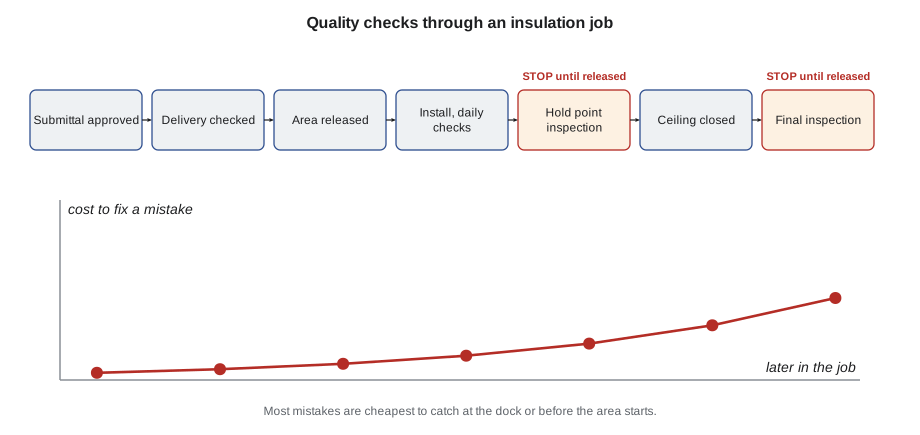
Insulation quality is built at several points, and a check at each one is cheaper than fixing the work later:
- Submittals: the product data sheets, samples and shop drawings sent to the engineer for review before ordering. An approved submittal fixes which products will be installed, and the crew needs a copy.
- Receiving: checking each delivery against the order and the submittal (lesson 4).
- Before starting an area: confirming the area is released, the pipe is tested, supports and shields are in place, and the surfaces are clean and dry.
- During the work: the foreperson's daily checks of thickness, joints, laps, sealing and finishing.
- Hold points: inspections that must happen before the work can be covered or the next step started.
- Before handover: the contractor's own final inspection, followed by the engineer's review and the deficiency list (lesson 11).
Hold points and witness points
A hold point is a stage at which work must stop until an inspection is done and the work is released. A witness point is a stage at which the inspector must be given notice and may attend, but work can continue if they do not come. Specifications for insulation often set hold points for:
- Vapor retarder and vapor stops on cold systems, before the jacket goes on, as Bernie's check of the Carrow Park trench mastic on July 30 was before the PVC (INS-320).
- Concealed insulation above ceilings and in shafts, before the ceiling or wall is closed.
- Firestop systems, before they are covered (INS-330).
- Removable covers and fabricated items, at delivery.
- Insulation on equipment before the jacket goes on, where the engineer wants to see the pins, layers and joints.
The specification says how much notice the inspector needs, often 48 hours. A foreperson who does not give the notice can be told to uncover the work, at the contractor's cost. A foreperson who gives notice and then is not ready wastes the inspector's time and damages trust. Bernie's rule is to book a hold point inspection only when her own check is done.
The foreperson's checks
Coldstream's forepersons use checklists, adapted from the specification for each job. A typical checklist for hot and cold piping in a commercial building includes:
| Check | What to look for |
|---|---|
| Material | Product, thickness and jacket match the approved submittal and the schedule for the system and size |
| Thickness | Measured, not assumed: check the insulated outside diameter of a sample in each area |
| Joints | Butted tight, staggered where layers are doubled, no gaps |
| Laps and seams | Jacket laps sealed, seams positioned to shed water where it matters |
| Fittings and valves | Covered as specified, with inserts filling the cover, ends sealed |
| Supports | Shields and inserts in place, insulation continuous through hangers on cold lines |
| Vapor retarder | On cold work: continuous, sealed at every joint, vapor stops at the required spacing |
| Exclusions | Items that must stay accessible are left uncovered or have removable covers |
| Identification | Labels and flow arrows where the specification requires them |
| Housekeeping | Area clean, offcuts removed, other trades' work not damaged |
Thickness is the check most often skipped, because insulation that looks right can be the wrong size, as the Mountview carton was. The quick field check is the one lesson 3 described: measure the circumference of the insulated pipe and compare it with the expected value.
Worked problem
Checking thickness with a tape
What circumference should a 2 in pipe (outside diameter 2.375 in) show with 2 in of insulation? And what would the Mountview 4 in chilled water branch (4.5 in) have shown with the specified 1 1/2 in and with the 3/4 in that was installed?
Show solution
- 2 in: insulated diameter 2.375 + 2 × 2 = 6.375 in; circumference π × 6.375 = 20.0 in.
- 4 in, specified: 4.5 + 2 × 1.5 = 7.5 in; circumference 23.6 in.
- 4 in, as installed: 4.5 + 2 × 0.75 = 6.0 in; circumference 18.9 in.
Answer: A difference of 4.7 in in circumference, which a tape shows instantly. A foreperson who keeps a card of expected circumferences for the job's common sizes can check an area in a few minutes.
Pipe covering sizes are made to fit pipe outside diameters, as INS-130 explained, so the insulated diameter of a real product may differ by a few millimeters from the simple sum. The check is for gross errors such as a wrong thickness, not for small tolerances.
Inspections by others
Several people may inspect insulation on a commercial job:
- The mechanical contractor's foreman, who is responsible for the mechanical work as a whole and usually walks the areas before the engineer does.
- The engineer's field reviewer, such as Hollis Brandt at Mountview, who checks that the work generally conforms to the design and issues site reports listing deficiencies.
- The owner's representatives, such as a hospital's facilities and infection control staff, or a plant's maintenance and sanitation staff at Kellerton.
- Authorities and special inspectors: the local building department reviews life safety items such as fire separations, and some jurisdictions require special inspection of firestopping. Insulation itself is rarely inspected by the authority except where it affects fire ratings.
At Mountview, the penthouse mechanical room went through all of these in one week: Bernie's own inspection on Wednesday, October 28, with five items to fix; Hollis's review on Thursday, October 29, with two; and the sign-off on Friday, October 30. That sequence is the one to aim for: the contractor finds most of the problems, and the engineer finds few.
Deficiencies and their rates
Every inspection produces a list of deficiencies: items that do not meet the contract. Tracking how many are found, and of what kind, tells a contractor where its quality system is weak.
Worked problem
A deficiency rate
At Mountview's level 2, Rhoda Ingersoll's firestop crew completed 212 items, and the third-party inspector found 6 deficiencies at the inspection before sign-off, as INS-330 recorded. What is the deficiency rate per 100 items? If a later floor had 190 items and the same rate, how many deficiencies would be expected?
Show solution
- Rate: 6 ÷ 212 × 100 = 2.8 per 100 items.
- Later floor: 190 × 6 ÷ 212 = 5.4, about 5 deficiencies.
Answer: About 3 in 100. The number matters less than the trend: if the rate rises, something in the process has changed, such as a new crew member, a new product or a rushed schedule.
The kinds of deficiency matter more than the count. A missing label is quick to fix; a missing vapor stop on a cold line can cause condensation that soaks the insulation for years. Coldstream's forepersons sort their own findings into three groups: safety or performance items that must be fixed before the area is closed, workmanship items to fix before handover, and appearance items. The first group never waits.
Records
Quality records prove the work was done right, and they are part of the close-out (lesson 11). They include approved submittals, receiving checks, checklists signed by the foreperson, inspection reports, photos of concealed work before it was covered, test results, and the deficiency list with each item's date of correction. Photos are the cheapest record: a photo of a sealed vapor stop, taken before the jacket went on, settles a later argument in seconds. INS-330's firestop crew took 446 photos on the Mountview levels, each one tied to an item number.
When something goes wrong despite the system, the useful question is not who made the mistake but why the system did not catch it. The Mountview chilled water carton passed two checks that should have caught it, the delivery and the start of the area, and was found only on Bernie's Friday walk, after it was installed. Coldstream changed two things after it: receiving checks now compare every carton label with the approved submittal list for the job, and forepersons measure a sample circumference in each new area on the first day.
Quality on cold systems
Cold work needs the strictest quality control, because its failures are slow and expensive. A small gap in a vapor retarder on a chilled water line lets humid air reach the cold pipe, where moisture condenses inside the insulation. The insulation then loses its value, the pipe may corrode, and water drips from the ceiling months later, as INS-320 explained. None of this is visible on the day the work is finished.
For cold systems, Coldstream's forepersons add checks to the standard list: every longitudinal and butt joint sealed with the specified tape or mastic and pressed down; vapor stops at every fitting and at the spacing the specification requires; continuous insulation through hangers, with inserts of the right density; no staples or fasteners that pierce the vapor retarder unless they are sealed; and the vapor retarder inspected at a hold point before any outer jacket hides it. The Carrow Park trench inspection on July 30 was such a hold point.
The Carrow Park infrared check on August 20, three weeks after start-up, found a cold ring where the mastic had not been carried into a wall sleeve, which was fixed the next day. A thermal camera is a useful quality tool on cold work after the system is running, because it shows where the insulation is not performing before water does.
Quality on finished, exposed work
Exposed insulation in mechanical rooms, gymnasiums and occupied spaces is judged by how it looks as well as how it performs. The checks there are straight lines, neat laps all facing the same way, evenly spaced bands, fitting covers that match, clean jackets without fingerprints or adhesive, and labels that are level and readable. Specifications often call for a mock-up: a sample section installed early and approved by the engineer as the standard for the rest of the work. A mock-up costs a few hours and saves arguments about appearance for the rest of the job.
On Ridgemount's gymnasium mechanical mezzanine, where the alternate asked for an aluminum jacket on exposed piping, Raj's estimate included a mock-up of one run, two elbows and a valve, to be approved before the rest was jacketed.
Sampling large quantities
On a large job nobody can measure every meter. Forepersons use sampling: in each area, check a set number of items of each kind, such as one length of pipe of each size, every tenth fitting, and every valve on cold systems. If the sample is clean, the area is accepted for the engineer; if it shows problems, the check widens until the extent is known. The specification sometimes sets the sample for the inspector, as the firestop inspection standards in INS-330 do. For the contractor's own checks, the sample should be large enough that a systematic error, such as a wrong carton or a crew member who seals laps the wrong way, would show up.
Common mistakes
MistakeTreating the engineer's inspection as the place to find problems.
InsteadDo your own inspection first; book the hold point only when your checks are done.
MistakeCovering work at a hold point without the inspection.
InsteadGive the required notice and wait for release, or risk uncovering it at your cost.
MistakeChecking thickness by eye.
InsteadMeasure a sample circumference in each area and compare it with the expected value.
MistakeCounting deficiencies without sorting them.
InsteadSeparate safety and performance items from workmanship and appearance, and fix the first group before the area closes.
MistakeBlaming a person for a quality failure.
InsteadAsk why the system did not catch it, and fix the system.
Summary and key terms
- Quality control is the contractor's own system; quality assurance is the owner's or engineer's checking of it.
- Checks at submittals, receiving, area start, daily work, hold points and handover cost less than fixing work later.
- Hold points stop the work until it is inspected; witness points need notice but not attendance.
- A foreperson's checklist covers material, thickness, joints, laps, fittings, supports, vapor retarder, exclusions, labels and housekeeping.
- Deficiency rates and kinds show where the system is weak; photos and signed records prove the work.
- Quality control
- The contractor's system for making sure its own work meets the contract.
- Quality assurance
- Checking by the owner or engineer that the contractor's work meets the contract.
- Submittal
- Product data, samples or drawings sent to the engineer for review before ordering.
- Hold point
- A stage at which work stops until it is inspected and released.
- Witness point
- A stage at which the inspector is given notice and may attend.
- Deficiency
- An item of work that does not meet the contract requirements.
Practice problems
Work each problem on paper first, then reveal the answer to check.
What is the expected circumference of an 3 in pipe (3.5 in) with 2 in of insulation?
Show answer
π × (3.5 + 4) = 23.6 in.
What is the difference between a hold point and a witness point?
Show answer
Work stops at a hold point until it is inspected; at a witness point the inspector may attend but work can continue.
Why did Bernie book Hollis's review only after her own inspection?
Show answer
So that the contractor finds most of the problems and the engineer confirms the work.
An inspection finds 4 deficiencies in 160 items. What is the rate per 100 items?
Show answer
2.5 per 100.
Which of these must be fixed before an area closes: a missing label or a missing vapor stop on a cold line?
Show answer
The missing vapor stop.
Lesson quiz · 5 questions
Score 60% or more to complete this lesson.
Create a free account to save your progress, take quizzes and earn a certificate.