
INS-420 · Lesson 11 of 12 · 22 min
Closing out a job
▶ Video coming soon A video version of this lesson is on the way.
A job is not finished when the last section of pipe covering goes on. It is finished when the deficiencies are fixed, the records are handed over, the last change is paid, the holdback or retainage is released and the company has learned what the job had to teach. That last stretch, the close-out, is where many contractors lose money they had already earned: deficiency lists that drag on for months, missing paperwork that holds up final payment, and leftover material that nobody returns.
This lesson follows the close-out of Coldstream's jobs in 2026: Carrow Park arena, handed over on Friday, July 31, with its records the same day (INS-320); the Mountview penthouse mechanical room, signed off on Friday, October 30 (INS-130); and the Mountview project as a whole, whose records handover is planned for completion in the spring of 2027 (INS-330). It ends with Raj's review of five 2026 jobs, which is how Coldstream keeps its labor units honest.
Substantial completion and the deficiency list
Near the end of a project, the contractor asks the architect to review the work for substantial completion: the stage at which the work is sufficiently complete for the owner to occupy or use it for its intended purpose. Under AIA A201, the architect inspects the work and issues a certificate of substantial completion with a list of items to be completed or corrected, often called the punch list. Each trade receives the items that are its responsibility.
A deficiency list for insulation is usually short if the quality system in lesson 9 worked: damaged jacket from other trades, a missing label, an end cap not sealed, a valve cover left off for a balancing contractor. The rules for closing it are:
- Walk the list with the person who wrote it, so that each item is understood before the crew goes back.
- Separate your items from others': damage caused by another trade after your work was complete is usually theirs to pay for, but it must be recorded with photos and dates.
- Fix everything in one visit if possible: each trip back to a job costs travel, set-up and supervision.
- Get each item signed off, and keep the signed list.
At Carrow Park, the final walk on July 31 with Bernie, Nadia Ferrante of Frostline and Glen Kasprzak for the city found three items: a band on a lap, a pump cover edge and a label that had been covered. All three were fixed the same day, which is the best result a close-out can have.
Close-out documents
The specification's Division 01 and the insulation sections list the documents each trade must hand over. For insulation they typically include:
- Operation and maintenance information: product data for every insulation, jacket, mastic and accessory installed, with care instructions for removable covers.
- Record drawings (as-builts): drawings marked up to show where the installed work differs from the contract drawings, such as rerouted pipe or added insulation.
- Inspection and test records: signed checklists, hold point releases, photos of concealed work, and for firestopping the item list and photos that INS-330 described.
- Warranties: the contractor's warranty and any manufacturer's warranties the specification requires.
- Spare materials, if the specification asks for them, such as a carton of each pipe covering size for the owner's maintenance staff.
- Removable cover schedules: for plant work, a list of each cover with its tag, location and installation instructions, as for the Kellerton blankets in INS-340.
Close-out documents are often a condition of final payment. A missing warranty letter or a set of product data that was never assembled can hold back the last payment for months. Raj starts the close-out folder for each job the week the submittals are approved, adding to it as the job goes on, so that at the end it needs only the record drawings and the signed lists.
Warranties
Under AIA A201, the contractor corrects work found not to conform to the contract documents within one year after substantial completion, the correction period, and subcontracts pass the same obligation down. Specifications may ask for longer warranties on particular items. A manufacturer's warranty is separate: it covers the product, under the manufacturer's conditions, and may require installation to the manufacturer's instructions. Insulation warranty claims are rare, but when they come they are usually about condensation on cold systems, which is why INS-320 put so much weight on vapor retarders.
A warranty call should be answered quickly and investigated before anyone admits or denies fault. If the cause is the insulation work, it is fixed; if it is something else, such as a leaking valve or a damaged jacket from another trade, the investigation records it.
Getting paid: holdback and retainage
On private projects in Ohio, retainage is set by the contract, commonly 5 or 10 in 100 of each payment, and when the contractor receives final retainage from the owner it must pay each subcontractor's share within 10 calendar days, if the subcontractor's work is complete and accepted. On public projects such as Ridgemount, 8 in 100 is withheld from progress payments until the project is half complete and held in escrow, and released when the work, or a substantially complete part of it, is accepted. Mechanics' lien rights on private projects, and claims against the payment bond on public projects, protect unpaid subcontractors if they act within the deadlines the law sets.
Worked problem
Retainage on Mountview
Coldstream's subcontract with Harcourt for the Mountview insulation is worth a sample 412,000 dollars, with retainage of 5 in 100. How much will be retained by the end of the job, and when must Harcourt pay it?
Show solution
- Retainage: 0.05 × 412,000 = 20,600 dollars.
- Payment: within 10 calendar days after Harcourt receives final retainage from the owner, if Coldstream's work is complete and accepted.
Answer: 20,600 dollars, often the profit on the whole job. A missing closeout document can delay it.
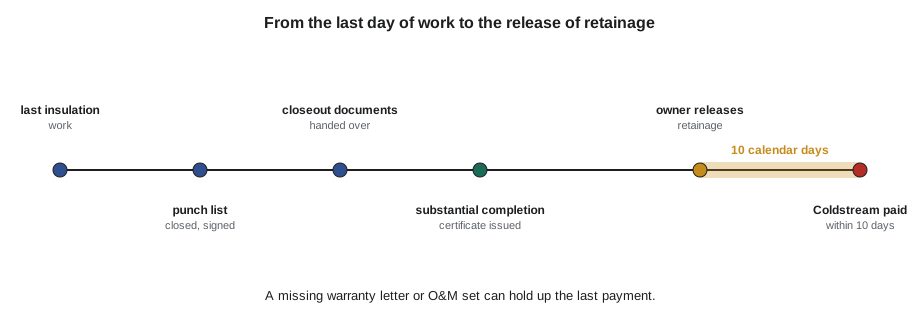
The amount held back on a job is often close to the profit on it, so a contractor that does not chase it has worked for nothing. Raj keeps a list of holdback and retainage owed on every job, with the date each becomes due, and reviews it monthly with Walt.
Demobilizing
Leaving a site is a task like any other. The crew removes its storage container, tools, access equipment and leftover material; returns rentals on time to stop the charges; cleans its areas; and hands keys and passes back. Leftover material goes back to the shop, or to the supplier for credit if full cartons can be returned (lesson 4). Each item is counted, because the count is part of the job review.
The job review
The last step of every job is the one most often skipped: comparing what was estimated with what happened. Coldstream's review takes an hour or two with the project manager and the foreperson, using the estimate, the weekly earned-hours reports, the change log and the leftover material count. It answers four questions: how did the hours compare with the estimate, item by item; why did they differ; what did the changes add; and what should change in the labor units, waste factors or methods for next time.
Worked problem
Five jobs from 2026
Raj's review of five 2026 jobs gave these estimated and actual crew-hours: Mountview penthouse mechanical room, 75 and 82 (INS-130); Kellerton yard rack, 138 and 147 (INS-220); Carrow Park arena, 240 (revised) and 252 (INS-320); Kellerton compressor noise job, 150 and 164 (INS-340); Mountview level 2 firestopping, 127.2 and 133 production hours (INS-330). What was the overrun on each, and overall?
Show solution
- Penthouse: (82 − 75) ÷ 75 = 9.3 in 100 over.
- Yard rack: (147 − 138) ÷ 138 = 6.5 in 100 over.
- Carrow Park: (252 − 240) ÷ 240 = 5.0 in 100 over.
- Compressor job: (164 − 150) ÷ 150 = 9.3 in 100 over.
- Firestopping: (133 − 127.2) ÷ 127.2 = 4.6 in 100 over.
- Overall: estimated 730.2, actual 778; (778 − 730.2) ÷ 730.2 = 6.5 in 100 over.
Answer: Every job ran over, by 5 to 9 in 100. One overrun is a story; five in a row is a pattern.
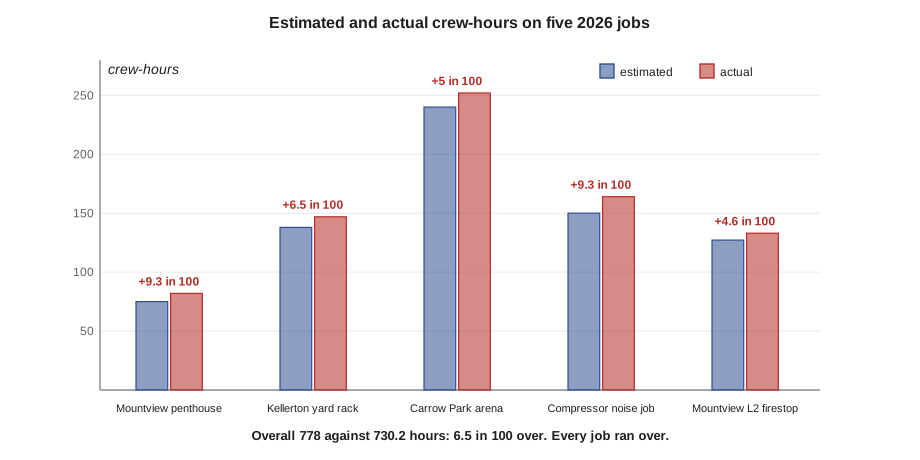
The reasons were different on each job, and Raj wrote them down: the penthouse lost time to the steam release and the hanger fix; the rack found more wet insulation than allowed; Carrow Park had water in the trench and a replaced carton; the compressor job took more time on the connection covers; the firestopping included fixes after inspection. But two things were common to all five: none of the estimates had any allowance for the unexpected, and four of the five overruns came from conditions that a site visit before pricing might have shown. Raj and Walt made two changes for 2027: a pre-bid site visit on every retrofit job, and a contingency line of 5 in 100 on retrofit estimates, priced openly rather than hidden in the units.
A job review is not a search for someone to blame. It is how a company's labor units stay true to its crews, and how its estimates get better every year. Raj's notebook of reviews is the modern version of the notebook Walt started with in the 1990s (lesson 5).
Training the owner's staff
Many specifications require the contractor to train the owner's maintenance staff in the systems installed. For insulation, the training is short but important: how to remove and reinstall removable covers, how to repair a damaged jacket or vapor retarder, which materials to use for repairs, and why damaged insulation on cold lines must be fixed quickly. At Kellerton, when the compressor covers went on in August, Wendell Ashby and Priya Lam showed the operators and Lou Brisebois how to remove and refit them, and the plant added a line to its work orders: remove the cover, bag and tag it, reinstall it before closing the work order, as INS-340 recorded. That one line will protect the covers for years.
On a building such as Ridgemount, the training would be part of the mechanical contractor's demonstration to the school board's facilities staff, with Coldstream attending for the insulation. A short written guide with photos, left in the operation and maintenance manual, is the record.
Final cost and the file
When the last payment is received, the project manager closes the job's cost records: final hours by area and item, final material cost, changes billed and paid, holdback or retainage received, and the final margin. The file keeps the estimate, the takeoff, the quotations, the subcontract, the change log, the daily reports, the quality records, the close-out documents and the job review notes. Most of it will never be opened again, but when a warranty call comes three years later, or a similar job is bid, the file is the company's memory. A file that holds the estimate but not the actual results is only half a memory.
Releasing holdback early
On a long project such as Mountview, Coldstream's work may be finished more than a year before the whole building. Waiting for the building's substantial completion to receive retainage would tie up the money for that whole time. Many subcontracts allow retainage on a trade's work to be reduced or released when that trade's work is complete and accepted, and Raj asks for it as soon as Coldstream's work is finished and its punch list is closed. He tracks each amount and its due date in his retainage list.
Common mistakes
MistakeLetting a deficiency list drag on with repeated visits.
InsteadWalk the list with its author, fix everything in one visit and get each item signed off.
MistakeAssembling close-out documents at the end of the job.
InsteadStart the close-out folder when submittals are approved and add to it as the job goes on.
MistakeForgetting to chase holdback or retainage.
InsteadKeep a list of amounts held back and the dates they become due, and follow them up.
MistakeLeaving leftover material and rentals on site.
InsteadCount and return material, and return rentals on time.
MistakeSkipping the job review.
InsteadCompare estimated and actual hours on every job and adjust the units for real differences.
Summary and key terms
- Substantial completion and the architect's review produce the punch list; each trade closes its items, ideally in one visit.
- Close-out documents include product data, record drawings, inspection records, warranties, spares and cover schedules; they often control final payment.
- Retainage is paid down the chain within 10 days of receipt in Ohio, public projects hold 8 in 100 until half complete, and the correction period runs one year from substantial completion.
- Demobilizing means removing equipment, returning rentals and counting leftover material.
- The job review compares estimated and actual hours item by item; Coldstream's five 2026 jobs ran 6.5 in 100 over, which led to site visits and a retrofit contingency.
- Substantial completion
- The stage at which the owner can occupy or use the work for its intended purpose.
- Punch list
- The list of incomplete or nonconforming items found at the review near completion.
- Record drawings
- Drawings marked to show where the installed work differs from the contract drawings.
- Retainage
- Money withheld from payments until the work is complete and accepted.
- Warranty
- The contractor's obligation to correct defects that appear within a set period.
- Job review
- A comparison of estimated and actual results at the end of a job, to improve future estimates.
Practice problems
Work each problem on paper first, then reveal the answer to check.
Why should the deficiency list be walked with the person who wrote it?
Show answer
So each item is understood before the crew goes back to fix it.
Why start the close-out folder when submittals are approved?
Show answer
So the documents are gathered as the job goes on and do not hold up final payment.
When must an Ohio contractor pay its subcontractor's share of final retainage on a private job?
Show answer
Within 10 calendar days after receiving it from the owner, if the work is complete and accepted.
A job was estimated at 200 hours and took 214. What was the overrun?
Show answer
7 in 100.
What two changes came out of Raj's 2026 job review?
Show answer
A pre-bid site visit on every retrofit job and an open contingency of 5 in 100 on retrofit estimates.
Lesson quiz · 5 questions
Score 60% or more to complete this lesson.
Create a free account to save your progress, take quizzes and earn a certificate.