
INS-420 · Lesson 7 of 12 · 21 min
Scheduling with other trades
▶ Video coming soon A video version of this lesson is on the way.
Insulation is almost never the first trade in an area and rarely the last. It follows the pipefitters, plumbers and sheet metal workers, because a pipe has to be installed and pressure tested before it is covered. It comes before the ceiling installers, painters and sometimes the firestoppers, because once the ceiling grid and tiles go in, reaching the pipe is slow and the finished ceiling gets damaged. That puts the insulation crew in the middle of the schedule, where delays from upstream arrive and pressure from downstream builds.
Bernie Valois saw it again at Mountview in October. On Monday, October 19, when Devon Marsh and Tessa Moreau started in the penthouse mechanical room, the walk-down with Gord Fennimore of Harcourt Mechanical showed that the steam had not been released: its pressure test was not until Wednesday, October 21. The crew worked on the other systems first and reached the steam after it was released, as INS-130 described. Little was lost because the plan for the area did not depend on one system. This lesson covers how construction schedules are built and read, the critical path method, look-ahead schedules, and the insulation foreperson's part in keeping the work flowing.
Construction schedules
A large project has a master schedule, prepared by the general contractor or construction manager, that shows every major activity from site work to occupancy. It is usually a bar chart (often called a Gantt chart) produced from scheduling software, with each activity shown as a bar along a time line and links between activities that depend on each other. The tender documents often require each subcontractor to work to it, and the subcontract may set milestone dates that carry penalties if missed.
Most subcontractors never see the whole schedule in detail. What they see is the part that affects them: the dates their areas will be ready, the dates the next trade needs them out, and the inspections that must happen between. The insulation estimator reads the master schedule at bid time to price the crew size and duration; the foreperson reads it during the job to plan the work.
Ridgemount's bid documents included a preliminary schedule: construction from April 2027 to August 2028, with the building enclosed by the end of 2027, mechanical rough-in through the winter, ceilings from March 2028 and occupancy for the fall 2028 school year. Raj read the dates for the insulation work off it, about January to June 2028, and used them to plan a crew of about six insulators for most of that time.
Dependencies
Every activity in a schedule depends on others. For insulation the common dependencies are:
- Pressure testing: piping must be tested and released before it is insulated, because a leak under insulation is hard to find and wets the insulation. Some specifications allow insulation of pipe before testing if the joints are left exposed; most do not.
- Duct leakage testing, where the specification requires it, before duct wrap goes on.
- Hangers, supports and shields in place, so that insulation can be installed through them without being cut later.
- Controls and instruments installed, so that wells, sensors and gauges are not insulated over or left without collars.
- Firestopping: penetrations through fire separations need the firestop system that matches the insulated pipe, which INS-330 showed is often listed for a particular insulation. Firestopping and insulation have to be sequenced together.
- Inspections: the engineer's or owner's review of concealed insulation before the ceiling closes.
- Following trades: ceiling grid and board, drywall bulkheads, painters and cleaners, all of whom need the insulation finished in their area.
Each of these is a link in the schedule. When one slips, everything after it moves unless someone makes up the time.
The critical path method
The critical path method (CPM) is the standard way to calculate a schedule. Each activity has a duration and a list of the activities that must finish before it can start. A forward pass through the network gives the earliest start and finish of each activity. A backward pass from the project's finish gives the latest start and finish that will not delay the project. The difference between an activity's latest and earliest start is its float: the time it can slip without delaying the finish. Activities with no float form the critical path, and any delay to them delays the whole job.
Worked problem
A floor of the classroom wing
Bernie's plan for one floor of a Ridgemount classroom wing has these activities: A, pressure test the heating water, 2 days; B, insulate the heating water, 7 days, after A (the 109 hours from lesson 5 with a crew of two working 8-hour days, 109 ÷ 16 = 6.8, rounded to 7); D, duct leakage test, 1 day; C, insulate the ducts, 6 days, after D; F, engineer's ceiling inspection, 1 day, after B and C; E, ceiling installation, 5 days, after F. Find the earliest finish, the critical path and the float on the ducts.
Show solution
- Forward pass: A runs from day 0 to 2; B from 2 to 9; D from 0 to 1; C from 1 to 7.
- F can start only when both B and C are finished: day 9. F runs from 9 to 10, and E from 10 to 15.
- The floor finishes on day 15. The path A, B, F, E has no spare time, so it is critical.
- Backward pass for the ducts: C must finish by day 9 for F to start on time. Its earliest finish is day 7, so C (and D before it) has 2 days of float.
Answer: 15 working days, with the heating water on the critical path and 2 days of float on the ducts. A late pressure test delays the ceilings; a late duct crew does not, unless it is more than 2 days late.
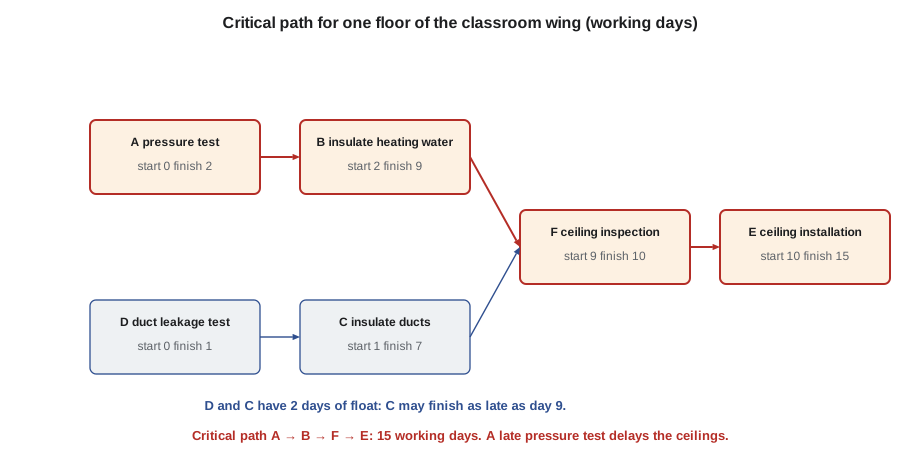
The insulation foreperson does not usually run CPM calculations, but knowing how they work explains what the general contractor's scheduler is asking for. When Bernie tells the superintendent "we need the heating water released by Tuesday or the ceilings slip," she is saying that the insulation is on the critical path. When she says "the duct crew can start Thursday and still be done in time," she is using float.
Float belongs to the project, not to the trade that happens to have it. A subcontractor that uses up float in its own work can leave none for the next trade. Most contracts say who owns float, and a careful foreperson does not assume that spare time is free.
Look-ahead schedules
The master schedule is too broad for daily planning. Superintendents run a look-ahead schedule, usually covering the next three weeks, that breaks each area down into the activities of each trade, day by day. It is updated every week at the coordination meeting, where each foreperson reports progress and problems and commits to the next week's work.
The weekly coordination meeting is where an insulation foreperson can do the most good. The useful habits are:
- Know your hours: come with the earned and remaining hours for each area (lesson 5), so that your dates are realistic.
- Ask for what you need in writing: areas released, tests completed, hangers fixed, storage space, a lift on a certain day.
- Report constraints early: an area not ready on Monday is a problem; the same area not ready on Friday is a delay.
- Commit only to what the crew can do: a promise missed damages trust more than a realistic date.
- Record what was agreed, in the minutes or the daily report (lesson 10), because disputes about delays are settled with records.
Crew size and duration
A schedule turns labor hours into calendar time. The basic relationship is simple: duration in days equals crew-hours divided by the number of workers times the hours they work each day. Adding workers shortens the duration, but only up to a point. An area has room for only so many people before they get in each other's way, and each new worker needs material, access and supervision. On Ridgemount, Raj planned for about six insulators across the building at peak, with no more than two or three on any one floor.
Work also has to be available. A crew of six is only productive if six people's worth of released work is ready every day. If the pipefitters release one floor a week, an insulation crew sized for two floors a week will spend half its time waiting or working in small pieces. Matching the crew to the flow of released work is the foreperson's most important scheduling decision, and it is why Bernie asked Gord at Mountview every Monday what he expected to release that week.
When the schedule is squeezed, contractors can add workers, add shifts, work overtime, or resequence the work. Each has costs. Lesson 5 showed the productivity loss of long weeks; a second shift needs its own supervision and lighting; resequencing needs other trades to agree. A subcontractor that is asked to accelerate because others are late should get the request in writing, because the extra cost is usually a change (lesson 10).
The insulation crew in the sequence
On commercial work, insulation is often squeezed between late rough-in and fixed ceiling dates. Three practices help:
- Work in released areas only, and ask for written release of each area after testing, so that the crew is not blamed for insulating pipe that later leaks.
- Keep a list of incomplete items in each area: a missing hanger shield, a valve not yet installed, a test point not marked. Close them before the ceiling closes, or record that they were left for others.
- Coordinate with the firestopper: agree which penetrations are done first, and use the insulation the firestop system lists (INS-330).
On plant work such as Kellerton's, the schedule is driven by outages: short periods when equipment is shut down and made safe, as the November 2–6 boiler house outage was in INS-110. Outage work is planned in detail weeks ahead, with materials staged, access built and permits arranged before the shutdown starts, because a day lost during an outage cannot be recovered. The Kellerton work planned for the Christmas shutdown, described in INS-310 and INS-410, would be scheduled the same way.
A worked look-ahead
Bernie's three-week look-ahead for one classroom floor at Ridgemount, drawn from the CPM example, would show the pressure test on the Monday and Tuesday of week one, the heating water insulation from Wednesday of week one to Thursday of week two, the duct test on the first Monday and the duct insulation from Tuesday to the following Monday, the engineer's inspection on the Friday of week two, and the ceilings from the Monday of week three. Under each bar she would write what she needs: the written release of the heating water after the test, the duct test report, a booking for the engineer with 48 hours' notice, and a storage spot on the floor for her cartons.
At each weekly meeting the look-ahead rolls forward one week. The bars that slipped are moved, the reasons are recorded in the minutes, and the new week is added at the end. Over a job, the record of moved bars and their reasons becomes the history of the schedule, which matters if there is ever a dispute about who caused a delay.
Schedules and money
The schedule also drives cash. Coldstream bills each month for the work done, usually by percentage complete against a schedule of values: a breakdown of the contract price by area or system, agreed at the start of the job. If the insulation falls behind because areas are not released, Coldstream bills less that month but its crew and overhead costs continue. If it accelerates, it spends more before it is paid. A project manager watches both the schedule and the billing, and a foreperson's weekly quantities (lesson 5) feed both.
The schedule of values is worth building carefully. Raj splits it by system and area, matching the takeoff, so that each month's billing can be checked against the installed quantities. A schedule of values that front-loads the price, billing too much early, may help cash flow but damages trust with the mechanical contractor and can be rejected.
Common mistakes
MistakeInsulating pipe before it has been tested and released.
InsteadGet written release after the pressure test, area by area.
MistakeTreating float as the insulation crew's spare time.
InsteadFloat belongs to the project; check the contract and coordinate before using it.
MistakeAdding workers to an area that cannot hold them.
InsteadMatch the crew to the released work and the space available.
MistakeReporting a constraint only when it causes a delay.
InsteadRaise it at the coordination meeting as soon as it appears, in writing.
MistakeAccelerating at another trade's request without documentation.
InsteadGet the request in writing, because the extra cost is usually a change.
Summary and key terms
- Insulation follows testing and rough-in and comes before ceilings, so it sits in the middle of the schedule.
- The master schedule shows the whole project; the look-ahead breaks the next three weeks into daily trade activities.
- The critical path method uses forward and backward passes to find each activity's float; activities with no float are critical.
- Duration is crew-hours divided by workers times hours per day, limited by space and by the flow of released work.
- Good forepersons know their hours, ask for releases in writing, report constraints early and record what was agreed.
- Master schedule
- The overall project schedule, usually a bar chart prepared by the general contractor or construction manager.
- Critical path
- The chain of activities with no float, which determines the earliest finish of the project.
- Float
- The time an activity can slip without delaying the project finish.
- Forward pass
- The calculation of each activity's earliest start and finish.
- Look-ahead schedule
- A detailed schedule of the next few weeks, updated at each coordination meeting.
- Release
- A written statement that an area or system has been tested and is ready for the next trade.
Practice problems
Work each problem on paper first, then reveal the answer to check.
Why must piping be pressure tested before it is insulated?
Show answer
A leak under insulation is hard to find and wets the insulation.
In the classroom wing example, what happens if the pressure test takes 3 days instead of 2?
Show answer
The critical path moves out a day and the ceilings start a day later.
How much can the duct crew slip without delaying the ceilings?
Show answer
2 days.
How many days do 240 crew-hours take for a crew of three working 8-hour days?
Show answer
240 ÷ 24 = 10 days.
What is usually the driving factor in a plant schedule such as Kellerton's?
Show answer
Outages, when equipment is shut down and made safe.
Lesson quiz · 5 questions
Score 60% or more to complete this lesson.
Create a free account to save your progress, take quizzes and earn a certificate.