
INS-420 · Lesson 10 of 12 · 23 min
Changes, extras and documentation
▶ Video coming soon A video version of this lesson is on the way.
Every construction job changes. The owner adds a room, the engineer revises a detail, a pipe runs somewhere other than where it was drawn, an area is not ready on the date in the schedule, or something is found that nobody knew was there. A contractor that handles changes well is paid for the extra work and keeps the job friendly. A contractor that handles them badly either works for nothing or ends up in a dispute that costs more than the change was worth.
Coldstream had examples of both kinds in 2026. At Carrow Park arena in July, Marcel's dew-point check in the trench led to a second layer of cellular glass on the brine headers, and Raj priced it as a change while the work was in progress, as INS-320 described. At the Kellerton yard rack in October, the wet insulation under the old jacket turned out to be about 79 ft instead of the 60 ft allowed, as INS-220 recorded. This lesson covers what counts as a change, the contract procedures for changes, how to price them, the records that support them, and requests for information.
What is a change?
A change is any difference between the work the contract describes and the work the contractor is directed or forced to do. The common kinds in insulation work are:
- Added scope: more pipe, duct or equipment than the contract documents show, or a system added by the owner.
- Changed specification: a different material, thickness or jacket from the one the contract specifies.
- Changed conditions: work that costs more because conditions differ from what the documents show or a reasonable bidder would expect, such as wet insulation found under a jacket, a hidden asbestos-containing fitting, or water in a trench.
- Delay and disruption: work that takes longer because areas were not released on time, the sequence changed, or the crew was moved around by others.
- Acceleration: a direction to finish faster than the schedule required.
Not every difference is a change. Work that the contract documents show, even in a place the estimator missed, is part of the contract. A mistake in the takeoff is the contractor's own problem. That is why lesson 1 stressed reading the documents and asking questions before bidding: once the contract is signed, the question is what the documents say, not what the estimator assumed.
Contract procedures for changes
Standard contracts set out how changes are made. Under AIA A201, the owner may make a change order, a written amendment signed by the owner, contractor and architect, with an agreed adjustment to the price and the time. If they cannot agree on the price in time, the owner and architect may issue a construction change directive, which instructs the contractor to proceed while the price is settled later, often on the basis of actual cost plus a fee. A minor change that does not affect the price or time may be ordered by the architect alone. Subcontracts pass these procedures down, so a mechanical contractor will issue change orders and directives to Coldstream in the same way.
Three rules apply under almost every contract:
- Written direction: do not do extra work on a verbal instruction alone. Get it in writing, even a short e-mail from the person with authority, before starting.
- Give notice: send written notice of a change, a changed condition or a delay within the time the contract sets, often a few days. Many claims fail not because the work was not extra, but because notice was not given.
- Authority: only certain people can authorize changes. A superintendent who asks for extra work may not have authority to approve its cost; the subcontract usually names who does.
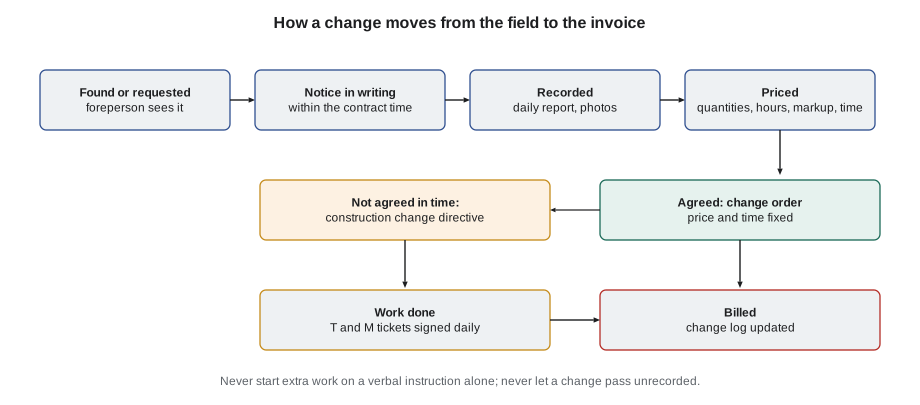
Changes often start with the foreperson, because the foreperson is the first to see them. Coldstream's forepersons are trained to recognize a possible change, stop and tell the project manager, write it in the daily report, and photograph it. They are not expected to decide whether it is extra; that is Raj's job. They are expected never to let one pass without recording it.
Pricing a change
A change is priced the same way as a bid (lesson 1): quantities, material, labor at the burdened rate, access, and markup. The markup for overhead and profit on changes is often set in the contract or subcontract, sometimes on a sliding scale by size, and it may differ for work done by the contractor's own forces and for work by its subcontractors.
Worked problem
The Carrow Park trench change
The trench section of the Carrow Park brine headers was 170 ft long. Adding the second layer of cellular glass raised its labor unit from 0.345 to 0.43 h/ft. With a sample burdened rate of 88 dollars an hour, sample added material of 1,550 dollars and a markup of 15 in 100 set in the subcontract, what was the change worth?
Show solution
- Added hours: 170 × (0.43 − 0.345) = 14.45 h.
- Labor: 14.45 × 88 = 1,271.60 dollars.
- Direct cost: 1,271.60 + 1,550 = 2,821.60 dollars.
- Markup: 0.15 × 2,821.60 = 423.24 dollars.
- Change price: 2,821.60 + 423.24 = 3,244.84 dollars.
Answer: About 3,245 dollars, and the estimate rose from 226 to 240 hours, as INS-320 recorded. Raj submitted the price the day after the change was agreed in principle, while everyone still remembered why it was needed.
A change can also affect time. If the extra work is on the critical path (lesson 7), the schedule moves, and the contractor should ask for a time extension in the same notice. A change priced without time can leave the contractor responsible for a delay it did not cause.
Some changes are deductions: the owner deletes work, or allows a cheaper material. A credit is priced the same way, usually without the profit markup, and a contractor should check that the deleted work had not already been bought or fabricated.
Time and material tickets
When the extent of the extra work is not known in advance, as with the Kellerton wet insulation, the work is often done on time and material (T&M): the contractor records the labor hours and materials actually used, gets them signed by the customer's representative each day, and bills them at agreed rates. A T&M ticket shows:
- Date, job, location and a description of the work, tied to the direction or change number.
- Each worker's name or classification and hours.
- Materials and equipment used, with quantities.
- The signature of the customer's representative, the same day.
Worked problem
A T&M ticket at the Kellerton rack
When the wet insulation at the Kellerton yard rack extended about 19 ft beyond the 60 ft allowed in Raj's price, Lou Brisebois agreed in writing that the extra removal and replacement would be done on T&M. The crew recorded two workers for 5.5 hours each, plus material. At the sample rate of 88 dollars an hour, what was the labor on the ticket?
Show solution
- Hours: 2 × 5.5 = 11 h.
- Labor: 11 × 88 = 968 dollars, before materials and the agreed markup.
Answer: 11 hours, which are part of the 147 actual hours INS-220 recorded for the job. The ticket was signed by Lou at the end of each day. A ticket signed a week later, by someone who did not see the work, is much harder to collect.
T&M tickets record facts, not entitlement. Signing a ticket confirms the hours and materials were used; it may not confirm that the work is extra. The contract decides that. Forepersons should still get every ticket signed daily, and note on it the direction it relates to.
Requests for information
A request for information (RFI) is a written question to the designer, sent through the contractor chain, about something the documents do not make clear. During construction, an insulator's RFIs are often about conflicts between drawings and specification, missing thicknesses, details that cannot be built, or substitutions. A good RFI states the question precisely, refers to the drawing and specification, proposes an answer where possible, and says when an answer is needed to avoid delay.
The Carrow Park question about bare clamps on three brine supports, in INS-320, is a good example: it described the problem, proposed inserts, and asked for an answer before the insulation reached those supports. The answer came within two days, Frostline fitted the inserts, and the work continued. An RFI answer that changes the work is a change, and the contractor should give notice and price it, even if the answer itself does not say so.
Daily reports and other records
Changes are won or lost on records. The most important is the foreperson's daily report, written every day on every job, whether or not anything unusual happened. Coldstream's daily report records:
- Date, weather (on outdoor work), crew names and hours.
- Work done, by area and item, with quantities installed.
- Areas not ready, delays, interruptions and who caused them.
- Directions received, from whom, and whether they were written.
- Changes, extras and T&M tickets, with numbers.
- Safety items: toolbox talks, incidents, near misses, inspections.
- Deliveries, material shortages and equipment.
- Photos taken, with numbers.
Other records that support changes are e-mails and letters, meeting minutes, RFIs and answers, the look-ahead schedules, marked-up drawings and the weekly earned-hours reports from lesson 5. Raj keeps a change log for each job: a list of every possible change with its number, date, description, status, price and the date it was approved and billed. At the end of the job, the change log and the daily reports are what make the close-out and the job review possible (lesson 11).
Delay and disruption
Delays are the hardest changes to price, because their cost is spread over many days. When areas are not released on time, a crew either waits, moves to other work, or works in small pieces with more set-up and travel. Each costs hours that were not in the estimate. The records that support a delay claim are the look-ahead schedules showing when areas were promised, the daily reports showing when they were actually released, the notices sent, and the earned-hours reports showing productivity before and during the disruption.
A common way to measure disruption is to compare the crew's productivity in an undisturbed period with its productivity in the disrupted period, on the same kind of work. If the crew earned 0.95 hours for each hour worked before the disruption and 0.75 during it, the difference, applied to the hours worked in the disrupted period, estimates the lost hours. The method is only as good as the records behind it, which is why lesson 5's weekly quantities matter for changes as well as for productivity.
Small delays are often absorbed to keep a good relationship, and that is a business decision. But it should be a decision, recorded as such, not an accident. Raj notes in the change log any delay Coldstream chooses not to claim, so that if the delays mount up, the full history is available.
Changes on plant work
On plant work under a service agreement, changes are simpler and more frequent. The owner's maintenance staff often ask for small additions on the spot: another valve while the crew is there, a damaged section on the way out. Coldstream's agreement with Kellerton sets T&M rates, so these are handled on signed tickets with the plant's work order number, and billed weekly. The foreperson's job is the same as on a building site: written request, signed ticket, same day.
Larger plant changes, such as the extra wet insulation at the yard rack, are priced before the work if there is time, or on T&M with a not-to-exceed figure if there is not. A not-to-exceed figure protects the owner's budget, and the contractor must give notice early if it might be reached.
Changes that reduce risk
Not every change starts as a problem. An insulator who sees a better or cheaper way to do something can propose it as a change: a different product that meets the specification and is easier to install, a sequence that avoids a scaffold, or a removable cover where the drawings show a fixed one at a valve that will need service. The proposal goes in writing, through the contractor chain, with the reason and the effect on price and time. If the engineer accepts it, it becomes a change order like any other.
Common mistakes
MistakeDoing extra work on a verbal instruction.
InsteadGet written direction from someone with authority before starting.
MistakeMissing the contract's notice period.
InsteadGive written notice of changes, changed conditions and delays within the time the contract sets.
MistakePricing a change without its time.
InsteadAsk for a time extension in the same notice if the work affects the schedule.
MistakeGetting T&M tickets signed days later.
InsteadHave the customer's representative sign each ticket the same day.
MistakeWriting daily reports only when something goes wrong.
InsteadWrite one every day; the routine days are the background that makes the unusual ones believable.
Summary and key terms
- A change is a difference between the contract work and the work directed or forced; takeoff mistakes are not changes.
- AIA A201 uses change orders, construction change directives and minor changes; subcontracts pass the procedures down.
- Written direction, notice within the contract's time and the right authority are needed for almost every change.
- Changes are priced like bids, with the contract's markup, and with time if the schedule is affected; T&M tickets record actual hours and materials and are signed daily.
- RFIs ask precise written questions; daily reports and a change log are the records that win changes.
- Change order
- A written amendment to a contract with an agreed adjustment to price and time.
- Construction change directive
- A written instruction to proceed with a change before its price is agreed.
- Changed condition
- A site condition that differs from what the documents show or a reasonable bidder would expect.
- Time and material
- Payment for actual hours and materials used, at agreed rates.
- Request for information
- A written question to the designer about the contract documents.
- Daily report
- The foreperson's daily record of crew, work, delays, directions, changes, safety and deliveries.
- Change log
- A list of every possible change on a job with its status, price and approval.
Practice problems
Work each problem on paper first, then reveal the answer to check.
Is a pipe run the estimator missed on the drawings a change?
Show answer
No; it was shown in the contract documents, so it is part of the contract.
Why must notice be given within the contract's time?
Show answer
Many claims are refused because notice was late, even when the work was extra.
A change adds 100 ft of pipe at 0.085 h/ft. How many hours is that?
Show answer
8.5 h.
What makes a T&M ticket easy to collect?
Show answer
It is detailed and signed by the customer's representative the same day.
What should a foreperson do on seeing a possible change?
Show answer
Tell the project manager, record it in the daily report and photograph it.
Lesson quiz · 5 questions
Score 60% or more to complete this lesson.
Create a free account to save your progress, take quizzes and earn a certificate.