
HSE-240 · Lesson 2 of 12 · 32 min
Airborne contaminants and exposure limits
Before anyone can choose a respirator, they need to know what is in the air, what physical form it takes and how much of it is acceptable. This lesson covers the forms airborne contaminants take, how particle size controls where they go in the body, and the exposure limits that define how much is too much in each country.
Particles: dusts, fumes, mists, fibers and bioaerosols
Particles are tiny solid or liquid pieces suspended in air. They are measured in micrometers (µm), one-thousandth of a millimeter; a human hair is roughly 50 to 100 µm across. The way a particle is formed largely determines its size, and size determines both where it lands in the lungs and how a filter captures it.
| Form | How it is made | Typical size | Examples |
|---|---|---|---|
| Dust | Mechanical breaking of solids: grinding, cutting, crushing, sanding | About 0.5 to 100 µm | Concrete and stone dust, wood dust, grain dust |
| Fume | Vapor from heated metal condenses into very fine solid particles | Mostly below 1 µm, often clumped | Welding fume, lead fume from cutting painted steel |
| Smoke | Incomplete burning of organic material | Below 1 µm | Fire smoke, diesel soot |
| Mist | Liquid droplets from spraying, splashing or condensation | About 1 to 100 µm | Paint spray, oil mist from machining, acid mist from plating |
| Fiber | Particles much longer than they are wide | Diameter below 3 µm can be respirable | Asbestos, refractory ceramic fibers |
| Bioaerosol | Living or dead microorganisms and their parts | Viruses below 0.3 µm (usually carried in larger droplets); bacteria 0.5 to 5 µm; spores 2 to 30 µm | Tuberculosis bacteria, mold spores, Legionella |
Occupational hygienists divide particles by how far they penetrate. The inhalable fraction is what can enter the nose and mouth at all. The thoracic fraction passes the larynx into the airways. The respirable fraction reaches the gas-exchange region, with a median cut-off of about 4 µm. Exposure limits often say which fraction they apply to, for example respirable crystalline silica or inhalable wood dust, and air sampling must collect the same fraction for the comparison to mean anything.
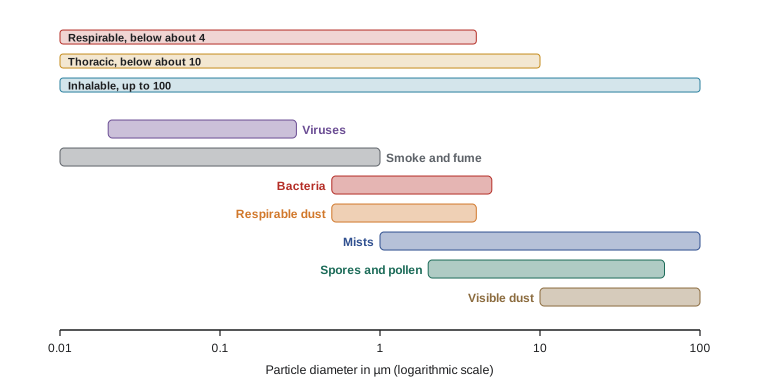
A practical rule follows: if you can see a dust cloud, there is almost certainly an invisible respirable fraction as well. Fumes and smoke are mostly invisible individually and appear only as a haze once concentrations are already high. The absence of visible dust does not mean the air is safe.
Gases and vapors
A gas is a substance that is gaseous at normal room temperature and pressure, such as carbon monoxide, chlorine, ammonia or nitrogen. A vapor is the gaseous form of a substance that is normally liquid or solid at room temperature, such as the vapor above a solvent, gasoline or mercury. Gases and vapors are individual molecules, far smaller than any particle, so particulate filters do nothing to stop them. They must be removed by chemical sorbents in cartridges or canisters, or the worker must be supplied with clean air.
Vapor concentration depends strongly on temperature. A warm solvent tank evaporates far faster than a cold one, and an enclosed space lets vapor accumulate. The maximum concentration a liquid can produce in still air is set by its vapor pressure. Acetone, with a high vapor pressure, can easily produce concentrations hundreds of times its exposure limit in a poorly ventilated room. That is one reason gas and vapor hazards can exceed the capacity of air-purifying respirators.
Some exposures combine forms. Spray painting produces both paint mist and solvent vapor, so a respirator needs a particulate prefilter and an organic vapor cartridge. Welding on galvanized or coated steel produces metal fume and may produce gases such as ozone, nitrogen oxides or carbon monoxide. Hot asphalt produces both fume and vapor. The hazard assessment must name every form present.
Concentration units
Gases and vapors are usually measured in parts per million (ppm) by volume. One ppm means one volume of contaminant in a million volumes of air. Particles, fumes and mists are measured in milligrams per cubic meter (mg/m³). Fibers are counted in fibers per cubic centimeter (f/cc). Exposure limits for gases are often given in both units, and you can convert between them at normal room conditions using the molecular weight.
Here \(MW\) is the molecular weight in grams per mole and 24.45 is the volume in liters occupied by one mole of gas at 25 °C and normal atmospheric pressure. The conversion matters when a limit is listed in one unit and a monitor reads in the other.
Worked problem
Converting toluene from ppm to mg/m³
A direct-reading instrument shows 50 ppm of toluene (molecular weight 92.1 g/mol) at 25 °C. Express this in mg/m³.
Show solution
- Use \(C_{\text{mg/m}^3} = C_{\text{ppm}} \times MW \div 24.45\).
- \(50 \times 92.1 = 4{,}605\).
- \(4{,}605 \div 24.45 = 188\) mg/m³.
Answer: About 188 mg/m³. Always check that the limit you compare against is in the same unit.
Types of exposure limits
Exposure limits are concentrations that most workers can be exposed to repeatedly without adverse health effects. They are not sharp lines between safe and unsafe, and they are not targets. Good practice is to keep exposures as far below the limit as reasonably practicable, especially for carcinogens and sensitizers. There are three main kinds of limit.
| Limit | Averaging period | Purpose |
|---|---|---|
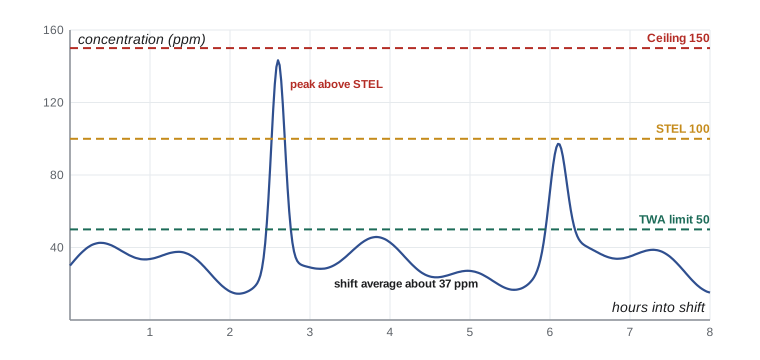
| Time-weighted average (TWA) | Usually 8 hours per day, 40 hours per week | Protects against chronic effects from repeated daily exposure |
| Short-term exposure limit (STEL) | 15 minutes | Protects against irritation and acute effects from brief peaks; usually limited to four such periods a day, at least an hour apart |
| Ceiling (C) | Not to be exceeded at any time | Protects against substances that act very quickly |
Some limits carry notations. A skin notation means the substance can be absorbed through the skin in significant amounts, so a respirator alone will not control total exposure; gloves and protective clothing may also be needed. A sensitizer notation warns that the substance can cause allergy. Carcinogen notations flag substances where exposure should be reduced to the lowest reasonably achievable level, not just below the number.
Who sets the limits
In the United States, the legally enforceable limits are OSHA's permissible exposure limits (PELs). Most PELs were adopted in 1971 from consensus values of the late 1960s and have never been updated; OSHA itself acknowledges that many are outdated and not protective. Other organizations publish more current recommended values that employers can and often should use.
| Body | Values | Status |
|---|---|---|
| OSHA | Permissible exposure limits (PELs) in 29 CFR 1910.1000 Tables Z-1, Z-2 and Z-3, plus substance-specific standards (lead, silica, benzene, methylene chloride and others) | Legally enforceable; most Z-table values date from 1971 |
| Cal/OSHA and some state plans | Own PEL tables, often lower than federal values | Enforceable in those states |
| NIOSH | Recommended exposure limits (RELs), usually 10-hour TWAs, plus IDLH values | Recommendations based on health and feasibility |
| ACGIH | Threshold limit values (TLVs) published annually | Not law on their own; widely used as good practice |
| OSHA general duty clause | Section 5(a)(1) of the OSH Act | Can be used where a recognized hazard exists even if exposures are below an outdated PEL |
Because PELs are often outdated, OSHA's own annotated Z-tables list Cal/OSHA PELs, NIOSH RELs and ACGIH TLVs side by side and encourage employers to consider the more protective values. A well-run program usually selects respirators against the most protective credible limit, not just the legal minimum. That choice also changes respirator selection, because the maximum use concentration depends on the limit used.
Worked problem
Comparing limits for the same exposure
Sampling shows a worker's 8-hour TWA exposure to a solvent is 60 ppm. The OSHA PEL is 100 ppm, but the ACGIH TLV is 50 ppm and the NIOSH REL is 50 ppm. Is the exposure acceptable?
Show solution
- The legal limit is the PEL, 100 ppm, so the exposure is below the enforceable value.
- 60 ppm is above both the TLV and the REL, which reflect more current health evidence.
- A responsible program treats the exposure as excessive, adds controls and, if respirators are used, selects them against 50 ppm.
Answer: It is legally compliant with the PEL but exceeds current health-based limits, so good practice requires further control.
Mixtures
Workers are often exposed to several substances at once. When the substances affect the same organ in the same way, for example several solvents that depress the central nervous system, their effects are generally assumed to add. The combined exposure is assessed with the additive mixture formula.
Each \(C\) is the measured concentration and each \(L\) is the corresponding limit. If \(E_m\) is greater than 1, the mixture exceeds the limit even if each substance on its own is below its individual limit.
Worked problem
An additive solvent mixture
A painter's 8-hour TWA exposures are toluene 12 ppm (limit 20 ppm), xylene 30 ppm (limit 100 ppm) and n-butyl acetate 20 ppm (limit 50 ppm). All three affect the central nervous system. Is the mixture over the limit? (Limits are illustrative; use the values in force in your jurisdiction.)
Show solution
- Toluene: 12 ÷ 20 = 0.60.
- Xylene: 30 ÷ 100 = 0.30.
- Butyl acetate: 20 ÷ 50 = 0.40.
- Sum: 0.60 + 0.30 + 0.40 = 1.30.
Answer: The mixture index is 1.30, so the combined exposure exceeds the limit even though each solvent is individually below its own limit.
When substances act on different organs, their effects are assessed independently. Deciding whether effects are additive is a professional judgment and is one of the reasons complex mixtures should be assessed by an occupational hygienist.
Unusual work schedules
TWA limits assume roughly 8-hour shifts and 40-hour weeks, with 16 hours of recovery between shifts. Workers on 10- or 12-hour shifts receive a larger daily dose and have less recovery time. For substances with chronic effects, hygienists reduce the limit for long shifts.
The simplest and most widely cited method is the Brief and Scala model, which reduces the limit by a factor that accounts for both longer exposure and shorter recovery.
Here \(h\) is the length of the shift in hours. The adjusted limit is the normal limit multiplied by \(RF\). Brief and Scala is deliberately conservative and is not applied to ceiling limits or to substances that act acutely.
OSHA's PELs do not contain a formal adjustment for unusual shifts, but OSHA guidance and industrial hygiene practice commonly use Brief and Scala or toxicokinetic models when assessing exposure on extended shifts. Some substance-specific standards define exposure as an 8-hour TWA regardless of shift length, so long shifts must be sampled and evaluated carefully.
Worked problem
Adjusting a limit for a 12-hour shift
A substance with chronic effects has an 8-hour TWA limit of 10 mg/m³. Workers on a rotating schedule work 12-hour shifts. What is the Brief and Scala adjusted limit?
Show solution
- \(RF = (8 \div 12) \times ((24 - 12) \div 16) = 0.667 \times 0.75 = 0.50\).
- Adjusted limit = 10 × 0.50 = 5 mg/m³.
Answer: About 5 mg/m³ for a 12-hour shift. Respirator selection for these workers should use the adjusted value.
Common mistakes
MistakeAssuming air without visible dust is free of particles.
InsteadRespirable particles and fumes are invisible; only sampling tells you the concentration.
MistakeUsing a particulate filter against solvent vapor.
InsteadGases and vapors need chemical cartridges or supplied air; particulate filters do not stop them.
MistakeComparing a respirable dust result with an inhalable dust limit.
InsteadMatch the sampled fraction to the fraction the limit applies to.
MistakeChecking only the 8-hour average.
InsteadCheck short-term and ceiling limits too; brief peaks can exceed them while the average is low.
MistakeJudging each substance in a mixture separately when their effects add.
InsteadUse the additive mixture formula for substances with the same effect.
MistakeApplying an 8-hour limit unchanged to a 12-hour shift.
InsteadAdjust limits for extended shifts using the method your jurisdiction or hygienist specifies.
Summary and key terms
- Dusts, fumes, smoke, mists, fibers and bioaerosols are particles; gases and vapors are individual molecules that particulate filters do not stop.
- Particle size controls where particles land: the respirable fraction, below about 4 µm, reaches the gas-exchange region.
- Gases and vapors are measured in ppm, particles in mg/m³ and fibers in f/cc; ppm converts to mg/m³ by multiplying by molecular weight and dividing by 24.45.
- TWA, STEL and ceiling limits protect against different effects and must each be checked.
- OSHA PELs are enforceable but mostly date from 1971; NIOSH RELs and ACGIH TLVs are more current and widely used as good practice.
- Mixtures of substances with the same effect are assessed with the additive formula; a sum above 1 exceeds the limit.
- Limits should be reduced for extended shifts, for example with the Brief and Scala model.
- Fume
- Very fine solid particles formed when vapor from heated metal condenses in air.
- Mist
- Liquid droplets suspended in air, produced by spraying, splashing or condensation.
- Vapor
- The gaseous form of a substance that is normally liquid or solid at room temperature.
- Respirable fraction
- The part of airborne particles that can reach the gas-exchange region of the lungs.
- Time-weighted average (TWA)
- The average concentration over a work shift, usually 8 hours, weighted by time.
- Short-term exposure limit (STEL)
- A 15-minute average concentration that should not be exceeded.
- Ceiling limit
- A concentration that must not be exceeded at any time.
- Threshold limit value (TLV)
- An exposure guideline published annually by the ACGIH.
- Permissible exposure limit (PEL)
- An enforceable US exposure limit set by OSHA.
- Skin notation
- A label showing that a substance can be absorbed through the skin in significant amounts.
- Additive mixture formula
- The sum of each concentration divided by its limit, used for substances with the same effect.
Practice problems
Work each problem on paper first, then reveal the answer to check.
What is the difference between a gas and a vapor?
Show answer
A gas is gaseous at room temperature; a vapor is the gaseous form of a substance that is normally liquid or solid.
Why does a particulate filter not protect against solvent vapor?
Show answer
Vapor is made of individual molecules far smaller than particles; it must be removed by a chemical sorbent or the worker must be given clean air.
Convert 25 ppm of ammonia (MW 17.0) to mg/m³ at 25 °C.
Show answer
25 × 17.0 ÷ 24.45 = 17.4 mg/m³.
Which limit protects against brief peaks of irritants?
Show answer
The short-term exposure limit (STEL), averaged over 15 minutes.
What does a skin notation tell you about respiratory protection?
Show answer
A respirator alone will not control total exposure; skin protection is also needed.
Calculate the mixture index for 40 ppm of a solvent with a 100 ppm limit and 30 ppm of another with a 50 ppm limit, both with the same effect.
Show answer
0.40 + 0.60 = 1.00, which is at the limit.
Calculate the Brief and Scala reduction factor for a 10-hour shift.
Show answer
(8 ÷ 10) × (14 ÷ 16) = 0.80 × 0.875 = 0.70.
Why do many US employers look beyond OSHA PELs?
Show answer
Most PELs date from 1971 and are not protective; NIOSH RELs and ACGIH TLVs reflect more current evidence.
Why should exposures to carcinogens be kept well below the limit?
Show answer
Limits are not sharp safe lines, and for carcinogens the risk falls with every reduction in exposure.
Name two exposures that combine particles and vapor.
Show answer
Spray painting (mist and solvent vapor) and hot asphalt work (fume and vapor), among others.
Lesson quiz · 5 questions
Score 60% or more to complete this lesson.
Create a free account to save your progress, take quizzes and earn a certificate.