
HSE-240 · Lesson 11 of 12 · 29 min
Supplied air, SCBA and emergencies
Atmosphere-supplying respirators give the highest protection, and they are the only respirators permitted in atmospheres that are immediately dangerous to life or health. They also introduce new hazards: breathing air that can itself be contaminated, hoses that can fail, cylinders that run out, and high-pressure equipment that needs specialist maintenance. This lesson covers breathing air quality, supplied-air systems, SCBA duration and air management, and the emergency planning that goes with IDLH work.
Breathing air quality
A supplied-air respirator or SCBA is only as safe as the air it delivers. Compressed breathing air can be contaminated by carbon monoxide from engine exhaust drawn into the compressor intake or from an overheating oil-lubricated compressor, by oil mist and vapor, by water, which can freeze in valves and regulators, and by excess carbon dioxide. Carbon monoxide is the most dangerous because it has no smell and can cause collapse while the wearer believes they are breathing clean air.
| Specification (CGA G-7.1 Grade D, as required by 1910.134(i)) | Limit |
|---|---|
| Oxygen content | 19.5 to 23.5 percent |
| Condensed hydrocarbons (oil) | 5 mg/m³ or less |
| Carbon monoxide | 10 ppm or less |
| Carbon dioxide | 1,000 ppm or less |
| Odor | No pronounced odor |
OSHA also requires that compressors be located to prevent contaminated air from entering the system; that moisture be minimized so the dew point at 1 atmosphere is at least 10 °F (5.56 °C) below the ambient temperature; that sorbent beds and filters be maintained and tagged with the date of change; that non-oil-lubricated compressors keep carbon monoxide at or below 10 ppm; and that oil-lubricated compressors have a high-temperature alarm, a carbon monoxide alarm or both, with frequent testing for carbon monoxide if only a high-temperature alarm is used (1910.134(i)). Cylinder air must come with a certificate of analysis showing it meets Grade D.
Worked problem
Spotting a compressor intake hazard
A contractor sets up a portable breathing air compressor for blasting hoods behind a building. The compressor intake is 3 meters from the exhaust of a running diesel generator, downwind. The compressor is oil-lubricated with a high-temperature shutdown but no carbon monoxide monitor. What are the hazards and what should be required?
Show solution
- Diesel exhaust contains carbon monoxide and other contaminants; with the intake downwind and close, exhaust will be drawn into the breathing air.
- An oil-lubricated compressor can also generate carbon monoxide if it overheats.
- Without a carbon monoxide monitor, workers would have no warning; carbon monoxide has no odor.
- Relocate the intake upwind and well away from any exhaust, extend the intake with a hose if needed, add a continuous carbon monoxide monitor with an alarm in the purification line, and test the air before use.
Answer: Move the intake to clean air upwind of all exhaust sources and add a carbon monoxide alarm and air testing before the blasters connect.
Supplied-air systems
A supplied-air system includes the air source (compressor or cylinder bank), purification (filters, separators, sorbent beds), pressure regulation, hoses and couplings, and the respirator. Each part must be compatible and, for the respirator and hose, part of the NIOSH-approved assembly. Approval specifies the hose length and the pressure range at the point of attachment; using a longer hose or a different pressure can starve the respirator of air.
Couplings deserve special attention. Breathing air couplings must be incompatible with outlets for other gases, such as nitrogen, argon or plant air. Deaths have occurred when a worker connected an airline hood to a nitrogen line that used the same type of quick-connect fitting. Plants that have both breathing air and other gases should use distinctive breathing air couplings and label every outlet.
| Hazard | Control |
|---|---|
| Contaminated air | Intake location, purification, carbon monoxide alarms, air testing |
| Wrong gas connected | Unique breathing air couplings, labeling, training |
| Hose damage or kinking | Route hoses away from traffic and sharp edges; inspect before use; protect with guards |
| Loss of supply | Low-pressure alarms; reserve cylinders; escape cylinders for IDLH work |
| Pressure or hose length outside approval | Use only the approved hose length and pressure range |
| Entanglement and trips | Hose management plan; attendants for long runs |
SCBA duration and air management
SCBA cylinders are rated for nominal durations such as 30, 45 or 60 minutes. Those ratings come from approval tests at a moderate breathing rate of about 40 liters per minute. Real breathing rates vary widely: a worker at rest may breathe 15 to 20 L/min, while a firefighter or rescuer working hard and under stress can breathe 60 to 100 L/min. A 30-minute cylinder may last only 12 to 15 minutes during strenuous work.
The air available in a cylinder can be estimated from its water volume and pressure.
This simple version ignores the fact that air at very high pressure compresses less than an ideal gas, so the real volume is somewhat smaller, and it ignores the reserve that triggers the low-air alarm. Use it to plan conservatively, not to push limits.
Worked problem
How long will the air last?
An SCBA has a cylinder rated at 45 cubic feet of free air at 4,500 psi. Estimate the free air in liters, and the time to the low-air alarm at 33 percent remaining, for a worker breathing 60 L/min during hard work.
Show solution
- Free air: 45 ft³ × 28.3 L/ft³ = about 1,274 L.
- Air used before the alarm at 33 percent remaining: 67 percent of 1,274 = 854 L.
- Time to alarm at 60 L/min: 854 ÷ 60 = 14 minutes.
- The remaining 33 percent, about 420 L, gives roughly 7 minutes at the same rate, which must be enough to get out.
Answer: About 14 minutes to the alarm and 7 minutes of reserve at hard work, far less than the nominal 30-minute rating suggests.
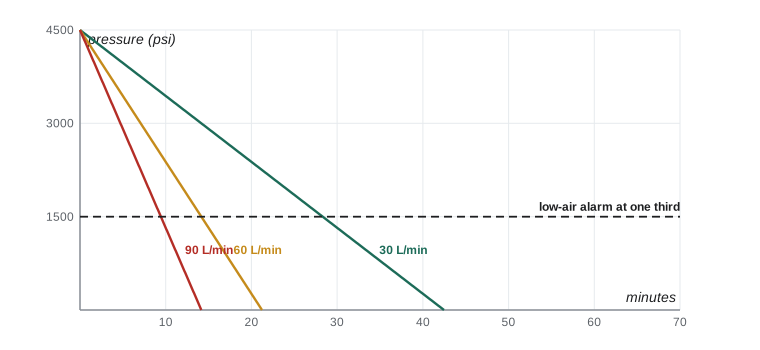
NIOSH-approved SCBA must have a remaining service-life indicator, usually an audible alarm plus a gauge or heads-up display. For fire service SCBA, the NFPA 1981 standard sets the low-air alarm at 33 percent of capacity. Many industrial teams use an air management rule such as planning to begin the exit when one-third of the air has been used for entry, leaving the rest for exit and reserve, and they track entry times and pressures at a control point.
Inspection and maintenance of SCBA
SCBA requires a more demanding inspection regime than other respirators. Before each use and at the monthly inspection, check that the cylinder is full, the gauge readings at the cylinder and regulator agree within the manufacturer's tolerance, the low-air alarm sounds when tested, the facepiece and harness are in good condition, the regulator delivers air and maintains positive pressure, and the cylinder's hydrostatic test date is current.
Compressed air cylinders must be requalified by hydrostatic testing at intervals set by Department of Transportation rules (49 CFR Parts 173 and 180) and the cylinder's specification or special permit, commonly every five years for many composite SCBA cylinders, and many composite cylinders have a limited service life, often 15 years. Annual flow testing and servicing of SCBA by a manufacturer-trained technician is standard practice.
Emergency planning for IDLH work
Any task that requires IDLH-capable respirators also requires an emergency plan. Respirators alone do not make IDLH work safe; what matters is what happens when something goes wrong.
| Element | What it involves |
|---|---|
| Standby person | At least one employee outside, in visual, voice or signal line communication, trained and equipped to provide effective rescue (1910.134(g)(3)) |
| Communication | Visual contact, voice, radio or signal lines that work with the respirators in use |
| Retrieval equipment | Harnesses and lifelines or other means to remove a worker without entry where practical |
| Notification | The employer or designee is told before the standby person enters to rescue, so further help can be summoned |
| Escape respirators | Available to anyone who could be caught by a release |
| Rescue service | A trained in-house team or arranged external service that can respond in time |
| Drills | Practice rescues and escapes under realistic conditions |
The single most important rule in respiratory emergencies is that no one enters to rescue without proper respiratory protection. Many deaths in sewers, tanks and pits have been would-be rescuers who rushed in to help a collapsed co-worker and were overcome by the same atmosphere. Training must make this rule automatic: raise the alarm, use retrieval equipment from outside if possible, and enter only with SCBA as part of a planned rescue.
Worked problem
A collapse in a pit
A worker cleaning a wastewater sump collapses at the bottom. His co-worker, who has an air-purifying respirator and no gas monitor, starts down the ladder to help. What should the co-worker do instead?
Show solution
- Assume the atmosphere is IDLH, for example from hydrogen sulfide or oxygen deficiency; an air-purifying respirator offers no protection.
- Stay out and raise the alarm immediately, calling the rescue team or emergency services.
- If the collapsed worker is attached to a retrieval line, try non-entry rescue with the winch.
- Ventilate the sump if that can be done without entering.
- Entry for rescue should be made only by trained rescuers using SCBA, with a standby person outside.
Answer: Do not enter. Raise the alarm, attempt non-entry retrieval and wait for SCBA-equipped rescuers. Entering with an air-purifying respirator would likely create a second victim.
Escape planning
Workers in areas where a sudden release is possible, such as near ammonia refrigeration, chlorine handling or process units with toxic gases, should carry or have immediate access to escape respirators approved for the hazard. They need to know where escape respirators are, how to don them quickly, how long they last and where to go. Escape respirators are inspected before being carried into the workplace and as the manufacturer specifies, and they are never used to re-enter or continue work.
Training for SCBA users goes well beyond the training for air-purifying respirators. Workers must practice donning quickly and correctly, reading gauges, responding to the low-air alarm, managing hoses and lines, communicating through the facepiece, and escaping with limited visibility. Many teams require periodic practical drills in realistic conditions so that these actions remain automatic under stress.
Common mistakes
MistakeAssuming compressor air is clean because it has no smell.
InsteadCarbon monoxide has no odor; use proper intake location, purification, alarms and testing.
MistakeUsing the same quick-connect couplings for breathing air and nitrogen.
InsteadUse breathing air couplings that cannot connect to other gas outlets, and label every outlet.
MistakePlanning SCBA work around the nominal 30-minute rating.
InsteadPlan for real breathing rates during hard work and start the exit well before the low-air alarm.
MistakeUsing a longer airline hose than the approval allows.
InsteadUse only the approved hose length and pressure range.
MistakeRushing into a pit to help a collapsed worker.
InsteadRaise the alarm, try non-entry retrieval, and enter only with SCBA as part of a planned rescue.
MistakeLeaving escape respirators uninspected or in an unknown location.
InsteadInspect them, place them along escape routes and train workers to use them.
Summary and key terms
- Breathing air can be contaminated by carbon monoxide, oil, water and carbon dioxide; carbon monoxide is odorless and especially dangerous.
- OSHA requires Grade D air, compressor intake and alarm controls, dew point limits and certificates of analysis for cylinder air.
- Supplied-air systems need approved hose lengths and pressures, unique couplings and protection against hose damage and loss of supply.
- SCBA ratings assume about 40 L/min; hard work can halve the real duration.
- Free air is roughly cylinder volume times pressure; plan to exit well before the low-air alarm.
- SCBA needs monthly and pre-use inspection, cylinder requalification and servicing by trained technicians.
- IDLH work needs standby persons, communication, retrieval equipment, rescue arrangements and drills; never enter to rescue without proper protection.
- Grade D air
- The US specification for breathing air in CGA G-7.1, required by OSHA.
- CSA Z180.1
- The Canadian standard for compressed breathing air and systems.
- Dew point
- The temperature at which water vapor in air condenses; low dew points prevent freezing in equipment.
- Sorbent bed
- A purification stage that removes contaminants such as oil vapor and water from compressed air.
- Free air volume
- The volume compressed air would occupy at normal atmospheric pressure.
- Low-air alarm
- A warning that an SCBA cylinder has reached its reserve level.
- Air management
- Planning and tracking SCBA air use so workers exit with a safe reserve.
- Hydrostatic test
- A pressure test that requalifies a cylinder for continued service.
- Non-entry rescue
- Removing a worker from a hazardous space using retrieval equipment without anyone entering.
- Escape respirator
- A respirator approved only for leaving a hazardous atmosphere.
Practice problems
Work each problem on paper first, then reveal the answer to check.
Why is carbon monoxide the most dangerous breathing air contaminant?
Show answer
It has no odor and can cause collapse without warning.
What does OSHA require for oil-lubricated compressors?
Show answer
A high-temperature alarm, a carbon monoxide alarm or both, with frequent CO testing if only a temperature alarm is used.
Why must breathing air couplings be incompatible with other gas outlets?
Show answer
Workers have died after connecting airline respirators to nitrogen or other inert gas lines.
Why do SCBA cylinders often last much less than their rated time?
Show answer
Ratings assume about 40 L/min; hard work and stress raise breathing rates to 60 to 100 L/min.
A 9-liter cylinder at 300 bar is used at 50 L/min. Estimate the time to empty, ignoring reserve.
Show answer
9 × 300 = 2,700 L; 2,700 ÷ 50 = 54 minutes, less in reality.
What does the low-air alarm tell the wearer?
Show answer
The cylinder has reached its reserve; the wearer must already be leaving.
Name four things to check on an SCBA before use.
Show answer
Cylinder pressure, gauge agreement, low-air alarm, facepiece and harness condition, regulator function, hydrostatic test date.
What is the role of a standby person in IDLH work?
Show answer
To stay outside, keep communication, raise the alarm and provide rescue with proper equipment.
What should a worker do if a co-worker collapses in a pit?
Show answer
Stay out, raise the alarm, try non-entry retrieval, and let SCBA-equipped rescuers enter.
What limits apply to escape respirators?
Show answer
They are approved only for escape from specific hazards for limited times and must not be used to enter or continue work.
Lesson quiz · 5 questions
Score 60% or more to complete this lesson.
Create a free account to save your progress, take quizzes and earn a certificate.