
HSE-240 · Lesson 8 of 12 · 30 min
Medical evaluation and fitness to wear
A respirator protects the lungs, but it also asks something of the body. It makes breathing harder, adds weight, traps heat, and for some people triggers anxiety. For most healthy workers these burdens are small. For a worker with significant heart or lung disease, they can be dangerous. Medical evaluation exists to identify workers for whom a particular respirator, task and environment would create an unacceptable risk, and to find ways to protect them anyway. This lesson covers why evaluations are needed, what they involve in each country, and how supervisors should handle the results.
The physiological burden of respirators
Every respirator adds some load. The size of the load depends on the type of respirator, the work rate, the temperature and the duration of wear.
| Burden | Source | Who is most affected |
|---|---|---|
| Breathing resistance | Air must be drawn through filters or cartridges on inhalation and pushed out through valves on exhalation | Workers with asthma, chronic obstructive lung disease or reduced lung function |
| Dead space | Exhaled air trapped in the facepiece is rebreathed, raising carbon dioxide slightly | Workers doing heavy work in tight-fitting respirators for long periods |
| Weight | An SCBA can weigh 10 to 14 kg; airline hoses and PAPR blowers add load | Workers with heart disease, back problems or low fitness |
| Heat stress | Facepieces and hoods trap heat and moisture; protective clothing often worn with them | Workers in hot environments, those with heart conditions or on certain medications |
| Psychological effects | Enclosure of the face can cause anxiety or claustrophobia | Workers with anxiety disorders or a history of panic attacks |
| Sensory limitation | Reduced field of view and muffled speech | Tasks needing communication or wide vision, such as rescue |
The heaviest burden comes from SCBA used during strenuous work in heat, as in firefighting or rescue. The lightest comes from a filtering facepiece or a loose-fitting PAPR worn during light work. A sound evaluation considers both the worker's health and the specific respirator and work, rather than giving a general 'fit for respirators' stamp.
Worked problem
Estimating the extra load of an SCBA
A rescue team member weighing 80 kg climbs stairs carrying a 13 kg SCBA plus 5 kg of protective clothing and tools. If the energy cost of climbing is roughly proportional to the total mass carried, by about what percentage does the equipment increase the work of climbing compared with climbing unloaded?
Show solution
- Unloaded mass: 80 kg.
- Loaded mass: 80 + 13 + 5 = 98 kg.
- Increase: (98 − 80) ÷ 80 = 0.225, about 23 percent.
- Breathing resistance, heat and the stress of an emergency add further load on top of this.
Answer: Roughly 23 percent more work from the weight alone, which is why SCBA users need a more thorough evaluation than workers who wear only a filtering facepiece.
When evaluation happens
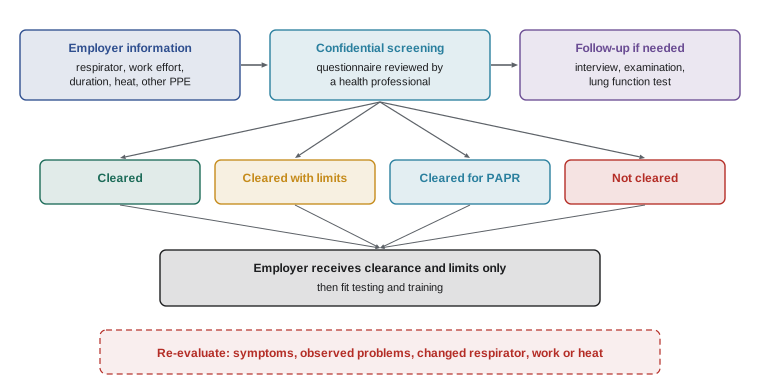
Evaluation must happen before a worker is fit-tested or uses a respirator in the workplace. The order matters: fit testing itself involves wearing a respirator while exercising, and a worker with an undiagnosed condition should not discover it during a fit test. Re-evaluation is needed when a worker reports symptoms, when a supervisor or fit tester observes problems, when the health professional asks for follow-up, and when workplace conditions change in ways that increase the burden, such as a heavier respirator, longer wear, hotter conditions or harder work.
Medical evaluation in your country
OSHA requires a medical evaluation, by a physician or other licensed health care professional (PLHCP), before an employee is fit-tested or uses a respirator (1910.134(e)). The evaluation uses the questionnaire in Appendix C of the standard or an initial medical examination that obtains the same information. The questionnaire must be administered confidentially, during normal working hours or at a time and place convenient to the employee, and in a way the employee understands. Any employee who gives a positive answer to certain questions must receive a follow-up medical examination.
Whatever the jurisdiction, the health professional needs information about the respirator and the work to make a sound judgment. Employers should provide it in writing.
| Information for the health professional | Why it matters |
|---|---|
| Type and weight of the respirator | An SCBA is very different from a filtering facepiece |
| Duration and frequency of use, including rescue and escape duties | Long or frequent use increases the burden |
| Expected physical work effort | Heavy work raises breathing rate and heart rate |
| Other protective clothing and equipment | Chemical suits and heavy clothing add heat and weight |
| Temperature and humidity extremes | Heat stress is a major risk for workers with heart conditions |
| A copy of the written program and the respiratory protection standard | Required to be provided to the PLHCP under 1910.134(e)(5)(ii) |
The PLHCP gives the employer a written recommendation limited to whether the employee is medically able to use the respirator, any limitations, and the need for follow-up evaluations, and gives the employee a copy (1910.134(e)(6)). If the PLHCP finds a medical condition that may place the employee's health at increased risk with a negative-pressure respirator, the employer must provide a PAPR if the PLHCP finds the employee can use one.
On 1 July 2025, OSHA proposed removing the medical evaluation requirement for filtering facepieces and loose-fitting PAPRs, arguing that their physiological burden is low. The comment period was reopened to 6 July 2026. Until a final rule takes effect, the current requirement applies to all required respirator use; check the Federal Register for the outcome.
Conditions that need careful assessment
No single condition automatically disqualifies a worker from all respirator use. The health professional weighs the condition against the specific respirator and work. Conditions that typically prompt a closer look include:
| Condition | Possible concern | Possible accommodation |
|---|---|---|
| Heart disease or high blood pressure | Added work and heat stress | Lighter respirator such as a PAPR; limits on heavy work or heat |
| Asthma, chronic bronchitis, emphysema | Breathing resistance; asthma triggered by exertion | Lower-resistance respirator such as a PAPR; medication plan |
| Seizure disorders | Loss of consciousness while wearing a respirator, especially in hazardous atmospheres | Restriction from IDLH and rescue work |
| Claustrophobia or anxiety | Panic while wearing a tight facepiece or hood | Gradual acclimatization; alternative styles; restriction from SCBA work |
| Facial scarring or deformity | Inability to achieve a seal | Loose-fitting PAPR or supplied-air hood |
| Perforated eardrum, recent surgery | Specific risks with some respirators | Temporary restriction |
| Pregnancy | Increased breathing demand and heat stress in later stages | Reassessment as pregnancy progresses; lighter respirators |
A recurring theme is that a powered or loose-fitting respirator can often protect a worker who should not wear a negative-pressure facepiece. A program that offers only one respirator style forces health professionals into an all-or-nothing choice; a program that offers alternatives can keep more workers safely at work.
Worked problem
A follow-up after a positive answer
A new laboratory technician answers 'yes' to a questionnaire item about shortness of breath when walking up a hill. The job requires a half-mask respirator with organic vapor cartridges for about an hour a day of light bench work. What should happen?
Show solution
- The supervisor does not see the answer; the health professional reviews it.
- The professional follows up, which may involve an interview, examination or lung function test.
- If the technician has mild, well-controlled asthma, the professional may clear the half mask for light work, or recommend a PAPR to reduce breathing resistance.
- The employer receives only the clearance and any limitations, for example 'cleared for half-mask air-purifying respirator, light work only; reassess in 12 months'.
- Fit testing proceeds only after the clearance.
Answer: The positive answer triggers a confidential follow-up by the health professional, who decides on clearance and limitations. The supervisor acts on the written clearance, not on the medical details.
Medical evaluation versus medical surveillance
Medical evaluation for respirator use asks whether a worker can safely wear a respirator. Medical surveillance asks whether a worker's exposure is harming them. They are different programs, although they are often run by the same health professional.
Substance-specific standards require medical surveillance for some hazards, such as the respirable crystalline silica standards, which require exams including chest X-rays and lung function tests every three years for workers who must wear respirators 30 or more days a year, and the lead standards, which require blood lead testing. Those programs are covered in HSE-242 and HSE-246. A worker who is cleared to wear a respirator still needs the surveillance program if the hazard requires it.
Role of supervisors
Supervisors play a crucial role in medical fitness even though they do not handle medical information. They should make sure no worker is fit-tested or assigned respirator work before clearance; watch for signs that a worker is struggling, such as frequent removal of the respirator, dizziness, breathlessness, anxiety or heat strain; refer workers for re-evaluation when they report symptoms or when conditions change; and respect limitations, for example by not assigning a worker cleared only for light work to an SCBA rescue role.
Worked problem
A change in conditions
A maintenance crew has been cleared to wear half-mask respirators for occasional dusty work indoors. The company now asks the crew to do several days of demolition in a hot attic, wearing full-facepiece respirators with protective coveralls. What should the supervisor do about medical clearance?
Show solution
- The respirator type, work rate, duration and temperature have all changed.
- The original clearance was for half masks during occasional indoor work.
- Give the health professional updated information about the full facepiece, heavy work, heat and coveralls, and ask whether re-evaluation is needed.
- Plan heat stress controls, such as work-rest cycles and water, which also reduce the medical risk.
Answer: Treat this as a significant change in conditions. Ask the health professional to review clearance for the new respirator and work before the job starts.
Records and frequency
OSHA does not require annual medical evaluations, but they must be repeated when the triggers in 1910.134(e)(7) occur. Many employers re-administer the questionnaire periodically as good practice. Medical evaluation records are kept under 1910.1020, generally for the duration of employment plus 30 years.
Heat, work rate and wear time together
In practice, the medical risk of respirator use depends less on the respirator alone than on the combination of respirator, work rate, heat and duration. A healthy worker can wear a half mask for a full shift of light work in a cool shop without difficulty. The same worker wearing a full facepiece and impermeable coveralls while digging out debris in summer heat may reach dangerous heat strain within an hour. Programs reduce this combined risk by choosing lower-burden respirators where they give adequate protection, scheduling heavy respirator work for cooler parts of the day, building in rest breaks out of the contaminated area, providing water, and watching for early signs of heat illness such as heavy sweating, headache, dizziness and confusion. These measures protect everyone, not only workers with known health conditions, and they make it more likely that respirators are worn correctly for the whole exposure.
Common mistakes
MistakeFit-testing a worker before medical clearance.
InsteadComplete medical evaluation first; fit testing itself places a burden on the worker.
MistakeAsking the supervisor to review the health questionnaire.
InsteadThe health professional reviews it; the employer receives only clearance and limitations.
MistakeGiving a single "fit for respirators" clearance regardless of type and work.
InsteadEvaluate against the specific respirator, work rate, duration and environment.
MistakeOffering only one respirator style, so a medical concern means no clearance.
InsteadOffer alternatives such as PAPRs that may allow safe use.
MistakeIgnoring a change from light indoor work to heavy work in heat.
InsteadRequest re-evaluation when conditions change significantly.
MistakeConfusing respirator medical evaluation with exposure surveillance.
InsteadRun surveillance programs where required in addition to fitness evaluation.
Summary and key terms
- Respirators add breathing resistance, dead space, weight, heat and psychological stress, most heavily with SCBA during heavy work in heat.
- Medical evaluation must be completed before fit testing and before respirator use.
- OSHA requires evaluation by a PLHCP using the Appendix C questionnaire or an equivalent examination, with follow-up for positive answers.
- The health professional needs information on respirator type and weight, work effort, duration, other PPE and environmental extremes.
- The employer receives only clearance, limitations and follow-up needs, not medical details.
- Powered and loose-fitting respirators often allow workers with medical concerns to work safely.
- Re-evaluate when symptoms appear, problems are observed or conditions change; medical surveillance for specific hazards is separate.
- Medical evaluation
- An assessment of whether a worker can safely wear a particular respirator for particular work.
- Health screening questionnaire
- A confidential questionnaire used to identify health conditions relevant to respirator use.
- PLHCP
- Physician or other licensed health care professional, the person who performs medical evaluations under OSHA rules.
- Clearance
- The health professional's written statement that a worker may use a respirator, with any limitations.
- Dead space
- The volume inside a facepiece where exhaled air is rebreathed.
- Breathing resistance
- The effort needed to draw air through a respirator or exhale through its valves.
- Heat stress
- The total heat load on the body from work, environment and clothing.
- Medical surveillance
- Monitoring of workers' health to detect effects of exposure to a hazard.
- Accommodation
- A change to equipment or work that allows a worker with a health condition to work safely.
Practice problems
Work each problem on paper first, then reveal the answer to check.
Name four burdens a respirator places on the wearer.
Show answer
Any four of breathing resistance, dead space, weight, heat stress, psychological stress and sensory limitation.
Why must medical evaluation come before fit testing?
Show answer
Fit testing involves wearing a respirator while exercising, which itself places a burden on the worker.
An 80 kg worker carries 20 kg of equipment. By what percentage does climbing work increase?
Show answer
20 ÷ 80 = 25 percent from the weight alone.
What information should the employer give the health professional?
Show answer
Respirator type and weight, duration and frequency, work effort, other PPE, temperature and humidity, and the program.
What should the supervisor receive after an evaluation?
Show answer
Only whether the worker is cleared, for which respirators, any limitations and follow-up needs.
Why can a PAPR help a worker with a lung condition?
Show answer
The blower reduces breathing resistance.
Give three triggers for re-evaluation.
Show answer
Symptoms reported, problems observed during fit testing or work, the professional's request, or significant changes in respirator, work or environment.
What is the difference between medical evaluation and medical surveillance?
Show answer
Evaluation checks fitness to wear a respirator; surveillance checks for health effects of exposure.
What signs might show a worker is struggling with a respirator?
Show answer
Frequent removal, dizziness, breathlessness, anxiety or heat strain.
What did OSHA propose in July 2025 about medical evaluation?
Show answer
To remove the requirement for filtering facepieces and loose-fitting PAPRs; it is not final at the time of writing.
Lesson quiz · 5 questions
Score 60% or more to complete this lesson.
Create a free account to save your progress, take quizzes and earn a certificate.