
HSE-240 · Lesson 7 of 12 · 28 min
Filters, cartridges and change schedules
An air-purifying respirator is only as good as what it uses to clean the air. Particulate filters and chemical cartridges work on completely different principles, wear out in completely different ways and need different replacement rules. Misunderstanding the difference is one of the most common causes of respirator failure. This lesson explains how filters and cartridges work, how they are classified and marked, and how to set a change schedule that holds up to scrutiny.
How particulate filters work
A particulate filter is a mat of fine fibers, often electrostatically charged. It does not work like a sieve. Particles are captured by several mechanisms acting together. Large particles cannot follow the air as it bends around fibers and hit them by inertial impaction. Medium particles touch fibers as they pass close by, which is called interception. The smallest particles move randomly as they are bombarded by air molecules and drift into fibers by diffusion. Electrostatic charges attract particles of all sizes.
Because impaction and interception work best on large particles and diffusion works best on very small ones, there is a size range where capture is least efficient. For most respirator filters this most penetrating particle size is roughly 0.1 to 0.3 µm. Approval tests deliberately use particles near this size, so a filter rated 95 percent efficient is at least that efficient for both larger and smaller particles.
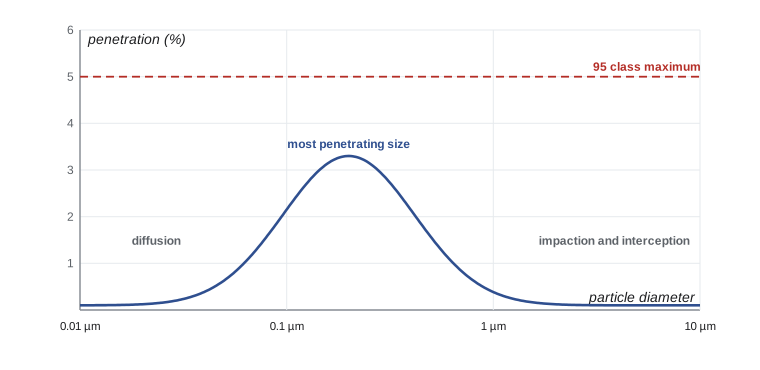
A counter-intuitive consequence is that particulate filters become more efficient as they load with dust, because the captured particles help trap others. The problem with a loaded filter is not leakage through the filter but rising breathing resistance. As resistance rises, the wearer must suck harder, which increases leakage around the seal of a negative-pressure respirator and makes the respirator more tiring to wear. For PAPRs, loading reduces air flow.
NIOSH filter classes
NIOSH classifies particulate filters by two features: resistance to oil and minimum efficiency. Oil can degrade the electrostatic charge on some filter media, so filters are tested with either a solid salt aerosol or an oily aerosol.
| Class | Oil resistance | Efficiency | Typical use limits |
|---|---|---|---|
| N95, N99, N100 | Not resistant to oil | At least 95, 99 or 99.97 percent | Use where no oil aerosols are present |
| R95, R99, R100 | Resistant to oil | At least 95, 99 or 99.97 percent | With oil present, generally limited to one shift (8 hours of use) |
| P95, P99, P100 | Oil-proof | At least 95, 99 or 99.97 percent | With oil present, follow the manufacturer's time-use limit |
| HE (PAPR) | Varies | At least 99.97 percent | High-efficiency filters for PAPRs; NIOSH is adding a PAPR100 class |
The class letter and number describe filter performance only, not overall protection. An N95 filtering facepiece and an elastomeric half mask with P100 filters have the same APF of 10, because leakage around the seal, not filter penetration, usually limits protection. The higher-efficiency filter is still worth choosing for highly toxic particles, for asbestos and other substances whose regulations require it, and where oil mist is present.
How chemical cartridges work
Gas and vapor cartridges contain granules of a sorbent, most often activated carbon, which has an enormous internal surface area, often around 1,000 square meters per gram. Organic vapor molecules stick to that surface by adsorption. Other cartridges use carbon treated with chemicals that react with specific gases, such as acid gases, ammonia or formaldehyde.
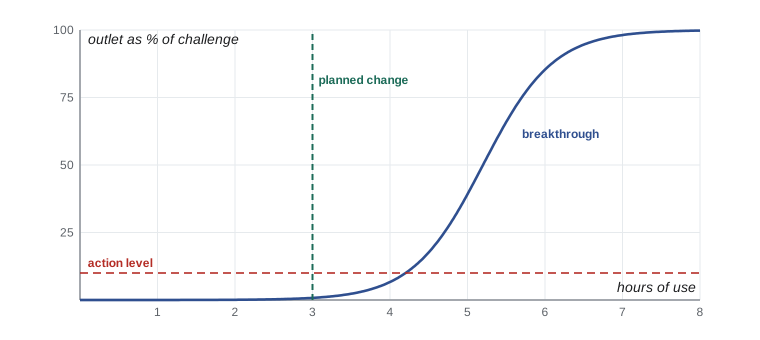
Unlike a particulate filter, a cartridge has a fixed capacity. As contaminant is adsorbed, a zone of saturated carbon moves through the bed toward the outlet. When that zone reaches the outlet, contaminant starts passing through: this is breakthrough. After breakthrough the concentration inside the facepiece rises steadily. A cartridge never gets better with use; it only gets closer to failure.
| Factor | Effect on cartridge service life |
|---|---|
| Higher concentration | Shorter life, roughly in proportion |
| Higher breathing rate (heavy work) | Shorter life: more air, and more contaminant, passes per minute |
| High humidity (above about 65 percent relative humidity) | Shorter life: water competes for carbon surface, especially for low concentrations of volatile vapors |
| Higher temperature | Generally shorter life |
| Low boiling point or high volatility | Much shorter life: very volatile vapors such as methanol or dichloromethane are poorly retained |
| Mixtures | Shorter life: strongly adsorbed vapors can displace weakly adsorbed ones, causing sudden breakthrough |
| Storage after use | Adsorbed vapors can migrate through the bed overnight; a partly used cartridge may break through soon after reuse |
Cartridge types and markings
Cartridges are approved for specific contaminants and marked accordingly. Color coding helps with identification: in North America organic vapor cartridges are typically black, acid gas white, combined organic vapor and acid gas yellow, ammonia and methylamine green, and multi-gas olive, while P100 filters are usually magenta. Colors have been standardized for many years, but they are a quick check, not a substitute for reading the approval label, which states exactly what the cartridge is approved for and any limits.
Some contaminants cannot be handled by air-purifying cartridges at all, or only by special cartridges. Carbon monoxide, for example, is not removed by ordinary cartridges. Some substances have such poor warning properties or such short service lives that regulations or manufacturers require supplied air instead. Where a substance-specific regulation sets cartridge requirements, those take precedence.
Why odor is not a change schedule
For decades, workers were told to change cartridges when they smelled or tasted the contaminant. That practice is no longer acceptable as the primary method. Odor thresholds vary widely between people, many substances have odor thresholds above their exposure limits, people become used to odors within minutes (olfactory fatigue), and some substances deaden the sense of smell. By the time a worker notices breakthrough, they may already have been overexposed for some time.
OSHA requires, for protection against gases and vapors, either cartridges with an end-of-service-life indicator (ESLI) certified by NIOSH for the contaminant, or a change schedule based on objective information or data that ensures cartridges are changed before the end of their service life. The basis for the schedule must be described in the written program (1910.134(d)(3)(iii)(B)). Odor and other warning properties may be used only as a backup, not as the basis of the schedule.
Setting a change schedule
A defensible change schedule is based on objective data, usually from one of these sources:
| Source | How it works | Notes |
|---|---|---|
| Manufacturer service life software or tables | Enter contaminant, concentration, humidity, temperature and work rate; the tool estimates service life | The most common method; keep a printout in the program file |
| Experimental testing | Cartridges are tested against the actual mixture under workplace conditions | Most accurate; used for unusual mixtures |
| Mathematical models | Published models estimate breakthrough from carbon properties and conditions | Usually applied by hygienists |
| End-of-service-life indicator (ESLI) | A color indicator on the cartridge changes when capacity is nearly used | Available for only a few contaminants |
Whatever the source, programs then apply a safety factor and round down to a practical interval, such as 'change at the start of each shift' or 'change at lunch and at the start of each shift'. Many programs also adopt the simple rule of never reusing organic vapor cartridges from one day to the next, because of migration during storage.
Worked problem
An illustrative service life estimate
A painter is exposed to up to 200 ppm of toluene (753 mg/m³) during heavy work, breathing about 40 L/min. Suppose the manufacturer's data show a pair of organic vapor cartridges can hold about 10 g of toluene before breakthrough at normal humidity, and humidity in the booth reduces capacity by about half. Estimate the service life. (The capacity and humidity factor are illustrative; use the manufacturer's tool for real decisions.)
Show solution
- Air breathed per minute: 40 L = 0.040 m³.
- Toluene drawn into the cartridges per minute: 753 mg/m³ × 0.040 m³ = 30 mg.
- Capacity at normal humidity: 10 g = 10,000 mg, so 10,000 ÷ 30 = 333 minutes, about 5.5 hours.
- Humidity halves the capacity: about 2.8 hours.
- Apply a safety factor of, say, 1.5: about 1.9 hours.
Answer: Changing cartridges every 1.5 to 2 hours, for example at each break, would be a reasonable schedule in this illustrative case. A schedule of 'once a week' or 'when you smell it' would not.
The example shows why heavy work and humidity matter so much. If the same painter worked lightly at 20 L/min in dry air, the estimated life would be four times longer. The change schedule must be based on the worst realistic conditions for the task, or on separate schedules for different conditions.
Worked problem
A mixture that breaks through suddenly
A degreasing operation uses a solvent blend of mostly a high-boiling hydrocarbon with about 10 percent acetone. The change schedule was set using the main hydrocarbon component alone. Workers report noticing an acetone odor after about an hour. What is happening?
Show solution
- Acetone is more volatile and less strongly adsorbed than the main hydrocarbon.
- As the hydrocarbon fills the carbon, it displaces adsorbed acetone, pushing it through the bed ahead of the main front.
- The acetone breaks through long before the schedule predicted.
Answer: The schedule must be set for the mixture, using software or testing that accounts for the least strongly adsorbed component. Workers should leave the area and change cartridges immediately when they notice odor, and the program administrator must revise the schedule.
When to replace particulate filters
Particulate filters do not have a breakthrough point in the same sense. Replace them when breathing resistance becomes noticeable, when they are damaged, wet or visibly soiled, when the PAPR flow check fails, when a substance-specific regulation requires replacement (for example after each shift in some asbestos work), and when the manufacturer's time limit for oil exposure is reached. Filters used against infectious agents or highly toxic dusts should be handled and discarded as contaminated waste. Filtering facepieces are generally replaced at least each shift and whenever they are damaged, soiled or hard to breathe through, unless the program has specific reuse procedures.
Combination filters and prefilters
When both particles and vapors are present, use a combination cartridge or a cartridge with a particulate filter or prefilter attached. Prefilters protect the carbon from clogging with paint mist or dust, and can often be replaced more frequently than the cartridge. Make sure the combination is listed in the NIOSH approval for the facepiece, and that the particulate filter is mounted on the inlet side as the manufacturer specifies.
Common mistakes
MistakeChanging organic vapor cartridges only when the wearer smells the vapor.
InsteadUse a data-based change schedule or a certified ESLI; odor is only a backup signal to leave and change immediately.
MistakeReplacing particulate filters frequently because they become less efficient as they load.
InsteadLoaded particulate filters become more efficient; replace them when breathing resistance rises or they are damaged or soiled.
MistakeUsing an N-series filter in an oil mist.
InsteadUse R or P filters where oil aerosols are present, respecting their time limits.
MistakeReusing partly used organic vapor cartridges the next day.
InsteadAssume migration during storage and change cartridges at least each shift unless data support reuse.
MistakeSetting a schedule using light work in dry air when the task is heavy work in a humid booth.
InsteadBase the schedule on the worst realistic conditions for the task.
MistakeRelying on cartridge color alone.
InsteadRead the approval label for the contaminants and limits.
Summary and key terms
- Particulate filters capture particles by impaction, interception, diffusion and electrostatic attraction, and are least efficient near 0.1 to 0.3 µm.
- Loaded particulate filters become more efficient but harder to breathe through; replace them for resistance, damage, soiling or regulation.
- NIOSH filter classes N, R and P describe oil resistance, and 95, 99 and 100 describe minimum efficiency.
- Chemical cartridges have a fixed capacity and break through; they never improve with use.
- Service life falls with higher concentration, heavier breathing, higher humidity and temperature, more volatile contaminants and mixtures.
- Odor is not an acceptable basis for change schedules; use manufacturer software, testing, models or certified ESLIs, with a safety factor.
- Combination cartridges and prefilters are needed when particles and vapors are both present, and must be part of the approved assembly.
- Most penetrating particle size
- The particle size, about 0.1 to 0.3 µm, at which a filter is least efficient.
- Diffusion
- Random motion of very small particles that carries them into filter fibers.
- Inertial impaction
- Capture of larger particles that cannot follow air around filter fibers.
- Adsorption
- The adhesion of gas or vapor molecules to the surface of a solid such as activated carbon.
- Breakthrough
- The point at which a contaminant begins to pass through a cartridge.
- Service life
- The time a cartridge can be used before breakthrough reaches an unacceptable level.
- Change schedule
- A written, data-based schedule for replacing gas and vapor cartridges.
- End-of-service-life indicator (ESLI)
- A device on a cartridge that signals when its capacity is nearly exhausted.
- Migration
- Movement of adsorbed vapor through a cartridge during storage.
- Prefilter
- A particulate filter mounted ahead of a cartridge to protect it from particles.
- Olfactory fatigue
- Loss of the ability to smell an odor after continued exposure.
Practice problems
Work each problem on paper first, then reveal the answer to check.
Why is a filter rated 95 percent at least that efficient for all particle sizes?
Show answer
It is tested near the most penetrating particle size, where efficiency is lowest.
What happens to a particulate filter's efficiency as it loads?
Show answer
It increases, but breathing resistance also increases.
What do the letters N, R and P mean in NIOSH filter classes?
Show answer
Not oil resistant, oil resistant and oil-proof.
Why do an N95 filtering facepiece and a half mask with P100 filters have the same APF?
Show answer
Face seal leakage, not filter penetration, usually limits protection for half-facepiece respirators.
List four factors that shorten cartridge service life.
Show answer
Higher concentration, heavier breathing, high humidity, higher temperature, volatile contaminants and mixtures.
Why is odor a poor basis for changing cartridges?
Show answer
Odor thresholds vary, can exceed the limit, fade with olfactory fatigue and some substances deaden smell.
A worker breathes 30 L/min of air at 500 mg/m³. How much contaminant reaches the cartridges per minute?
Show answer
0.030 m³ × 500 mg/m³ = 15 mg per minute.
With 6,000 mg capacity and 15 mg/min uptake, estimate service life before any safety factor.
Show answer
6,000 ÷ 15 = 400 minutes, about 6.7 hours.
Why can a solvent mixture break through earlier than predicted for its main component?
Show answer
More strongly adsorbed components displace less strongly adsorbed ones, pushing them through early.
When should particulate filters be replaced?
Show answer
When breathing resistance rises, when damaged, wet or soiled, when PAPR flow fails, or as regulations or manufacturer limits require.
Lesson quiz · 5 questions
Score 60% or more to complete this lesson.
Create a free account to save your progress, take quizzes and earn a certificate.