
HSE-240 · Lesson 9 of 12 · 30 min
Fit testing and user seal checks
A tight-fitting respirator protects only as well as it seals. Faces vary enormously in size and shape, and no single model fits everyone. Fit testing is how a program confirms that a specific make, model and size of respirator seals on a specific worker's face. User seal checks are the quick daily checks that the respirator is on correctly. This lesson explains both, along with the facial hair rules that cause so much friction in workplaces.
Why fit testing matters
Studies of workers wearing respirators without fit testing have repeatedly found that many achieve only a fraction of the expected protection, and some get almost none. A half mask with an APF of 10 that leaks badly may deliver a real protection factor of 2 or 3. Fit testing does two things. It screens out respirators that do not seal on a particular face, so the worker can be offered a different model or size. And it trains the worker in how a good fit feels, which improves how they put on the respirator every day.
When fit testing is required
OSHA requires fit testing of all tight-fitting respirators before an employee first uses the respirator, whenever a different facepiece (size, style, model or make) is used, and at least annually thereafter (1910.134(f)(2)). Additional fit testing is required when the employee, the PLHCP, a supervisor or the program administrator reports changes in the employee's physical condition that could affect fit, such as facial scarring, dental changes, cosmetic surgery or an obvious change in body weight (1910.134(f)(3)). If the employee finds the fit unacceptable, they must be given a reasonable opportunity to select a different respirator and be retested.
| Trigger | Examples |
|---|---|
| Before first use | New worker; new respirator program |
| Change of respirator | Different make, model, style or size |
| Periodic | At least annually under OSHA |
| Change in the face | Significant weight change, dental work, facial surgery or scarring |
| Worker reports poor fit | Leakage, discomfort, difficulty sealing |
Fit testing applies only to tight-fitting facepieces. Loose-fitting hoods, helmets and visors do not need it. Fit testing must also be done with the same model and size the worker will use at work, and while wearing any other equipment that could affect fit, such as safety glasses, hearing protection or a hard hat.
Qualitative fit testing
A qualitative fit test (QLFT) is a pass or fail test that relies on the worker detecting a test agent by taste, smell or irritation. The worker first takes a sensitivity test without a respirator to confirm they can detect the agent. Then, wearing the respirator inside a hood or enclosure, they perform a series of exercises while the agent is introduced. If they detect the agent, the test fails.
| Test agent | Detected by | Notes |
|---|---|---|
| Isoamyl acetate (banana oil) | Smell | Requires organic vapor cartridges |
| Saccharin | Sweet taste | Works with particulate filters; widely used for filtering facepieces |
| Denatonium benzoate (Bitrex) | Bitter taste | Works with particulate filters; harder to ignore than saccharin |
| Irritant smoke | Involuntary cough | Uses an irritant aerosol; requires care; less commonly used now |
Qualitative tests are simple and inexpensive but limited. Because the result depends on the worker's honest response and senses, they can only confirm a fit factor of about 100. They are therefore permitted only for respirators that need a fit factor of 100 or less, which in practice means half masks and filtering facepieces, and full facepieces only when they are used in atmospheres where a half mask would be sufficient.
Quantitative fit testing
A quantitative fit test (QNFT) measures how much leaks in. The most common method uses a condensation particle counter, such as a PortaCount, that counts tiny ambient particles outside and inside the facepiece through a probe or adapter. The ratio is the fit factor. Other methods generate a test aerosol, or use controlled negative pressure (CNP) to measure the leak rate when the facepiece is briefly sealed and air is drawn out.
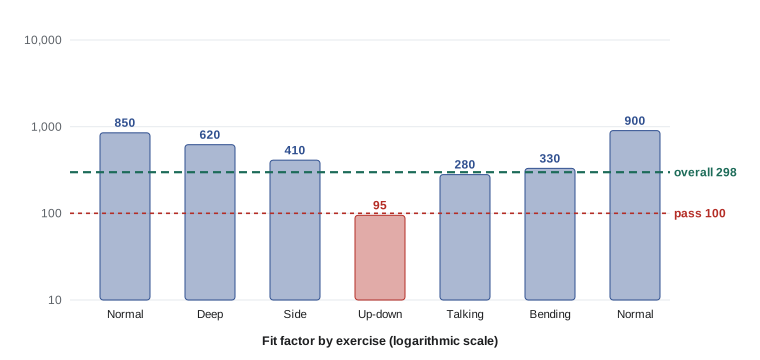
Each exercise in the test produces its own fit factor. The overall fit factor is not the simple average but the harmonic mean, which gives more weight to the exercises where the fit was worst. This reflects how leakage actually adds up: a few seconds of poor fit let in far more contaminant than many minutes of good fit keep out.
The standard protocol uses exercises that simulate work movements: normal breathing, deep breathing, turning the head side to side, moving the head up and down, talking aloud, bending over and normal breathing again. A grimace exercise may be included to break and reset the seal but is not counted. Shorter protocols for certain respirator types have been validated and are accepted in both countries' practice.
OSHA's pass criteria for quantitative fit testing are an overall fit factor of at least 100 for tight-fitting half facepieces and at least 500 for tight-fitting full facepieces (1910.134(f)(7)). Appendix A of the standard sets out the accepted protocols, including several shortened protocols added in 2019 for condensation nuclei counter testing.
Worked problem
Calculating an overall fit factor
A worker's quantitative fit test on a half-mask respirator gives these exercise fit factors: 850, 620, 410, 95, 280, 330 and 900. Calculate the overall fit factor and decide whether the test passes.
Show solution
- Reciprocals: 1/850 = 0.00118; 1/620 = 0.00161; 1/410 = 0.00244; 1/95 = 0.01053; 1/280 = 0.00357; 1/330 = 0.00303; 1/900 = 0.00111.
- Sum = 0.02347.
- Overall fit factor = 7 ÷ 0.02347 = 298.
- The simple average would be 498, but the harmonic mean is 298 because of the poor head up and down exercise.
- 298 is at least 100, so the half mask passes.
Answer: The overall fit factor is about 298, which passes for a half mask. The low result during head movement up and down suggests reviewing strap tension and nose fit with the worker.
Worked problem
When one exercise causes a failure
On a full-facepiece test, a worker's exercise fit factors are 4,000, 3,500, 2,800, 3,000, 120, 2,500 and 4,200. The talking exercise was 120. Does the respirator pass, and what should the fit tester do?
Show solution
- Reciprocals: 0.00025, 0.00029, 0.00036, 0.00033, 0.00833, 0.00040, 0.00024. Sum = 0.01020.
- Overall fit factor = 7 ÷ 0.01020 = 686.
- The pass level for a full facepiece is 500, so the test passes, but the talking exercise shows a seal weakness.
- The fit tester should check strap adjustment and facepiece size, and discuss with the worker whether a different size would seal better during speech.
Answer: It passes with an overall fit factor of about 686, but the weak talking result is a warning sign worth addressing, especially if the job involves a lot of talking.
Conducting a good fit test
A fit test is also a training session. A good fit tester checks medical clearance first, confirms the worker has not eaten, smoked or chewed gum shortly before a taste test, offers several models and sizes, lets the worker choose the most comfortable respirator that seals, observes donning, and explains what was seen. CSA Z94.4-18 added a comfort assessment as part of fit testing, recognizing that a respirator that hurts after an hour will not be worn properly for a shift.
| Common reason for failure | Response |
|---|---|
| Wrong size | Try another size of the same model |
| Face shape does not suit the model | Try a different model or manufacturer |
| Straps too loose, twisted or placed wrongly | Retrain on donning and repeat |
| Stubble or facial hair | Shave and retest, or use a loose-fitting respirator |
| Eyewear temple bars or hearing protection break the seal | Use spectacle kits in full facepieces or compatible equipment |
| Worker cannot tolerate the respirator | Refer for medical review; consider a PAPR |
User seal checks
A user seal check is a quick test the wearer does every time a tight-fitting respirator is put on, to make sure it is seated properly. It is not a substitute for a fit test, but it catches twisted straps, displaced facepieces and damaged valves.
| Check | How to do it | What a good seal looks like |
|---|---|---|
| Positive pressure check | Cover the exhalation valve and exhale gently | The facepiece bulges slightly with no air escaping around the edges |
| Negative pressure check | Cover the inlets of the cartridges or filters and inhale gently, holding for about 10 seconds | The facepiece collapses slightly and stays collapsed, with no air leaking in |
| Filtering facepiece check | Cup both hands over the respirator and exhale sharply (and inhale for unvalved models), following the manufacturer's instructions | No air felt leaking at the nose or edges |
If a seal check fails, adjust the respirator and repeat. If it still fails, do not enter the contaminated area; report it so the respirator can be inspected or the worker refitted.
Facial hair and other interferences
Facial hair that lies under the sealing surface of a tight-fitting respirator breaks the seal. Research shows that even a day or two of stubble measurably reduces fit factors, and beards can reduce protection dramatically. That is why both countries require tight-fitting respirator users to be clean-shaven where the respirator seals. Moustaches and other facial hair that stay entirely inside the facepiece without touching the seal or interfering with valves may be acceptable.
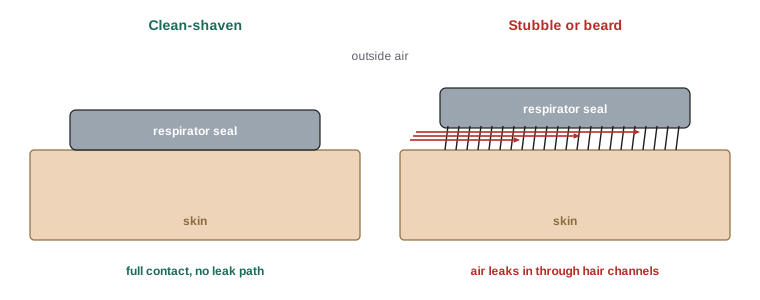
OSHA prohibits tight-fitting respirators from being worn by employees who have facial hair that comes between the sealing surface and the face or interferes with valve function (1910.134(g)(1)(i)). Where facial hair is a religious practice, Title VII of the Civil Rights Act requires employers to accommodate unless doing so causes undue hardship, and since the Supreme Court's 2023 decision in Groff v. DeJoy undue hardship means substantial increased costs in relation to the business. The usual accommodation is a respirator that does not depend on a face seal, such as a loose-fitting PAPR or supplied-air hood, where it provides adequate protection.
Other interferences include spectacle temple bars passing under a full-facepiece seal, which is why full facepieces need special spectacle inserts; head coverings or hoods under the straps; jewelry; and dentures, whose removal can change face shape. Workers who wear corrective lenses, hearing protection or hard hats with respirators should be fit-tested wearing them.
Worked problem
Planning for a clean-shaven policy
A plant introduces a clean-shaven requirement for 40 workers who wear half masks. Twelve workers have beards, two of them for religious reasons. How should the program respond?
Show solution
- Explain the reason for the requirement with evidence about seal leakage, not just a rule.
- Give workers who choose to shave a reasonable period and fit test them once clean-shaven.
- For the two religious accommodation requests, assess whether loose-fitting PAPRs provide adequate protection for their tasks; they usually do for exposures within an APF of 25.
- Consider offering PAPRs to other bearded workers too, if the cost is reasonable and the protection adequate.
Answer: Combine clear explanation, fit testing and loose-fitting alternatives. The religious accommodation is legally required unless it causes undue hardship, and PAPRs are typically a reasonable solution.
Common mistakes
MistakeIssuing one size of respirator to everyone without fit testing.
InsteadFit test each worker on the exact make, model and size they will use, and offer alternatives.
MistakeAveraging exercise fit factors arithmetically.
InsteadUse the harmonic mean, which reflects how leakage adds up.
MistakeUsing a qualitative fit test for a full facepiece needed at more than 10 times the limit.
InsteadQualitative tests confirm only a fit factor of about 100; use a quantitative test where more is needed.
MistakeTreating a passing seal check as a fit test.
InsteadSeal checks confirm donning each time; fit tests confirm the respirator suits the face.
MistakeAllowing a day or two of stubble under a tight-fitting seal.
InsteadRequire clean-shaven sealing surfaces, or provide a loose-fitting respirator.
MistakeFit testing without the safety glasses and earmuffs worn at work.
InsteadFit test with all equipment that could affect the seal.
Summary and key terms
- Fit testing confirms that a specific respirator seals on a specific face and trains workers in good fit.
- OSHA requires fit testing before first use, with any facepiece change, at least annually and after changes in the face.
- Qualitative tests use taste, smell or irritation and can confirm a fit factor of about 100 only.
- Quantitative tests measure leakage; the overall fit factor is the harmonic mean of exercise fit factors.
- Pass levels are generally 100 for half facepieces and 500 for full facepieces.
- User seal checks are done every time a tight-fitting respirator is put on and do not replace fit testing.
- Facial hair under the seal is not permitted; religious accommodation is usually provided with loose-fitting respirators.
- Fit test
- A test that confirms a tight-fitting respirator seals on a particular wearer.
- Qualitative fit test (QLFT)
- A pass or fail fit test based on the wearer detecting a test agent.
- Quantitative fit test (QNFT)
- A fit test that measures leakage numerically.
- Fit factor
- The ratio of the concentration outside the respirator to that inside during a fit test.
- Harmonic mean
- The number of values divided by the sum of their reciprocals; used to combine exercise fit factors.
- Condensation particle counter
- An instrument that counts very small particles to measure fit factors.
- Controlled negative pressure (CNP)
- A quantitative fit test method that measures leak rate under a set negative pressure.
- User seal check
- A positive or negative pressure check done by the wearer each time a respirator is put on.
- Clean-shaven
- Free of facial hair where the respirator seals against the skin.
- Undue hardship
- The legal limit of an employer's duty to accommodate.
Practice problems
Work each problem on paper first, then reveal the answer to check.
Name two things fit testing achieves.
Show answer
It screens out respirators that do not seal and trains workers in what a good fit feels like.
How often does OSHA require fit testing?
Show answer
Before first use, with any facepiece change, at least annually and after changes in the face.
Why are qualitative tests limited to respirators needing a fit factor of 100 or less?
Show answer
They rely on the wearer's senses and can only confirm a fit factor of about 100.
Calculate the overall fit factor for exercise fit factors of 200, 200, 50 and 200.
Show answer
4 ÷ (0.005 + 0.005 + 0.02 + 0.005) = 4 ÷ 0.035 = 114.
Why is the harmonic mean used rather than the average?
Show answer
It reflects how leakage adds up, giving more weight to poor-fit exercises.
What are the usual pass levels for half and full facepieces?
Show answer
100 for half facepieces and 500 for full facepieces.
Describe a negative pressure seal check.
Show answer
Cover the inlets, inhale gently and hold; the facepiece should collapse slightly and stay collapsed.
Why are spectacle inserts used in full facepieces?
Show answer
Temple bars passing under the seal would cause leakage.
What is the usual accommodation for a worker with a religious beard?
Show answer
A loose-fitting PAPR or supplied-air hood that does not rely on a face seal, where it gives adequate protection.
A worker fails a fit test with a medium half mask. Name two next steps.
Show answer
Try another size or model, check strap placement and donning, check for facial hair or eyewear interference.
Lesson quiz · 5 questions
Score 60% or more to complete this lesson.
Create a free account to save your progress, take quizzes and earn a certificate.