
HSE-240 · Lesson 1 of 12 · 31 min
Why respiratory protection matters
Every worker breathes roughly 10,000 liters of air in an eight-hour shift, and much more during heavy work. Whatever is suspended in that air, whether it is dust from cutting, fume from welding, mist from a spray gun, vapor from a solvent tank or microorganisms from a patient's cough, has a direct route into the lungs and, from there, into the blood. The lungs have a surface area roughly the size of a tennis court and a barrier between air and blood less than a micrometer thick. That design makes breathing efficient. It also makes the respiratory tract the most important route of entry for hazardous substances at work.
This course is about respiratory protection: the respirators, programs and decisions that protect workers when airborne contaminants or oxygen-deficient air cannot be controlled by other means. It is written for supervisors, safety coordinators, joint health and safety committee members, program administrators and workers who wear respirators. It builds on the overview in HSE-104 Personal Protective Equipment, lessons 6 and 7, and goes much further into exposure limits, exposure assessment, selection calculations, fit testing, maintenance, breathing air and running a complete program.
It does not make anyone a qualified fit tester, an industrial hygienist or a respirator program administrator on its own. OSHA's Respiratory Protection standard, 29 CFR 1910.134, requires a program administrator who is qualified by appropriate training or experience, and exposure assessments for complex exposures usually need an industrial hygienist. Think of this course as the knowledge base that lets you ask the right questions, recognize a weak program and work safely in a strong one.
How airborne contaminants harm people
Airborne contaminants cause harm in several different ways, and the way they harm people shapes how we protect against them. A respirator that prevents one kind of harm may do nothing for another, which is why selection always starts with understanding the hazard.
| Type of effect | What happens | Examples |
|---|---|---|
| Irritation | The contaminant inflames the eyes, nose, throat or airways, often within minutes | Ammonia, chlorine, sulfur dioxide, acid mists |
| Asphyxiation | Oxygen is displaced, or the body cannot use the oxygen it breathes | Nitrogen or argon displacing air; carbon monoxide; hydrogen cyanide |
| Systemic poisoning | The substance is absorbed through the lungs and damages organs elsewhere | Lead, mercury vapor, manganese fume, many solvents |
| Fibrosis and scarring | Particles deposited deep in the lung cause permanent scarring | Respirable crystalline silica, asbestos, coal dust |
| Sensitization and asthma | The immune system reacts, and later exposures trigger asthma even at tiny levels | Isocyanates, flour dust, wood dust, some enzymes |
| Cancer | The substance or the inflammation it causes leads to cancer years later | Asbestos, silica, diesel exhaust, hexavalent chromium, wood dust |
| Infection | Living microorganisms are inhaled and cause disease | Tuberculosis, influenza, Legionella, mold spores in some workers |
Two features of this table matter for respiratory protection. First, many effects are chronic. A worker who breathes silica dust today feels nothing; the scarring appears ten or twenty years later and cannot be reversed. Because there is no warning, workers and supervisors often underestimate the hazard, and respirator discipline slips. Second, some effects are acute and severe. An oxygen-deficient atmosphere can cause collapse within a few breaths. The respirator that is acceptable for a long-term dust hazard is not acceptable for an atmosphere that could kill in minutes.
Why the lungs are so vulnerable
Air enters through the nose and mouth, passes down the trachea and divides through about twenty-three generations of branching airways until it reaches roughly 300 million alveoli, the tiny air sacs where gas exchange happens. Large particles are caught in the nose and throat. Medium-sized particles land on the walls of the airways, where a moving layer of mucus carries them up to be swallowed or coughed out. The smallest particles, generally those below about 4 micrometers, can reach the alveoli. There is no mucus escalator in the alveoli, so particles that land there stay for months or years unless scavenger cells remove them. That is where silica and asbestos do their damage.
Gases and vapors behave differently. Water-soluble gases such as ammonia dissolve in the moist upper airways and cause immediate irritation, which at least warns the worker. Poorly soluble gases such as nitrogen dioxide or phosgene travel deep into the lung and may cause delayed, life-threatening fluid build-up hours after exposure. Solvent vapors pass easily into the blood and reach the brain, liver and kidneys. A worker can feel light-headed from solvent vapors long before any smell becomes unpleasant, and some substances, such as hydrogen sulfide at high concentration, paralyze the sense of smell entirely.
Respirators come last in the hierarchy of controls
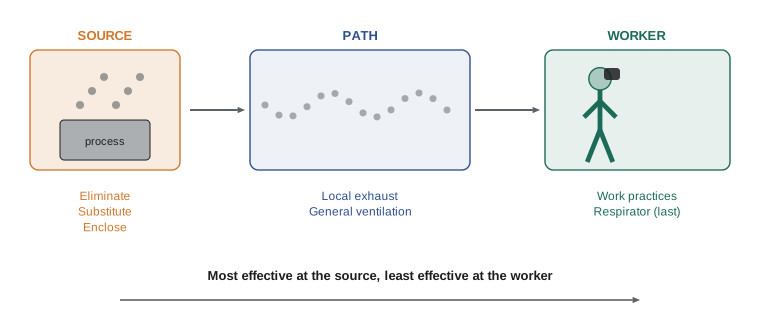
Every Canadian and US framework puts respirators near the bottom of the hierarchy of controls. That is not a technicality. A respirator protects one person, only while it is worn, only if it is the right type, only if it fits and only if it is maintained. Engineering controls protect everyone in the area all the time, whether or not anyone remembers to put on equipment.
| Level | Example for a dusty cutting task | Why it ranks where it does |
|---|---|---|
| Elimination | Order pre-cut components so no cutting happens on site | The hazard disappears |
| Substitution | Use a material with no crystalline silica | A less hazardous material replaces the hazardous one |
| Engineering controls | Saw with integrated water feed or shroud and dust extractor | Captures dust at the source for everyone nearby |
| Administrative controls | Schedule cutting when few people are present; rotate tasks; housekeeping by wet methods | Depends on people following rules |
| Personal protective equipment | Fit-tested respirator chosen for the measured or estimated concentration | Protects only the wearer, only when worn correctly |
OSHA's Respiratory Protection standard begins by saying that the primary objective is to prevent atmospheric contamination through accepted engineering control measures such as enclosure, confinement, general and local ventilation and substitution of less toxic materials. Respirators are required when effective engineering controls are not feasible, or while they are being put in place (29 CFR 1910.134(a)(1)). Several substance-specific standards, such as those for silica, lead and asbestos, repeat this rule. The practical meaning is the same everywhere: a supervisor who hands out respirators instead of turning on the dust collector has the order backwards.
Respirators still have a legitimate and permanent place. They are used while engineering controls are being designed or installed, for short or infrequent tasks where engineering controls are impractical, as a supplement when engineering controls reduce but do not fully control exposure, for maintenance and repair when normal controls are shut down, and for emergencies, rescue and escape. A good program treats each of these as a deliberate decision, documented in the hazard assessment.
Why respirators fail in practice
Laboratory tests show that a properly selected, fitted and maintained respirator can reduce exposure dramatically. Workplace studies show that real-world protection is often far lower, and the reasons are almost always program failures rather than equipment failures.
| Failure | Typical cause | Program element that prevents it |
|---|---|---|
| Wrong type of respirator | A dust mask is used against solvent vapor; an air-purifying respirator is used in an oxygen-deficient tank | Hazard assessment and selection |
| Poor fit | One model and size for everyone; no fit test; facial hair | Fit testing and a choice of models and sizes |
| Not worn all the time | Removed to talk, to wipe sweat or because it is uncomfortable | Training, comfort, supervision, rest breaks |
| Cartridges used too long | No change schedule; workers wait to smell the vapor | Change schedule based on data |
| Damaged or dirty equipment | Cracked valves, distorted facepieces, stored loose in a toolbox | Inspection, cleaning and storage procedures |
| Worker cannot tolerate the respirator | Undiagnosed heart or lung condition; claustrophobia | Medical evaluation |
| Contaminated breathing air | Compressor intake near exhaust; oil-lubricated compressor overheating | Breathing air quality testing and alarms |
Look at the right-hand column. Every failure is prevented by a program element, not by buying a better respirator. That is why the law in both countries requires a written respiratory protection program wherever respirators are required, and why most of this course is about running that program well.
Worked problem
Estimating how much a short gap costs
A worker wears a half-facepiece respirator that, when worn correctly, reduces the concentration inside the facepiece to one-tenth of the outside concentration. The outside concentration is 5 times the exposure limit. During an 8-hour shift the worker removes the respirator for a total of 30 minutes to talk and wipe sweat, while staying in the same area. What is the worker's average exposure as a multiple of the exposure limit?
Show solution
- While the respirator is worn (7.5 hours), the concentration inside is 5 ÷ 10 = 0.5 times the limit.
- While it is removed (0.5 hours), the worker breathes the full 5 times the limit.
- Time-weighted average = (7.5 × 0.5 + 0.5 × 5) ÷ 8 = (3.75 + 2.5) ÷ 8 = 0.78 times the limit.
- Without the gap the average would have been 0.5 times the limit. Thirty minutes without the respirator raised the dose by more than half.
Answer: About 0.78 times the exposure limit. Short removals inside a contaminated area erase much of the protection, which is why respirators must be worn for the whole time the worker is in the contaminated atmosphere.
The same arithmetic explains why respirator wear time matters more than the nominal protection factor. If the outside concentration were 50 times the limit, the 30-minute gap alone would deliver more than 3 times the limit as an 8-hour average, regardless of how good the respirator was during the rest of the shift.
The scale of the problem
In the United States, respiratory protection is one of OSHA's most frequently cited standards year after year. OSHA's preliminary list for fiscal year 2025 ranked Respiratory Protection (1910.134) fifth, with 1,953 citations, typically for missing written programs, missing medical evaluations and missing fit tests. NIOSH estimates that millions of US workers wear respirators at some point, and occupational lung diseases such as silicosis, coal workers' pneumoconiosis and occupational asthma continue to cause disability and death.
Those figures are a reminder that respiratory hazards are not an exotic specialty. Respirators are used by construction crews, painters, welders, farmers, health care workers, laboratory staff, cleaners, firefighters and maintenance staff in almost every industry. A supervisor in any of those settings will eventually need to make or review a respiratory protection decision.
What this course covers
The lessons follow the order in which a sound program is built. Lessons 2 and 3 cover the contaminants themselves, exposure limits and how exposure is measured. Lesson 4 sets out the law and the standards in your jurisdiction. Lessons 5 to 7 cover respirator types, selection using assigned protection factors, and filters and cartridges with change schedules. Lessons 8 to 10 cover medical evaluation, fit testing and seal checks, and use, maintenance and storage. Lesson 11 covers supplied air, self-contained breathing apparatus and emergencies. Lesson 12 brings everything together in a capstone program for an invented workplace.
Specific hazards that have their own detailed rules are covered in their own courses: silica and lead in HSE-242, asbestos in HSE-246, hydrogen sulfide in HSE-244 and infection prevention, including health care respirator use, in HSE-245. Confined space atmospheres are covered in HSE-216. This course gives you the general respiratory protection framework those courses rely on.
Worked problem
Recognizing when a respirator is not the first answer
A maintenance supervisor proposes issuing half-facepiece respirators with organic vapor cartridges to three workers who degrease parts by hand in an open solvent tank for most of each shift. Air sampling shows vapor levels about twice the exposure limit. What should a reviewer ask before accepting the proposal?
Show solution
- Can the task be eliminated or the solvent substituted with a water-based or lower-toxicity cleaner?
- Can engineering controls be added: a lid, a tank with lip exhaust ventilation, an enclosed parts washer?
- Are work practices adequate: keeping the lid closed, reducing the tank temperature, not leaving wet parts to evaporate in the breathing zone?
- If respirators are still needed after those steps, is there a written program with selection, medical evaluation, fit testing, a cartridge change schedule and training?
Answer: Respirators may be a reasonable interim or supplementary control, but the reviewer should insist that substitution and engineering controls are evaluated first and that any respirator use is part of a full written program.
Who does what
Respiratory protection depends on several roles working together. The employer is responsible for the program and for providing respirators, fit testing, training and medical evaluation at no cost to the worker. A program administrator runs the program day to day. Supervisors make sure the right respirator is worn, maintained and replaced, and that the controls described in the hazard assessment are in place. Workers wear, inspect and care for their respirators as trained and report problems. Health professionals carry out medical evaluations. Occupational hygienists assess exposures and recommend controls. Joint health and safety committees or safety representatives review the program and raise concerns.
One of the most common weaknesses in real programs is that nobody owns them. Respirators are bought by purchasing, fit testing is done by an outside contractor, cartridges are changed when someone remembers, and nobody checks whether the whole system works. A named program administrator with authority and time is one of the strongest single predictors of a program that actually protects people.
Common mistakes
MistakeIssuing respirators instead of fixing the ventilation or changing the material.
InsteadUse elimination, substitution and engineering controls first, and treat respirators as a deliberate last-line or interim control.
MistakeAssuming that a respirator protects as long as it is in the work area, even if it is pulled down to talk.
InsteadWear the respirator for the entire time spent in the contaminated atmosphere; short gaps erase much of the protection.
MistakeTreating every respirator as interchangeable.
InsteadSelect the respirator type for the specific contaminant, concentration and oxygen level found in the hazard assessment.
MistakeRelying on smell or irritation to tell workers when they are overexposed.
InsteadMany contaminants have poor or no warning properties; use exposure assessment and change schedules instead.
MistakeBuying respirators without a written program.
InsteadEstablish a written program with a named administrator covering selection, medical evaluation, fit testing, training, maintenance and evaluation.
Summary and key terms
- The respiratory tract is the main route of entry for hazardous substances at work, and many effects are chronic and irreversible.
- Contaminants cause irritation, asphyxiation, systemic poisoning, fibrosis, sensitization, cancer and infection, and selection depends on the type of harm.
- Respirators sit near the bottom of the hierarchy of controls because they protect only the wearer, only while worn correctly.
- Respirators remain legitimate for interim control, short tasks, maintenance, supplementary protection and emergencies.
- Most real-world respirator failures are program failures: wrong type, poor fit, partial wear, overused cartridges, poor maintenance and missing medical evaluation.
- A written program with a named administrator is the core requirement in both Canada and the United States.
- Specific hazards such as silica, lead, asbestos, hydrogen sulfide and infectious agents have their own courses that build on this framework.
- Respirator
- A device worn over the nose and mouth, or the whole head, that protects the wearer from breathing hazardous atmospheres.
- Airborne contaminant
- Any dust, fume, mist, gas, vapor or microorganism suspended in air that can harm a worker who breathes it.
- Alveoli
- The tiny air sacs deep in the lungs where oxygen and carbon dioxide are exchanged with the blood.
- Hierarchy of controls
- The order of preference for controls: elimination, substitution, engineering, administrative and, last, personal protective equipment.
- Chronic effect
- Harm that develops slowly over months or years of exposure, often without warning.
- Acute effect
- Harm that appears quickly, within minutes or hours of exposure.
- Sensitizer
- A substance that causes an immune reaction so that later exposures trigger symptoms, such as asthma, even at very low levels.
- Contaminant warning properties
- Odor, taste or irritation that alerts a worker to the presence of a contaminant at or below a harmful level.
- Program administrator
- The person responsible for running and evaluating the respiratory protection program.
- Respiratory protection program
- The written set of procedures covering selection, medical evaluation, fit testing, training, use, maintenance and evaluation of respirators.
Practice problems
Work each problem on paper first, then reveal the answer to check.
Roughly how much air does a worker breathe in an eight-hour shift?
Show answer
About 10,000 liters, and more during heavy work.
Name three ways airborne contaminants cause harm.
Show answer
Any three of irritation, asphyxiation, systemic poisoning, fibrosis, sensitization, cancer and infection.
Why are particles smaller than about 4 micrometers especially hazardous?
Show answer
They can reach the alveoli, where there is no mucus escalator to remove them.
Why are respirators placed near the bottom of the hierarchy of controls?
Show answer
They protect only the wearer, only while worn, and only if correctly selected, fitted and maintained.
Give three situations where respirators are a legitimate control.
Show answer
Interim control while engineering controls are installed, short or infrequent tasks, maintenance, supplementary protection and emergencies or escape.
A respirator reduces exposure tenfold but is removed for 1 hour of an 8-hour shift in an atmosphere at 4 times the limit. What is the average exposure?
Show answer
(7 × 0.4 + 1 × 4) ÷ 8 = 0.85 times the limit.
Why is relying on smell a poor way to decide when to change cartridges?
Show answer
Many contaminants have poor warning properties, and some paralyze the sense of smell.
Which program element prevents a dust mask being used against solvent vapor?
Show answer
Hazard assessment and respirator selection.
Which other courses cover silica, asbestos and hydrogen sulfide in detail?
Show answer
HSE-242 for silica and lead, HSE-246 for asbestos and HSE-244 for hydrogen sulfide.
What is one of the strongest single predictors of a program that works?
Show answer
A named program administrator with the authority and time to run it.
Lesson quiz · 5 questions
Score 60% or more to complete this lesson.
Create a free account to save your progress, take quizzes and earn a certificate.