
HSE-240 · Lesson 12 of 12 · 32 min
Capstone: a respiratory protection program
This capstone brings the course together by building a respiratory protection program for an invented workplace. Northgate Fabrication is a fictional company; its processes, numbers and people are made up for teaching, and the exposure limits used are illustrative. Work through each step as if you were the program administrator, then compare your decisions with the worked examples. The final sections cover program evaluation, which keeps a program honest over time, and a review of a weak draft program.
The workplace
Northgate Fabrication employs 60 people in a single building. It cuts, welds, grinds and paints steel frames for agricultural equipment. Its main respiratory hazards come from five activities.
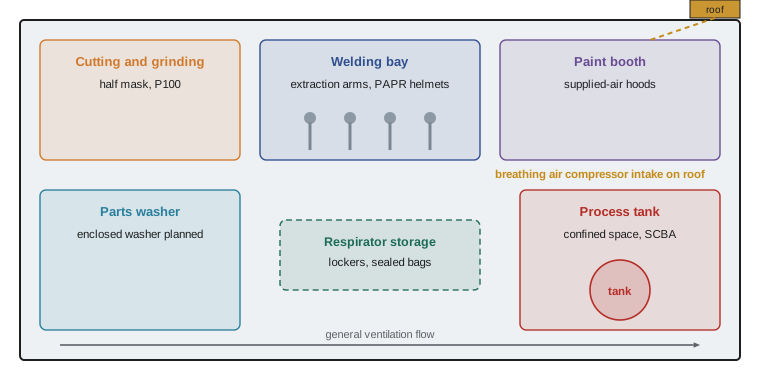
| Area | Task | Hazard | Existing controls | Exposure data |
|---|---|---|---|---|
| Cutting and grinding | Grinding welds on painted and plain steel, 6 workers | Metal dust and fume; some old paint containing lead on refurbished parts | Grinders with shrouds and vacuum on some benches; general ventilation | Respirable dust up to 4 times the limit on benches without extraction |
| Welding bay | MIG welding mild steel, 12 workers | Welding fume, manganese | Fume extraction arms, often not positioned well | Manganese up to 6 times the limit when arms are not used; below the limit when used correctly |
| Parts washer | Hand degreasing, 2 workers, 3 hours per shift | Hydrocarbon solvent vapor | Open tank, no lid in use | Up to 2 times the limit |
| Paint booth | Spraying solvent-borne coatings, 3 workers | Paint mist and solvent vapor | Downdraft booth | Inside the booth while spraying: particulate up to 30 times the limit, solvent up to 8 times |
| Process tank | Annual cleaning of a 20 m³ tank used for phosphate pre-treatment | Possible oxygen deficiency, residual chemicals | Confined space program; mechanical ventilation | Unknown until tested; treated as IDLH until shown otherwise |
Step 1: Control before respirators
The first job of the program administrator is to push controls up the hierarchy. Respirators will be needed, but every improvement here reduces the protection factor required, the cost and the burden on workers.
Worked problem
Engineering and administrative improvements first
For each area, identify at least one control that should be implemented or improved before or alongside respirators.
Show solution
- Grinding: install shrouds and vacuum extraction on all benches; strip lead paint from refurbished parts chemically or by a controlled method before grinding, and treat lead work under the specific lead rules covered in HSE-242.
- Welding: train welders to position extraction arms within about one hood diameter of the arc and make it part of the job procedure; consider on-torch extraction.
- Parts washer: replace the open tank with an enclosed washer or keep the lid closed and add lip exhaust; evaluate a water-based cleaner.
- Paint booth: confirm booth airflow meets design; schedule spraying when no one else is in the booth; consider lower-solvent coatings.
- Tank: ventilate, isolate and test under the confined space program before any entry.
Answer: With these controls, grinding and welding exposures should fall below the limit for most work, the parts washer may no longer need respirators, and respirators remain essential in the paint booth and for tank entry.
Step 2: Selection for each task
Next, the administrator selects respirators for the exposures that remain, using the method from lesson 6. Northgate decides to use the upper end of its measured data and to plan for the possibility that engineering controls are not always used correctly during the transition.
Worked problem
Selecting respirators task by task
Using the exposure data in the hazard summary, select a respirator class for each area during the transition period while engineering controls are being improved.
Show solution
- Grinding: required protection factor up to 4. A half-mask air-purifying respirator with P100 filters (APF 10) is adequate. Where lead paint is present, follow the lead rules, which may require higher protection.
- Welding: required protection factor up to 6 when arms are not used. A half mask with P100 filters (APF 10) under a welding helmet, or a PAPR welding helmet (APF 25), which welders often find more comfortable and which helps with heat.
- Parts washer: required protection factor up to 2. A half mask with organic vapor cartridges (APF 10) and a change schedule, until the enclosed washer is installed.
- Paint booth: particulate requires 30 and solvent 8, so the governing requirement is 30. A half mask (10) is not enough; a full facepiece (50) or a supplied-air hood rated APF 1,000 by the manufacturer. Northgate chooses continuous-flow supplied-air paint hoods because they also provide eye and face protection, avoid cartridge change schedules and are cooler.
- Tank: unknown atmosphere, treated as IDLH: pressure-demand SCBA or a pressure-demand airline respirator with escape cylinder, with standby and rescue arrangements.
Answer: Half masks with P100 filters for grinding, half masks or PAPR welding helmets for welding, half masks with organic vapor cartridges for degreasing, supplied-air hoods in the paint booth, and SCBA or combination airline units for tank entry.
Step 3: Program elements
With selection made, the administrator writes the rest of the program. The table summarizes Northgate's decisions.
| Element | Northgate decision |
|---|---|
| Program administrator | The health and safety coordinator, with time allocated and training in respiratory protection and fit testing |
| Medical evaluation | Appendix C questionnaire reviewed by a contracted PLHCP before fit testing; re-evaluation when the 1910.134(e)(7) triggers occur |
| Fit testing | Quantitative fit testing at least annually for all tight-fitting users, three half-mask models in several sizes |
| Change schedules | Organic vapor cartridges changed at the start of each shift and at lunch, based on manufacturer software for the worst conditions; P100 filters changed when breathing resistance rises or when damaged |
| Breathing air | Oil-free compressor with roof intake away from exhausts, purification panel, carbon monoxide monitor with alarm, Grade D air verified by testing |
| Maintenance and storage | Individual issue; cleaning weekly or more often with the manufacturer's cleaner; sealed storage bags in personal lockers; monthly documented SCBA inspection |
| Training | Before first use and every year, combined with fit testing; supervisor training on enforcing use and spotting problems |
| Facial hair | Clean-shaven policy for tight-fitting users; PAPR welding helmets and supplied-air hoods offered to workers who keep beards, including for religious reasons |
| Emergency procedures | Tank entry under the confined space program with SCBA, standby person and arranged rescue; escape respirators at the phosphate chemical storage |
| Evaluation and records | Annual program audit and worker survey; records of assessments, clearances, fit tests, training and inspections |
Worked problem
Estimating the annual program cost
Estimate Northgate's annual direct cost for the tight-fitting part of the program, using these illustrative figures: 23 workers need tight-fitting respirators; each elastomeric half mask costs $45 and lasts two years; P100 filter pairs cost $15 and each worker uses one pair a week for 48 weeks; organic vapor cartridge pairs cost $25 and the 2 degreasers use two pairs per shift for 240 shifts until the enclosed washer arrives; fit testing costs $60 per worker; medical screening costs $50 per worker; training costs one hour of paid time at $40 per worker.
Show solution
- Half masks: 23 × $45 ÷ 2 years = $518 per year.
- P100 filters for the 21 particulate users: 21 × 48 × $15 = $15,120.
- Organic vapor cartridges: 2 workers × 2 pairs × 240 shifts × $25 = $24,000.
- Fit testing, screening and training: 23 × ($60 + $50 + $40) = $3,450.
- Total: $518 + $15,120 + $24,000 + $3,450 = $43,088.
Answer: About $43,000 a year in this illustrative case, more than half of it for organic vapor cartridges for just two workers. An enclosed parts washer that removes the need for respirators would likely pay for itself within a year or two, which is the hierarchy of controls expressed in dollars.
Step 4: Program evaluation
A written program is a promise; evaluation checks whether it is kept. Evaluation should be done at least annually and whenever there are signs of trouble, such as complaints, symptoms, inspection findings or new processes.
OSHA requires the employer to conduct evaluations of the workplace as necessary to ensure the written program is being properly implemented, and to regularly consult employees required to use respirators to assess their views on program effectiveness and to identify problems, including respirator fit, appropriate selection, proper use under workplace conditions and proper maintenance (1910.134(l)).
| What to check | How to check it |
|---|---|
| Are respirators worn when and where required? | Walk-throughs at different times and shifts; observe without warning |
| Are they the right type and in good condition? | Spot-check approvals, cartridges and condition against the selection table |
| Are change schedules followed? | Check cartridge dates and logs; ask workers when they change |
| Do respirators fit and are they comfortable? | Worker interviews or surveys; fit test records; comfort complaints |
| Are medical evaluations, fit tests and training current? | Records audit against the roster |
| Is breathing air tested and are alarms working? | Test certificates; alarm function tests |
| Have exposures or processes changed? | Compare current processes and materials with the hazard assessment |
| Are engineering controls being improved? | Track the control plan; respirator reliance should fall over time |
Worked problem
Reading audit results
Northgate's first annual audit finds: 3 of 12 welders observed with extraction arms out of position; 2 workers with expired fit tests; organic vapor cartridges in the parts washer area dated three days earlier; 5 respirators stored on hooks in the welding bay; one worker survey comment that the half mask cannot be worn under a welding helmet without slipping. What actions follow?
Show solution
- Welding arms: retrain and add arm positioning to supervisor checks; evaluate on-torch extraction. This attacks the source and reduces respirator reliance.
- Expired fit tests: remove the two workers from respirator tasks until retested, and add automatic reminders.
- Cartridges: a three-day-old cartridge breaks the change schedule; replace immediately, retrain, and add a dated cartridge log at the washer.
- Storage: provide sealed bags and lockers and remove hooks from the bay.
- Comfort complaint: trial PAPR welding helmets, which remove the half mask from under the helmet entirely.
Answer: Each finding gets a specific corrective action with an owner and date, and the most important actions are those that reduce reliance on respirators, such as better fume extraction.
Reviewing a weak draft program
Finally, practice the reviewer's eye. Suppose a contractor submits this one-page draft for painting work at Northgate: 'All painters will wear 3M masks. Cartridges will be changed when painters smell paint. Fit testing will be done if a worker asks. Masks will be kept in the paint room. Supervisors will make sure masks are worn.'
| Draft statement | Weakness | What a compliant program needs |
|---|---|---|
| "All painters will wear 3M masks" | No hazard assessment, no respirator type, no approval check | Exposure assessment, required protection factor, specific approved respirator class and models |
| "Cartridges changed when painters smell paint" | Odor is not an acceptable change schedule | A data-based change schedule, or supplied air |
| "Fit testing if a worker asks" | Fit testing is mandatory before use and periodically | Fit testing before first use, at least annually and after changes |
| "Masks kept in the paint room" | Storage in the contaminated area | Clean sealed storage outside the paint area |
| "Supervisors make sure masks are worn" | No medical evaluation, training, maintenance, breathing air or evaluation | All program elements, a named administrator and records |
Respiratory protection is a system. The respirator is the visible part, but it works only when the hazard assessment, selection, medical evaluation, fit testing, training, maintenance, breathing air and evaluation all work together. A supervisor who understands that system can protect workers, catch weak programs before they fail and push steadily toward controls that make respirators less necessary.
Common mistakes
MistakeStarting a program by buying respirators.
InsteadStart with the hazard assessment and controls higher in the hierarchy.
MistakeUsing one respirator type for every area of a site.
InsteadSelect for each task's contaminants, concentration and conditions.
MistakeTreating the written program as finished once it is approved.
InsteadEvaluate it at least annually, with worker input, and act on findings.
MistakeIgnoring the cost of consumables.
InsteadCount the full cost of respirator use, which often justifies engineering controls.
MistakeAccepting a contractor's one-page respirator policy.
InsteadRequire a full program with assessment, selection, change schedules, fit tests, medical clearance and training.
Summary and key terms
- A program starts with controls higher in the hierarchy; every improvement reduces respirator needs and cost.
- Select respirators task by task from the exposure data, the required protection factor and conditions such as eye hazards and heat.
- Program decisions cover the administrator, medical evaluation, fit testing, change schedules, breathing air, maintenance, training, facial hair, emergencies and records.
- Cost estimates often show that consumables for a few workers justify engineering controls.
- Evaluate the program at least annually through observation, records audits and worker consultation.
- Each audit finding needs a corrective action with an owner and date, prioritizing actions that reduce reliance on respirators.
- A reviewer should recognize weak programs: no assessment, odor-based change schedules, optional fit testing, poor storage and missing elements.
- Program evaluation
- A periodic check that the respiratory protection program is followed and effective.
- Transition period
- The time during which respirators are used while engineering controls are being improved.
- Selection table
- A table in the program listing the respirator required for each task.
- Corrective action
- A specific step, with an owner and date, to fix a program weakness.
- Continuous-flow supplied-air hood
- A loose-fitting hood supplied with a constant flow of breathing air.
- Clean-shaven policy
- A rule requiring tight-fitting respirator users to have no facial hair under the seal.
- Consumables
- Items used up in a program, such as filters, cartridges and filtering facepieces.
- Worker consultation
- Asking respirator users about fit, comfort, use and problems.
Practice problems
Work each problem on paper first, then reveal the answer to check.
Why does the capstone start with engineering controls rather than respirators?
Show answer
Controls higher in the hierarchy protect everyone and reduce the protection, cost and burden of respirators.
The paint booth needs protection factors of 30 for particulate and 8 for solvent. Which governs?
Show answer
The higher, 30.
Why is a half mask not enough in the paint booth?
Show answer
Its APF of 10 is below the required 30.
Why did Northgate choose supplied-air hoods for painters?
Show answer
They meet the protection factor, protect the eyes and face, avoid cartridge schedules and are cooler.
What respirator is needed for the tank cleaning, and why?
Show answer
SCBA or a combination airline unit, because the atmosphere is unknown and treated as IDLH.
In the cost example, what was the largest single cost?
Show answer
Organic vapor cartridges for the two degreasers.
Name four things to check during program evaluation.
Show answer
Wear, type and condition, change schedules, fit and comfort, current records, breathing air, changed processes and progress on controls.
What should happen to workers with expired fit tests?
Show answer
Remove them from respirator tasks until retested.
Why is "change cartridges when you smell paint" unacceptable?
Show answer
Odor is not a reliable warning and is not an acceptable change schedule.
What is the key message of the course?
Show answer
Respiratory protection is a system; the respirator works only when all program elements work together, and controls should reduce reliance on respirators.
Lesson quiz · 5 questions
Score 60% or more to complete this lesson.
Create a free account to save your progress, take quizzes and earn a certificate.