
HSE-240 · Lesson 5 of 12 · 30 min
Types of respirators
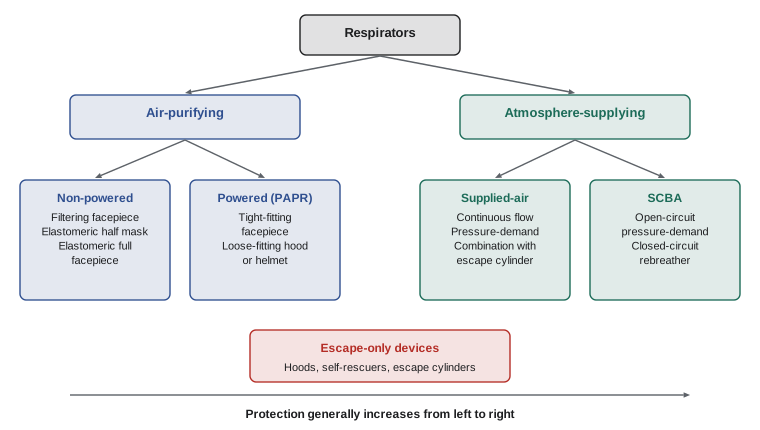
Respirators come in two broad families. Air-purifying respirators clean the surrounding air by passing it through filters, cartridges or canisters. Atmosphere-supplying respirators provide clean breathing air from a separate source. Within each family, the design of the facepiece and the way air moves through it determine how much protection the respirator can give and in what situations it can be used. HSE-104 introduced these families; this lesson looks at each type in more depth, including how it works, what it is good for, and how it fails.
Tight-fitting and loose-fitting facepieces
The first distinction is how the respirator meets the face. A tight-fitting respirator seals against the skin: a quarter mask covers the nose and mouth, a half mask covers the nose and mouth and fits under the chin, and a full facepiece covers the eyes, nose and mouth and seals around the face perimeter. Any tight-fitting respirator depends on that seal, so it must be fit-tested and the wearer must be free of anything, such as facial hair, that breaks the seal.
A loose-fitting respirator does not seal against the face. Hoods, helmets and loose-fitting facepieces rely on a constant flow of clean air to keep contaminants out. They can be worn with facial hair and usually do not need fit testing, but they work only while the air flow is sufficient. If the blower stops or the air supply fails, a loose-fitting respirator provides almost no protection.
Non-powered air-purifying respirators
Non-powered air-purifying respirators are the most common type. The wearer's own breathing draws air through the filter or cartridge. During inhalation, the pressure inside the facepiece is lower than outside, so any gap in the seal lets contaminated air leak in. That is why these respirators are called negative-pressure respirators and why their protection depends so heavily on fit.
| Type | Description | Typical uses | Limitations |
|---|---|---|---|
| Filtering facepiece respirator | The whole facepiece is filter material, often called a disposable respirator (for example an N95) | Dusts and mists at modest concentrations; many health care uses | Particles only; disposable; fit varies widely by model and face; no gas or vapor protection unless specially designed for nuisance levels |
| Elastomeric half mask | Reusable rubber or silicone facepiece with replaceable filters or cartridges | Dusts, fumes, mists and, with cartridges, gases and vapors at moderate concentrations | No eye protection; must be cleaned and maintained; negative pressure |
| Elastomeric full facepiece | Reusable facepiece covering eyes, nose and mouth, with filters, cartridges or a canister | Higher concentrations; eye irritants; tasks needing eye protection | Heavier; lens can fog; spectacle kits needed; negative pressure |
| Gas mask (canister) | Full facepiece with a large canister, front- or back-mounted | Higher vapor concentrations for limited times; some escape uses | Not for oxygen-deficient or IDLH atmospheres except for escape where approved |
Filtering facepieces deserve special comment because they are so widespread. A properly fitted N95 or better can provide meaningful protection against particles. But fit varies widely between models and faces, many workers wear them loosely or with the straps moved, and some products sold as masks are not approved respirators at all. A surgical or procedure mask is designed to protect the patient from the wearer and to resist fluid splash; it is not designed to seal and is not a respirator unless it is a NIOSH-approved surgical respirator. Cloth face coverings and nuisance dust masks without approval numbers are not respirators.
Powered air-purifying respirators
A powered air-purifying respirator (PAPR) uses a battery-powered blower to push filtered air into the facepiece, hood or helmet. Because the blower supplies air, the wearer does not have to suck air through the filter, which reduces breathing resistance and heat build-up. With a tight-fitting facepiece, the blower keeps the inside pressure positive most of the time, so small leaks blow outward rather than inward.
| PAPR style | Features | Considerations |
|---|---|---|
| Tight-fitting half or full facepiece | Higher protection; positive pressure during most breathing | Needs fit testing (in negative-pressure mode for quantitative tests); facial hair not allowed |
| Loose-fitting facepiece or visor | No seal; comfortable; can be worn with facial hair | Lower assigned protection; relies entirely on air flow |
| Hood or helmet | Covers the whole head; can include face shield and hard hat | Protection depends on design; some hoods achieve very high protection when tested; good for workers who cannot pass a fit test |
PAPRs need careful maintenance. Batteries must be charged and replaced on schedule, air flow must be checked with the manufacturer's flow indicator before each use, and filters must be replaced when flow can no longer be maintained. A PAPR that is running with a weak battery or clogged filter may not deliver enough air to keep up with heavy breathing. At very high work rates, the wearer can momentarily inhale faster than the blower supplies air, creating brief negative pressure inside a loose-fitting hood. This is called overbreathing and is one reason PAPR protection is lower in heavy work than in laboratory tests.
Worked problem
Planning PAPR battery use
A PAPR battery is rated by the manufacturer to run the blower for 8 hours when new and fully charged at room temperature with clean filters. The crew works 10-hour shifts in a cold building at about 0 °C, and the manufacturer's information says cold reduces run time by about 25 percent. Battery capacity also falls about 20 percent by the end of its service life. What run time should the program plan for, and what follows?
Show solution
- Start with 8 hours rated run time.
- Cold reduces it by 25 percent: 8 × 0.75 = 6.0 hours.
- An aging battery reduces it a further 20 percent: 6.0 × 0.80 = 4.8 hours.
- Loaded filters increase blower demand and shorten run time further, so the realistic run time could be below 4.8 hours.
Answer: Plan for under 5 hours per battery in these conditions (illustrative figures; use the manufacturer's data). Each worker needs at least one charged spare battery for a 10-hour shift, plus a flow check after each battery change.
Supplied-air respirators
Supplied-air respirators (SARs), also called airline respirators, deliver breathing air through a hose from a compressor or a bank of cylinders. They allow long work periods without the weight of a cylinder on the back and work against gases and vapors that air-purifying cartridges cannot handle. Their weaknesses are the hose, which limits movement and can be cut, crushed or disconnected, and the dependence on breathing air quality, covered in lesson 11.
| SAR mode | How air is delivered | Notes |
|---|---|---|
| Demand | Air flows only when the wearer inhales, creating negative pressure | Lower protection; rarely used today |
| Continuous flow | Air flows constantly into a facepiece, hood or helmet | Common for abrasive blasting hoods and painting; protection depends on flow |
| Pressure-demand | A regulator keeps the facepiece at positive pressure and increases flow during inhalation | Higher protection; used with full facepieces |
Supplied-air respirators must not be used to enter atmospheres that are immediately dangerous to life or health unless they are combined with an auxiliary self-contained air supply that lets the wearer escape if the airline fails. These combination units are a specialized category with their own approvals.
Self-contained breathing apparatus
Self-contained breathing apparatus (SCBA) gives the wearer an independent air supply carried on the back. Open-circuit SCBA, the type used by firefighters and many industrial rescue teams, supplies air from a cylinder and exhausts exhaled air to the atmosphere. Closed-circuit SCBA, also called a rebreather, removes carbon dioxide from exhaled air and adds oxygen, allowing much longer durations, and is used mainly in mine rescue.
Pressure-demand open-circuit SCBA with a full facepiece offers the highest level of respiratory protection and is the standard choice for atmospheres that are immediately dangerous to life or health, including oxygen-deficient atmospheres and unknown atmospheres during emergencies. Its limits are weight, limited duration, the need for intensive training and the need for a strict inspection and maintenance regime. SCBA is covered in detail in lesson 11.
Escape respirators
Escape-only respirators are designed to help a worker get out of a hazardous atmosphere, not to work in it. Examples include escape hoods for chemical releases, filter self-rescuers, self-contained self-rescuers used in mines, and small escape cylinders on airline systems. Each is approved for escape only and for specific hazards and durations. A worker must never use an escape device to enter or stay in a hazardous atmosphere.
Comparing respirator types
Each type trades off protection, comfort, mobility, cost and maintenance. Choosing among them is the subject of lesson 6, but the table below summarizes the main features.
| Type | Pressure inside facepiece | Facial hair allowed? | Gas and vapor protection | IDLH entry? |
|---|---|---|---|---|
| Filtering facepiece | Negative | No | No (particles only) | No |
| Elastomeric half or full mask | Negative | No | With approved cartridges, within limits | No |
| Tight-fitting PAPR | Mostly positive | No | With approved cartridges, within limits | No |
| Loose-fitting PAPR | Positive while flow is maintained | Yes | With approved cartridges, within limits | No |
| Continuous-flow SAR | Positive while flow is maintained | Hood types yes; tight-fitting no | Yes, from clean air | Only with escape cylinder (combination unit) |
| Pressure-demand SCBA | Positive | No (tight-fitting) | Yes, from clean air | Yes |
Worked problem
Matching a type to a worker
A long-time maintenance mechanic wears a full beard for religious reasons. His job includes periodic grinding on painted steel that produces metal fume above the limit, and the hazard assessment calls for respiratory protection with an assigned protection factor of at least 25. Which respirator types could work?
Show solution
- Tight-fitting respirators, including filtering facepieces, elastomeric masks and tight-fitting PAPRs, cannot seal over a beard.
- A loose-fitting PAPR with a hood or helmet and particulate filters does not rely on a face seal and has an assigned protection factor of at least 25.
- A continuous-flow supplied-air hood would also work but adds a hose and an air supply, which is unnecessary for this task.
- The employer must confirm that the specific PAPR model and filters are approved for the hazard and that the worker is trained and medically cleared.
Answer: A loose-fitting PAPR with appropriate particulate filters is the practical choice. It provides the required protection without a face seal and accommodates the worker's beard.
Things that look like respirators but are not
Several products are commonly mistaken for respirators. Surgical and procedure masks, cloth face coverings, single-strap nuisance dust masks without an approval number, bandanas and wet cloths do not provide reliable respiratory protection and must not be used where respirators are required. Equally, a product with a counterfeit approval mark is not a respirator. NIOSH publishes examples of counterfeit and misrepresented respirators; signs include spelling errors on the packaging, a missing or incorrect approval number, claims of approval for children, and decorative ear loops on products claiming N95 approval.
Worked problem
Checking a filtering facepiece before purchase
A supplier offers a large lot of 'N95 equivalent' masks with ear loops at half the usual price. The packaging shows a TC number but no manufacturer contact details. What should the program administrator do?
Show solution
- Look up the TC number and model in the NIOSH Certified Equipment List.
- Check whether the approval holder, model and strap design match; NIOSH-approved N95s for workplace use normally have head straps, not ear loops.
- Check NIOSH's counterfeit and misrepresentation notices.
- Reject the lot if any detail does not match, and buy from an authorized distributor.
Answer: Verify the approval before buying. 'N95 equivalent' with ear loops and no manufacturer details strongly suggests the product is not approved.
Common mistakes
MistakeUsing a surgical mask where a respirator is required.
InsteadUse a NIOSH-approved respirator; surgical masks are not designed to seal.
MistakeAssuming a filtering facepiece protects against solvent vapor.
InsteadFiltering facepieces stop particles only; use approved cartridges or supplied air for gases and vapors.
MistakeUsing a loose-fitting PAPR with a weak battery or clogged filter.
InsteadCheck air flow before each use and replace batteries and filters on schedule.
MistakeEntering an IDLH atmosphere with an airline respirator that has no escape supply.
InsteadUse pressure-demand SCBA, or a combination airline unit with an approved escape cylinder.
MistakeUsing an escape hood to finish a task in a leaking area.
InsteadEscape devices are for leaving only.
MistakeBuying respirators without checking the approval.
InsteadVerify the TC number and model in the NIOSH Certified Equipment List and buy from authorized distributors.
Summary and key terms
- Air-purifying respirators clean ambient air; atmosphere-supplying respirators provide clean air from a separate source.
- Tight-fitting respirators depend on a face seal and need fit testing; loose-fitting respirators depend on continuous air flow.
- Non-powered air-purifying respirators work under negative pressure, so leaks draw contaminated air in.
- PAPRs reduce breathing resistance and can accommodate facial hair in loose-fitting styles, but need charged batteries and checked air flow.
- Supplied-air respirators allow long work periods but depend on the hose and on breathing air quality; they need an escape supply for IDLH use.
- Pressure-demand SCBA provides the highest protection and is the standard for IDLH and unknown atmospheres.
- Surgical masks, cloth coverings and unapproved or counterfeit products are not respirators.
- Air-purifying respirator (APR)
- A respirator that removes contaminants from the surrounding air with filters, cartridges or canisters.
- Atmosphere-supplying respirator
- A respirator that provides breathing air from a source independent of the surrounding air.
- Tight-fitting respirator
- A respirator that seals against the face.
- Loose-fitting respirator
- A hood, helmet or loose facepiece that relies on air flow rather than a seal.
- Negative-pressure respirator
- A respirator in which pressure inside the facepiece falls below outside pressure during inhalation.
- Powered air-purifying respirator (PAPR)
- An air-purifying respirator that uses a blower to deliver filtered air.
- Supplied-air respirator (SAR)
- A respirator that delivers breathing air through a hose from a compressor or cylinders.
- Self-contained breathing apparatus (SCBA)
- A respirator with a breathing air supply carried by the wearer.
- Pressure-demand
- A mode that keeps the facepiece at positive pressure and increases air flow on inhalation.
- Overbreathing
- Inhaling faster than a powered or continuous-flow respirator supplies air, briefly creating negative pressure.
- Escape respirator
- A device approved only for leaving a hazardous atmosphere.
Practice problems
Work each problem on paper first, then reveal the answer to check.
What are the two broad families of respirators?
Show answer
Air-purifying and atmosphere-supplying respirators.
Why are non-powered air-purifying respirators called negative-pressure respirators?
Show answer
Inhalation lowers the pressure inside the facepiece below outside pressure.
Why can a loose-fitting PAPR be worn with a beard?
Show answer
It does not rely on a face seal; continuous air flow keeps contaminants out.
What happens if a loose-fitting PAPR's blower stops?
Show answer
It provides almost no protection.
A PAPR is rated for 8 hours; cold cuts run time by 25 percent and age by 20 percent. Estimate the run time.
Show answer
8 × 0.75 × 0.80 = 4.8 hours, before allowing for loaded filters.
What extra feature lets an airline respirator be used in an IDLH atmosphere?
Show answer
An approved auxiliary self-contained air supply for escape.
Which respirator type provides the highest protection?
Show answer
Pressure-demand open-circuit SCBA with a full facepiece.
Why is a surgical mask not a respirator?
Show answer
It is not designed to seal to the face and is not approved as a respirator unless it is a NIOSH-approved surgical respirator.
Name two signs of a counterfeit N95.
Show answer
Missing or wrong approval number, spelling errors, ear loops, claims of approval for children, no manufacturer details.
What is overbreathing?
Show answer
Inhaling faster than the respirator supplies air, creating brief negative pressure inside a powered or continuous-flow respirator.
Lesson quiz · 5 questions
Score 60% or more to complete this lesson.
Create a free account to save your progress, take quizzes and earn a certificate.