
FAT-220 · Lesson 1 of 12 · 20 min
How the installation standard is organized
On the first evening of the installation block, Gerry Tremaine puts a thick bound document on the table in front of Sasha Vukovic. It is Bramwell's copy of NFPA 72, the National Fire Alarm and Signaling Code, its margins full of pencil notes and colored tabs. 'Everything you've learned so far tells you what the parts are and how they work,' he says. 'This tells you how they have to go into a building. When the fire marshal's office or the acceptance test witness looks at our work, this is the rulebook they hold it against.' Over the next twelve evenings, the crew will work through the code chapter by chapter, and then apply it to the new north wing at Eastview General Hospital, which Bramwell is installing this winter. This lesson explains what the installation requirements are, how NFPA 72 is organized, how it relates to the building and fire codes, and how to find your way around it.
What an installation standard does
A building code says when a building needs a fire alarm system and what the system must do: which occupancies need one, whether it is single-stage or two-stage, whether it needs an annunciator or a voice system. It does not say how to mount a smoke detector, how far a strobe may be from the end of a corridor, or how a circuit must be wired so that a break in it is reported. Those details belong to the installation standard. The building code points to the standard, and by doing so makes the standard's requirements part of the law for that building.
In the United States, the requirements are in NFPA 72, which the International Building Code and International Fire Code reference in their Section 907. When a state or city adopts those codes, the edition of NFPA 72 they reference becomes part of the law. Unlike the Canadian system, where installation, verification and inspection are separate standards, NFPA 72 covers all of them in one document: installation, acceptance testing, and periodic inspection, testing and maintenance, along with supervising stations and emergency communication systems. Products are listed to separate UL standards, such as UL 864 for control units and UL 268 for smoke detectors, and the code requires listed equipment.
The installation standard is written in mandatory language. 'Shall' means a requirement; 'should' or 'may' does not appear in the requirements themselves. Explanatory material, examples and recommended practice are in appendices or annexes that are not part of the requirements, though they explain the intent and are often used by inspectors to interpret the rules. A technician quoting the standard needs to know whether the passage being quoted is a requirement or an explanation.
How the standard is laid out
NFPA 72 is organized in chapters. Chapters 1 to 3 cover administration, referenced publications and definitions. Chapter 7 covers documentation. Chapter 10 covers fundamentals that apply to every system: listed equipment, compatibility, power supplies, signal priority, and the qualifications of designers and installers. Chapter 11 covers cybersecurity, new in the 2025 edition. Chapter 12 covers circuits and pathways, including circuit classes and survivability. Chapter 14 covers inspection, testing and maintenance. Chapter 17 covers initiating devices and Chapter 18 notification appliances. Chapter 21 covers emergency control function interfaces, such as elevator recall and fan shutdown. Chapter 23 covers protected premises alarm systems, Chapter 24 emergency communication systems, Chapter 26 supervising station alarm systems, and Chapter 29 single- and multiple-station alarms. Annex A explains many sections and is keyed to them by number. Section numbers change between editions, so a reference should always state the edition: 'NFPA 72-2025, 17.7.3' is a reference; '17.7.3' alone is not.
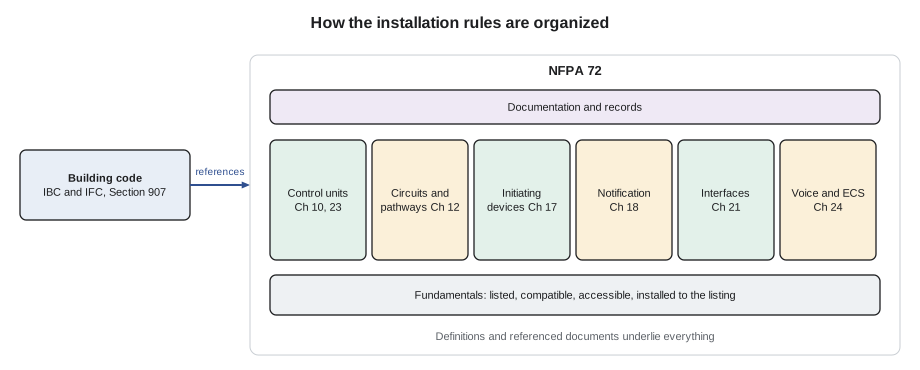
Requirements and how they nest
Most rules in the standard are layered. A general rule applies to every case unless a more specific rule changes it. For example, a general rule may require all field devices to be accessible for maintenance, while a specific rule for duct smoke detectors says how a detector above a ceiling is made accessible: with a remote test station and a marked access panel. When two rules seem to conflict, the specific one usually governs the case it addresses. When the standard and the building code conflict, the code governs, because it is the law that adopts the standard. And when the maker's installation instructions require something stricter than the standard, the instructions must be followed too, because a device installed against its instructions is no longer installed to its listing.
Gerry's rule of thumb for Sasha is to read three things before installing anything unfamiliar: the clause that governs it, the maker's installation sheet, and the project drawings and specification. The specification may require more than the standard, such as red junction boxes or a particular cable, and the drawings show what the designer intended. When the three disagree, the stricter one is followed and the disagreement is reported to the designer.
# Where to look: a small topic-to-section index (illustrative; always check the adopted edition)
index = {
    "control unit location":       ("S524 control unit section", "NFPA 72 Ch 10 and 23"),
    "annunciator":                 ("S524 annunciator section", "NFPA 72 Ch 10 and 23"),
    "circuit classes":             ("S524 wiring section", "NFPA 72 Ch 12"),
    "batteries and standby":       ("S524 power supply section", "NFPA 72 Ch 10"),
    "smoke detector spacing":      ("S524 initiating devices", "NFPA 72 Ch 17"),
    "strobe placement":            ("S524 visual signal devices", "NFPA 72 Ch 18"),
    "elevator recall interface":   ("S524 ancillary devices", "NFPA 72 Ch 21"),
    "record drawings":             ("S524 documentation", "NFPA 72 Ch 7"),
}
for topic, (ca, us) in index.items():
print(f"{topic:28s} | {ca:28s} | {us}")control unit location | S524 control unit section | NFPA 72 Ch 10 and 23 annunciator | S524 annunciator section | NFPA 72 Ch 10 and 23 circuit classes | S524 wiring section | NFPA 72 Ch 12 batteries and standby | S524 power supply section | NFPA 72 Ch 10 smoke detector spacing | S524 initiating devices | NFPA 72 Ch 17 strobe placement | S524 visual signal devices | NFPA 72 Ch 18 elevator recall interface | S524 ancillary devices | NFPA 72 Ch 21 record drawings | S524 documentation | NFPA 72 Ch 7
Prescriptive rules and performance alternatives
Most of the installation standard is prescriptive: it says exactly what to do, such as the maximum spacing of detectors on a smooth ceiling or the mounting height of a manual station. Prescriptive rules are easy to apply and easy to inspect, which is why they dominate. In a few places the standard allows a performance-based alternative, where the designer shows by analysis or testing that the system achieves the intended result. A performance-based detector layout, for example, uses fire modeling to show that the detectors will respond to a design fire in time. Performance alternatives need the authority's acceptance, and they are documented in detail so that future technicians know why the layout differs from what the prescriptive rules would give.
For the technician, the practical point is that a layout that looks wrong may be right. If the detectors in a high atrium are farther apart than the spacing tables allow, Sasha should check the design documents for a performance-based analysis before reporting a deficiency, and report it if there is none.
Equivalents and the authority having jurisdiction
NFPA 72 allows equivalent systems, methods and devices when the authority having jurisdiction approves them on the basis of technical documentation showing equivalent performance. The authority having jurisdiction, or AHJ, is the organization or person responsible for enforcing the code: in Charlotte, the building inspection department for new construction and the fire marshal's office for the fire code, with other authorities such as the state for hospitals or the insurer for property protection. A single project can have several AHJs, and the crew needs to know which one is reviewing the work.
Whatever the system, the authority's interpretation governs the project in front of it. Two inspectors may read a clause differently, and the installer's job is not to win the argument but to find out early which reading applies, preferably before the work is installed. Bramwell's practice is that Ravi Menon, the designer, settles interpretations with the authority during design and records them on the drawings, so that the crew in the field isn't left guessing.
Editions, amendments and existing buildings
The installation standard is revised every few years, but a building doesn't have to be upgraded every time it changes. A system is generally required to meet the edition in force when it was installed or last altered, unless a law requires retrofitting. When an existing system is altered, the new work usually has to meet the current edition, while the untouched parts may stay as they are. This creates real puzzles in older buildings: a new strobe on an old circuit must meet today's rules for candela and placement, but the circuit it is on may have been designed to a much older edition. The designer decides how far the upgrade must extend, and documents the decision.
Gerry keeps older editions of NFPA 72 on the shelf at Bramwell's office for exactly this reason: when Sasha works on Willowbank School's 12-zone panel, the original installation was done decades ago, and knowing what the rules were then explains why the system looks the way it does. North Carolina's adopted state code may also reference an edition of NFPA 72 older than the current one, which is the edition that governs projects there.
| Question | Where the answer is |
|---|---|
| Does this building need a fire alarm system? | IBC and IFC, Section 907 |
| Single-stage or two-stage? Voice? | IBC and IFC, with NFPA 72 |
| How must the detectors be spaced and mounted? | NFPA 72, Chapter 17 |
| How must the wiring be installed? | NFPA 72, Chapter 12, and NFPA 70, Article 760 |
| How is the new system checked before occupancy? | NFPA 72, Chapters 7 and 14 |
| How often is it tested afterward? | NFPA 72, Chapter 14, and the fire code |
Reading a clause properly
A clause in the installation standard has three parts worth noticing: the condition it applies to, the requirement, and any exceptions. 'Where a smoke detector is installed in an air duct, it shall be provided with a remote test facility, except where the detector is readily accessible' is a typical shape. Reading it properly means checking whether the condition applies (is this detector in a duct?), what the requirement is (a remote test facility), and whether an exception covers the case (is the detector readily accessible?). Most mistakes in reading the standard come from skipping one of the three: applying a rule where its condition doesn't hold, or missing an exception that does.
Definitions matter just as much. The standard defines terms such as 'ceiling', 'smooth ceiling', 'beam', 'zone' and 'annunciator' precisely, and the rule depends on the definition, not on the everyday meaning. A 'smooth ceiling' in the standard can have small projections, and a 'beam' has a defined minimum depth. When a rule seems to give a strange result, the first thing to check is whether a key word is defined.
Worked problem
Finding the rule for a duct detector
Sasha is asked where the standard says how to install a duct smoke detector serving the north wing's air handling unit AHU-N1. How should she find the rule and check that she has applied it correctly?
Show solution
- Start from the subject: duct detectors are initiating devices, so look in NFPA 72 Chapter 17, then within it the part on smoke detection for the control of smoke spread.
- Read the condition: does the rule cover a detector in the supply duct, the return duct, or both? Check which applies to AHU-N1.
- Read the requirements: location relative to the fan and filters, sampling tube orientation, airflow range, remote test or indicator, access.
- Read the exceptions, then the maker's installation sheet for the detector housing, which gives the airflow range and the sampling tube length for the duct width.
- Check the project drawings and specification for anything stricter, and note the edition of the standard on the work order.
Answer: The rule is found by subject, then read as condition, requirement and exceptions, and then checked against the maker's sheet and the project documents.
Common mistakes
MistakeCiting a clause number without the edition.
InsteadAlways state the edition with the clause.
MistakeTreating the appendix or annex as a requirement.
InsteadExplanatory material shows intent; only the body states requirements.
MistakeApplying a rule without checking its condition or exceptions.
InsteadRead the condition, the requirement and the exceptions together.
MistakeFollowing the standard but ignoring the maker's instructions.
InsteadA device installed against its instructions isn't installed to its listing.
MistakeArguing an interpretation with the inspector on site.
InsteadSettle interpretations with the authority during design and record them.
Summary and key terms
- NFPA 72 holds the installation requirements that the IBC and IFC require for fire alarm systems.
- The building code says when a system is needed; the standard says how it is installed.
- Requirements use 'shall'; appendix or annex material explains them.
- Specific rules govern the cases they address; the code governs over the standard.
- Performance-based and alternative designs need the authority's acceptance and full documentation.
- A system generally meets the edition in force when it was installed or last altered.
- NFPA 72
- The National Fire Alarm and Signaling Code, which covers installation, testing and maintenance in the United States.
- Prescriptive rule
- A requirement that states exactly what to do.
- Performance-based design
- A design shown by analysis or testing to meet the intended result.
- Equivalency
- A method accepted by the AHJ as giving performance equivalent to the code requirement.
- Authority having jurisdiction
- The organization or person responsible for enforcing the code on a project.
- Edition
- The dated version of a standard; clause numbers change between editions.
Practice problems
Work each problem on paper first, then reveal the answer to check.
What does the building code decide that the installation standard does not?
Show answer
Whether a building needs a fire alarm system and what type of system it needs.
What is the difference between 'shall' and explanatory material?
Show answer
'Shall' states a requirement; explanatory material explains intent and isn't mandatory.
When the maker's instructions are stricter than the standard, which is followed?
Show answer
Both, which in practice means the stricter instructions.
Why must a clause reference include the edition?
Show answer
Clause numbers and content change between editions.
A layout looks wider than the spacing tables allow. What should Sasha check before reporting it?
Show answer
Whether there is a documented performance-based design accepted by the authority.
Lesson quiz · 5 questions
Score 60% or more to complete this lesson.
Create a free account to save your progress, take quizzes and earn a certificate.