
FAT-220 · Lesson 4 of 12 · 21 min
Initiating device installation rules
Three weeks into the north wing job, the drywall is up and the painters are sanding. Sasha arrives on the third floor to find that another trade has mounted a dozen smoke detector bases and heads in the corridor ceiling, uncovered, in a cloud of drywall dust. Gerry looks at them and sighs. 'Every one of those heads is now suspect,' he says. 'Dust gets into the chamber, and it'll drift into trouble or false alarm in six months.' The heads come down, go back in their boxes, and the bases get covers. FAT-120 covered where initiating devices go and how they are spaced. This lesson covers how they are installed: the general rules every device follows, the specific rules for smoke and heat detectors, manual stations, duct detectors and sprinkler devices, and how devices are protected, identified and made ready for verification.
Rules every initiating device follows
Every initiating device is listed for its purpose and compatible with the circuit it connects to, installed to its listing and the maker's instructions, and located as the drawings show, within the spacing and placement rules FAT-120 covered. Every device must be accessible for inspection, testing and maintenance: a detector that can only be reached by removing a light fixture, or a flow switch buried behind ductwork, is a poor installation even if it works. Every device is mounted securely to the structure or a box, not to a ceiling tile alone, and is protected against physical damage where it is exposed, typically with a listed guard.
Every device must also be within its environmental limits. Smoke detectors have listed ranges of temperature, humidity and air velocity, and a detector in a space outside those ranges, such as an unheated loading dock or a room with strong air currents, may not respond correctly or may false alarm. Where the environment is outside a detector's range, a different technology is used, such as a heat detector in a dusty or cold space or an air-sampling system in a high-airflow room. Heat detectors are selected with a temperature rating suited to the normal ceiling temperature, so that they don't operate on a hot summer day under a metal roof.
Protecting devices during construction
NFPA 72 and the maker's instructions both address detectors installed before a building is clean. Smoke detectors are not to be installed until the area's construction cleanup is complete, except where the authority requires detection during construction, in which case the detectors are protected and then cleaned or replaced before acceptance, as the maker directs. A covered detector does not detect, so if the system is relied on for protection during construction, the covers are an impairment that the authority and the owner must know about.
On the north wing, Ravi's specification requires smoke detector heads to be installed only after the area is signed off as clean, with bases installed earlier and protected by covers. Heat detectors and manual stations, which are less sensitive to dust, can go in earlier, but they too are protected from paint overspray, which can coat a heat detector's element or seize a manual station's mechanism.
Smoke and heat detectors
Ceiling-mounted detectors are mounted on listed boxes or bases at the locations shown, with the spacing and wall distances FAT-120 covered, and clear of air diffusers, lights and other obstructions by the distances the standard and the maker set. Detectors are not mounted in dead-air spaces, such as the corner where a wall meets the ceiling, and on sloped or beamed ceilings they follow the specific rules for those ceilings. Sidewall-mounted detectors, where allowed, are mounted within the band below the ceiling that the standard sets.
The installer checks each location against the drawings in the field, because the building as built rarely matches the drawings exactly. A detector shown in the middle of a room may land on a beam that the architect's drawing didn't show, or next to a supply diffuser that the mechanical contractor moved. Small moves within the spacing rules are normal and are recorded on the as-built drawings. Moves that break a spacing rule, or that put a detector closer to a diffuser than allowed, go back to the designer.
Detectors in special locations follow additional rules. Elevator lobbies, hoistways and machine rooms are covered in Lesson 8, because their detectors control elevator recall. Detectors in high ceilings may need to be lowered or replaced by beam or air-sampling systems. Detectors in sleeping rooms or suites follow the residential rules covered in Lesson 9.
Manual stations
Manual stations are mounted with the operable part at a height of 42 to 48 inches above the floor, as NFPA 72 requires, located within 5 feet of the entrance to each exit on each floor, and placed so that the travel distance to the nearest station from any point on the floor does not exceed 200 feet. They must be red, unless the authority approves otherwise, and conspicuous and unobstructed. A station behind a door that swings over it, or on a surface that isn't flat, is relocated.
Stations exposed to damage or misuse may be fitted with listed protective covers, some of which sound a local horn when lifted. A cover must not prevent the station from being operated, and the cover itself must be listed for use with the station. In the hospital's psychiatric unit, the design calls for covers and, in some areas, key-operated stations used only by staff, which is a decision Ravi documents with the authority's agreement.
Duct smoke detectors
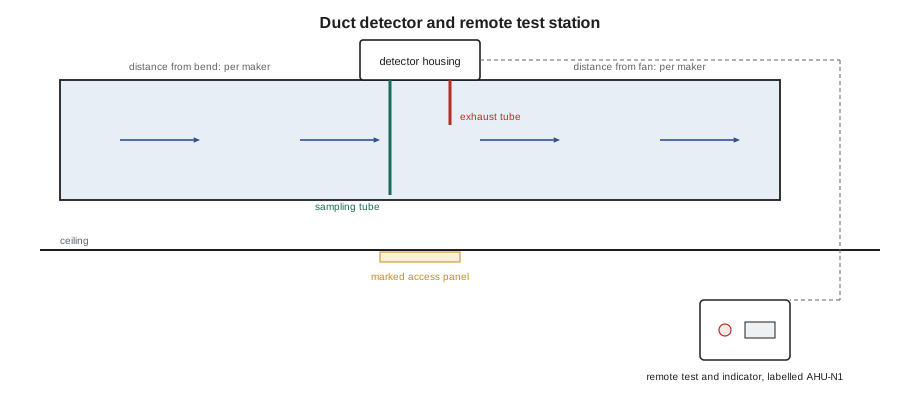
Duct smoke detectors sample the air moving through a duct and are used to shut down air handling units or close smoke dampers so that the system doesn't spread smoke through the building. They are not a substitute for area detection. A duct detector is installed in a housing on the duct, with sampling and exhaust tubes that cross the duct, in a location where the airflow is well mixed and within the detector's listed velocity range. The maker's instructions give the distances from bends, fans and filters, and the tube length for the duct's width.
Duct detectors are often above ceilings or in mechanical spaces where they can't be seen or reached easily. The installation standard requires that a detector that isn't readily accessible, or whose indicator can't be seen, be provided with a remote test station or indicator, mounted where it can be seen and labeled with the detector's identity. The access panel in the ceiling below the detector is marked so that the technician who does the annual test can find it.
# Duct detector: is the duct air velocity within the listed range? (illustrative listing)
flow = 6800          # design airflow, cubic feet per minute
w, h = 3.3, 2.0        # duct size, feet
area = w * h
v = flow / area
lo, hi = 100, 4000    # listed velocity range, ft/min
print(f"duct area {area:.2f} ft2, velocity {v:.1f} ft/min")
print("within listing" if lo <= v <= hi else "outside listing: choose another location or detector")duct area 6.60 ft2, velocity 1030.3 ft/min within listing
Sprinkler waterflow and supervisory devices
Waterflow switches and valve supervisory switches connect the sprinkler system to the fire alarm. The sprinkler contractor usually installs the switches themselves, as part of the sprinkler system, and the fire alarm installer wires them. The division of work must be clear, because the switch must be installed to the sprinkler standard and the wiring to the fire alarm standard. On the north wing, Luis, the sprinkler foreman, and Gerry walk the floor control assemblies together to agree which switch is which and how each will be labeled.
Each sprinkler zone's waterflow device is connected to give a separate alarm indication, and valve supervisory switches give a supervisory signal, distinct from alarm and trouble, when a valve is moved from its normal position. NFPA 72 requires the waterflow alarm to be initiated within 90 seconds of flow equal to a single sprinkler, and the supervisory switch to operate within two revolutions of the valve handle or one-fifth of the valve's travel. The waterflow retard is set on the switch to meet the 90-second limit.
Other suppression systems, such as kitchen hood systems and clean-agent systems, are monitored by the fire alarm through relays or monitor modules, as the design specifies. Their releasing circuits are not part of an ordinary fire alarm installation unless the panel is listed as a releasing panel, and that work follows the suppression system's standard as well.
Addressable devices: addresses and labels
On an addressable system, each device is set to its address before installation, by a dial, a programming tool or the panel's auto-addressing, and the address is recorded against its location on the drawings. A device with the wrong address reports from the wrong place, which is one of the most dangerous installation errors there is: firefighters sent to the third floor for a fire on the fourth. The installer labels each device or its base with its address, visible from the floor where the standard or specification requires, and checks the address against the drawing before closing up.
Monitor and control modules, which connect conventional devices such as flow switches and door holders to the addressable circuit, are installed in boxes near the device they serve, labeled with their address and function. Their wiring to the device is supervised where the standard requires, with the module's end-of-line resistor at the far device, not at the module.
# Mounting height check for initiating devices (values from FAT-120; check the adopted edition)
limits = {"manual station": (42, 48), "wall smoke, below ceiling": (4, 12)}
measured = [("pull N1-01", "manual station", 44), ("pull N3-04", "manual station", 50),
            ("smoke N2-17", "wall smoke, below ceiling", 10)]
for tag, kind, value in measured:
    lo, hi = limits[kind]
    ok = lo <= value <= hi
print(f"{tag:12s} {kind:26s} {value:>6} in {'OK' if ok else 'OUT OF RANGE'}")pull N1-01 manual station 44 in OK pull N3-04 manual station 50 in OUT OF RANGE smoke N2-17 wall smoke, below ceiling 10 in OK
Ready for verification
Before the system is verified, each initiating device is checked against the drawings: right location, right type, right address, dust covers removed, guards fitted where required, labels in place, and accessible. The field wiring is tested before devices are connected, as FAT-130 described, and the installer records the results. Any device that has been exposed to construction dust or paint is cleaned or replaced. The installer's own pre-test, before the formal verification or acceptance test, catches the problems while there is still time to fix them.
Worked problem
The dusty corridor
On the north wing's third floor, twelve smoke detectors were installed uncovered during drywall sanding. What should the crew do, and what changes would prevent a repeat?
Show solution
- Remove the twelve heads and set them aside for cleaning or replacement as the maker directs; most makers do not allow dust-contaminated detectors to be returned to service without cleaning by an approved method.
- Fit dust covers to the bases so that nothing more gets into them.
- Record the event on the job log, so that the pre-test checks those detectors specifically.
- Agree with the general contractor that detector heads are installed only after an area is signed off as clean, and that no other trade installs or removes fire alarm devices.
- If the system is relied on for protection during construction, confirm with the authority and owner how detection is maintained.
Answer: Dust-exposed detectors are cleaned or replaced before verification, and the sequence of work is fixed so that it doesn't happen again.
Devices in hazardous and special environments
Some locations need devices listed for special environments. Areas with flammable vapors or combustible dust, such as fuel storage rooms or some laboratory spaces, are classified as hazardous locations under the electrical code, and devices installed there must be listed for the specific class and group. Outdoor and wet locations need weatherproof devices. Freezers, unheated spaces and attics need devices listed for their temperature range. Areas where devices could be damaged, such as gymnasiums, need listed guards. In each case, the design names the device, and the installer checks the device's label against the location before mounting it.
Ceilings themselves can be special. In a ceiling with exposed joists or beams, the spacing and location rules FAT-120 covered change. In a ceiling higher than the detector's listed range, the design uses beam detectors, air sampling or a different approach. And in spaces where the ceiling isn't finished, such as a mechanical penthouse with an open deck, detectors are mounted on the deck itself or on listed brackets, not dangling from conduit.
The installer also watches for conditions the designer couldn't see. A detector shown above a door in a kitchen area may end up next to a dishwasher's steam vent. A heat detector shown in a storage room may be next to a heating unit. These are reported, because a device that is technically in the right place but in a poor environment will cause nuisance alarms, and nuisance alarms erode everyone's trust in the system.
Common mistakes
MistakeInstalling smoke detector heads during dusty work.
InsteadInstall heads after the area is clean, or protect them and clean or replace them.
MistakeMounting a detector closer to a supply diffuser than allowed.
InsteadCheck field locations against the clearances; send rule-breaking moves to the designer.
MistakeBurying a duct detector with no remote test or visible indicator.
InsteadProvide a remote test station where the detector isn't readily accessible.
MistakeWiring a valve switch so that a closed valve shows as trouble.
InsteadSupervisory signals must be distinct.
MistakeInstalling an addressable device without checking its address against the drawing.
InsteadVerify every address before closing up.
Summary and key terms
- Initiating devices must be listed, compatible, accessible and within their environmental limits.
- Smoke detectors are installed after construction dust, or protected and then cleaned or replaced.
- Field locations are checked against the drawings and spacing rules.
- Manual stations follow height, location and distance rules.
- Duct detectors need correct airflow and a remote test station when not accessible.
- Waterflow and supervisory devices give distinct alarm and supervisory signals.
- Every address is set, recorded and verified.
- Dust cover
- A temporary cover that protects a detector during construction; it stops detection.
- Remote test station
- A device that lets a hidden detector be tested and its status seen from an accessible place.
- Sampling tube
- The tube that draws duct air into a duct detector housing.
- Retard
- A delay on a waterflow switch that prevents false alarms from pressure surges.
- Monitor module
- A device that connects a conventional contact to an addressable circuit.
- Supervisory signal
- A signal showing an off-normal condition of a fire protection system, such as a closed valve.
Practice problems
Work each problem on paper first, then reveal the answer to check.
Why are heat detectors selected with a temperature rating above the normal ceiling temperature?
Show answer
So that they don't operate on normal hot days.
What must a hidden duct detector have?
Show answer
A remote test station or indicator, labeled and visible.
Who usually installs waterflow switches?
Show answer
The sprinkler contractor; the fire alarm installer wires them.
What signal does a closed sprinkler valve produce?
Show answer
A supervisory signal, distinct from alarm and trouble.
Why is a wrong address dangerous?
Show answer
It sends responders to the wrong location.
Lesson quiz · 5 questions
Score 60% or more to complete this lesson.
Create a free account to save your progress, take quizzes and earn a certificate.