
FAT-220 · Lesson 11 of 12 · 21 min
Documentation, record drawings and the as-built package
Two weeks before the north wing's verification, Donna Achebe asks Sasha to help assemble the documentation package. Sasha expects a binder. What she finds is a list of more than twenty items: record drawings for every floor, the final device list with addresses and descriptions, the battery and voltage-drop calculations rerun to the as-built conditions, the sequence of operation, a copy of the panel's program, the wiring test records, the maker's manuals, the training records and more. 'The system will be in that building for twenty years,' Donna says. 'Most of the people who'll work on it haven't been hired yet. This is what they'll have.' This lesson covers the documentation the installation standard requires when an installation is finished, how record drawings are produced from the field redlines, how the device schedule is reconciled against what was installed, and where the documents are kept.
Why documentation is part of the installation
A fire alarm system that works but isn't documented is a problem waiting to happen. Without record drawings, a technician tracing a ground fault has to open ceilings at random. Without a current device list, an annunciator description may send firefighters to the wrong room after a renovation. Without the program, a failed panel can't be restored. Without the calculations, nobody knows whether a circuit can take one more strobe. The installation standards treat documentation as part of the work, not paperwork afterward, and an installation isn't complete until its documents are.
NFPA 72, Chapter 7, sets the documentation required for new systems and alterations, including record drawings, the record of completion, the sequence of operation, the site-specific software, and the manufacturers' manuals, and requires them to be stored at the building in a documentation cabinet or another approved location. The acceptance test checks the documentation as well as the equipment.
Record drawings
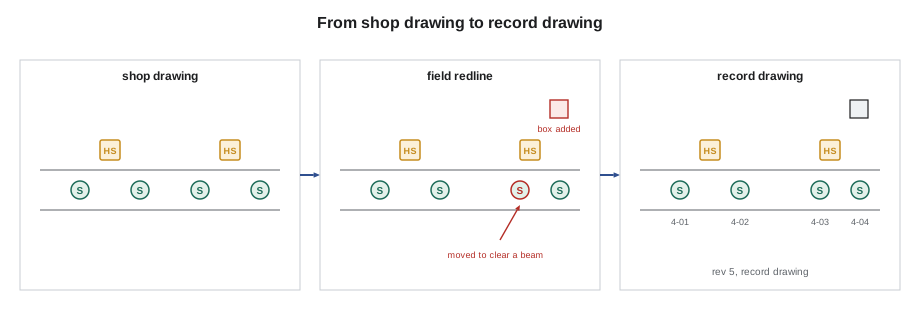
Record drawings, often called as-built drawings, show the system as it was actually installed: every device in its real location with its real address, every circuit with its real routing and end-of-line location, every junction box and splice, every control unit, transponder and power supply, and every interface to another system. They are produced from the shop drawings and the field redlines described in Lesson 10, by the designer or a drafter, and checked against the building. They are clearly marked as record drawings, with the date and the revision they supersede.
Good record drawings are as useful to someone who has never seen the building as to someone who installed it. They use the building's final room numbers, show north, show circuit numbers and address ranges, and include a legend. They show Class A return routes and protected risers, so that a future renovation doesn't cut them. And they are kept current: every later alteration to the system updates them, which is why the alteration's documentation always includes revised record drawings.
The device schedule and reconciliation
On an addressable system, the device schedule lists every device by address, type, location description and circuit, along with settings such as candela, sensitivity or the operating mode. It is the bridge between the drawings and the panel's program: the program's device descriptions should be taken from the schedule, and the schedule should match the record drawings. Before verification, the schedule is reconciled against what is actually installed, so that every device on the drawings is in the panel, every device in the panel is on the drawings, and their types and descriptions agree.
# Reconcile the designed device schedule with what the panel reports (illustrative data)
designed = {"1-001": ("smoke", "North wing L4 corridor near 4-102"), "1-002": ("smoke", "North wing L4 corridor near 4-110"),
            "1-003": ("heat", "North wing L4 staff lounge 4-118"), "1-004": ("pull", "North wing L4 east stair door"), "1-005": ("smoke", "North wing L4 medication room 4-116")}
panel = {"1-001": ("smoke", "North wing L4 corridor near 4-102"), "1-002": ("smoke", "North wing L4 corridor near 4-110"),
         "1-003": ("smoke", "North wing L4 staff lounge 4-118"), "1-004": ("pull", "North wing L4 east stair door"), "1-006": ("smoke", "unnamed")}
for addr in sorted(set(designed) | set(panel)):
    d, p = designed.get(addr), panel.get(addr)
    if d and not p:
        print(addr, "on drawings, not found in panel")
    elif p and not d:
        print(addr, "in panel, not on drawings")
    elif d[0] != p[0]:
        print(addr, f"type differs: drawing {d[0]}, installed {p[0]}")
    else:
print(addr, "matches")1-001 matches 1-002 matches 1-003 type differs: drawing heat, installed smoke 1-004 matches 1-005 on drawings, not found in panel 1-006 in panel, not on drawings
The reconciliation finds three faults. Address 1-003 in the staff lounge is a smoke detector, though revision 4 changed it to a heat detector; it must be replaced. Address 1-005, the new medication room detector, isn't reporting, because it was set to 1-006 by mistake; its address must be changed. And 1-006 must then disappear from the panel's list. Each fault is found in minutes on paper; in an emergency, the first two could have meant a false alarm every time someone made toast and a fire in the medication room reported as an unnamed device.
The sequence of operation and the program
The sequence of operation describes what the system does for each kind of input: which signals sound where, which elevators recall, which fans stop, which doors release, which signals are transmitted to the monitoring station, and how the system is silenced and reset. It is usually presented as the input and output matrix, with a written description. The final sequence must match the program as installed, and both must match what was tested. A sequence of operation written for the design and never updated is one of the most common documentation faults.
NFPA 72 requires a copy of the site-specific software to be stored on site in non-volatile media, or its location to be recorded, and requires the software version and the date of the last change to be documented. The program is what makes the panel behave as the sequence of operation describes, and it is retained so that the system can be restored if the panel fails. Many owners now require a copy on the hospital's own server as well, with access controlled as NFPA 72's cybersecurity provisions describe.
Test records and completion documents
The documentation package includes the records of the installer's tests: the field wiring tests, the installer's pre-test of every device and function, the audibility measurements, and the battery voltage and charger output at start-up. NFPA 72 requires a record of completion for new systems and alterations, a form completed by the installer and others that records the system's description, the documents provided, the testing done and the responsible parties, with the forms for each subsystem, such as emergency communications, completed as applicable. The acceptance test results are added to the package.
The package also includes the maker's installation and operating manuals for the control unit and major equipment, the data sheets for every device type, the warranty information, the training records for the owner's staff, and the contact information for the installer and the monitoring station. For a hospital, it includes the records the health authority and the hospital's own facilities department require.
| Document | What it is for |
|---|---|
| Record drawings | Finding devices, circuits, splices and routes years later |
| Device schedule | Matching addresses, types and descriptions to locations |
| Sequence of operation | Knowing what the system is supposed to do |
| Program copy and version | Restoring the panel after a failure |
| Battery and voltage-drop calculations | Knowing the spare capacity of each supply and circuit |
| Wiring and pre-test records | Showing the installation was checked |
| Record of completion and acceptance results | Showing the system was verified or accepted |
| Manuals and data sheets | Operating, servicing and replacing equipment |
Where the documents are kept
NFPA 72 requires the documents to be stored in a documentation cabinet at the system control unit, or another approved location, with the cabinet labeled 'SYSTEM RECORD DOCUMENTS'; if they are stored elsewhere, the location is identified at the control unit. At Eastview, the hospital's main documentation cabinet is in the central plant beside the main control unit; the north wing's documents go there, with a second set of record drawings and the device list in a cabinet next to the wing's node, because technicians will service the wing from there.
Electronic copies are increasingly common and useful, especially for large drawings, but the standards generally expect the key documents to be available at the building without depending on someone's laptop or a network connection that may be down during an emergency. Bramwell provides both: printed records in the cabinet and an electronic set on a labeled drive, with a copy for the hospital's facilities department.
Keeping the documents current
Documentation decays. A device is moved during a renovation and the drawing isn't updated. A description is changed in the panel but not in the schedule. A new circuit is added and the battery calculation isn't rerun. Each change is small, but after a few years the documents no longer describe the system. The rule Gerry teaches Sasha is that no change to the system is finished until the documents are updated: record drawings, device schedule, program copy, sequence and calculations, as each applies. Service records, covered in FAT-230, become part of the package over the system's life.
# Deliverables tracker for the as-built package (status two weeks before acceptance testing)
items = [("record drawings L1-L6", True), ("riser diagram as built", True),
         ("device schedule reconciled", False), ("sequence of operation final", False),
         ("program copy and version", False), ("battery calcs as built", True),
         ("voltage-drop calcs as built", True), ("wiring test records", True),
         ("pre-test records", False), ("audibility measurements", False),
         ("manuals and data sheets", True), ("training records", False)]
done = sum(1 for _, ok in items if ok)
print(f"{done} of {len(items)} items complete")
for name, ok in items:
    if not ok:
print(" outstanding:", name)6 of 12 items complete outstanding: device schedule reconciled outstanding: sequence of operation final outstanding: program copy and version outstanding: pre-test records outstanding: audibility measurements outstanding: training records
Worked problem
Assembling the north wing package
Two weeks before testing, the tracker shows six items outstanding: the reconciled device schedule, the final sequence of operation, the program copy, the pre-test records, the audibility measurements and the training records. In what order should Sasha and Donna tackle them, and why?
Show solution
- Reconcile the device schedule first, because the program's descriptions and the pre-test both depend on it; fix the faults it finds in the field and in the panel.
- Finalize the sequence of operation against the program and the interface matrix, so that the pre-test checks the final behavior.
- Complete the pre-test and the audibility measurements, correcting faults as they appear, and record the results.
- Save the program and record its version once the pre-test is passed, so that the copy is of the tested program.
- Schedule the training for the hospital's staff close to handover, and record attendance.
- Update the record drawings with any changes found along the way.
Answer: Each document builds on the one before it, so working in dependency order avoids redoing work.
Training and handover
Part of completing an installation is handing it over to the people who will live with it. The specification usually requires training for the owner's staff: how to read the annunciator, how to acknowledge, silence and reset the system, what to do for each type of signal, how to call for service, and, in a hospital, how the fire alarm fits into the fire plan. Training is delivered to the staff who will actually use the system, often in several sessions to reach different shifts, and the attendance is recorded.
At Eastview, the north wing's training covers the nurse station staff on each floor, who will hear the alert signals and start the fire plan, the facilities staff who will respond to troubles and supervisory signals, and the security staff who monitor the main control unit overnight. Each group gets a session focused on what they will do. The training records go into the documentation package, along with a short quick-reference card left at each nurse station.
Handover also includes the warranty and service arrangements, the monitoring station's details and any outstanding items agreed with the owner. Donna's handover letter lists each one, and the owner's representative signs to acknowledge receipt of the documentation package. From that day, the hospital's own staff and its service contractor are responsible for the system, and the documents are what they will rely on.
Common mistakes
MistakeTreating documentation as paperwork after the job.
InsteadDocumentation is part of the installation, and the job isn't done until it is.
MistakeProducing record drawings from the shop drawings without the redlines.
InsteadRecord drawings come from the field redlines and are checked against the building.
MistakeLeaving the sequence of operation as written at design.
InsteadUpdate the sequence to match the final program and tests.
MistakeSaving the program before testing is finished.
InsteadSave the program and version after the tested configuration is final.
MistakeUpdating the system without updating the documents.
InsteadEvery change updates the records it affects.
Summary and key terms
- Documentation is part of the installation and is required by the standards.
- Record drawings show the system as actually installed, from the redlines.
- The device schedule is reconciled against the panel and the drawings before testing.
- The sequence of operation and the program copy must match what was tested.
- Test records and completion documents show the installation was checked.
- Documents are kept at the building, usually in a cabinet at the control unit, and kept current.
- Record drawings
- Drawings showing the system as actually installed.
- Device schedule
- The list of every device with its address, type, location and settings.
- Reconciliation
- Checking that the drawings, schedule and panel agree.
- Sequence of operation
- The description of what the system does for each input.
- Site-specific software
- The panel configuration that makes it behave as the sequence describes.
- Record of completion
- The NFPA 72 form recording the system, documents, tests and responsible parties.
Practice problems
Work each problem on paper first, then reveal the answer to check.
Where do record drawings come from?
Show answer
The shop drawings and the field redlines, checked against the building.
What does reconciliation compare?
Show answer
The drawings, the device schedule and what the panel reports.
Why is a copy of the program kept?
Show answer
To restore the panel if it fails.
Where are the documents usually kept?
Show answer
In a documentation cabinet at the main control unit.
When is a system change finished?
Show answer
When the documents it affects are updated.
Lesson quiz · 5 questions
Score 60% or more to complete this lesson.
Create a free account to save your progress, take quizzes and earn a certificate.