
BAR-223 · Lesson 9 of 12 · 20 min
Michigan family law, probate under EPIC and the Michigan Constitution
▶ Video coming soon A video version of this lesson is on the way.
The probate files at Nolan's firm come in a steady stream: a widow in Wyoming, Michigan, whose husband left a will he wrote himself at the kitchen table; a son in Holland who found his late mother's typed instructions on her laptop but no signed will; a couple who want a trust so that their lake cottage near Traverse City stays in the family. Family law files arrive too, usually from existing clients whose marriages are ending. 'I can recite the Uniform Probate Code from my wills class,' Nolan told Marchetti, 'but I keep hearing EPIC this and EPIC that at the firm. And the partners talk about the Friend of the Court as if it were a person.'
Marchetti laughed. 'It is an office, not a person, though some families feel as if it has a personality. Family law and probate are two areas where the MEE tests general principles, and Michigan has its own statutes that a new lawyer must know. Let us take them in turn, and then spend a few minutes on the Michigan Constitution, which changed in an important way in 2022.'
Divorce in Michigan
Michigan is a no-fault divorce state. Under MCL 552.6, a court may grant a divorce when there has been a breakdown of the marriage relationship to the extent that the objects of matrimony have been destroyed and there remains no reasonable likelihood that the marriage can be preserved. The complaint states that ground in the words of the statute, and the plaintiff does not have to prove fault. Fault can still matter in deciding property division and spousal support, which is a distinctive feature of Michigan practice.
Residency rules come first. To file for divorce in Michigan, one spouse must have lived in Michigan for at least 180 days and in the county where the complaint is filed for at least 10 days immediately before filing, subject to limited exceptions. Waiting periods follow: a divorce cannot be granted until 60 days after filing, or six months if there are minor children, although the court may shorten the six-month period in cases of unusual hardship.
Property is divided equitably, not necessarily equally. The court first separates marital property, generally what the spouses acquired during the marriage, from separate property, such as property owned before the marriage or received by gift or inheritance and kept separate. Marital property is then divided according to factors the Michigan Supreme Court set out in Sparks v. Sparks in 1992: the duration of the marriage, contributions to the marital estate, the age, health, life status and needs of the parties, earning abilities, past relations and conduct, and general principles of equity. Separate property can be invaded in limited circumstances, such as when one spouse contributed significantly to its growth or when the other spouse's award is otherwise insufficient for support.
Spousal support, which Michigan statutes call alimony, is discretionary and depends on similar factors, including the length of the marriage, the parties' ability to work and pay, their needs and their conduct. Michigan has no fixed formula for spousal support, unlike child support.
Children: custody, parenting time and support
The Child Custody Act, MCL 722.21 and following, governs custody disputes. The guiding standard is the best interests of the child, and MCL 722.23 lists twelve factors that the court must evaluate, including the love and emotional ties between the parties and the child, each party's capacity to provide guidance and to meet the child's material needs, the stability of the child's environment, the moral fitness and mental and physical health of the parties, the child's home, school and community record, the child's reasonable preference if the child is old enough, each parent's willingness to facilitate a close relationship with the other parent, and domestic violence.
Michigan adds a distinctive procedural layer: the established custodial environment. If the court finds that a child has an established custodial environment with a parent, meaning the child naturally looks to that parent for guidance, discipline, the necessities of life and comfort over an appreciable time, the court may not change custody in a way that alters that environment unless the change is shown by clear and convincing evidence to be in the child's best interests. A parent seeking to modify an existing custody order must first show proper cause or a change of circumstances, a threshold that the Court of Appeals explained in Vodvarka v. Grasmeyer in 2003.
Child support is calculated under the Michigan Child Support Formula, a manual published by the State Court Administrative Office that sets out how to compute support from the parents' incomes, the number of overnights each parent has and the costs of child care and health care. Courts must follow the formula unless they find on the record that its application would be unjust or inappropriate and explain the deviation.
The Friend of the Court is an office attached to each circuit court's family division. It investigates and makes recommendations on custody, parenting time and support, enforces support and parenting time orders, and processes support payments. New family lawyers deal with the Friend of the Court constantly.
| Issue | Michigan rule | Source |
|---|---|---|
| Ground for divorce | Breakdown of the marriage relationship; no proof of fault needed | MCL 552.6 |
| Residency | 180 days in Michigan and 10 days in the county before filing | MCL 552.9 |
| Waiting period | 60 days; six months with minor children | MCL 552.9f |
| Property division | Equitable division of marital property under the Sparks factors | Sparks v. Sparks (1992) |
| Custody | Best interests under twelve statutory factors; clear and convincing evidence to change an established custodial environment | MCL 722.23, 722.27 |
| Child support | Michigan Child Support Formula; deviations explained on the record | SCAO formula manual |
Probate: the Estates and Protected Individuals Code
Michigan's probate statute is the Estates and Protected Individuals Code, known as EPIC, which took effect on April 1, 2000 and is codified at MCL 700.1101 and following. EPIC is based in large part on the Uniform Probate Code, so much of what Nolan learned in his wills class carries over, but Michigan made its own choices in several places. The Michigan Trust Code, which took effect on April 1, 2010, is part of EPIC and is based on the Uniform Trust Code.
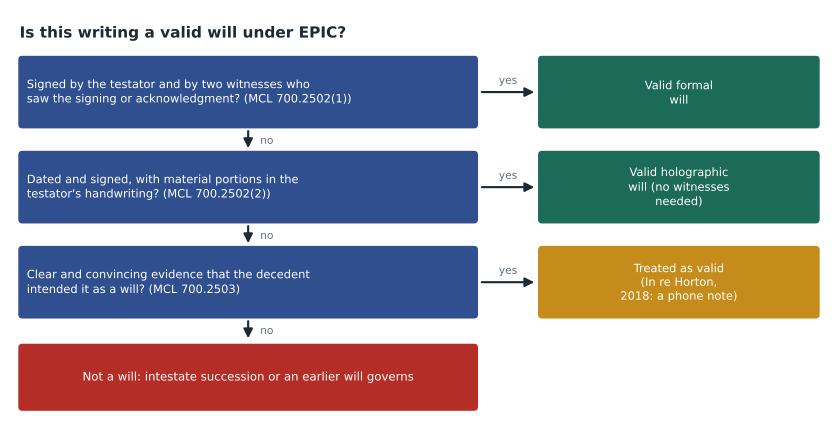
Will execution is the first area to know. Under MCL 700.2502(1), a will must be in writing, signed by the testator or by someone else in the testator's presence and at the testator's direction, and signed by at least two witnesses, each of whom signed within a reasonable time after witnessing the testator's signing or acknowledgment. Under MCL 700.2502(2), a holographic will is valid without witnesses if it is dated, signed by the testator at the end, and the material portions are in the testator's handwriting. The widow's kitchen-table will may well be valid as a holographic will, if it is dated and the material portions are in her husband's hand.
Michigan also adopted a harmless error rule. Under MCL 700.2503, a document that was not executed in compliance with section 2502 is treated as if it had been, if the proponent establishes by clear and convincing evidence that the decedent intended it to be the decedent's will. In In re Estate of Horton, decided by the Court of Appeals in 2018, the court applied that section to an unsigned, unwitnessed electronic note that the decedent had typed on his phone shortly before his death, and held that it could be admitted as his will because the evidence of intent was clear and convincing. The son in Holland may be able to use the same section for his mother's typed instructions, but the standard is demanding and the facts must be strong.
Intestate succession follows the general Uniform Probate Code model, with Michigan's own fractions. A surviving spouse takes the entire estate only if the decedent left no surviving descendants or parents. Otherwise the spouse takes a fixed dollar amount, adjusted for inflation each year, plus a fraction of the balance that depends on which relatives survive, and the rest passes to descendants or parents. Michigan's shares differ in places from the uniform act's, so a new lawyer should read MCL 700.2102 and the current inflation-adjusted figure rather than relying on the version studied in law school. A surviving spouse who is dissatisfied with a will can elect against it and take a statutory share instead. Michigan abolished dower in 2017, so the old widow's dower election no longer exists.
EPIC also contains Michigan's rules on advance planning documents. A Michigan durable power of attorney for financial matters must meet statutory signing requirements. A health care agent in Michigan is called a patient advocate, and the patient advocate designation under MCL 700.5506 and following has its own execution rules and takes effect only when the patient is unable to participate in medical treatment decisions, as determined by the attending physician and another physician or licensed psychologist. New estate planning lawyers in Michigan should use Michigan forms and terms rather than generic ones.
The Michigan Constitution and reproductive freedom
Michigan's current constitution was adopted in 1963, and it can be amended by legislative proposal or by citizen initiative approved by the voters. In November 2022, Michigan voters approved Proposal 3, which added Article I, Section 28, the right to reproductive freedom.
Section 28 provides that every individual has a fundamental right to reproductive freedom, which entails the right to make and effectuate decisions about all matters relating to pregnancy, including prenatal care, childbirth, postpartum care, contraception, sterilization, abortion care, miscarriage management and infertility care. The state may not deny, burden or infringe that right unless justified by a compelling state interest achieved by the least restrictive means, and a state interest is compelling only if it is for the limited purpose of protecting the health of an individual seeking care, consistent with accepted clinical standards and evidence-based medicine, and does not infringe on that individual's autonomous decision-making.
The state may regulate abortion after fetal viability, but it may never prohibit an abortion that, in the professional judgment of an attending health care professional, is medically indicated to protect the life or physical or mental health of the pregnant individual. The section also bars the state from penalizing anyone for aiding or assisting a pregnant individual in exercising the right with that individual's voluntary consent, and from prosecuting or penalizing an individual based on actual, potential, perceived or alleged pregnancy outcomes, including miscarriage, stillbirth or abortion.
For a new lawyer, Section 28 matters in two ways. It is a source of state constitutional rights that does not depend on federal law, a reminder that the Michigan Constitution can protect more than the United States Constitution does. And it has generated litigation over existing Michigan statutes that regulated abortion, so a lawyer advising a health care provider must check current case law and legislation rather than assume older statutes still apply.
Worked problem
Two probate files
Widow's file: her husband's will is entirely in his handwriting, signed at the end, but undated, and no one witnessed it. Son's file: his mother's typed laptop document lists who gets what, is titled 'My final wishes', and is unsigned. Can either be probated?
Show solution
- Widow's file: a holographic will under MCL 700.2502(2) must be dated, so this one does not qualify as holographic on its face. But MCL 700.2503 can save it if the proponent shows by clear and convincing evidence that he intended it as his will. A handwritten, signed document leaving property at death is strong evidence.
- Son's file: the typed document cannot be a formal or holographic will. Under MCL 700.2503 and Horton, it can be admitted if there is clear and convincing evidence that she intended it as her will, such as statements to family, its title, where it was kept, and whether it reads as a final disposition rather than a draft.
- In both files, gather evidence of intent early: witnesses to the decedent's statements, the circumstances of the document's creation, and any earlier wills.
Answer: Both documents fail the formalities of section 2502, and both may still be probated under section 2503 if the evidence of intent is clear and convincing.
Common mistakes
MistakeMichigan requires proof of fault for divorce.
InsteadMichigan is a no-fault state under MCL 552.6, although fault can matter in property division and support.
MistakeMichigan divides marital property equally.
InsteadMichigan divides marital property equitably under the Sparks factors.
MistakeA Michigan will must always have two witnesses.
InsteadA dated, signed holographic will needs no witnesses, and MCL 700.2503 can save a defective document on clear and convincing evidence.
MistakeA Michigan health care power of attorney takes effect when signed.
InsteadA patient advocate designation takes effect only when the patient cannot participate in medical treatment decisions, as determined under the statute.
MistakeMichigan's reproductive freedom provision is a statute.
InsteadIt is Article I, Section 28 of the Michigan Constitution, added by Proposal 3 in November 2022.
Summary and key terms
- Michigan grants no-fault divorce for a breakdown of the marriage relationship; residency is 180 days in the state and 10 days in the county; waiting periods are 60 days or six months with minor children.
- Marital property is divided equitably under the Sparks factors; spousal support has no formula, but child support follows the Michigan Child Support Formula.
- Custody turns on twelve best-interest factors, and changing an established custodial environment requires clear and convincing evidence.
- EPIC, effective April 1, 2000, governs wills and estates; MCL 700.2502 sets formal and holographic will rules, and MCL 700.2503 adopts harmless error by clear and convincing evidence (In re Horton, 2018).
- Michigan uses patient advocate designations for health care decisions and abolished dower in 2017.
- Article I, Section 28, added by Proposal 3 in 2022, protects a fundamental right to reproductive freedom subject to a strict compelling-interest test.
- 0
- breakdown of the marriage relationship
- 1
- established custodial environment
- 2
- Friend of the Court
- 3
- EPIC
- 4
- holographic will
- 5
- harmless error
- 6
- patient advocate
- 7
- Article I, Section 28
Practice problems
Work each problem on paper first, then reveal the answer to check.
A couple with two children files for divorce. When is the earliest the divorce can be granted?
Show answer
Six months after filing, unless the court shortens the period for unusual hardship.
What standard applies to admitting a document under MCL 700.2503?
Show answer
Clear and convincing evidence that the decedent intended the document to be the decedent's will.
What must a parent show before the court will revisit an existing custody order?
Show answer
Proper cause or a change of circumstances, and then, if an established custodial environment would change, clear and convincing evidence that the change is in the child's best interests.
What test does Article I, Section 28 apply to state restrictions on reproductive freedom?
Show answer
A compelling state interest achieved by the least restrictive means, with the compelling interest limited to protecting the health of the individual seeking care.
Lesson quiz · 5 questions
Score 60% or more to complete this lesson.
Create a free account to save your progress, take quizzes and earn a certificate.