
BAR-223 · Lesson 7 of 12 · 20 min
Michigan courts and the Michigan Court Rules
▶ Video coming soon A video version of this lesson is on the way.
In early November the firm's litigation partner handed Nolan a file and a sticky note. The file was a slip-and-fall claim against a grocery store in Kent County; the note said 'Summary disposition under (C)(10)? Draft the brief outline.' Nolan understood the idea, because it looked like a federal Rule 56 motion, but he did not know the Michigan vocabulary, the timing rules or which court the case was even in. 'I passed civil procedure,' he told Marchetti, 'but it was federal civil procedure. I feel like I have to learn a second language.'
'You do,' Marchetti said, 'but it is a dialect, not a new language. The Michigan Court Rules were modeled in many places on the federal rules, and the concepts carry over. The names, the numbering, the deadlines and a few important practices are Michigan's own. Remember that the MBE and MEE test the federal rules, so you keep federal procedure for February and learn the Michigan dialect for practice.'
This lesson covers the structure of the Michigan courts, the Michigan Court Rules and the features of Michigan civil procedure that a new lawyer meets first: pleadings and summary disposition, discovery and initial disclosures, case evaluation and offers of judgment, limitation periods and appeals.
The structure of the courts
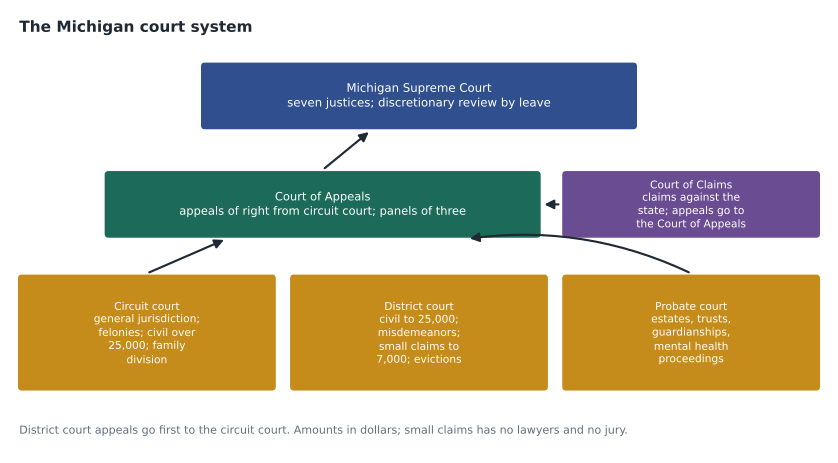
Michigan has a single, unified court system under the general superintending control of the Michigan Supreme Court. The Supreme Court has seven justices elected statewide for eight-year terms; candidates are nominated by party conventions but appear on the nonpartisan section of the ballot. The court hears most cases only by granting leave to appeal, and it also administers the court system and adopts the court rules.
The Court of Appeals is the intermediate appellate court. It hears appeals of right from final judgments of the circuit court and the Court of Claims, and appeals by leave from many other orders. It sits in panels of three judges. Most litigants get one appeal of right, to the Court of Appeals, and then must ask the Supreme Court for leave.
The circuit court is the trial court of general jurisdiction. It hears civil cases where the amount in controversy is more than 25,000 dollars, all felonies and high court misdemeanors, and equitable claims. Each circuit court has a family division, which handles divorce, custody, support, adoption, juvenile matters and personal protection orders. The circuit court also hears appeals from district court and from many administrative agencies.
The district court is the trial court of limited jurisdiction. It hears civil cases up to 25,000 dollars, landlord-tenant and land contract forfeiture cases, ordinary misdemeanors, civil infractions, and felony arraignments and preliminary examinations. Its small claims division handles claims up to 7,000 dollars, the limit since January 1, 2024. Small claims cases are informal: the parties give up the right to a lawyer, a jury and an appeal from a judge's decision (a magistrate's decision can be reviewed by a district judge), so a party who wants a lawyer or an appeal should have the case removed to the regular civil docket.
The probate court handles decedents' estates, trusts, guardianships, conservatorships and mental health commitment proceedings. The Court of Claims hears claims against the state and its agencies; since 2013 it has been part of the Court of Appeals, with Court of Appeals judges assigned to sit as Court of Claims judges, and its judgments are appealed to the Court of Appeals.
The Michigan Court Rules
The Michigan Court Rules, cited as MCR, are adopted by the Michigan Supreme Court. They are organized in chapters: chapter 1 contains general provisions, chapter 2 civil procedure, chapter 3 special proceedings and actions, chapter 4 district court rules, chapter 5 probate, chapter 6 criminal procedure, chapter 7 appellate rules, chapter 8 administrative rules of court and chapter 9 professional disciplinary proceedings. A rule number tells you the chapter: MCR 2.116 is a civil procedure rule, and MCR 7.204 is an appellate rule.
The court amends the rules regularly by administrative order, usually after publishing proposals for comment. A new lawyer should always use the current version from the court's website, and should check whether a recent amendment applies to a pending case, since amendments often apply to pending cases unless the order says otherwise. Michigan's evidence rules, the Michigan Rules of Evidence, are also adopted by the court; they track the Federal Rules of Evidence closely and were comprehensively restyled in 2024 to read more like the federal rules.
Pleadings and summary disposition
A Michigan civil action starts with a complaint and a summons. Michigan is a fact-pleading state in the sense that the complaint must state the facts on which the claim is based with enough specificity to inform the defendant of the claim, and the defendant answers each allegation. Affirmative defenses must be stated in the first responsive pleading or they may be waived.
Summary disposition under MCR 2.116 does the work of both a federal motion to dismiss and a federal summary judgment motion. The rule lists grounds by subrule letter, and Michigan lawyers refer to motions by those letters. Three are used constantly. A (C)(7) motion raises defenses such as immunity granted by law, the statute of limitations, release or prior judgment. A (C)(8) motion tests the legal sufficiency of the complaint on the pleadings alone, like a federal Rule 12(b)(6) motion. A (C)(10) motion argues that there is no genuine issue as to any material fact and the moving party is entitled to judgment as a matter of law, like a federal Rule 56 motion, and it must be supported by affidavits, depositions, admissions or other documentary evidence.
| MCR 2.116 ground | What it tests | What the court looks at |
|---|---|---|
| (C)(4) | Lack of subject-matter jurisdiction | Pleadings and evidence |
| (C)(7) | Immunity, limitations, release, prior judgment and similar bars | Pleadings and documentary evidence |
| (C)(8) | Failure to state a claim | Pleadings only, taking allegations as true |
| (C)(10) | No genuine issue of material fact | Affidavits, depositions, admissions and documents |
That answered the partner's sticky note. A (C)(10) motion in the grocery store case would argue that the evidence, viewed in the light most favorable to the plaintiff, shows no genuine dispute on an element such as notice of the hazard. Nolan's outline would need the deposition testimony and any surveillance footage as support, not just the pleadings.
Discovery and initial disclosures
Michigan overhauled its discovery rules in amendments effective January 1, 2020. The changes brought Michigan closer to federal practice. Parties must now make initial disclosures early in the case, including the factual basis of claims and defenses, the names of people likely to have discoverable information and a description of relevant documents, without waiting for a request. Discovery must be proportional to the needs of the case. The rules also address electronically stored information and set limits on the number of interrogatories.
In practice, the 2020 amendments mean that a Michigan litigator must gather information much earlier than under the old rules. A new associate assigned to a fresh case should calendar the initial disclosure deadline on day one.
Case evaluation and offers of judgment
For decades, Michigan was known for case evaluation under MCR 2.403: a panel of three lawyers heard short presentations and placed a value on the case, and a party who rejected the award and did no better at trial paid the other side's costs and attorney fees. Amendments effective January 1, 2022 changed that significantly. Case evaluation is now one of several alternative dispute resolution options rather than the default, and the sanctions for rejecting an award were eliminated. Parties who still use case evaluation face penalties for missing deadlines, and the panel must issue its award within seven days of the hearing.
Offers of judgment under MCR 2.405 remain. A party can make a written offer to stipulate to entry of a judgment; if the offer is rejected and the final verdict is less favorable to the rejecting party than the offer, after the adjustments the rule describes, the rejecting party may have to pay the offering party's costs. With case evaluation sanctions gone, offers of judgment have become a more important tool for putting settlement pressure on the other side.
Limitation periods
Michigan's general limitation periods are in the Revised Judicature Act. The general period for personal injury and property damage claims, including ordinary negligence, is three years. The period for breach of contract is generally six years. Medical malpractice has a two-year period with a discovery rule and a special notice requirement: before filing, a plaintiff must serve a notice of intent and wait the statutory period, generally 182 days, and the notice tolls the limitation period. No-fault benefit claims have their own rule, discussed in Lesson 8. A new lawyer should never rely on a remembered period; check the statute and its exceptions for each claim.
Appeals
An appeal of right to the Court of Appeals from a final circuit court judgment must generally be filed within 21 days after entry of the judgment or of an order deciding a timely post-judgment motion. Applications for leave to appeal in the Court of Appeals have their own time limits, and an application for leave to appeal to the Supreme Court is generally due within 42 days after the Court of Appeals decision. Missing an appellate deadline can be fatal to a client's case, so new lawyers should calendar it the day the judgment enters.
Worked problem
Which court, which motion, which deadline?
A client was injured in Grand Rapids in August 2024 when she tripped on a broken step at a privately owned store. Her damages are estimated at 60,000 dollars. When must she sue, where, and what early motion should the plaintiff expect?
Show solution
- Limitation period: ordinary negligence is three years, so suit must be filed by August 2027.
- Court: the amount in controversy is over 25,000 dollars, so the case belongs in circuit court, here the Kent County Circuit Court.
- Early motion: the defendant may move under MCR 2.116(C)(10) after discovery, arguing for example that the store lacked notice of the broken step; since Kandil-Elsayed v. F & E Oil (2023), the open and obvious character of a hazard goes to breach and comparative fault rather than duty, so it is a weaker ground for summary disposition than it once was. The plaintiff must answer with evidence, not allegations.
- Disclosures: both sides must make initial disclosures under the 2020 discovery rules.
Answer: Circuit court, filed within three years, with initial disclosures early and a (C)(10) motion likely after discovery.
Common mistakes
MistakeMichigan district courts hear civil claims of any size.
InsteadDistrict court civil jurisdiction is limited to 25,000 dollars; larger claims go to circuit court.
MistakeA (C)(8) motion can be decided on deposition testimony.
InsteadA (C)(8) motion is decided on the pleadings alone; evidence belongs in a (C)(10) motion.
MistakeA party who rejects a case evaluation award still pays sanctions if it does worse at trial.
InsteadCase evaluation sanctions were eliminated effective January 1, 2022.
MistakeThe Court of Claims is a separate trial court with its own appeals to the Supreme Court.
InsteadThe Court of Claims is part of the Court of Appeals, and its judgments are appealed to the Court of Appeals.
MistakeThe small claims limit is 3,000 dollars.
InsteadIt has been 7,000 dollars since January 1, 2024.
Venue, service and filing in practice
Three more practical points round out the Michigan civil litigation picture for a new associate. Venue in Michigan is governed by statute. For most tort actions, venue is proper in the county where the original injury occurred or where a defendant resides, has a place of business or conducts business, and the court rules let a party move for a change of venue when it was improper. Getting venue right matters because a successful venue motion costs the client time and money.
Service of process follows MCR 2.105, which allows personal delivery or registered or certified mail with restricted delivery, among other methods, and sets out special rules for corporations, partnerships and governmental bodies. A summons expires after a set period, generally 91 days after the complaint is filed, unless the court extends it, so an associate who files a complaint should calendar the summons expiration date along with the initial disclosure deadline.
Michigan courts have moved to electronic filing through the statewide e-filing system, and most courts now require lawyers to file electronically. Each court's local practices still matter, so new lawyers should read the local administrative orders and the judge's practice guidelines before filing anything significant.
Federal practice in Michigan
Michigan has two federal judicial districts, the Eastern District of Michigan, with its main courthouse in Detroit, and the Western District of Michigan, with its main courthouse in Grand Rapids, and appeals from both go to the United States Court of Appeals for the Sixth Circuit. Admission to the Michigan bar does not by itself admit a lawyer to practice in federal court; each district has its own admission procedure. Nolan's firm practices regularly in the Western District, so he planned to apply there soon after taking the oath. In federal court, of course, the Federal Rules of Civil Procedure and the Federal Rules of Evidence govern, which means the procedure he is studying for February will be immediately useful in that part of his practice.
Summary and key terms
- Michigan has a Supreme Court of seven elected justices, a Court of Appeals in three-judge panels, circuit, district and probate trial courts, and a Court of Claims within the Court of Appeals.
- District court hears civil claims up to 25,000 dollars and small claims up to 7,000 dollars; circuit court hears larger claims, felonies and family matters.
- The Michigan Court Rules are numbered by chapter; MCR 2.116 governs summary disposition, with (C)(7), (C)(8) and (C)(10) the most common grounds.
- Since January 1, 2020, Michigan requires initial disclosures and proportional discovery.
- Since January 1, 2022, case evaluation is voluntary and carries no rejection sanctions; offers of judgment under MCR 2.405 remain.
- Common limitation periods: three years for negligence, six for contract, two for medical malpractice with a notice of intent; appeals of right are due in 21 days.
- 0
- MCR
- 1
- circuit court
- 2
- district court
- 3
- Court of Claims
- 4
- summary disposition
- 5
- initial disclosures
- 6
- case evaluation
- 7
- offer of judgment
Practice problems
Work each problem on paper first, then reveal the answer to check.
Which MCR 2.116 ground would a defendant use to argue the statute of limitations has run?
Show answer
(C)(7).
A tenant is sued for possession by her landlord. Which court hears it?
Show answer
District court, which handles landlord-tenant summary proceedings.
What changed in Michigan case evaluation on January 1, 2022?
Show answer
It became voluntary, one of several ADR options, and the sanctions for rejecting an award were eliminated.
How long does a party have to file an appeal of right from a circuit court judgment?
Show answer
Generally 21 days after entry of the judgment or of the order deciding a timely post-judgment motion.
Lesson quiz · 5 questions
Score 60% or more to complete this lesson.
Create a free account to save your progress, take quizzes and earn a certificate.