
BAR-223 · Lesson 3 of 12 · 21 min
Character and fitness and the MPRE
▶ Video coming soon A video version of this lesson is on the way.
Nolan arrived at his third session with a printed copy of the Affidavit of Personal History from the State Bar's applicant portal, with two questions circled in red. 'The first one is about academic discipline,' he said. 'In my second year of college a group lab report I worked on was flagged for missing citations, and I got a written warning. Nothing went on my transcript. The second is about lawsuits. When I moved out of my apartment in Ann Arbor, the landlord kept my security deposit, I sued in small claims, and we settled in the hallway before the hearing. Do I really have to put either of those down?'
Marchetti did not hesitate. 'Yes, both, if the question covers them, and read the questions as broadly as they are written. Neither one is going to keep you out of practice. What could cause trouble is leaving them off and having the committee find them on its own. In every state I have worked with, the cover-up is treated as more serious than the event.'
This lesson covers Michigan's character and fitness process, which the State Bar of Michigan runs for the Board of Law Examiners, and the Multistate Professional Responsibility Examination, where Michigan requires a scaled score of 85.
Why character and fitness exists
Rule 1 of the Rules for the Board of Law Examiners requires every applicant to be of good moral character. The purpose is protective: clients hand lawyers their money, their secrets and their liberty, and courts rely on lawyers' statements. The question the committees ask is whether the applicant's past conduct suggests a risk to clients, courts or the public, and whether the applicant has shown rehabilitation where something went wrong.
The State Bar's materials stress one more point that candidates often miss. Political views and associations are not part of the inquiry. The committees look at conduct and candor, not beliefs. An applicant who has been active in politics, protest or advocacy of any kind has nothing to fear from the process on that ground alone.
The Michigan process, step by step
The process starts in the State Bar's applicant portal. The applicant completes the Affidavit of Personal History, a long questionnaire that covers residence and employment history, education, military service, criminal matters, civil litigation, financial obligations, licensing, and mental or physical conditions to the extent the questions ask about current conduct or impairment. Answers must be complete and accurate, and the affidavit is signed under oath.
Three supporting items follow. The applicant signs a Waiver and Release, which lets the State Bar obtain records from schools, employers, courts and agencies; the State Bar requires a wet signature on paper and asks for it within about two weeks of filing. The applicant has fingerprints taken through the Livescan process using the State Bar's form, so that criminal history checks can be run. And the applicant arranges references, usually five people who can speak to the applicant's character, or files the State Bar's reference waiver form where that option applies.
State Bar staff then review the file. Many files are complete and unremarkable, and staff recommend approval. Where a file raises a question, such as an unexplained gap, a criminal matter, significant financial problems or an inconsistency between the affidavit and the records, the file is referred to a District Committee. The District Committee interviews the applicant, usually with two or more lawyer members, and makes a recommendation. Difficult files go to the Standing Committee on Character and Fitness, which can hold a formal hearing. The Board of Law Examiners makes the final decision.
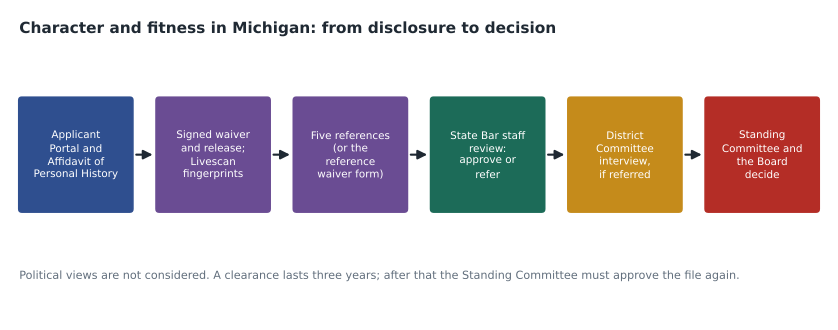
A favorable clearance does not last forever. Under Michigan practice a character and fitness clearance is good for three years. An applicant who is not admitted within that period, perhaps because of repeated exam attempts, must have the file recertified, which means updating the affidavit, paying the 300-dollar recertification fee under Rule 6 and receiving approval again from the Standing Committee. Questions go to the State Bar's character and fitness staff at the email address published on the State Bar's admissions pages.
What the committees look at
The committees are interested in conduct that bears on honesty, trustworthiness, diligence and respect for the law. Typical subjects include criminal matters, including arrests that did not lead to conviction if the questions ask about them; academic or employment discipline; civil suits, especially those involving fraud or unpaid debts; financial irresponsibility such as debts in collection, defaulted student loans or unfiled tax returns; prior bar or professional licensing problems; and conduct during the application process itself.
Two themes run through the decisions. The first is candor. An applicant who discloses a problem fully and explains it honestly is in a far better position than one whose problem is discovered by the investigator. Omission can itself become the reason for an unfavorable recommendation. The second is rehabilitation. The committees weigh how long ago the conduct occurred, the applicant's age at the time, whether it was a single event or a pattern, whether restitution was made, and what the applicant has done since.
| Factor | Helps the applicant | Hurts the applicant |
|---|---|---|
| Candor | Full disclosure, documents attached, consistent story | Omissions, minimizing, inconsistent explanations |
| Time | Conduct long ago, with a clean record since | Recent conduct or continuing problems |
| Pattern | A single incident | Repeated similar conduct |
| Responsibility | Acknowledges the conduct and what was learned | Blames others or the system |
| Restitution | Debts paid or on a plan; harm repaired | Ignored judgments or collections |
| Conduct since | Steady work, service, treatment where relevant | New incidents during the application |
Worked problem
Nolan's two disclosures
Nolan's college gave him a written warning for missing citations in a group lab report in 2019, and he settled a small claims suit with his former landlord over a security deposit in 2024. How should he handle each?
Show solution
- Read each question literally. If the academic discipline question asks about any warning or sanction, a written warning is covered even though it is not on his transcript.
- Describe the lab report briefly and factually: the course, the date, what happened, the outcome, and what he changed in his own practice afterward.
- Disclose the small claims suit under the civil litigation question even though he was the plaintiff and it settled. Give the court, the year and the outcome.
- Attach documents where he has them: the warning letter and a copy of the small claims filing or settlement.
- Make the explanations match exactly what the records will show, without adjectives or excuses.
Answer: Both disclosures are minor and complete. Neither should delay his clearance, and full disclosure removes the only real risk, which is a finding of lack of candor.
Updating the file
The affidavit speaks as of the date it is signed, but the obligation to keep it accurate continues until admission. A new traffic citation, an arrest, a lawsuit, a new job or a change of address all need to be reported promptly through the portal or by letter. Nolan's colleagues at the firm warned him about one common gap: a candidate who changes jobs after filing and forgets to update the employment history. The committees treat a late update far more kindly than a discovery.
Mental health questions deserve a word. Like most states, Michigan has revised its questions over the years to focus on current conduct and current impairment rather than on diagnosis or treatment history. Seeking counseling or treatment is not itself a reason for concern. Answer exactly the question asked, and if you are unsure what a question covers, ask the State Bar's staff before filing rather than guessing.
The MPRE
The Multistate Professional Responsibility Examination is a separate NCBE exam that tests the law governing lawyers: the ABA Model Rules of Professional Conduct, the ABA Model Code of Judicial Conduct, and controlling constitutional and procedural law. It is a two-hour computer-based exam of 60 multiple-choice questions, 50 of which are scored and 10 of which are being pretested. It is given at testing centers several times a year, usually in March, August and November.
Michigan requires a scaled score of at least 85. Scores are reported on a scale from 50 to 150. Michigan does not set a time limit on when the MPRE must have been taken, so a score earned early in law school remains good. That is one difference from some neighboring states, which require the MPRE within a fixed number of years of the bar exam or of admission.
The MPRE tests the Model Rules, not the Michigan Rules of Professional Conduct. For most questions the two give the same answer, but Lesson 10 shows several places where Michigan's rules differ, especially on confidentiality. On the MPRE, answer by the Model Rules. In Michigan practice, follow the Michigan rules.
For candidates who have not yet taken it, Marchetti recommends planning the MPRE at least one full testing window before the bar exam, so that a retake is possible without delaying admission. An MPRE taken in November that comes back short can be retaken in March, and the Board will accept a passing score earned after the bar exam, but a candidate cannot be admitted until it is in.
Common mistakes
MistakeA minor matter that is not on my record does not need to be disclosed.
InsteadIf the question covers it, disclose it. The committees care more about candor than about minor events.
MistakeA referral to a District Committee means I am likely to be denied.
InsteadA referral is common and is a chance to explain. Most referred applicants are approved.
MistakeCharacter and fitness clearance lasts until I am admitted, however long that takes.
InsteadA clearance lasts three years; after that the file must be recertified for a 300-dollar fee.
MistakeMichigan requires an MPRE of 80.
InsteadMichigan requires 85, with no time limit on the score.
MistakeThe MPRE tests the Michigan Rules of Professional Conduct.
InsteadThe MPRE tests the ABA Model Rules and related law; Michigan practice follows the Michigan rules.
Writing the explanations
Every disclosure on the Affidavit of Personal History needs a short written explanation. Marchetti teaches a four-part structure that works for almost any matter. First, the facts: what happened, when, where, and who was involved, stated plainly. Second, the outcome: the charge, the sanction, the judgment, or the settlement, with case numbers or document references. Third, responsibility: what the applicant did wrong, if anything, said without excuses and without self-punishment. Fourth, what has changed: what the applicant learned, what was repaid, and what the record has looked like since.
Length matters less than accuracy. A three-sentence explanation for a speeding ticket is fine. A serious matter, such as a criminal conviction or a large debt in default, may need a page and supporting documents. In every case the explanation should match the records exactly. An investigator who finds a court file saying the applicant was charged with retail fraud will notice if the applicant described it as a misunderstanding at a store.
Applicants sometimes worry that frank explanations will look bad. Marchetti's experience is the opposite. Committees read hundreds of files, and they recognize the difference between a candid account and a lawyerly one. The applicant who writes 'I was 19, I drank at a party, I drove, and I was arrested; I completed every condition of probation and have not had a drink and driven since' reads as trustworthy. The applicant who writes 'I was briefly detained following a misunderstanding about a traffic matter' reads as someone who will spin a client's facts.
The District Committee interview
If a file is referred, the applicant receives a letter asking for an interview with a District Committee, usually in the applicant's area. The interview is not a trial. Two or more lawyer volunteers ask about the matters in the file, and the applicant explains. Applicants may bring a lawyer, and some do for serious matters, but many attend alone for routine referrals.
Preparation is straightforward. Reread the affidavit and every explanation. Bring copies of supporting documents. Be ready to describe what happened and what has changed in the applicant's own words. Answer questions directly, and if the honest answer is 'I do not remember', say that rather than guessing. After the interview, the District Committee makes a recommendation. If it recommends against approval, the file goes to the Standing Committee, which can hold a formal hearing with testimony and counsel.
Financial responsibility
Debt is the most common reason Michigan files need extra attention, and it is also the easiest to address. Having student loans is not a problem; nearly every applicant has them. The committees look at whether obligations are being handled responsibly. A defaulted loan, a judgment that has been ignored, or a tax return that was never filed is a concern. The same debt on a written payment plan, with payments being made, usually is not.
An applicant with financial problems should act before filing if possible: contact creditors, set up payment plans, file overdue returns, and keep the paperwork. Then disclose everything and attach proof of the plan. Nolan's colleague at the firm, admitted two years earlier, had a credit card in collections during law school. She arranged a payment plan the month before filing, disclosed it with the plan attached, and was approved without an interview.
When a clearance must be recertified
Because a clearance lasts three years, recertification usually affects candidates who needed several attempts at the exam or who delayed admission for a job, a clerkship elsewhere, or family reasons. The process is shorter than the original investigation, but it is not automatic: the applicant updates the affidavit for everything since the original filing, pays the 300-dollar fee, and waits for the Standing Committee's approval. A candidate who expects to cross the three-year mark should start recertification early, so that a passing exam result is not left waiting for a character and fitness file.
Summary and key terms
- The State Bar of Michigan investigates character and fitness; the Board of Law Examiners decides.
- The file includes the Affidavit of Personal History, a wet-signed Waiver and Release, Livescan fingerprints and five references or the reference waiver form.
- Files are approved by staff or referred to a District Committee interview; the Standing Committee handles hard cases; political views are not considered.
- Candor and rehabilitation drive outcomes; an omission can be more serious than the conduct itself.
- Clearance lasts three years; recertification costs 300 dollars.
- Michigan requires an MPRE scaled score of 85, with no time limit on when it was earned.
- 0
- Affidavit of Personal History
- 1
- Waiver and Release
- 2
- Livescan
- 3
- District Committee
- 4
- Standing Committee on Character and Fitness
- 5
- recertification
- 6
- MPRE
Practice problems
Work each problem on paper first, then reveal the answer to check.
A candidate disclosed everything but changed jobs a month after filing. What should she do?
Show answer
Report the new employment promptly through the State Bar portal or by letter; the duty to update continues until admission.
What MPRE score does Michigan require, and does it expire?
Show answer
A scaled score of 85, and Michigan does not set a time limit on it.
Who makes the final character and fitness decision in Michigan?
Show answer
The Board of Law Examiners, after the State Bar's investigation and recommendation.
Name two factors a committee weighs when deciding whether an applicant is rehabilitated.
Show answer
Any two of: time since the conduct, age at the time, whether it was a pattern, restitution, acceptance of responsibility and conduct since.
Lesson quiz · 5 questions
Score 60% or more to complete this lesson.
Create a free account to save your progress, take quizzes and earn a certificate.