
BAR-223 · Lesson 6 of 12 · 21 min
Michigan Law Basics and how Michigan law appears
▶ Video coming soon A video version of this lesson is on the way.
Nolan opened his sixth session by admitting something. 'I thought Michigan Law Basics was a formality,' he said. 'A box to tick. Then a partner at the firm asked me to look at a client's no-fault claim and I realized I could not tell him whether the client's policy even had unlimited medical coverage, or what had changed in 2019. I did not learn that in law school, and the bar exam will not teach it to me either.'
Marchetti nodded. 'That is exactly why Michigan created the component. When the court adopted the UBE, the main objection was that new Michigan lawyers would no longer have to show they knew anything about Michigan law. The court's answer was a short required course, taken after graduation, that introduces the Michigan rules a new lawyer is most likely to meet. It will not make you an expert. It gives you a map, and the rest of this course will help you fill it in.'
This lesson explains the Michigan Law Component under Rule 3a: what it requires, how the ICLE course works, and when to take it. It then explains how Michigan law appears in a candidate's life now that the bar exam itself tests general law, and it introduces a few distinctive Michigan rules in criminal law and real property that the later lessons do not cover in depth.
The rule
Rule 3a of the Rules for the Board of Law Examiners requires every applicant for admission by examination, and every applicant transferring a UBE score under Rule 4a, to complete the Michigan Law Component. The Board satisfies the requirement through an online course called Michigan Law Basics, offered by the Institute of Continuing Legal Education, which is a joint project of the State Bar of Michigan and several Michigan law schools.
The rule has three features that matter in planning. First, the course must be completed after graduation from law school; work done as a student does not count. Second, the Board will not release an applicant's official UBE result until it has received the applicant's completion certificate. Third, the component is separate from the exam: it is not graded on a curve, it does not affect the UBE score, and it travels with the applicant's Michigan file, not with the score.
How the course works
Michigan Law Basics is a self-paced online course of six lessons. ICLE estimates the total time at about 12 hours. Each lesson combines reading, short video segments and examples, and each ends with two hurdle questions that the applicant must answer correctly to move on. Access lasts 60 days from enrollment, so an applicant should enroll only when ready to finish within that window. On completion, ICLE issues a certificate, and the applicant submits it to the Board as the Board's instructions direct.
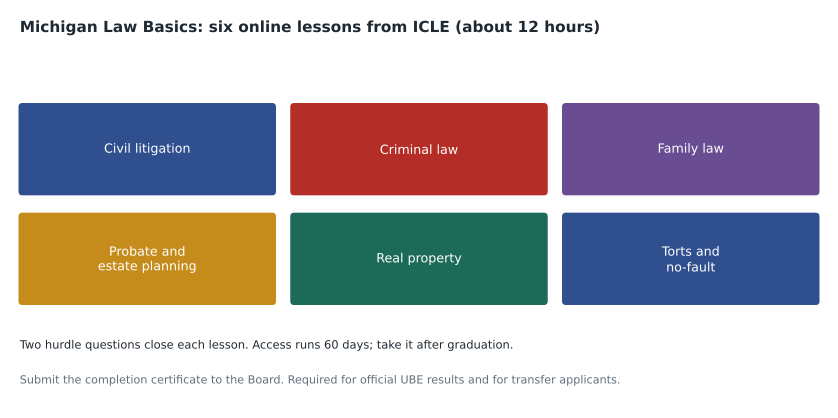
The six lessons are civil litigation, criminal law, family law, probate and estate planning, real property, and torts and no-fault. The choice is telling. These are the areas where a general practitioner or a new associate in a small firm is most likely to need Michigan rules in the first year, and several of them, especially no-fault, governmental immunity and probate, are areas where Michigan law differs sharply from the general principles tested on the bar exam.
| Lesson | Typical Michigan topics | Where this course covers it |
|---|---|---|
| Civil litigation | Court structure, Michigan Court Rules, summary disposition, case evaluation, limitation periods | Lesson 7 |
| Criminal law | Felony and misdemeanor classes, sentencing guidelines, district and circuit court roles | This lesson |
| Family law | No-fault divorce, custody best-interest factors, child support formula, Friend of the Court | Lesson 9 |
| Probate and estate planning | EPIC, will formalities and harmless error, intestacy, the Michigan Trust Code, patient advocates | Lesson 9 |
| Real property | Land contracts, recording, tax foreclosure and surplus proceeds | This lesson |
| Torts and no-fault | Comparative fault, damages caps, governmental immunity, no-fault after 2019 | Lesson 8 |
When to take it
Because access lasts 60 days and the course takes about 12 hours, timing is a matter of fitting it into the study calendar. Marchetti gives Michigan candidates two options. The first is to take it in a light week before the exam, such as the week between the end of the substantive review and the start of full simulated exams. The advantage is that the certificate is filed before results come out, so nothing delays the official result. The second is to take it in the days right after the exam, while results are pending. That keeps exam study free of Michigan material, but it requires discipline, because a candidate who puts it off until results arrive will delay admission.
Nolan chose the first option. He planned to enroll in early January, work through one lesson an evening during a lighter week, and file the certificate before the end of the month. 'It also gives me something useful to tell the partner about no-fault,' he said.
What candidates should not do is mix Michigan Law Basics material into their exam answers. The MEE asks for general principles. An MEE answer on a negligence question that applies Michigan's no-fault threshold or its modified comparative fault rule would apply the wrong law. Marchetti's two-notebook rule from Lesson 1 exists for exactly this reason.
How Michigan law appears now
Under the old exam, Michigan law appeared in the essay questions. Under the UBE, Michigan law appears in three other places. The first is Michigan Law Basics. The second is the affidavit of study required for UBE score transfer under Rule 4a, in which a transferring applicant affirms study of the Michigan Court Rules, the Michigan Rules of Professional Conduct and the Code of Judicial Conduct. The third, and by far the most important, is practice. Michigan law is the law a Michigan lawyer will use every day, and the first year of practice is where most of it is learned.
That is why Lessons 7 to 10 of this course focus on the Michigan law that matters most in early practice. They do not try to cover everything. They take the areas where Michigan rules are most distinctive and most likely to trip up a new lawyer trained on general principles: the court system and the court rules, torts and no-fault, family law and probate, and the Michigan Rules of Professional Conduct.
A few Michigan criminal law basics
Michigan criminal law is mostly statutory, collected in the Michigan Penal Code and other statutes, and the Michigan Code of Criminal Procedure governs procedure along with the court rules. Several features differ from the general law that the MBE tests.
The classification of offenses is the first. In Michigan, a felony is generally an offense punishable by imprisonment in state prison, and the Penal Code treats offenses punishable by more than one year as felonies. Misdemeanors are generally punishable by up to one year in jail. Michigan also has a distinctive middle category, the high court misdemeanor, which is punishable by up to two years and is treated as a felony for some purposes, such as habitual offender rules and court jurisdiction. Felonies and high court misdemeanors are tried in circuit court; ordinary misdemeanors are tried in district court, which also handles felony arraignments and preliminary examinations.
Sentencing is the second. Michigan has statutory sentencing guidelines that score offense and prior record variables to produce a recommended minimum sentence range. In People v. Lockridge, decided in 2015, the Michigan Supreme Court held that mandatory use of the guidelines violated the Sixth Amendment where judicial fact-finding increased the range, and it made the guidelines advisory. Judges must still score them and consider them, and a sentence outside the range is reviewed for reasonableness. Michigan also uses indeterminate sentencing: the judge sets the minimum term, and the statutory maximum generally sets the upper limit, with parole decided by the parole board.
A few Michigan real property basics
Two Michigan real property features stand out for new lawyers. The first is the land contract, an installment sale in which the seller keeps legal title until the buyer pays the price over time. Land contracts are common in Michigan, especially for buyers who cannot get conventional financing, and Michigan has its own forfeiture and foreclosure procedures for them. A buyer's equitable interest is real, and forfeiture proceedings run through district court with statutory notice and redemption periods.
The second is property tax foreclosure. Under the General Property Tax Act, counties foreclose on tax-delinquent property and sell it. In Rafaeli, LLC v. Oakland County, decided in 2020, the Michigan Supreme Court held that a county that sold foreclosed property for more than the taxes owed and kept the surplus took the former owner's property without just compensation under the Michigan Constitution. The legislature then amended the act to create a claims process for surplus proceeds. A new lawyer handling a tax foreclosure, on either side, needs to know that the former owner may have a claim to the surplus, and that the claims process has strict notice and filing deadlines.
Worked problem
A client question in the first month
Suppose that in March 2027, after passing the exam, Nolan is asked to meet a client who bought a house on a land contract in 2023 and has fallen two payments behind. The seller has sent a notice of forfeiture. What should Nolan know from Michigan Law Basics before the meeting?
Show solution
- The client has an equitable interest under the land contract, not just a lease, so she has more protection than a tenant.
- Michigan provides statutory forfeiture procedures for land contracts, with notice requirements and a period during which the buyer can cure the default.
- Forfeiture actions for land contracts are brought in district court under the summary proceedings statute.
- Before the meeting, Nolan should read the contract, the notice and the current statute, check the dates, and look at whether the client's payments to date affect the redemption period.
Answer: Michigan Law Basics gives Nolan the vocabulary and the map; the statute, the court rules and a supervising lawyer give him the details. That is exactly the role the component is meant to play.
Common mistakes
MistakeMichigan Law Basics can be completed during the last semester of law school.
InsteadRule 3a requires the course to be completed after graduation.
MistakeMichigan Law Basics is graded and affects the UBE score.
InsteadIt is a completion requirement with hurdle questions; it does not affect the score, but the official result waits for the certificate.
MistakeMichigan law should be used on the MEE because the exam is given in Michigan.
InsteadMEE answers are graded on general principles; Michigan rules belong in practice, not in UBE essays.
MistakeMichigan's sentencing guidelines are mandatory.
InsteadSince People v. Lockridge in 2015 they are advisory, although judges must still score and consider them.
Criminal procedure features a new lawyer meets early
Two more Michigan criminal features come up quickly in a general practice. The first is the preliminary examination. A defendant charged with a felony in Michigan is entitled to a preliminary examination in district court, generally within 14 days after arraignment, at which the prosecutor must show probable cause that a felony was committed and that the defendant committed it. Defendants may waive the examination, and many do as part of plea negotiations, but it is also a valuable discovery tool for the defense, because prosecution witnesses testify under oath and can be cross-examined. If the district court finds probable cause, the defendant is bound over to circuit court for trial.
The second is the set-aside of convictions. Michigan's Clean Slate legislation, enacted in 2020, expanded the number and types of convictions that can be set aside on application and created an automatic set-aside process for some older convictions. New lawyers in general practice see these applications often. They also matter in a quieter way to bar applicants: a set-aside conviction may still need to be disclosed if a character and fitness question asks about it, so read every question carefully and ask the State Bar's staff if the wording is unclear.
Studying Michigan Law Basics well
Because the course is a completion requirement rather than a graded test, some candidates click through it as quickly as possible. Marchetti encourages Michigan candidates to treat it instead as the first draft of their practice notebook. Her method is simple. For each of the six lessons, write one page of notes under three headings: the Michigan rule, how it differs from the general rule tested on the bar exam, and where to find the current text, such as a statute section, a court rule or a leading case. Keep those six pages separate from bar study materials, and add to them during the first year of practice.
That method pays off in two ways. During the exam season, it keeps Michigan law out of UBE answers, because every Michigan rule is written down in the context of how it differs from the general rule. After admission, it gives a new lawyer a quick reference for the questions that come up most often, such as which court hears a case, what limitation period applies, whether a no-fault policy has unlimited medical benefits, or whether an unwitnessed document can be probated as a will.
Nolan's colleagues at the firm had another suggestion: ask a supervising lawyer for one real file in each area and read it alongside the matching lesson. A no-fault claim file, a probate inventory, a land contract forfeiture and a district court misdemeanor file together cover most of what the course introduces, and seeing the rules applied in real documents makes them stick.
When Michigan law and the exam collide
A few topics are especially easy to confuse. Comparative fault is the clearest example: the MEE generally expects candidates to identify pure comparative fault, modified comparative fault and contributory negligence as the main approaches and to apply the approach the question specifies or, if none, to discuss the majority approaches, while Michigan's own rule bars noneconomic damages only when the plaintiff's fault exceeds everyone else's combined. Another example is will execution: the MEE tests the traditional formalities and the Uniform Probate Code's harmless error rule as general law, while Michigan has adopted its own version of harmless error in EPIC. In each case, answer the exam question with the rule the question calls for, and save the Michigan rule for practice.
Summary and key terms
- Rule 3a requires the Michigan Law Component for applicants by examination and by UBE score transfer.
- ICLE's Michigan Law Basics is a self-paced online course of six lessons, about 12 hours, with two hurdle questions per lesson and 60 days of access.
- The course must be completed after graduation, and the official UBE result is not released until the Board has the certificate.
- Michigan law now reaches candidates through Michigan Law Basics, the Rule 4a affidavit of study and practice, not through the exam.
- Michigan has a high court misdemeanor category; its sentencing guidelines are advisory after Lockridge.
- Land contracts and tax foreclosure surplus claims after Rafaeli are distinctive Michigan property topics.
- 0
- Michigan Law Component
- 1
- Michigan Law Basics
- 2
- hurdle question
- 3
- high court misdemeanor
- 4
- advisory guidelines
- 5
- land contract
- 6
- surplus proceeds
Practice problems
Work each problem on paper first, then reveal the answer to check.
How long does an applicant have to finish Michigan Law Basics after enrolling?
Show answer
60 days of access.
Which applicants must complete the Michigan Law Component?
Show answer
Applicants for admission by examination and applicants transferring a UBE score under Rule 4a.
What did Rafaeli, LLC v. Oakland County decide?
Show answer
That a county taking and keeping the surplus from a tax foreclosure sale, beyond the taxes owed, took property without just compensation under the Michigan Constitution.
In which Michigan court is an ordinary misdemeanor tried?
Show answer
District court.
Lesson quiz · 5 questions
Score 60% or more to complete this lesson.
Create a free account to save your progress, take quizzes and earn a certificate.