
BAR-223 · Lesson 12 of 12 · 20 min
Capstone: Michigan practice questions and an exam-day plan
▶ Video coming soon A video version of this lesson is on the way.
Nolan's last session in the course came on a cold evening in mid-November, with the first lake-effect snow of the season falling on Grand Rapids. His application was in, his character and fitness file had been acknowledged, his MPRE score was long settled, and Michigan Law Basics was on the calendar for January. 'I have all the pieces,' he told Marchetti. 'What I need now is a plan that puts them in order, and some practice that tells me whether I can actually do this under time.'
'Then that is today,' Marchetti said. 'Three parts. First, a twelve-week plan to February 23 that is weighted the way the UBE is scored. Second, a set of original practice questions: some in the style of the exam, which tests general law, and some on the Michigan rules you will use in practice, so that you can see the difference clearly. Third, exam week, down to the hour, including the things that go wrong in February in Michigan.'
A twelve-week plan
Lesson 4 showed that the MBE and the written portion each count for half of the UBE total. A good plan gives both halves serious time and shifts the balance toward the weaker half. Nolan's diagnostic put him at about 136 on the MBE and 128 on the written portion, so his plan puts slightly more weight on writing, especially in the second half.
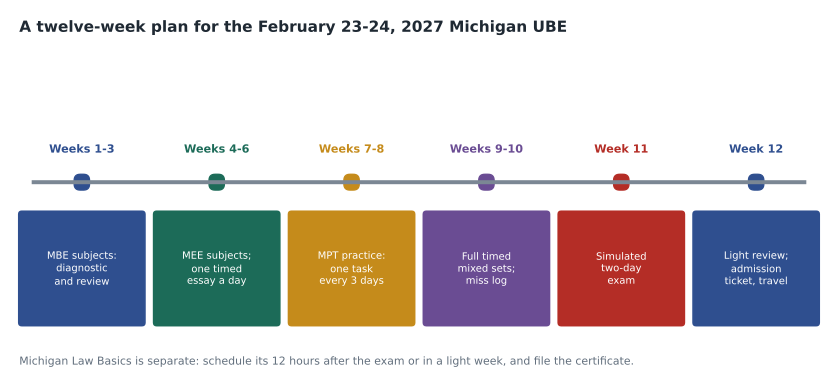
| Weeks | Main focus | Daily practice | Checkpoint |
|---|---|---|---|
| 1 to 3 | MBE subjects: diagnostic, then targeted review of the weakest three | 34 timed MBE questions; miss log | 100-question timed set at the end of week 3 |
| 4 to 6 | MEE-only subjects: business associations, family law, trusts and estates, conflict of laws, secured transactions | One timed essay; 25 MBE questions | Six essays in three hours |
| 7 to 8 | MPT: task types and time control | One full MPT every third day; essays on other days | Two MPTs back to back |
| 9 to 10 | Mixed review | Mixed MBE sets; one essay and one MPT section each day | Full written day under exam timing |
| 11 | Simulated two-day exam | Tuesday written day, Wednesday MBE day | Score and review every component |
| 12 | Light review and logistics | Outlines and miss log only | Rest before Tuesday |
Michigan Law Basics sits outside the plan. Nolan scheduled it for a lighter week in January, one lesson each evening, so that the certificate is filed before results come out. He keeps it out of his exam study by writing its notes in his separate Michigan notebook.
How to use the practice questions
The questions below are original. They are not released bar exam questions, and they are written to practice two different things. The first group is in the style of the UBE and tests general principles, the law the exam rewards. The second group tests the Michigan rules from Lessons 7 to 11, the law Nolan will use at the firm. After each group comes the analysis a grader or supervising lawyer would look for. Answer each question before reading the analysis, and time yourself: about 1.8 minutes for each multiple-choice question and 30 minutes for the essay.
Group one: exam-style questions on general law
Question 1. A driver ran a red light and struck a pedestrian who was crossing against a 'Don't Walk' signal while looking at her phone. A jury finds the driver 60 percent at fault and the pedestrian 40 percent at fault, with damages of 100,000 dollars. The jurisdiction follows modified comparative negligence with a 50 percent bar. How much does the pedestrian recover? Answer: 60,000 dollars. Under modified comparative negligence with a 50 percent bar, a plaintiff recovers reduced damages if her fault is no greater than the defendant's; at 40 percent she recovers 60 percent of her damages. Note what the question did: it told you the rule. Michigan's split treatment of economic and noneconomic damages is irrelevant on the exam.
Question 2. A testator signed a typed will in the presence of one witness, who signed it. The jurisdiction requires two witnesses but has adopted the Uniform Probate Code's harmless error provision. The testator's sister challenges the will. What is the best argument for the will's proponent? Answer: that there is clear and convincing evidence the testator intended the document to be his will, so the harmless error provision treats it as validly executed. That is the general UPC rule; it happens to match Michigan's MCL 700.2503, but on the exam you would cite the general rule, not Michigan's statute.
Question 3. A plaintiff sues in federal court on a state-law claim, invoking diversity jurisdiction. The defendant moves to dismiss for failure to state a claim. Which rule governs the motion, and what does the court consider? Answer: Federal Rule of Civil Procedure 12(b)(6); the court considers the complaint's factual allegations, accepted as true, and asks whether they state a plausible claim. In Michigan state court the counterpart is MCR 2.116(C)(8), but the MBE tests the federal rule.
Question 4. A lawyer learns that her client intends to commit a burglary of a neighbor's empty vacation home next week. Under the ABA Model Rules, may she reveal that information to prevent the crime? Answer: generally no, unless an exception applies. The Model Rules permit disclosure to prevent reasonably certain death or substantial bodily harm and to prevent certain crimes or frauds involving substantial financial injury in which the lawyer's services were used; a burglary of an empty house in which the lawyer's services were not used fits neither. The MPRE tests that answer. Under Michigan's MRPC 1.6(c)(4), by contrast, she may reveal the client's intention to commit a crime and the information necessary to prevent it.
Group two: Michigan practice questions
Question 5. Nolan's client was injured in a crash in October 2026 and has a Michigan auto policy with a 250,000-dollar PIP medical limit. Her medical bills reach 300,000 dollars. Who pays the excess, and can she sue the at-fault driver? Analysis: her insurer pays allowable expenses up to the 250,000-dollar limit, under the fee schedule. For the excess, she may sue the at-fault driver for economic losses beyond the PIP limit, and for noneconomic damages only if her injury meets the threshold of death, serious impairment of body function or permanent serious disfigurement. Andary does not apply, because she was injured after June 11, 2019.
Question 6. A cyclist was injured on October 3, 2026 when her wheel caught in a deep pothole on a county road. On February 10, 2027 she consults Nolan's firm. What is the first concern? Analysis: the highway exception to governmental immunity requires written notice to the road agency within 120 days of the injury, which ends on January 31, 2027. Unless notice was already given, the claim may be barred. The firm must find out at once whether she or anyone on her behalf gave notice that met the statutory requirements.
Question 7. A shopper slips on a spilled liquid in a store aisle. The store moves for summary disposition under MCR 2.116(C)(10), arguing that the spill was open and obvious. What is the likely result? Analysis: after Kandil-Elsayed v. F & E Oil (2023), the open and obvious character of a hazard does not negate the store's duty of reasonable care; it bears on breach and on the shopper's comparative fault, which are usually questions for the jury. The motion is unlikely to succeed on that ground alone.
Question 8. A client wants Nolan's firm to handle her personal injury case for 40 percent of any recovery. May the firm agree? Analysis: no. MCR 8.121 caps contingent fees in personal injury cases at one-third of the amount recovered, computed after litigation expenses, and treats a higher fee as clearly excessive. The agreement must also be in writing under MRPC 1.5(c).
Question 9. A lawyer who passed the UBE in Minnesota in July 2024 with a 269 is moving to Lansing. Can she transfer her score? Analysis: yes, if she applies within three years of the July 2024 exam. Her 269 meets Michigan's 268. She also needs an MPRE of 85, Michigan Law Basics, the affidavit of study, character and fitness clearance and the 400-dollar fee.
The essay: a timed MEE-style practice question
Write this one in 30 minutes. A homeowner hired a contractor under a written contract to renovate her kitchen for 40,000 dollars, with completion due by June 1. The contractor stopped work on May 1 after completing about half the job, saying a better-paying project had come along. The homeowner hired a second contractor, who finished the work for 28,000 dollars, completing it on July 15. During the delay the homeowner ate out and spent 3,000 dollars on restaurant meals. She had paid the first contractor 15,000 dollars before he left. (1) What claim does the homeowner have against the first contractor, and what damages can she recover? (2) Can the first contractor recover anything for the work he completed?
A strong answer has two headed parts. On part one, the contractor's unjustified abandonment of the job is a material breach, indeed a repudiation of the rest of the contract. The homeowner's expectation damages are the cost to complete beyond the unpaid contract price: she would have paid 40,000 dollars in total, she paid 15,000 dollars, so 25,000 dollars remained; completion cost 28,000 dollars, so her direct damages are 3,000 dollars. The restaurant meals are consequential damages and are recoverable only if they were foreseeable as a probable result of the breach at the time of contracting and are proved with reasonable certainty; a kitchen renovation makes some added food expense foreseeable, but a court may limit the recovery to the reasonable added cost over what she would have spent cooking at home. She also had a duty to mitigate, which she met by hiring a replacement promptly.
On part two, a breaching party generally cannot recover on the contract, but many courts allow a party who has conferred a benefit to recover in restitution, measured by the benefit to the other party, less the damages caused by the breach, and capped by the contract rate. Here the homeowner received half a kitchen. Because she has paid 15,000 dollars and her damages are at least 3,000 dollars, the contractor's restitution claim depends on whether the value of the work exceeded 18,000 dollars; a willful breach may also lead some courts to deny restitution entirely. A grader rewards the statement of both views and a conclusion.
Look at what the answer leaves out. It does not cite Michigan statutes or Michigan cases, because the MEE is graded on general principles. It uses headings that track the call, states each rule, applies it to the facts with numbers, and concludes.
Exam week
The exam days are Tuesday, February 23 and Wednesday, February 24, 2027. Marchetti plans exam week backward from the reporting time on Tuesday morning.
| When | What to do |
|---|---|
| Thursday before | Confirm the test-site address and reporting time in the Board's instructions; confirm the laptop software is registered and the mock exam is uploaded |
| Friday | Last full review day; stop new material by evening |
| Saturday | Light review of outlines and miss log; pack the bag: admission ticket, identification, permitted items, medication, a warm layer |
| Sunday | Rest; short walk; no practice tests |
| Monday | Travel to the test-site area; check the weather and the route at the actual reporting time; early night |
| Tuesday | MPT morning, MEE afternoon; eat lunch away from other candidates; do not discuss answers |
| Wednesday | MBE day; pace at about 1.8 minutes a question; mark and move on |
| After | File the Michigan Law Basics certificate if not already done; update the character and fitness file for any changes |
Two Michigan-specific warnings belong on the list. The first is weather. Late February in Michigan can bring heavy snow and icy roads, and a candidate who drives from Bay City or the Upper Peninsula on the morning of the exam is taking a risk. Stay near the site the night before, and check the forecast on Sunday so that travel plans can change. The second is the certificate. The Board will not release an official result without the Michigan Law Basics certificate, so a candidate who has not filed it before the exam should do so in the first week after.
Worked problem
Nolan's final checklist
In the last session, Marchetti asks Nolan to read his checklist aloud.
Show solution
- Application filed in October 2026, before the November 1 deadline: done.
- Character and fitness: portal affidavit, wet-signed waiver, Livescan fingerprints and five references in; disclosures of the 2019 academic warning and the 2024 small claims settlement made with documents.
- MPRE 91, above Michigan's 85: done.
- Michigan Law Basics: one lesson an evening in the third week of January; certificate to the Board by the end of the month.
- Study plan: twelve weeks, written-heavy, simulated exam in week eleven.
- Exam week: hotel near the site for Monday and Tuesday nights; route checked; laptop software tested.
Answer: Every track is either complete or scheduled. What remains is the work itself.
Marchetti closed the course the way she closes every course. 'You know the process, you know where the points are, and you know which law belongs on the exam and which belongs at the firm,' she said. 'Now do the work, one day at a time, and walk in on February 23 knowing you prepared for exactly this exam.'
Common mistakes
MistakeUsing Michigan statutes in MEE answers shows extra knowledge.
InsteadMEE answers are graded on general principles; Michigan rules can cost points if they replace the rule the question calls for.
MistakeThe last week should be the hardest week of study.
InsteadThe last week is for light review, logistics and rest.
MistakeMichigan Law Basics can wait until results arrive.
InsteadThe official result is held until the certificate is filed; finish it before or right after the exam.
MistakePractice essays are useful even if untimed.
InsteadTimed practice, compared against a list of issues, is what builds exam performance.
Summary and key terms
- Weight the twelve-week plan by the score: the MBE and the written portion are each half; shift time toward the weaker half.
- Practice general law for the exam and Michigan law for practice, and keep the two in separate notebooks.
- On the MEE, use headings that track the call, state rules, apply them with the facts and conclude.
- Michigan practice questions turn on no-fault thresholds and PIP limits, highway defect notice, Kandil-Elsayed, MCR 8.121 and Rule 4a transfer.
- Exam days are February 23 and 24, 2027; plan for winter travel and file the Michigan Law Basics certificate.
- 0
- diagnostic
- 1
- miss log
- 2
- expectation damages
- 3
- mitigation
- 4
- restitution
- 5
- simulated exam
Practice problems
Work each problem on paper first, then reveal the answer to check.
On the MEE, a negligence question does not specify a comparative fault rule. Should you apply Michigan's rule?
Show answer
No. Discuss the general approaches the question calls for, such as pure and modified comparative negligence, not Michigan's statute.
A client injured on a city sidewalk on December 1, 2026 calls in May 2027. What Michigan deadline is the first concern?
Show answer
The governmental immunity act's 120-day notice requirement, which would have run in late March 2027 for a highway-exception claim.
What is the maximum contingent fee percentage in a Michigan personal injury case?
Show answer
One-third of the net recovery under MCR 8.121.
What two things should a Michigan candidate do in the first week after the exam if not already done?
Show answer
File the Michigan Law Basics certificate and update the character and fitness file for any changes.
Lesson quiz · 5 questions
Score 60% or more to complete this lesson.
Create a free account to save your progress, take quizzes and earn a certificate.