
BAR-223 · Lesson 11 of 12 · 20 min
Score transfer, admission without examination and practice after admission
▶ Video coming soon A video version of this lesson is on the way.
Two people in Nolan's life raised the same question in the same week. His roommate, the Ohio law graduate, wondered whether he could sit the UBE in Ohio and move his score to Michigan later. And a lawyer at the firm, licensed in Illinois for eight years, had just moved to Grand Rapids with her family and wanted to know whether she had to take the bar exam again. 'I told them both I would ask you,' Nolan said to Marchetti. 'I think the answers are different.'
'They are,' Marchetti said. 'Your roommate needs the transfer rule. Your colleague needs admission without examination. And both of them, like you, need to know what Michigan expects of lawyers after admission, which is a short list, because Michigan is unusual: no continuing legal education requirement at all.'
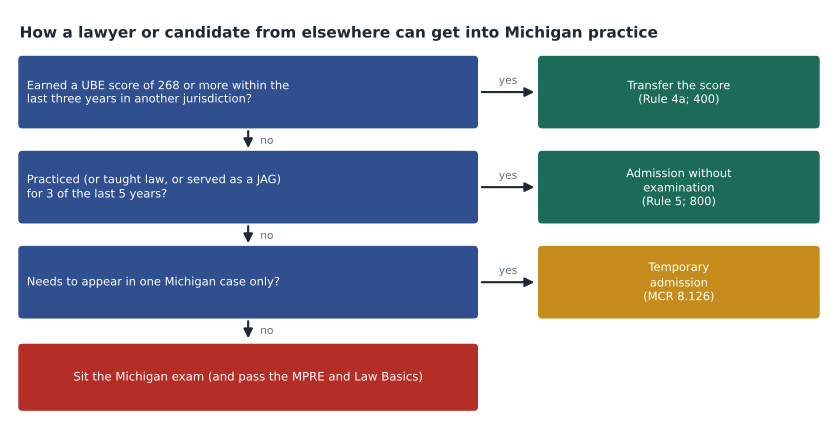
This lesson covers transfer of a Uniform Bar Examination score under Rule 4a, admission without examination under Rule 5, the narrower routes for out-of-state lawyers, and the obligations that begin on the day of admission.
Transferring a UBE score under Rule 4a
A UBE score earned in any UBE jurisdiction can be transferred to Michigan if it meets Michigan's requirements. Rule 4a of the Rules for the Board of Law Examiners sets them out. The score must be at least Michigan's passing score of 268, and it must have been earned in an exam taken no more than three years before the application. The applicant must also have an MPRE scaled score of at least 85, complete the Michigan Law Component, and file an affidavit stating that the applicant has studied the Michigan Court Rules, the Michigan Rules of Professional Conduct and the Michigan Code of Judicial Conduct. The transfer fee is 400 dollars, and the applicant must clear character and fitness through the State Bar like any other applicant and take the oath within three years.
Three practical points follow. First, the 268 threshold is strict. A candidate who passed with a 266 in a jurisdiction where 266 passes cannot transfer that score to Michigan. Second, the three-year clock runs from the exam date, so a transfer applicant should file well before the deadline to allow time for character and fitness. Third, transfer is not available for a score earned in Michigan itself, because a Michigan score is already a Michigan result; a Michigan candidate whose clearance or other requirements lapse deals with the Board under the regular rules.
For Nolan's roommate, the answer is yes, with conditions. If he sits the UBE in Ohio and earns at least 268, he can transfer the score to Michigan within three years by applying under Rule 4a, finishing Michigan Law Basics, filing the affidavit of study and clearing character and fitness. If he scores between Ohio's passing score and 268, he will be admitted in Ohio but cannot transfer to Michigan.
Transferring a Michigan score out
The reverse question matters to Michigan candidates who may move. A Michigan UBE score can be transferred to other UBE jurisdictions under their rules. Each jurisdiction sets its own time limit, often between two and five years, its own minimum score and its own local requirements, such as a local law course or exam. Michigan's 268 is near the top of the range of passing scores, so a Michigan passing score meets the minimum in most UBE jurisdictions. Candidates should check NCBE's transfer charts and the target jurisdiction's own rules before relying on a transfer.
Admission without examination under Rule 5
Rule 5 is the route for experienced lawyers. An applicant licensed in another jurisdiction may be admitted without examination if the applicant has been actively engaged in the practice of law, as a full-time teacher of law at a qualifying law school, or as a judge advocate in the armed forces, for at least three of the five years immediately before applying. The applicant must hold a J.D. from an ABA-approved law school, must be in good standing wherever licensed, must meet Michigan's character and fitness requirements, and must intend to practice in Michigan. The fee is 800 dollars plus the NCBE character report fee.
The practice requirement is the heart of the rule. The Board looks at whether the applicant's work was the practice of law under the law of the place where it was done, whether it was substantial and continuous, and whether the applicant was licensed where the practice took place. Part-time practice, practice without a license, or work that did not involve legal services may not count. Applicants should describe their practice history carefully and attach supporting letters from employers or colleagues.
For the Illinois lawyer at Nolan's firm, the answer is likely yes. With eight years of active practice in Illinois, she easily meets the three-of-five-years requirement. She applies under Rule 5, pays 800 dollars plus the NCBE fee, completes the character and fitness process, and takes the oath. She does not sit the exam.
| Route | Key requirement | Fee in dollars | Michigan Law Basics? |
|---|---|---|---|
| UBE transfer (Rule 4a) | Score of 268 or more, no more than three years old | 400 | Yes |
| Admission without examination (Rule 5) | Three of the last five years in practice, teaching or JAG service | 800 plus NCBE fee | Check current rule |
| Temporary admission (MCR 8.126) | Licensed elsewhere; associated with a Michigan lawyer; court permission | Set by the court rule | No |
| Special legal consultant (Rule 5) | Lawyer from another country advising on that country's law | Set by the Board | No |
Narrower routes
Several narrower routes let lawyers from elsewhere do limited work in Michigan without a full license. Temporary admission under MCR 8.126, often called pro hac vice, lets a lawyer licensed in another United States jurisdiction appear in a specific Michigan case, on motion, when associated with an active member of the State Bar of Michigan who appears as counsel of record. The rule limits how often a lawyer may use it, requires a fee paid to the State Bar and requires disclosure of other recent temporary admissions. It is not a license and covers only the case in which it is granted.
Rule 5 also provides for special certificates in limited situations and for special legal consultants, who are lawyers admitted in another country and may advise in Michigan on the law of that country without being admitted to practice Michigan law. Michigan's version of MRPC 5.5 permits some temporary practice by out-of-state lawyers in limited circumstances, such as work related to a matter pending elsewhere. Lawyers who rely on any of these routes should read the current rules closely, because they are narrow and the consequences of unauthorized practice are serious.
The day of admission
Once the Board certifies an applicant, the applicant takes the oath of office, usually at a ceremony held by a court. The oath includes a promise to support the Constitution of the United States and the Constitution of the State of Michigan and to conduct oneself as an attorney with fidelity to the courts and to clients. After the oath, the new lawyer is enrolled as an active member of the State Bar of Michigan and receives a State Bar number, which appears on every court filing.
Michigan has a unified bar. Every lawyer licensed in Michigan must be a member of the State Bar of Michigan and pay annual dues, which fund the State Bar's work and the discipline system. Lawyers who are not practicing can choose inactive status, which carries lower dues but does not allow practice. Lawyers must keep their contact information current with the State Bar, because official notices, including discipline notices, go to the address on file.
No mandatory continuing legal education
Here Michigan stands almost alone. Michigan does not require lawyers to complete continuing legal education. There is no annual or multi-year hour requirement, no ethics hour requirement and no new-lawyer course requirement. The State Bar has studied mandatory CLE over the years, and the court has considered proposals, but as of November 2026 no requirement is in effect. The Michigan Supreme Court's April 2026 order in a State Bar matter, effective October 1, 2026, dealt with the State Bar's Representative Assembly and did not create a CLE requirement. Judges, by contrast, are subject to continuing judicial education requirements set by the Supreme Court.
Nolan was surprised. 'So I never have to take another course?' he asked. 'You never have to,' Marchetti said. 'But you will. Your competence duty under MRPC 1.1 does not go away just because nobody counts hours. ICLE, the State Bar sections and the local bar associations run programs year round, and the lawyers who do well in Michigan use them. And if you are ever admitted somewhere else, that jurisdiction's CLE rules will apply to you there.'
Worked problem
A lawyer moving to Michigan
Nolan's former law school classmate Ivo passed the UBE in Colorado in July 2024 with a 272 and has practiced in Denver since. In November 2026 he takes a job in Detroit. Which Michigan route should he use?
Show solution
- Transfer: his score of 272 exceeds 268, and July 2024 is within three years of November 2026, so Rule 4a is open until July 2027. He would also need the MPRE 85, Michigan Law Basics and the affidavit of study.
- Admission without examination: he has been in practice since late 2024, about two years, which is short of three of the last five years. Rule 5 is not yet available.
- Timing: he should file under Rule 4a promptly, because the three-year window closes in July 2027 and character and fitness takes months.
- Until admitted, he cannot practice Michigan law, though temporary admission might cover a single case with a Michigan lawyer.
Answer: Ivo should transfer his score under Rule 4a now, before the three-year window closes.
Common mistakes
MistakeAny passing UBE score from another state transfers to Michigan.
InsteadThe score must be at least 268 and no more than three years old.
MistakeTransfer applicants do not need Michigan Law Basics.
InsteadRule 3a and Rule 4a require transfer applicants to complete the Michigan Law Component.
MistakeAdmission without examination requires five years of practice.
InsteadRule 5 requires three of the five years immediately before applying.
MistakePro hac vice admission lets a lawyer practice in Michigan generally.
InsteadTemporary admission under MCR 8.126 covers one case, with a Michigan lawyer as counsel of record.
MistakeMichigan lawyers must complete CLE hours each year.
InsteadMichigan has no mandatory CLE for lawyers; only judges have continuing education requirements.
A first-year checklist for a new Michigan lawyer
Marchetti ended the session with the checklist she gives every Michigan candidate who passes, so that the first months of practice do not produce avoidable problems. It has six items.
The first is the State Bar record. Pay dues on time every year, because a lawyer who does not pay dues can be suspended from practice until the dues and any late charges are paid, and practicing while suspended is itself misconduct. Keep the address, email and firm information on file current, because official notices go there.
The second is federal court admission. Admission to the Michigan bar does not admit a lawyer to the federal courts. A lawyer who expects to practice in the Eastern or Western District of Michigan, or in the Sixth Circuit, applies separately under each court's rules.
The third is trust accounting. A lawyer who will hold client funds, even occasionally, needs a trust account at a financial institution approved by the State Bar, a ledger for each client and a monthly reconciliation. Lesson 10 explains why: overdraft reports go straight to the Grievance Administrator.
The fourth is a supervising lawyer. Michigan does not require a formal mentoring program for new lawyers, but the State Bar and many local bar associations offer mentoring and new-lawyer programs. A new lawyer in a small firm or solo practice should find an experienced lawyer to call with questions, and the ethics helpline is available for professional conduct questions.
The fifth is wellbeing. The State Bar runs a Lawyers and Judges Assistance Program that offers confidential help with stress, substance use and mental health concerns. New lawyers often carry heavy workloads and student debt at the same time, and early support is far better than a crisis later.
The sixth is competence without CLE hours. Because Michigan sets no hour requirement, it is easy to let learning slide. Marchetti suggests a simple target: one substantive program in each main practice area each year, chosen from ICLE, State Bar sections or local bar associations, and a habit of reading the Michigan Supreme Court's significant opinions as they come out. Kandil-Elsayed and Andary, both decided in 2023, changed daily practice for Michigan tort lawyers; a lawyer who missed them would be giving clients outdated advice.
'Admission is the starting line,' Marchetti told Nolan. 'Michigan trusts its lawyers to keep themselves current without counting hours. Earn that trust.'
Summary and key terms
- Rule 4a transfer: UBE score of 268 or more, no more than three years old, MPRE 85, Michigan Law Basics, affidavit of study, 400 dollars, character and fitness and the oath.
- Rule 5 admission without examination: three of the last five years in practice, full-time law teaching or JAG service; 800 dollars plus the NCBE fee.
- Temporary admission under MCR 8.126 covers a single case with a Michigan lawyer; special certificates and special legal consultants are narrow routes.
- New lawyers take the oath and must join the State Bar of Michigan, a unified bar, and pay annual dues.
- Michigan has no mandatory CLE for lawyers; competence under MRPC 1.1 still requires keeping current.
- 0
- score transfer
- 1
- affidavit of study
- 2
- admission without examination
- 3
- temporary admission
- 4
- special legal consultant
- 5
- unified bar
- 6
- inactive status
Practice problems
Work each problem on paper first, then reveal the answer to check.
A candidate scored 266 on the UBE in another state in 2025. Can she transfer it to Michigan?
Show answer
No. Michigan requires a transferred score of at least 268.
What three kinds of experience count under Rule 5?
Show answer
Active practice of law, full-time teaching at a qualifying law school and service as a judge advocate.
What does a transfer applicant affirm in the affidavit of study?
Show answer
Study of the Michigan Court Rules, the Michigan Rules of Professional Conduct and the Michigan Code of Judicial Conduct.
Does Michigan require new lawyers to take a practice skills or ethics course after admission?
Show answer
No. Michigan has no mandatory CLE, including for new lawyers.
Lesson quiz · 5 questions
Score 60% or more to complete this lesson.
Create a free account to save your progress, take quizzes and earn a certificate.