
BAR-223 · Lesson 10 of 12 · 20 min
Michigan Rules of Professional Conduct
▶ Video coming soon A video version of this lesson is on the way.
Nolan's MPRE score of 91 came from studying the ABA Model Rules, and he assumed that was the end of his ethics preparation. Then a partner at the firm stopped by his desk with a question. A long-time client had mentioned, half joking, that he was going to 'teach his business partner a lesson' by taking equipment from their shared warehouse that night. 'Can we tell anyone?' the partner asked. 'Or is that locked up by confidentiality?' Nolan started to answer from the Model Rules, and then realized he did not know whether Michigan's rule was the same.
Marchetti was pleased he caught himself. 'It is not the same,' she said. 'Michigan's confidentiality rule is built on different language and gives lawyers broader permission to prevent a client's crime. That is the most important difference, but there are several others that a Michigan lawyer meets in the first year. The MPRE tests the Model Rules; your license depends on the Michigan rules.'
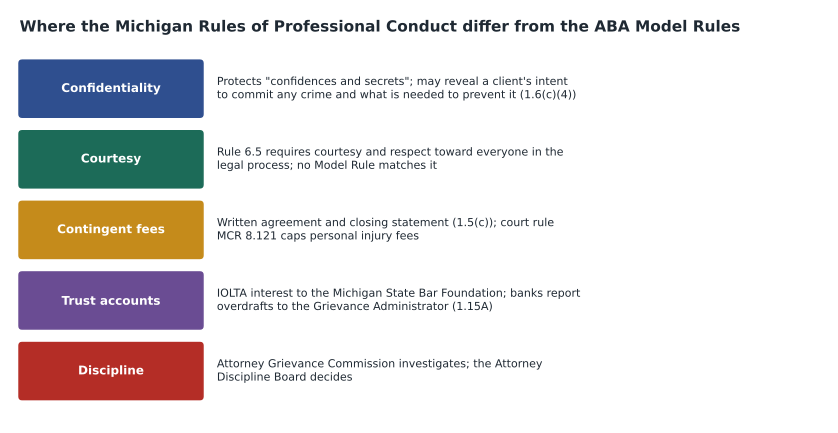
This lesson explains where the Michigan Rules of Professional Conduct come from and how they are enforced, and then walks through the differences from the ABA Model Rules that matter most in early practice: confidentiality, fees, trust accounts, the courtesy rule, advertising and solicitation, limited-scope representation and reporting misconduct.
Source and structure
The Michigan Rules of Professional Conduct, cited as MRPC, are adopted by the Michigan Supreme Court. They took effect in 1988, replacing the older Code of Professional Responsibility, and they follow the structure and numbering of the ABA Model Rules. The comment to MRPC 1.0 explains that the rules were drawn largely from the Model Rules, with changes made by the State Bar and the court. The court amends them by order, most recently with changes effective January 1, 2026, so a lawyer should always use the current text on the court's website.
MRPC 1.0 sets the ground rules. A violation of the rules is a basis for discipline, but it does not by itself create a cause of action against a lawyer or a presumption that a legal duty was breached. The text of each rule is authoritative; the comments explain and guide interpretation but do not add obligations.
Discipline in Michigan
Michigan's discipline system is set out in chapter 9 of the Michigan Court Rules. The Attorney Grievance Commission investigates and prosecutes misconduct through its staff, headed by the Grievance Administrator. Formal complaints are heard by hearing panels of the Attorney Discipline Board, and the Board reviews panel decisions. The Michigan Supreme Court has final authority. Judicial misconduct is handled separately by the Judicial Tenure Commission under the Code of Judicial Conduct.
Confidentiality: the biggest difference
MRPC 1.6 does not use the Model Rules' phrase 'information relating to the representation of a client'. Instead it protects confidences and secrets, terms carried over from the old Code. A confidence is information protected by the attorney-client privilege; a secret is other information gained in the professional relationship that the client has asked to be kept confidential or whose disclosure would embarrass or likely harm the client. In practice the protected area is broad, but the vocabulary differs, and a Michigan lawyer should use it.
The permitted disclosures in MRPC 1.6(c) also differ. A Michigan lawyer may reveal confidences or secrets with the client's consent after full disclosure; when permitted or required by the rules or by law or court order; to the extent reasonably necessary to rectify the consequences of a client's illegal or fraudulent act in which the lawyer's services were used; to establish or collect a fee or to defend against an accusation of wrongful conduct; and, under MRPC 1.6(c)(4), to reveal the intention of a client to commit a crime and the information necessary to prevent the crime. The Model Rules, by contrast, permit disclosure to prevent reasonably certain death or substantial bodily harm, and to prevent, mitigate or rectify certain crimes or frauds involving substantial financial injury in which the lawyer's services were used.
Two features of the Michigan rule stand out. First, the crime-prevention permission in (c)(4) covers any crime the client intends to commit, not only crimes threatening death, bodily harm or serious financial injury. Second, the disclosures in (c) are permissive. The comment states that a lawyer's decision not to disclose as permitted by paragraph (c) does not violate the rule. Other duties, such as the duty of candor to a tribunal under MRPC 3.3, can require disclosure even of protected information.
That answered the partner's question. The client's stated intention to take equipment that belongs to the partnership may be a plan to commit a crime. Under MRPC 1.6(c)(4), the firm may, but need not, reveal the intention and the information necessary to prevent it. The better first step is usually to counsel the client against it, and the firm must not assist.
Fees
MRPC 1.5 follows the Model Rule in requiring reasonable fees and in listing the factors for judging reasonableness. Contingent fees must be in a writing that states the method by which the fee is determined, and at the conclusion of the matter the lawyer must give the client a written statement of the outcome and, if there is a recovery, the remittance to the client and the method of its determination. Contingent fees are prohibited in domestic relations matters where payment depends on securing a divorce or the amount of support or property settlement, and in criminal defense.
Michigan adds a court rule. MRPC 1.5 points to MCR 8.121, which governs contingent fees in personal injury and wrongful death cases. That rule caps the fee at one-third of the amount recovered, computed on the net recovery after deducting the expenses of litigation, and it treats a fee above the cap as clearly excessive. A new lawyer drafting a contingent fee agreement for an injury client in Michigan must comply with both the rule of professional conduct and the court rule.
Financial assistance to clients
MRPC 1.8(e) lets a lawyer advance court costs and litigation expenses, with repayment that may be contingent on the outcome, and lets a lawyer representing an indigent client pay those costs outright. A lawyer representing an indigent client pro bono may also provide modest gifts for basic living expenses, such as transportation, lodging when it costs less than repeated transportation, meals and clothing. The lawyer may not promise such help to win the representation, seek repayment, or advertise it.
Trust accounts
MRPC 1.15 requires lawyers to hold client and third-person funds in an IOLTA account or a non-IOLTA interest-bearing trust account, separate from the lawyer's own money. Advance fees remain in trust until earned. The lawyer must keep complete records for five years after the representation ends, promptly notify clients when funds arrive, and promptly deliver funds the client is entitled to receive. Interest on IOLTA accounts goes to the Michigan State Bar Foundation, which funds legal aid.
MRPC 1.15A adds an overdraft notification rule. Trust accounts must be kept only at financial institutions approved by the State Bar of Michigan, and those institutions agree to report any overdraft or dishonored item on a trust account to the Grievance Administrator, generally within five banking days. A lawyer who receives an inquiry must respond in writing, generally within 21 days. Many Michigan grievance investigations begin with one of these overdraft reports, often caused by careless bookkeeping rather than theft, so new lawyers who handle trust funds should reconcile the account every month.
Courtesy: MRPC 6.5
Michigan has a rule with no direct counterpart in the Model Rules. MRPC 6.5 requires a lawyer to treat with courtesy and respect all persons involved in the legal process, and to take particular care to avoid treating such a person discourteously or disrespectfully because of the person's race, gender or other protected personal characteristic. A lawyer must, to the extent possible, require subordinates and agents to do the same. The comment explains that a lawyer may pursue a client's interests diligently and speak bluntly, but must not cross into impermissible rudeness. Discipline under MRPC 6.5 is rare, but the rule shapes the tone of Michigan practice and appears in grievance complaints about uncivil conduct in depositions and correspondence.
Advertising, solicitation and referral services
Michigan's advertising rules follow the Model Rules in general, with some local features. MRPC 7.2 requires a lawyer to keep a copy of each advertisement for two years after its last dissemination. MRPC 7.1 restricts former judges, referees and magistrates from using those titles unless 'retired' or 'former' comes before them. MRPC 7.3 prohibits soliciting professional employment from a person with whom the lawyer has no family or prior professional relationship when a significant motive is pecuniary gain, and it bars any solicitation involving coercion, duress or harassment or directed at someone who has asked not to be solicited. Truthful, nondeceptive letters to people known to need legal services are permitted, following Shapero v. Kentucky Bar Ass'n. MRPC 6.3 lets lawyers participate in lawyer referral services only if the service is registered with the State Bar of Michigan.
Limited-scope representation and pro bono
Michigan permits limited-scope representation and ties several rules to it. MRPC 1.2 allows a lawyer to limit the scope of a representation if the limitation is reasonable and the client gives informed consent, and the Michigan versions of MRPC 4.2 and 4.3 explain how other lawyers communicate with a person who has limited-scope counsel, coordinated with MCR 2.117, which governs limited appearances in court. That combination supports unbundled services for clients who cannot afford full representation.
MRPC 6.1 states that a lawyer should render public interest legal service, such as free or reduced-fee work for people of limited means, work for charitable and public service organizations, or financial support for legal aid. Michigan's rule does not set a number of hours, and the comment states that it is not intended to be enforced through the disciplinary process.
Reporting misconduct
MRPC 8.3 requires a lawyer who knows that another lawyer has committed a significant violation of the rules that raises a substantial question about that lawyer's honesty, trustworthiness or fitness to inform the Attorney Grievance Commission, and requires a lawyer with similar knowledge about a judge to inform the Judicial Tenure Commission. The duty does not require disclosure of information protected by MRPC 1.6, so a lawyer who learns of misconduct while representing a client must work through the confidentiality analysis first.
Worked problem
Drafting a Michigan contingent fee agreement
A client injured in a fall wants Nolan's firm to take her case on contingency. The partner asks Nolan to draft the fee agreement and to explain what Michigan requires that the MPRE did not cover.
Show solution
- MRPC 1.5(c): the agreement must be in writing and state the method of determining the fee, including how litigation expenses are handled.
- MCR 8.121: the fee may not exceed one-third of the amount recovered, computed on the net recovery after litigation expenses are deducted.
- MRPC 1.8(e): the firm may advance costs and expenses, with repayment contingent on the outcome.
- At the end of the case, MRPC 1.5(c) requires a written closing statement showing the outcome, the remittance to the client and how it was calculated.
- MRPC 1.15: any settlement funds go into the firm's trust account and are distributed promptly, with any disputed portion held until resolved.
Answer: The agreement must satisfy both the professional conduct rule and the court rule cap, and the firm's trust accounting must be ready for the recovery.
Common mistakes
MistakeMichigan lawyers may reveal client information only to prevent death or serious bodily harm.
InsteadMRPC 1.6(c)(4) permits revealing a client's intention to commit any crime and the information necessary to prevent it.
MistakeA lawyer who declines to disclose under MRPC 1.6(c) violates the rule.
InsteadThe disclosures in paragraph (c) are permissive; declining does not violate the rule.
MistakeContingent fees in Michigan injury cases are limited only by reasonableness.
InsteadMCR 8.121 caps them at one-third of the net recovery.
MistakeTrust account overdrafts are private matters between the lawyer and the bank.
InsteadApproved banks report trust account overdrafts to the Grievance Administrator under MRPC 1.15A.
MistakeMichigan has no rule on civility.
InsteadMRPC 6.5 requires courtesy and respect toward all persons involved in the legal process.
Finding answers in practice
Ethics questions in practice rarely arrive labeled. They come up in the middle of a phone call, a deposition or a settlement conference, and a new lawyer needs a quick, reliable way to find the Michigan answer. Marchetti gave Nolan a short routine. First, read the current text of the Michigan rule and its comment on the court's website, not a Model Rules summary from MPRE study. Second, check the State Bar of Michigan's ethics opinions, which are searchable on its website and address many recurring questions, from fee sharing to file retention. Third, for a live question, call the State Bar's confidential ethics helpline, which gives informal guidance to Michigan lawyers. Fourth, talk to a supervising lawyer, and write down the question, the answer and the sources in the client file.
That routine matters most for the differences covered in this lesson. A lawyer who assumes the Model Rule applies may disclose too little or too much under MRPC 1.6, draft a contingent fee agreement that exceeds MCR 8.121, or treat a trust account overdraft as a bank problem instead of a grievance risk. A few minutes with the Michigan text prevents each of those mistakes.
Nolan added one more step for himself. He started a page in his Michigan practice notebook titled 'Not the MPRE', listing every Michigan rule in this lesson beside the Model Rule he had memorized. 'If I write the difference down once,' he told Marchetti, 'I will stop reaching for the Model Rule out of habit.'
Summary and key terms
- The MRPC, effective since 1988 and most recently amended effective January 1, 2026, follow the Model Rules' structure with Michigan changes; violations support discipline but not a private cause of action.
- The Attorney Grievance Commission investigates, the Attorney Discipline Board decides, and the Judicial Tenure Commission handles judges.
- MRPC 1.6 protects confidences and secrets and permits disclosure of a client's intention to commit any crime; paragraph (c) disclosures are permissive.
- Contingent fees need a writing and a closing statement; MCR 8.121 caps injury contingent fees at one-third of the net recovery.
- IOLTA interest goes to the Michigan State Bar Foundation, and MRPC 1.15A requires approved banks to report trust overdrafts to the Grievance Administrator.
- MRPC 6.5 requires courtesy and respect; MRPC 8.3 requires reporting significant misconduct to the Attorney Grievance Commission or the Judicial Tenure Commission.
- 0
- MRPC
- 1
- confidences and secrets
- 2
- Attorney Grievance Commission
- 3
- Attorney Discipline Board
- 4
- IOLTA
- 5
- overdraft notification
- 6
- MCR 8.121
- 7
- limited-scope representation
Practice problems
Work each problem on paper first, then reveal the answer to check.
Under which Michigan rule may a lawyer reveal a client's intention to commit a crime?
Show answer
MRPC 1.6(c)(4).
What is the maximum contingent fee in a Michigan personal injury case, and how is it computed?
Show answer
One-third of the amount recovered, computed on the net recovery after litigation expenses, under MCR 8.121.
Who receives a trust account overdraft report from an approved bank?
Show answer
The Grievance Administrator of the Attorney Grievance Commission, and the account holder.
Which Michigan rule has no direct counterpart in the ABA Model Rules and requires courtesy toward everyone in the legal process?
Show answer
MRPC 6.5.
Lesson quiz · 5 questions
Score 60% or more to complete this lesson.
Create a free account to save your progress, take quizzes and earn a certificate.