
BAR-223 · Lesson 1 of 12 · 21 min
Becoming a lawyer in Michigan
▶ Video coming soon A video version of this lesson is on the way.
Nolan Szymanski grew up in Bay City, a few blocks from the Saginaw River, and he still drives home most Sundays for dinner at his grandmother's house. He finished law school at a Michigan law school in May 2026, and since June he has worked as a law clerk at a small firm in Grand Rapids that handles auto no-fault claims, some municipal defense work and a steady stream of probate files. In October 2026 he filed his application for the February 2027 Michigan bar examination, and a few weeks later he joined Hollis Marchetti's online study group, where the Tuesday evening sessions now include a candidate from almost every corner of the country.
At his first one-on-one session with Marchetti, Nolan explained what was bothering him. 'Everybody at the firm took the old Michigan exam,' he said. 'They talk about Michigan essays on no-fault and the governmental immunity act as if I will be writing those in February. Then my classmates tell me Michigan has the UBE now and there is no Michigan law on the test at all. And somebody else said there is a separate Michigan course I have to finish before I get my score. I want one clear picture of what I actually have to do.'
Marchetti smiled. 'Your colleagues are describing a test that no longer exists. Michigan gave its last exam with Michigan-specific essays in February 2022. Since July 2022 the written exam in Michigan has been the Uniform Bar Examination, written by the National Conference of Bar Examiners, with a passing score of 268. Michigan law has not disappeared from the process, though. It moved into a separate online course called Michigan Law Basics, which you take after graduation, and you cannot receive your official score until the Board has your completion certificate. Then there is character and fitness, which the State Bar runs, and the MPRE, where Michigan needs an 85. So you have four separate tracks, and this course will keep each of them in view.'
This lesson maps the whole process: who controls admission in Michigan, the institutions that do the work, the routes into practice and the usual order of events for a first-time candidate. Later lessons take each step in detail and then turn to the Michigan law that a new lawyer in Detroit, Lansing, Grand Rapids or the Upper Peninsula meets in the first months of practice, which is also the law that Michigan Law Basics covers.
Who controls admission
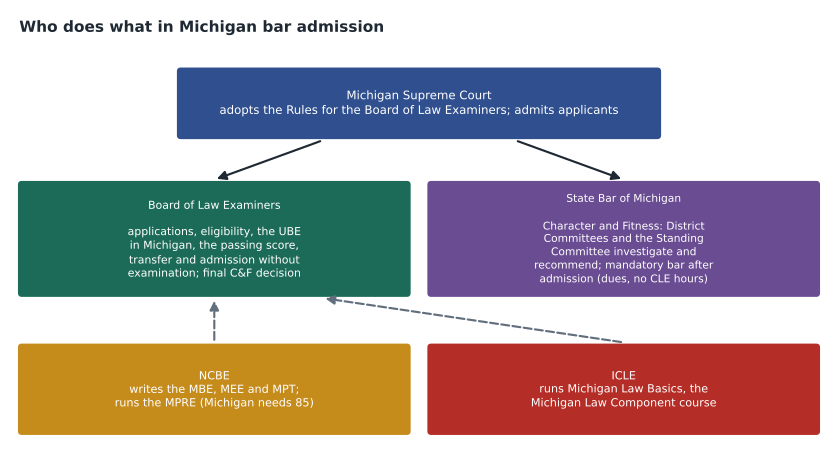
Admission to the practice of law in Michigan is controlled by the Michigan Supreme Court. The Michigan Constitution gives the court general superintending control over all courts, and the regulation of the practice of law has long been treated as part of the judicial power. The court exercises that power through rules. The admission rules are the Rules for the Board of Law Examiners, a short set of numbered rules that the court amends by administrative order. The current version took effect on September 2, 2026, and it covers eligibility, the examination, scoring, transfer of a Uniform Bar Examination score, admission without examination, fees, waivers and recertification of character and fitness.
The court does its admissions work through the Board of Law Examiners, a body of lawyers the court appoints. The Board receives applications, decides who is eligible to sit, administers the Uniform Bar Examination in Michigan, sets the passing score, decides transfer and admission without examination applications, and makes the final decision on character and fitness. When the Board certifies that an applicant has met every requirement, the applicant takes the oath of office and is admitted.
The character and fitness investigation itself is done by the State Bar of Michigan. That is a feature that surprises candidates from some other states. The State Bar's Standing Committee on Character and Fitness and its District Committees review the files, interview applicants when needed and make recommendations, and the Board decides. The State Bar is also the body you join on admission: Michigan has a unified, or mandatory, bar, so every lawyer licensed in Michigan must be an active member of the State Bar and pay its annual dues.
Two outside organizations complete the picture. The National Conference of Bar Examiners, usually called NCBE, writes the three parts of the Uniform Bar Examination, scales and reports the scores, and runs the Multistate Professional Responsibility Examination. NCBE also offers its own character report service, and Michigan applicants for admission without examination pay an NCBE character fee as part of that route. The Institute of Continuing Legal Education, known as ICLE, runs Michigan Law Basics, the online course that satisfies the Michigan Law Component under Rule 3a.
Why the authority matters to you
The first practical consequence is where you check a fact. Every deadline and fee that matters to you is in a court rule or on the Board's pages at courts.michigan.gov, and every character and fitness instruction is on the State Bar's pages at michbar.org. A commercial outline or a classmate's memory is a starting point, not an authority. Michigan's rules changed significantly in 2022, when the UBE arrived, and again in September 2026, and the two official sources do not always use the same late-filing date. When they disagree, ask the Board directly and keep the answer in writing.
The second consequence is that the Board, not NCBE, decides what counts as passing in Michigan. NCBE writes and scales the exam, but the 268 passing score is a Michigan choice. So is the decision to require Michigan Law Basics, the three-year life of a passing score, the rules for transferring a score in from another state, and the rules for lawyers who want to come in without an exam. When Michigan moves to the NextGen bar exam in July 2028, the Board will set the new passing score and decide the transfer rules for NextGen scores.
The third consequence is that two different bodies hold parts of your file. The Board holds your exam application and your scores. The State Bar holds your character and fitness file. A candidate who updates one and forgets the other can delay admission by weeks. Marchetti tells every Michigan candidate to keep a single folder, paper or digital, with copies of everything sent to either body and the date it was sent.
The routes into Michigan practice
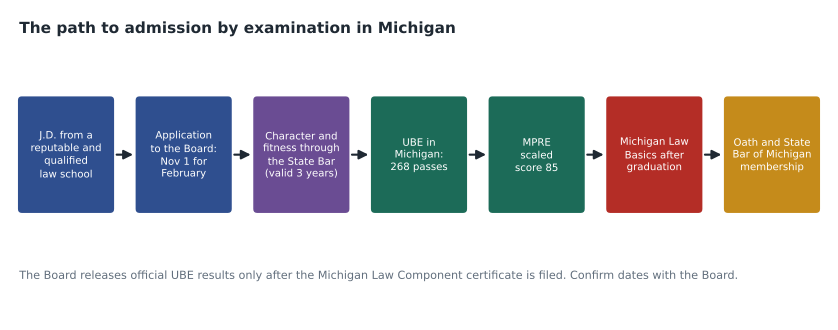
There are three main routes to a full Michigan license. The first is examination: graduate from a qualifying law school, apply to the Board, pass the Uniform Bar Examination in Michigan with a 268 or better, pass the MPRE with an 85, complete Michigan Law Basics, clear character and fitness, and take the oath. That is Nolan's route and the route this course follows most closely.
The second route is transfer of a Uniform Bar Examination score earned in another jurisdiction. Rule 4a lets an applicant who has a passing Michigan-equivalent UBE score, earned within the previous three years, apply for admission on that score without sitting again. The applicant still needs the MPRE, Michigan Law Basics, character and fitness clearance and an affidavit of study of Michigan's court rules and ethics rules, and pays a 400-dollar fee.
The third route is admission without examination under Rule 5, sometimes called admission on motion. It is for experienced lawyers: an applicant who has been actively engaged in the practice of law, full-time law teaching at a qualifying law school, or service as a judge advocate, for at least three of the five years before applying. The fee is 800 dollars plus the NCBE character report fee. Lesson 11 covers both transfer and admission without examination, along with the narrower options, such as temporary admission for a single case.
| Route | Who uses it | Key Michigan requirements |
|---|---|---|
| Examination | New graduates and anyone without a qualifying score or practice history | UBE 268, MPRE 85, Michigan Law Basics, character and fitness, oath |
| UBE score transfer (Rule 4a) | Candidates who passed the UBE elsewhere in the last three years | Score of 268 or more, MPRE 85, Michigan Law Basics, affidavit of study, 400 dollars |
| Admission without examination (Rule 5) | Lawyers with 3 of the last 5 years in practice, teaching or JAG service | Qualifying experience, character and fitness, 800 dollars plus NCBE fee |
| Temporary admission (MCR 8.126) | Out-of-state lawyers for one case | Association with a Michigan lawyer and court permission; not a license |
The usual order of events
For a first-time candidate the steps fall into a predictable order, although several of them run at the same time. The law school years come first. Michigan requires a law degree from a reputable and qualified law school, and a degree from a school approved by the American Bar Association meets that standard. Candidates usually take the MPRE during law school, often in the second or third year, so that the score is in hand well before the bar exam.
The application comes next. For a February exam the regular filing deadline is November 1 of the year before, and for a July exam it is March 1. Late filing is possible for a short window after those dates with a 100-dollar surcharge. The character and fitness file is opened through the State Bar's applicant portal at about the same time, and it takes the longest of any step, because it depends on references, fingerprints and records from other people and agencies.
The exam itself is two days. Day one is written: two Multistate Performance Test tasks in the morning and six Multistate Essay Examination questions in the afternoon. Day two is the Multistate Bar Examination, 200 multiple-choice questions split into two three-hour sessions. Scores are released several weeks later, but the Board will not release an official Michigan result until it has your Michigan Law Basics certificate, so most candidates finish that course before or soon after the exam.
Admission follows. Once the Board has a passing score, an MPRE score, the Law Basics certificate and a favorable character and fitness decision, it certifies the applicant, who then takes the oath and becomes an active member of the State Bar of Michigan. Michigan does not require new lawyers to complete continuing legal education hours, which sets it apart from most states, but membership and annual dues are mandatory from the start.
Worked problem
Putting Nolan on the map
Nolan graduated in May 2026, took the MPRE in August 2025 and scored 91, filed his February 2027 application in October 2026, and opened his character and fitness file in the State Bar portal the same week. What is left, and in what order?
Show solution
- The MPRE is done: 91 is above Michigan's 85, and Michigan does not put a time limit on an MPRE score.
- The application is timely: it went in before the November 1, 2026 regular deadline, so he pays the 400-dollar exam fee with no late surcharge.
- Character and fitness is open. He needs his fingerprints taken, five references submitted (or the reference waiver form), and the signed waiver and release mailed within two weeks.
- Michigan Law Basics can be taken now, because he has graduated. He plans to start it in a light week in January or right after the exam.
- The exam is February 23 and 24, 2027.
Answer: Nolan's remaining tracks are character and fitness, Michigan Law Basics and the exam itself. None depends on the others to start, so he can work on all three at once.
What this course covers
Lessons 2 to 5 cover the admission process in detail: eligibility, education, deadlines and fees; character and fitness and the MPRE; the format and scoring of the Uniform Bar Examination as Michigan uses it; and the move to the NextGen exam in July 2028. Lesson 6 explains Michigan Law Basics and how Michigan law reaches candidates now that the exam itself is national.
Lessons 7 to 10 turn to the Michigan law that matters most in early practice and that Michigan Law Basics introduces: the court system and the Michigan Court Rules; torts, including Michigan's modified comparative fault rule, the governmental immunity act and the no-fault auto insurance system after the 2019 reform; family law, probate under the Estates and Protected Individuals Code and the 2022 reproductive freedom amendment to the Michigan Constitution; and the Michigan Rules of Professional Conduct. Lesson 11 covers transfer, admission without examination and life after admission, and Lesson 12 is a capstone with original practice questions and an exam-week plan.
Marchetti finished the session with one instruction. 'Your firm will want to talk Michigan law with you all spring, and that is good for your career,' she told Nolan. 'But in February the graders want the general law the MEE asks about, not Michigan law. Keep two notebooks: one for the national exam and one for Michigan practice. Never let the Michigan notebook leak into your essays.'
Common mistakes
MistakeMichigan still tests Michigan law in its own essay questions.
InsteadMichigan's last exam with Michigan essays was in February 2022. Since July 2022 the exam is the UBE, which tests general law; Michigan law is covered by Michigan Law Basics.
MistakeThe State Bar of Michigan decides who is admitted.
InsteadThe Michigan Supreme Court admits, through the Board of Law Examiners. The State Bar investigates character and fitness and recommends; the Board decides.
MistakeA passing UBE score is enough to be admitted.
InsteadYou also need the MPRE score of 85, the Michigan Law Basics certificate, character and fitness clearance and the oath.
MistakeMichigan has a continuing legal education requirement for new lawyers.
InsteadMichigan has no mandatory CLE for lawyers. State Bar membership and dues are mandatory.
Summary and key terms
- The Michigan Supreme Court controls admission through the Rules for the Board of Law Examiners, most recently effective September 2, 2026.
- The Board of Law Examiners runs applications, the exam, scoring, transfer and admission without examination, and makes the final character and fitness decision.
- The State Bar of Michigan investigates character and fitness through its District Committees and Standing Committee, and every admitted lawyer must join it.
- The exam is the UBE, first given in Michigan in July 2022; the passing score is 268 and the MPRE requirement is 85.
- Michigan Law Basics, an ICLE online course, satisfies the Michigan Law Component; official results wait for its certificate.
- The three main routes are examination, UBE score transfer under Rule 4a and admission without examination under Rule 5.
- 0
- Board of Law Examiners
- 1
- State Bar of Michigan
- 2
- Uniform Bar Examination
- 3
- Michigan Law Component
- 4
- Michigan Law Basics
- 5
- admission without examination
- 6
- unified bar
Practice problems
Work each problem on paper first, then reveal the answer to check.
Which body makes the final decision on a Michigan applicant's character and fitness?
Show answer
The Board of Law Examiners. The State Bar's committees investigate and recommend, and the Board decides.
When was the first Uniform Bar Examination given in Michigan?
Show answer
July 2022, under the court's October 2021 order adopting the UBE.
Name the four tracks a first-time Michigan candidate must complete besides the oath.
Show answer
The UBE with a 268 or better, the MPRE with an 85, Michigan Law Basics and character and fitness clearance.
A friend says Michigan new lawyers must complete 12 CLE hours in their first year. Is that right?
Show answer
No. Michigan has no mandatory continuing legal education for lawyers; only judges have continuing education rules.
Lesson quiz · 5 questions
Score 60% or more to complete this lesson.
Create a free account to save your progress, take quizzes and earn a certificate.