
BAR-223 · Lesson 2 of 12 · 20 min
Eligibility, education, deadlines and fees
▶ Video coming soon A video version of this lesson is on the way.
Nolan's second session with Marchetti began with a question from his roommate, who had finished law school at a school in Ohio and wanted to work in Detroit. 'He asked me whether he can even sit in Michigan,' Nolan said, 'and I realized I could not answer. I know I am eligible because the Board accepted my application, but I could not explain why.' Marchetti pulled up the Rules for the Board of Law Examiners. 'Then let us make sure you can explain it,' she said. 'Eligibility questions come up constantly once you are a lawyer, from friends, from summer associates, from your own siblings. And the deadlines are where good candidates lose a whole exam cycle.'
This lesson works through Rules 1, 2 and 6 of the Rules for the Board of Law Examiners as they stand after the September 2, 2026 amendments: the general qualifications, the education requirement, the filing calendar, the fees and the waiver rule. It closes with Nolan's own filing checklist.
General qualifications under Rule 1
Rule 1 sets the baseline that every applicant must meet, whatever route they use. An applicant must be at least 18 years old, must be of good moral character, and must have completed at least 60 semester hours or 90 quarter hours of undergraduate study at an accredited college or university before starting law school. Almost every law graduate meets the age and undergraduate requirements without thinking about them. The good moral character requirement is the subject of Lesson 3, and in practice it is the requirement that takes the most time.
The undergraduate requirement matters mainly for unusual paths, such as a candidate who entered law school through a program that admitted students before they finished a bachelor's degree. If you are in that group, check the credit count early, because a shortfall cannot be cured after the fact by graduate study.
The law degree under Rule 2
Michigan requires a juris doctor degree from a law school that the Board considers reputable and qualified. A degree from a law school approved by the American Bar Association meets that standard, and that is the path nearly every Michigan candidate takes. NCBE's comprehensive guide notes that an ABA-approved J.D. is not strictly the only route to sit the exam in Michigan, because the Board applies the reputable and qualified standard itself, but it is required for admission without examination. In practical terms, a graduate of any ABA-approved school in any state can sit the Michigan exam on the same terms as a graduate of a Michigan school.
That answers Nolan's roommate. His Ohio law school is ABA-approved, so he meets the education requirement in Michigan just as Nolan does. He applies to the Michigan Board, sits the Michigan exam or, if he has already passed the UBE in Ohio within the last three years, applies to transfer that score under Rule 4a.
Some candidates fall outside this framework. Michigan has no special examination for experienced lawyers from other states, sometimes called an attorneys' exam, so a lawyer who does not qualify for transfer or admission without examination sits the full UBE like anyone else. Graduates of law schools outside the United States are not eligible to sit the Michigan exam on the strength of a foreign law degree alone; a foreign-trained lawyer usually needs a J.D. from an ABA-approved school first. Rules on these points change and the Board decides individual cases, so a foreign-trained applicant should ask the Board before investing in a course of study.
Michigan does not allow students to sit the exam before graduation. The application requires proof that the degree has been awarded, usually by a certificate from the law school, and Michigan Law Basics can only be taken after graduation as well.
| Requirement | Rule | What Michigan asks for |
|---|---|---|
| Age | Rule 1 | At least 18 |
| Undergraduate study | Rule 1 | At least 60 semester hours or 90 quarter hours before law school |
| Character | Rule 1 | Good moral character, investigated by the State Bar |
| Law degree | Rule 2 | J.D. from a reputable and qualified law school; ABA-approved schools qualify |
| MPRE | Rule 2 | Scaled score of at least 85 |
| Michigan Law Component | Rule 3a | Michigan Law Basics completion certificate, after graduation |
The filing calendar
Rule 2 sets two regular filing deadlines. For a February examination the application is due by November 1 of the previous year. For a July examination it is due by March 1 of the same year. Michigan accepts late applications for a short window after each regular deadline, with a 100-dollar late surcharge on top of the regular fee. Under the rule as published, the late window runs to December 1 for February and to May 1 for July.
Here is a trap. The official sources do not all line up. NCBE's comprehensive guide has listed later late dates in the middle of December and May, and the State Bar's character and fitness page for the 2027 exams gives December 15, 2026 for February 2027 character and fitness filings and May 1, 2027 for July 2027. Some of the difference is that the exam application and the character and fitness application are two different filings. The safe course is simple: file both by the regular deadline, and if you must file late, confirm the date in writing with the Board and the State Bar before relying on it.
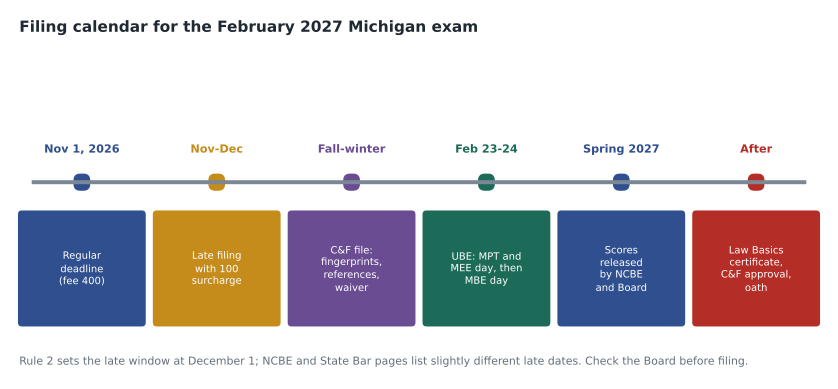
Exam dates are set nationally because the UBE is given on the same days everywhere. The February 2027 exam falls on Tuesday, February 23 and Wednesday, February 24, 2027. The July 2027 exam falls in the last week of July. The Board announces the Michigan test site and reporting instructions to registered applicants, and those instructions are the only ones to follow on exam morning.
Testing accommodations have their own process and their own documentation. An applicant with a disability who needs extra time, a separate room or other changes should request them with the application, not after, because medical documentation and Board review take time. A request filed late may not be decided before the exam.
Fees under Rule 6
Rule 6 sets the fees, and the 2026 amendments left them in a simple pattern. The examination fee for a first-time applicant is 400 dollars. A reexamination fee is 300 dollars. The late surcharge is 100 dollars. An application to transfer a UBE score is 400 dollars, and recertification of character and fitness, needed when a clearance has expired, is 300 dollars. Admission without examination under Rule 5 costs 800 dollars, plus the separate NCBE character report fee.
There is no separate laptop fee in the rule itself; the software provider for typing the written portions charges its own fee, and the Board's instructions explain how to register. Fingerprinting through the State Bar's Livescan process also carries its own vendor charge. Build those amounts into the budget along with travel to the test site and a hotel for two nights if the site is not close to home.
| Item | Fee in dollars |
|---|---|
| Examination (first time) | 400 |
| Reexamination | 300 |
| Late filing surcharge | 100 |
| UBE score transfer (Rule 4a) | 400 |
| Admission without examination (Rule 5) | 800 plus NCBE character fee |
| Recertification of character and fitness | 300 |
Worked problem
Can Nolan's classmate still make February?
Nolan's classmate Bryn missed the November 1, 2026 regular deadline because her law school was slow to confirm her degree. It is now mid-November. What should she do?
Show solution
- The regular deadline has passed, so any application is late and carries the 100-dollar surcharge on top of the 400-dollar exam fee.
- The published rule allows late filing until December 1 for the February exam, and other official pages list later dates. She should not gamble on the later date.
- She should file the exam application immediately, open the State Bar character and fitness file the same day, and email the Board to confirm the application is within the late window.
- If the degree confirmation is still missing, she should ask the law school registrar for a written statement of the expected conferral date and send it to the Board.
Answer: Bryn can still make February if she files at once and pays 500 dollars in total. If she misses the late window, July 2027 is the next sitting, with a March 1 regular deadline.
Retakes, waivers and the life of a score
Michigan does not limit the number of times an applicant may sit the exam. A candidate who fails files again for the next sitting and pays the 300-dollar reexamination fee. That is more generous than some states, but each attempt costs a season of study, so the goal is still to pass the first time.
Rule 4 treats the Board's scoring as final, except for clerical errors. There is no regrading or appeal of essay grades in Michigan. A candidate who believes an arithmetic or recording mistake was made can ask the Board to check, but disagreement with the grader's judgment is not a ground for review. Rule 4 also gives a passing score a three-year life for Michigan admission purposes: an applicant who passes but delays completing the other requirements past three years may have to sit again.
Rule 7 gives the Board power to waive some requirements in individual cases for good cause. Waivers are discretionary and fact-specific, and they are not a substitute for meeting a deadline. A candidate who thinks a waiver might apply should write to the Board early, explain the circumstances, and include documents.
Nolan's filing checklist
Marchetti keeps a one-page checklist for every Michigan candidate, and she went through it with Nolan line by line. The first block is dates: the regular deadline, the late deadline as confirmed by the Board, the accommodation deadline, and the exam days. The second is documents: the law school certificate, the State Bar applicant portal confirmation, the signed waiver and release, the Livescan receipt and the reference list. The third is money: the exam fee, the typing software fee, the fingerprint vendor charge, and the hotel. The fourth is follow-up: a calendar note two weeks after each filing to confirm it was received.
'Most late applications I have seen were not about laziness,' Marchetti told him. 'They were about one missing document that nobody chased. If you write down the date you sent something, you will notice when the reply does not come.'
Common mistakes
MistakeOnly graduates of Michigan law schools can sit the Michigan exam.
InsteadGraduates of any ABA-approved law school meet the education requirement.
MistakeMichigan limits candidates to a fixed number of attempts.
InsteadMichigan has no limit on attempts; each retake costs a 300-dollar reexamination fee.
MistakeThe late window is the same on every official page, so any date will do.
InsteadThe rule, NCBE and the State Bar have listed different late dates. File by the regular deadline or confirm in writing.
MistakeA disappointed candidate can appeal an essay grade to the Board.
InsteadScores are final except for clerical errors; there is no regrading.
MistakeA passing score stays good for admission forever.
InsteadA passing score is valid for Michigan admission for three years.
Special situations Marchetti sees every year
A few eligibility questions come up in almost every Michigan cohort, and each has a straightforward answer once you know where to look.
The first is the candidate who has already passed the UBE somewhere else. That candidate does not file a regular exam application at all. A score of 268 or more earned in the last three years can be transferred under Rule 4a, which has its own application and its own 400-dollar fee. A score below 268 cannot be transferred into Michigan, even if it passed in the jurisdiction where it was earned, so a candidate with a 266 from a state with a 266 passing score must sit the Michigan exam or wait until qualifying for admission without examination.
The second is the candidate who wants to sit in Michigan but expects to practice mostly in another UBE state. The Michigan score is portable, subject to the other state's rules, but Michigan's requirements for admission in Michigan, such as Michigan Law Basics, do not travel. A candidate who never intends to be admitted in Michigan should compare passing scores and test-site logistics and consider sitting in the state where admission is the goal.
The third is the candidate with a name change, such as a recent marriage. The name on the application, the identification shown on exam day and the name in the State Bar character and fitness file must all match, or the candidate must document the change. Update the Board and the State Bar together, and bring the supporting document to the test site.
The fourth is the candidate who moves after filing. Address changes go to both the Board and the State Bar, because exam notices come from one and character and fitness correspondence comes from the other. A missed letter from a District Committee asking for an interview can delay a clearance by a full cycle.
The fifth is the active-duty service member or military spouse. Michigan's rules include provisions that can help, especially on the admission without examination side, and the Board can explain how service time is counted. Judge advocate service counts toward the three-of-five-years experience requirement under Rule 5, which Lesson 11 covers.
Marchetti closed the session by having Nolan explain the rules back to her as if she were his roommate. 'If you can explain eligibility to someone else in two minutes,' she said, 'you understand it well enough to never miss a deadline yourself.'
Summary and key terms
- Rule 1 requires age 18, good moral character and 60 semester or 90 quarter hours of undergraduate study.
- Rule 2 requires a J.D. from a reputable and qualified law school; ABA-approved schools qualify, and admission without examination requires one.
- Regular deadlines are November 1 for February and March 1 for July; late filing costs a 100-dollar surcharge, and the closing date should be confirmed.
- Fees: 400 to sit, 300 to retake, 400 to transfer a score, 800 for admission without examination plus the NCBE fee, 300 to recertify character and fitness.
- There is no limit on attempts and no regrading; a passing score is valid for three years.
- 0
- reputable and qualified
- 1
- regular deadline
- 2
- late surcharge
- 3
- reexamination fee
- 4
- clerical error
- 5
- waiver
Practice problems
Work each problem on paper first, then reveal the answer to check.
What is the regular deadline for the July 2027 Michigan exam?
Show answer
March 1, 2027.
How much does a first-time applicant who files late pay in Board fees?
Show answer
500 dollars: the 400-dollar exam fee plus the 100-dollar late surcharge.
Can a graduate of an ABA-approved school in Indiana sit the Michigan exam?
Show answer
Yes. An ABA-approved J.D. meets Michigan's education requirement wherever the school is located.
A candidate passed in July 2023 but has not finished the other requirements. What risk does she face in late 2026?
Show answer
Her passing score is valid for three years, so by late 2026 it may have expired for Michigan admission and she may need to sit again.
Lesson quiz · 5 questions
Score 60% or more to complete this lesson.
Create a free account to save your progress, take quizzes and earn a certificate.