
BAR-223 · Lesson 4 of 12 · 20 min
The Michigan bar exam: the UBE, scoring and the 268 passing score
▶ Video coming soon A video version of this lesson is on the way.
Nolan's firm has a partner, Rosemary Kowalczyk, who took the Michigan exam in the 1990s and graded Michigan essays for a few cycles afterward. When Nolan mentioned at lunch that the passing score was 268, she frowned. 'We used to talk about a 135 on the MBE,' she said, 'and the essays were all Michigan law. I am not sure I understand what 268 even means.' Nolan realized he was not sure either, and he brought the question to Marchetti that evening.
'Then let us take it apart,' Marchetti said. 'Once you understand how a UBE score is built, you will know where your points come from, how much each kind of practice is worth, and why a strong essay day can rescue a weak multiple-choice day. That is the whole strategy of this exam.'
This lesson explains the format of the Uniform Bar Examination as Michigan gives it, how the three components are weighted and scaled, what the 268 passing score means, and what happens when results come out.
How Michigan came to the UBE
For decades Michigan gave the Multistate Bar Examination on one day and its own essay examination on the other, with essays on Michigan law written and graded by Michigan examiners. In 2019 the Michigan Supreme Court opened an administrative file on adopting the Uniform Bar Examination, and on October 13, 2021 it entered an order adopting the UBE, effective March 1, 2022. The February 2022 exam was the last one with Michigan essays. The first UBE in Michigan was given in July 2022.
The order was not unanimous. One justice dissented, and another wrote separately to explain her support. The debate was familiar from other states: the UBE gives new lawyers a portable score they can transfer to other UBE jurisdictions, and it is graded to a national standard, but it no longer requires candidates to show knowledge of local law. Michigan answered the second concern with the Michigan Law Component, which Lesson 6 covers.
The three parts of the UBE
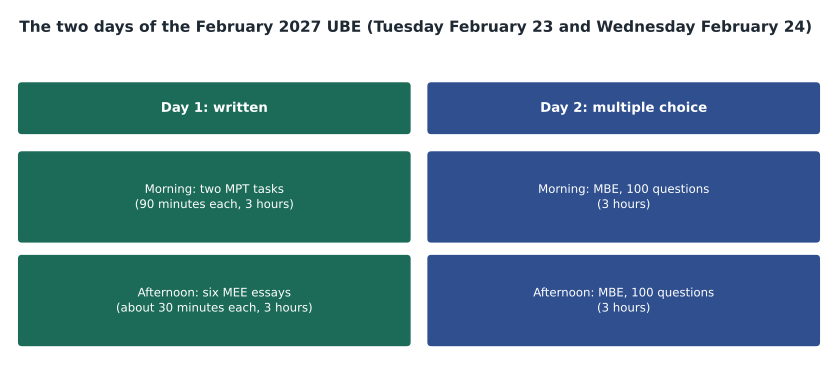
The Uniform Bar Examination has three components, all written by NCBE. Michigan gives them on two consecutive days, Tuesday and Wednesday, in the last week of February and the last week of July.
The Multistate Performance Test, or MPT, is a practical writing test. Each MPT task gives the candidate a File, with the facts in the form of memos, transcripts, letters and documents, and a Library, with the cases, statutes and rules needed for the task. The candidate must produce a lawyer's work product, such as an objective memo, a persuasive brief, a client letter, or a set of proposed findings. Each task is designed to be completed in 90 minutes, and the UBE uses two tasks.
The Multistate Essay Examination, or MEE, has six essay questions, each designed to take about 30 minutes. MEE questions can draw on any of the MBE subjects plus business associations, conflict of laws, family law, secured transactions under Article 9 of the Uniform Commercial Code, and trusts and estates. Answers are graded on general principles of law, not on any one state's rules, and graders follow NCBE's grading materials adapted by the jurisdiction's graders.
The Multistate Bar Examination, or MBE, has 200 multiple-choice questions on seven subjects: civil procedure, constitutional law, contracts, criminal law and procedure, evidence, real property and torts. Of the 200 questions, 175 are scored and 25 are pretest questions that do not count, and the candidate cannot tell which is which. The MBE is given in two three-hour sessions of 100 questions each.
Weighting and scaling
The three components are weighted as follows: the MBE counts for 50 percent of the total score, the MEE for 30 percent and the MPT for 20 percent. The written components together are therefore half of the score, which is why Marchetti spends so much of her coaching time on writing.
The MBE score is a scaled score. NCBE converts the number of scored questions answered correctly into a scaled score through a statistical process called equating, which adjusts for small differences in difficulty between exam forms. A scaled MBE score of 134, for example, means the same level of performance whether earned in February or in July, in Michigan or in Montana.
The written scores are scaled to the MBE. Graders in each jurisdiction read the MEE and MPT answers and assign raw grades on the jurisdiction's own grading scale. Those raw grades are then converted so that they have the same mean and spread as the MBE scores of the same group of candidates in that jurisdiction. The effect is that a candidate's written score is measured against how strong the group is on the MBE, which keeps written scores comparable across administrations.
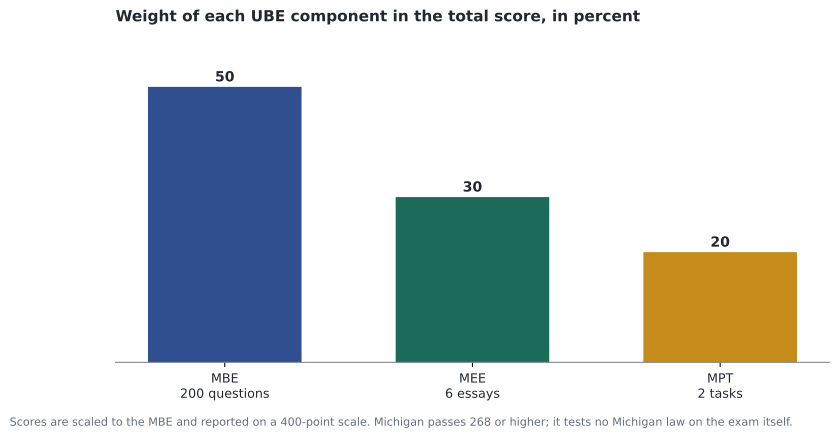
Finally, the scaled written score and the scaled MBE score are combined on the 400-point UBE scale. The MBE contributes its scaled score as is, out of about 200, and the written portion contributes the combined MEE and MPT score, also out of about 200. A total score of 268 or more passes in Michigan.
What 268 means
A total of 268 means, roughly, an average of 134 on each half. That is what Kowalczyk's 135 MBE memory was pointing toward. But the halves do not have to be equal. A candidate with a 128 MBE passes with a written score of 140. A candidate with a 142 MBE passes with a written score of 126. Because the score is compensatory, a candidate's stronger half can make up for the weaker one.
| Scaled MBE | Written score needed to reach 268 |
|---|---|
| 124 | 144 |
| 128 | 140 |
| 132 | 136 |
| 134 | 134 |
| 138 | 130 |
| 142 | 126 |
| 146 | 122 |
Different UBE jurisdictions set different passing scores, from 260 in the lowest jurisdictions to 270 in the highest. Michigan's 268 sits near the top of that range. That matters for transfer, as Lesson 11 explains: a score earned in Michigan that clears 268 can transfer to every UBE jurisdiction with a passing score of 268 or lower, but a score earned elsewhere must meet Michigan's 268 to transfer in.
Worked problem
Where should Nolan put his last month?
Nolan's practice scores in mid-November put him at about 136 on the MBE and 128 on the written portion, a total of 264. He asks Marchetti whether to spend January on more MBE questions or more essays.
Show solution
- Write down the gap: he is 4 points short of 268.
- The written portion is 50 percent of the total and is scaled against Michigan's candidates' MBE scores, so written improvements count point for point on the 200-point half, just like MBE improvements.
- His written score is 8 points below his MBE score. In Marchetti's experience, structure and timing problems in essays respond faster to practice than knowledge gaps on the MBE.
- Plan: keep a maintenance level of 34 MBE questions a day, but add one timed MEE essay every day and one full MPT every third day, graded against the model answers.
Answer: Nolan should shift his emphasis to the written portion. Gaining 4 to 6 points on the written half is the most direct path past 268.
Results and what follows
Michigan releases results several weeks after each exam; February results usually come in the spring and July results in the fall. NCBE reports the scaled scores, and the Board issues the official Michigan result. Under Rule 3a the Board will not release an official result until it has the candidate's Michigan Law Basics certificate. Candidates who pass are certified for admission once character and fitness is complete.
Under Rule 4, scores are final except for clerical errors. There is no regrade, and the Board does not return essays for review as part of any appeal. Candidates who fail may file for the next exam and pay the 300-dollar reexamination fee. A failing candidate receives the component scores, which are the best guide to where to focus next time.
A passing Michigan score is valid for Michigan admission for three years under Rule 4. The same score can also be transferred to other UBE jurisdictions under their own rules, usually within two to five years, depending on the jurisdiction.
Exam-day logistics
The Board sends registered applicants the test-site location, the reporting time and the list of permitted and prohibited items. Candidates may type the written portions on a laptop using the approved exam software, which must be registered and tested before the exam, or write by hand. Identification must match the name on the application. Items such as phones and smart watches are not allowed in the testing room, and candidates who need medication or medical devices should check the accommodation rules in advance.
Marchetti's rule is to treat the exam as a two-day trip, even for candidates who live near the site. 'Sleep somewhere close the night before day one,' she tells candidates. 'Check the route at the actual reporting time. Pack the night before. You do not want to discover a dead laptop battery at 7:30 on a Tuesday morning in February in Michigan.'
Common mistakes
MistakeThe UBE tests Michigan law on the essays.
InsteadMEE answers are graded on general principles. Michigan law is covered by Michigan Law Basics, not the exam.
MistakeYou must pass each component separately.
InsteadThe UBE is compensatory: a strong half can make up for a weak half if the total reaches 268.
MistakeAll 200 MBE questions count.
Instead175 are scored and 25 are unscored pretest questions.
MistakeWritten scores are graded on a fixed national curve.
InsteadWritten scores are scaled to the MBE scores of the same group of candidates in the jurisdiction.
MistakeThe MEE and MPT together are worth less than the MBE.
InsteadThe written portion is 50 percent of the total, the same as the MBE.
How MEE and MPT answers are graded
Kowalczyk's next question at lunch was how the essays are graded now that Michigan examiners no longer write them. Marchetti, who graded UBE essays for six years in another jurisdiction, explained the process to Nolan in detail so that he could pass it on.
NCBE writes each MEE question and MPT task and supplies grading materials: an analysis of the issues, the expected conclusions and the points that strong answers address. Before grading begins, graders from the jurisdictions meet, in person or online, to study the materials and grade sample answers together so that they apply the same standards. Each jurisdiction's graders then read their own candidates' answers. Grading is relative: graders sort answers into score bands by comparing them with each other, so an answer is rewarded for being clearer and more complete than the others in the same pile.
That has three practical consequences. First, issue spotting counts heavily. An answer that addresses every issue in the call, even briefly, usually beats an answer that analyzes one issue brilliantly and misses two. Second, structure matters. Graders read many answers in a sitting, and an answer with headings that track the call, a clear rule statement, application to the specific facts and a conclusion for each issue is easier to reward. Third, a correct conclusion without analysis earns little. The points are in the application of the rule to the facts.
MPT grading follows the same relative approach, but the task is different. MPT graders look for whether the candidate followed the instructions in the task memo, used the law in the Library rather than outside knowledge, organized the work as the assignment asked, and wrote in the requested format and tone. The most common MPT failure is not a wrong answer; it is an unfinished one. Candidates who spend too long reading leave themselves no time to write, and a half-finished brief scores poorly no matter how good the first half is.
Budgeting time on day one
Day one is six hours of writing. Marchetti's rule for the MPT morning is 90 minutes per task, with roughly 35 to 45 minutes for reading the task memo, the File and the Library, and the rest for outlining and writing. For the MEE afternoon she teaches 30 minutes per essay, with five minutes to read and outline and 25 minutes to write, and a firm rule against borrowing time from later essays. A candidate who spends 45 minutes on the first essay has 15 minutes for the last one, and a weak sixth essay costs more than a slightly shorter first essay gains.
Practice that moves the score
For the MBE, the most effective practice is timed sets of licensed NCBE questions, reviewed carefully. Marchetti asks candidates to keep a miss log: for each wrong answer, the subject, the rule tested and the reason for the mistake, such as not knowing the rule, misreading the facts or changing a correct answer. Patterns in the log show where to study. For the MEE and MPT, the most effective practice is writing full answers under time and comparing them honestly with the grading materials.
Candidates sometimes ask whether to aim for a balanced score or play to their strengths. Because the UBE is compensatory, playing to strengths is legitimate, but neglecting a weak half is dangerous. A candidate who expects 145 on the MBE can afford a weaker written score, but a single bad essay day can still pull the total below 268. Marchetti's goal for every candidate is to bring the weaker half to at least 130, then build the stronger half from there.
Summary and key terms
- Michigan adopted the UBE by order of October 13, 2021, effective March 1, 2022; the first UBE in Michigan was July 2022.
- The UBE has three parts: two MPT tasks, six MEE essays and the 200-question MBE, given on two days.
- Weights: MBE 50 percent, MEE 30 percent, MPT 20 percent; written scores are scaled to the MBE.
- Scores are reported on a 400-point scale; Michigan passes 268 or more, and the score is compensatory.
- Results wait for the Michigan Law Basics certificate; scores are final except for clerical errors; a passing score is valid three years.
- 0
- MPT
- 1
- MEE
- 2
- MBE
- 3
- scaled score
- 4
- equating
- 5
- compensatory scoring
- 6
- 400-point scale
Practice problems
Work each problem on paper first, then reveal the answer to check.
A candidate scores 131 on the MBE. What written score does she need to pass in Michigan?
Show answer
137, because 131 plus 137 equals 268.
How many MBE questions are scored?
Show answer
175 of the 200; the other 25 are pretest questions.
When was the last Michigan exam with Michigan-specific essays?
Show answer
February 2022.
Why does a candidate's written score depend partly on other candidates' MBE scores?
Show answer
Written raw scores are scaled to the MBE distribution of the same group of candidates in the jurisdiction, which keeps them comparable across administrations.
Lesson quiz · 5 questions
Score 60% or more to complete this lesson.
Create a free account to save your progress, take quizzes and earn a certificate.