
AERO-200 · Lesson 9 of 12 · 21 min
Rockets and spaceflight basics
Prairiewind Aerospace's wing-structures business has landed a new customer: a small launch company that needs composite fairings and interstage structures for a rocket designed to put 300 kg satellites into low Earth orbit. Marcus asks Arjun to help with the load calculations, which means learning how rockets work, why they are so big for such small payloads, and what orbit actually is. Aeronautics and astronautics share materials, structures and much of their engineering culture, but the physics of getting to orbit is very different from the physics of staying aloft on wings.
What an orbit is
A satellite in orbit is falling, continuously, toward Earth, but it moves sideways so fast that the surface curves away beneath it at the same rate it falls. Isaac Newton described this with a thought experiment: a cannon on a very high mountain fires balls faster and faster until one never lands but circles the globe. In a circular orbit, gravity provides exactly the centripetal force needed, which gives the orbital speed at radius \(r\) from Earth's center. Earth's gravitational parameter \(\mu = GM\) is about \(3.986 \times 10^{14}\ \text{m}^3/\text{s}^2\).
At 400 km above the surface, where the International Space Station flies, \(r = 6771\ \text{km}\) and the orbital speed is about 7.67 km/s, roughly 27,600 km/h. One orbit takes about 92 minutes. Higher orbits are slower: a geostationary satellite 35,786 km up travels at 3.07 km/s and takes exactly one sidereal day to circle Earth, so it appears to hover over one point on the equator. That property makes geostationary orbit valuable for communications and weather satellites, while low Earth orbit (roughly 200 to 2000 km) suits Earth observation, constellations for internet service, and crewed stations.
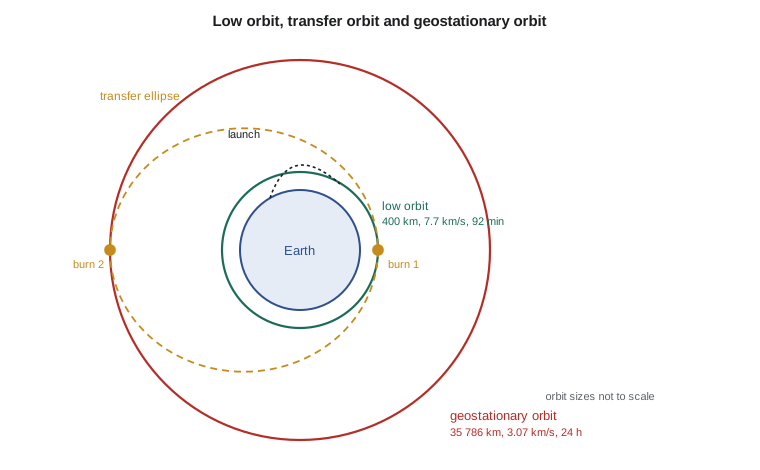
Most orbits are actually ellipses, with Earth at one focus. The closest point is the perigee and the farthest the apogee. Johannes Kepler described these orbits in the early 1600s from astronomical observations, and Newton explained them with gravity later that century. To move from one circular orbit to a higher one, a spacecraft can fire its engine to enter an elliptical transfer orbit whose apogee touches the higher orbit, then fire again at apogee to circularize. This two-burn maneuver, the Hohmann transfer, is the most energy-efficient way to change between two circular orbits.
# Orbital speed and the rocket equation
import math
mu = 3.986e14          # Earth's gravitational parameter, m^3/s^2
Re = 6.371e6
for h_km in (200, 400, 800, 35786):
    r = Re + h_km * 1000
    v = math.sqrt(mu / r)
    T = 2 * math.pi * math.sqrt(r**3 / mu)
    print(f"circular orbit {h_km:6d} km: v = {v/1000:5.2f} km/s, period {T/60:7.1f} min")

g0 = 9.80665
def dv(isp, m0, mf): return isp * g0 * math.log(m0 / mf)
print("\nSingle stage, Isp 300 s, structure 10% of propellant-plus-structure, 1% payload:")
m_pay, m0 = 1.0, 100.0
m_struct = 0.10 * (m0 - m_pay)
print(f"  delta-v = {dv(300, m0, m_pay + m_struct)/1000:.2f} km/s")
print("Two stages splitting the same mass:")
# stage 1 burns, drops its structure, stage 2 continues
m1_prop = 70.0; m1_str = m1_prop / 9; m2_total = m0 - m1_prop - m1_str
m2_prop = (m2_total - m_pay) * 0.9; m2_str = (m2_total - m_pay) * 0.1
dv1 = dv(300, m0, m0 - m1_prop)
dv2 = dv(340, m2_total, m2_total - m2_prop)
print(f" stage 1 {dv1/1000:.2f} km/s + stage 2 {dv2/1000:.2f} km/s = {(dv1+dv2)/1000:.2f} km/s")circular orbit 200 km: v = 7.79 km/s, period 88.4 min circular orbit 400 km: v = 7.67 km/s, period 92.4 min circular orbit 800 km: v = 7.46 km/s, period 100.7 min circular orbit 35786 km: v = 3.07 km/s, period 1435.7 min Single stage, Isp 300 s, structure 10% of propellant-plus-structure, 1% payload: delta-v = 6.52 km/s Two stages splitting the same mass: stage 1 3.54 km/s + stage 2 6.54 km/s = 10.09 km/s
How a rocket works
A rocket carries both its fuel and its oxidizer, so it can work in the vacuum of space. It burns them in a combustion chamber at high pressure and expands the hot gas through a converging-diverging nozzle, which accelerates the exhaust to several kilometers per second. Thrust comes from the momentum of the exhaust plus a pressure term that depends on the difference between the nozzle exit pressure and the surrounding pressure; in a vacuum, that pressure term is largest.
The specific impulse, \(I_{sp}\), measures how efficiently a rocket uses propellant: the thrust produced per unit weight of propellant consumed per second, expressed in seconds. It equals the effective exhaust velocity divided by standard gravity, \(g_0 = 9.80665\ \text{m/s}^2\). Higher is better. Solid rocket motors reach about 250 to 290 s; kerosene and liquid oxygen engines about 300 to 350 s; liquid hydrogen and oxygen engines about 450 s in vacuum. Electric thrusters on satellites reach 1500 to 3000 s or more, but with tiny thrust, suitable only for slow maneuvers in space.
| Propulsion type | Typical specific impulse (s) | Uses |
|---|---|---|
| Solid rocket motor | 250 to 290 | Boosters, missiles, small launchers |
| Kerosene and liquid oxygen | 300 to 350 | First and upper stages of many launchers |
| Methane and liquid oxygen | 330 to 380 | Newer reusable launchers |
| Liquid hydrogen and liquid oxygen | about 450 in vacuum | High-performance upper stages |
| Storable hypergolic propellants | 280 to 320 | Spacecraft maneuvering and orbit insertion |
| Electric (ion or Hall-effect) thrusters | 1500 to 3000+ | Satellite station-keeping and orbit raising |
The rocket equation
In 1903 Konstantin Tsiolkovsky derived the equation that rules all of rocketry. As a rocket burns propellant, it gets lighter, and each kilogram of exhaust pushes a lighter vehicle. Integrating Newton's second law over the burn, in the absence of gravity and drag, gives the ideal change in velocity, \(\Delta v\), in terms of the exhaust velocity and the ratio of the initial mass to the final mass.
The logarithm is the problem. Reaching low Earth orbit requires about 9.3 to 10 km/s of \(\Delta v\) in practice: about 7.8 km/s of orbital speed plus 1.5 to 2 km/s lost to gravity while climbing and to air drag. With a kerosene engine of \(I_{sp} = 330\ \text{s}\), \(I_{sp}g_0 \approx 3.2\ \text{km/s}\), so the mass ratio must be about \(e^{9.4/3.2} \approx 19\): the vehicle must be 95 percent propellant at lift-off. The tanks, engines, structure, avionics and payload must all fit in the remaining 5 percent. No single-stage vehicle has yet reached orbit with a useful payload, because tanks and engines cannot be made that light.
Staging
The solution is staging: discarding empty tanks and engines once their propellant is used, so that later stages do not have to carry dead weight. A two-stage rocket gets two shots at the rocket equation, each with a good mass ratio. The program for this lesson shows the effect: a single stage with 10 percent structure and 1 percent payload reaches about 6.5 km/s, far short of orbit, while splitting the same total mass into two stages and using a more efficient upper-stage engine reaches about 10 km/s. Most orbital launchers use two or three stages, and some add strap-on boosters for extra thrust at lift-off.
Worked problem
Velocity change from a two-stage rocket
A rocket has a lift-off mass of 100 units, of which 1 is payload. Stage 1 carries 70 units of propellant with structure equal to one-ninth of that (7.78 units) and \(I_{sp} = 300\ \text{s}\). The remaining 22.2 units form stage 2 and payload; stage 2 is 90 percent propellant and 10 percent structure (excluding payload), with \(I_{sp} = 340\ \text{s}\). Find the ideal \(\Delta v\).
Show solution
- Stage 1: \(\Delta v_1 = 300 \times 9.81 \times \ln(100/30) = 3.54\ \text{km/s}\).
- Stage 2 mass: 22.2 units, including 1 unit of payload; propellant \(0.9 \times 21.2 = 19.1\) units.
- Stage 2: \(\Delta v_2 = 340 \times 9.81 \times \ln(22.2/3.1) = 6.54\ \text{km/s}\).
- Total: \(3.54 + 6.54 = 10.1\ \text{km/s}\), enough to reach low orbit after gravity and drag losses.
Answer: Only 1 percent of the lift-off mass reaches orbit as payload, which is typical for expendable rockets. This is why launch costs have historically been measured in thousands of dollars per kilogram, and why recovering and reusing first stages, now routine for some launchers, has cut costs so much. The interstage that Prairiewind Aerospace is building carries the full thrust of stage 1 into stage 2 at maximum acceleration, which is why it must be strong and stiff yet as light as possible.
Launch loads and the space environment
Launch is violent. The structure must carry the thrust of the engines, the weight of everything above it multiplied by axial accelerations that build to several g as propellant burns off, bending loads from wind and steering, and intense acoustic and vibration loads near lift-off. The point of maximum dynamic pressure, max q, typically occurs about a minute into flight, when the vehicle is moving fast through still-dense air; engines are often throttled back to keep loads down. Satellites are designed and tested to survive these loads before they ever see space.
Space itself is harsh in different ways. A spacecraft faces a vacuum, which makes some materials release gases and makes lubricants behave differently; temperature swings of hundreds of degrees between sunlight and shadow; radiation that degrades electronics and solar cells; atomic oxygen in low orbit that erodes some surfaces; and the threat of collision with orbital debris traveling at kilometers per second. Thermal control, radiation-tolerant electronics, shielding and careful materials selection are part of every spacecraft design.
Orbital debris is a growing concern. Tens of thousands of tracked objects, and many more too small to track, orbit Earth. A collision at orbital speed can shatter a satellite into thousands of pieces, which in turn threaten others. International guidelines ask operators to remove satellites from low orbit within a set time after their missions end, usually by lowering them so drag pulls them into the atmosphere to burn up, and regulators now require debris mitigation plans as a condition of licensing. In the United States, the Federal Communications Commission adopted a five-year post-mission disposal rule for low-orbit satellites in 2022.
Space programs and regulation
In the United States, NASA leads civil space science and exploration, while commercial companies now build and fly most launch vehicles and many spacecraft under contract. The FAA's Office of Commercial Space Transportation licenses commercial launches and re-entries under 14 CFR Part 450, which focuses on public safety on the ground and in the air. The Federal Communications Commission licenses satellite radio frequencies and enforces debris mitigation rules, and the National Oceanic and Atmospheric Administration licenses commercial remote-sensing satellites.
Internationally, the 1967 Outer Space Treaty sets the basic principles: space is free for exploration by all, no nation can claim sovereignty over celestial bodies, and states are responsible for their national space activities, including those of private companies. The Liability Convention makes the launching state liable for damage its space objects cause. These principles explain why launches need national licenses and why governments care about the safety and debris records of the companies they license.
Common mistakes
MistakeThinking astronauts in orbit are weightless because there is no gravity there.
InsteadGravity at 400 km is about 90 percent of its surface value; astronauts are in free fall along with their spacecraft.
MistakeBelieving higher orbits require higher orbital speeds.
InsteadCircular orbital speed falls with altitude, v = √(μ/r), although reaching a higher orbit takes more total energy.
MistakeUsing only the 7.8 km/s orbital speed to size a launcher.
InsteadGravity and drag losses add 1.5 to 2 km/s; launchers need about 9.3 to 10 km/s of Δv.
MistakeAssuming more propellant always gives proportionally more Δv.
InsteadΔv grows only with the logarithm of the mass ratio; staging and higher Isp matter more.
MistakeTreating specific impulse as a measure of thrust.
InsteadIsp measures efficiency per unit of propellant; electric thrusters have very high Isp but tiny thrust.
Summary and key terms
- An orbit is continuous free fall; circular orbital speed is \(v = \sqrt{\mu/r}\), about 7.7 km/s in low orbit and 3.07 km/s at geostationary altitude.
- Elliptical orbits have a perigee and apogee; a Hohmann transfer moves efficiently between circular orbits.
- Rockets carry fuel and oxidizer; specific impulse measures propellant efficiency.
- The rocket equation \(\Delta v = I_{sp}g_0\ln(m_0/m_f)\) forces launchers to be mostly propellant; staging makes orbit achievable.
- Launch structures face high axial, bending, acoustic and vibration loads; spacecraft must survive vacuum, temperature extremes, radiation and debris.
- National agencies license launches and frequencies under international treaties that make states responsible for their space activities.
- Orbit
- The path of a body in free fall around another, moving sideways fast enough not to hit it.
- Low Earth orbit
- Orbits from roughly 200 to 2000 km altitude.
- Geostationary orbit
- A circular equatorial orbit 35,786 km up with a period of one sidereal day.
- Hohmann transfer
- A two-burn, minimum-energy maneuver between two circular orbits using an elliptical transfer orbit.
- Specific impulse
- Thrust per unit weight flow of propellant, in seconds; a measure of rocket efficiency.
- Rocket equation
- Tsiolkovsky's relation Δv = I_sp g₀ ln(m₀/m_f).
- Mass ratio
- Initial mass divided by final mass for a rocket stage.
- Staging
- Discarding empty tanks and engines during ascent to improve performance.
- Max q
- The point of maximum dynamic pressure during ascent.
- Orbital debris
- Defunct satellites, spent stages and fragments orbiting Earth.
Practice problems
Work each problem on paper first, then reveal the answer to check.
Find the circular orbital speed at 600 km altitude.
Show answer
r = 6971 km; v = √(3.986 × 10¹⁴/6.971 × 10⁶) = 7.56 km/s.
A rocket engine has Isp = 320 s. What is its effective exhaust velocity?
Show answer
320 × 9.81 = 3.14 km/s.
Find the ideal Δv of a stage with Isp = 300 s and mass ratio 8.
Show answer
300 × 9.81 × ln 8 = 6.12 km/s.
What mass ratio does a single stage with Isp = 450 s need for Δv = 9.5 km/s?
Show answer
e^(9500/4415) = e^2.15 ≈ 8.6.
Why can electric thrusters not launch rockets from the ground?
Show answer
Their thrust is far smaller than the vehicle's weight, even though their specific impulse is very high.
In the program, raise stage 2's Isp to 450 s. What is the new total Δv?
Show answer
Stage 2 rises to about 8.66 km/s, giving about 12.2 km/s in total.
Lesson quiz · 5 questions
Score 60% or more to complete this lesson.
Create a free account to save your progress, take quizzes and earn a certificate.