
AERO-200 · Lesson 7 of 12 · 22 min
Stability and control basics
During a design review, Élise asks the room a question that seems simple: if a gust bumps the Tern's nose up while the pilot's hands are off the controls, what happens next? Does the nose come back down, keep rising, or swing up and down for a while? The answer depends on where the center of gravity sits relative to an aerodynamic point called the neutral point, on the size of the tail, and on how the design team has arranged the controls. Arjun spends the next two weeks helping Sam's flight test group prepare a loading envelope, and in the process learns the basics of aircraft stability and control.
Axes and controls
An aircraft rotates about three axes through its center of gravity. The longitudinal axis runs from nose to tail; rotation about it is roll. The lateral axis runs from wingtip to wingtip; rotation about it is pitch. The vertical axis runs top to bottom; rotation about it is yaw. The primary flight controls act on these axes: the elevator, on the horizontal tail, controls pitch; the ailerons, near the wingtips, control roll; and the rudder, on the vertical fin, controls yaw. In the cockpit, the pilot moves a control column or stick fore and aft for pitch and side to side for roll, and presses rudder pedals for yaw.
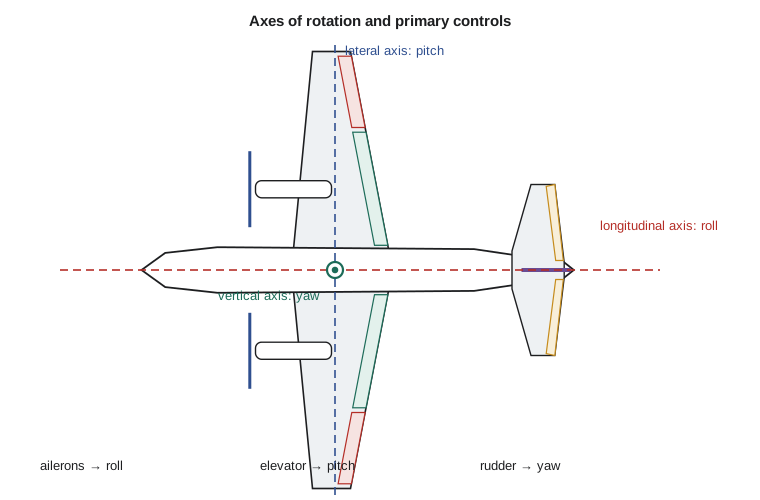
Control surfaces work by changing the camber of the surface they are attached to. Deflecting the elevator trailing edge down increases the lift on the horizontal tail, pushing the tail up and the nose down. Raising one aileron and lowering the other increases lift on one wing and reduces it on the other, rolling the aircraft. Rudder deflection produces a side force on the fin that yaws the nose. Secondary controls include flaps, spoilers, trim tabs and, on larger aircraft, an adjustable horizontal stabilizer used for pitch trim.
What stability means
An aircraft is statically stable if, after a disturbance, the forces and moments that arise tend to return it toward its original condition. A marble in a bowl is statically stable; a marble balanced on top of an upturned bowl is unstable; a marble on a flat table is neutrally stable. Static stability describes only the initial tendency. Dynamic stability describes what happens over time: whether the motion dies out, oscillates with growing amplitude, or diverges. An aircraft can be statically stable but dynamically unstable, for example if it overcorrects and oscillates with increasing amplitude.
Pilots generally want positive static stability in pitch and yaw, so the aircraft holds its speed and heading with little attention, and a mild tendency in roll to return to wings level. Too much stability makes an aircraft sluggish and tiring to maneuver; too little makes it twitchy and hard to fly accurately. Fighter aircraft are often designed to be slightly unstable for agility, with computers making constant corrections; transport and commuter aircraft are designed to be stable even without computers, because certification requires it for most aircraft and because it provides a safety margin if systems fail.
Longitudinal static stability
Pitch stability is the most important and the easiest to understand. Consider the aircraft's pitching moment about its center of gravity. If a gust raises the nose, the angle of attack of both the wing and the tail increases, and both produce more lift. The wing's extra lift acts near its aerodynamic center, close to a quarter of the way back along the chord. The tail's extra lift acts far behind the center of gravity, with a long moment arm, and pushes the nose back down. The combined aircraft has an aerodynamic center of its own, called the neutral point, where the change in total lift effectively acts.
If the center of gravity is ahead of the neutral point, extra lift from a nose-up disturbance acts behind the center of gravity and produces a nose-down restoring moment: the aircraft is stable. If the center of gravity is behind the neutral point, the same disturbance produces a nose-up moment that increases the disturbance: the aircraft is unstable. The distance between them, measured as a fraction of the mean aerodynamic chord, is the static margin. Most transport and commuter aircraft operate with static margins of about 5 to 20 percent of the mean aerodynamic chord.
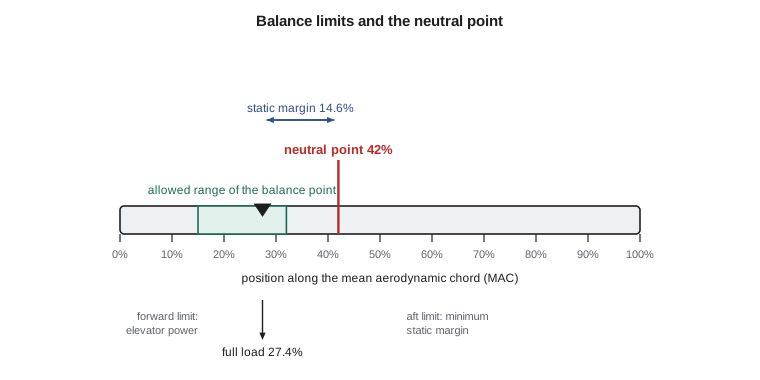
The derivative \(dC_m/dC_L\), the change in pitching-moment coefficient per unit change in lift coefficient, equals minus the static margin. A negative slope means stability. Engineers estimate the neutral point from the wing's aerodynamic center, the tail's size and distance from the wing, and the downwash the wing sends onto the tail. The tail volume coefficient, the tail area times its moment arm divided by the wing area times the mean chord, is a quick measure of how much stabilizing power the tail provides; values around 0.5 to 1.0 are typical for the horizontal tail.
Trim and the center-of-gravity envelope
A stable aircraft also needs to be in balance, or trimmed, so that the total pitching moment about the center of gravity is zero at the desired speed. Wing lift acting behind the center of gravity, plus the nose-down pitching moment of a cambered wing, usually has to be balanced by a small downward force on the tail. The pilot sets the elevator or stabilizer angle, or adjusts a trim tab, so this balance occurs with no force on the controls. Moving the center of gravity forward increases stability but requires more tail download to trim, which adds drag and makes the elevator work harder; at some forward position the elevator can no longer raise the nose for take-off rotation or the landing flare.
These two effects set the center-of-gravity envelope. The aft limit is set by the minimum acceptable static margin and by handling qualities; the forward limit by elevator power at low speed. The aircraft must be loaded so that the center of gravity stays inside the envelope throughout the flight, as fuel burns off and passengers move. For the Tern, the batteries do not change weight during flight, which simplifies things, but passengers sitting in different rows and baggage in the aft hold move the center of gravity significantly. Every flight begins with a weight and balance calculation.
Worked problem
Weight and balance for the Tern
Find the Tern's center of gravity and static margin with a full load and with no passengers in rows 4 and 5 and no aft baggage. The empty aircraft (4300 kg, 9480 lb) has its center of gravity 0.85 m (2.8 ft) aft of the leading edge of the mean aerodynamic chord (MAC). The crew (180 kg) sit 3.6 m ahead of it, rows 1–3 (450 kg) 1.2 m ahead, rows 4–5 (300 kg) 1.6 m behind, aft baggage (150 kg) 4.2 m behind, and the energy storage (1120 kg) 1.10 m behind. The MAC is 2.7 m (8.9 ft) long and the neutral point is at 42 percent MAC.
Show solution
- Moments about the MAC leading edge (mass × arm, positive aft): empty 3655, crew −648, rows 1–3 −540, rows 4–5 480, baggage 630, energy storage 1232 kg·m.
- Full load: total mass 6500 kg, total moment 4809 kg·m, so \(x_{cg} = 4809/6500 = 0.740\ \text{m}\), which is \(0.740/2.7 = 27.4\%\) MAC.
- Static margin, full load: \(42.0 - 27.4 = 14.6\%\) MAC.
- Without rows 4–5 and aft baggage: mass 6050 kg, moment 3699 kg·m, \(x_{cg} = 0.611\ \text{m} = 22.6\%\) MAC, static margin 19.4%.
Answer: Both loadings sit inside a typical envelope. Removing the aft passengers and baggage moves the center of gravity forward and makes the aircraft more stable but heavier on the controls during the landing flare. The flight test team will verify both ends of the envelope by flying with ballast at the forward and aft limits.
# Static margin and the center of gravity envelope
c = 2.7                 # mean aerodynamic chord, m
x_np = 0.42             # neutral point, fraction of chord aft of the MAC leading edge
items = [               # (name, mass kg, arm m from the MAC leading edge)
    ("empty aircraft", 4300, 0.85),
    ("crew", 180, -3.6),
    ("passengers row 1-3", 450, -1.2),
    ("passengers row 4-5", 300, 1.6),
    ("baggage, aft", 150, 4.2),
    ("fuel or battery mass", 1120, 1.10),
]
def cg(selected):
    mass = sum(m for _, m, _ in selected)
    moment = sum(m * x for _, m, x in selected)
    return mass, moment / mass
for label, sel in (("full load", items), ("no aft passengers or baggage", items[:3] + items[5:])):
    mass, x = cg(sel)
    xc = x / c
print(f"{label:<30} mass {mass:5.0f} kg cg {xc*100:5.1f}% MAC static margin {(x_np - xc)*100:5.1f}% MAC")full load mass 6500 kg cg 27.4% MAC static margin 14.6% MAC no aft passengers or baggage mass 6050 kg cg 22.6% MAC static margin 19.4% MAC
Lateral and directional stability
Directional stability, also called weathercock stability, comes mainly from the vertical fin. If the aircraft yaws so the nose points left of the flight path, the airflow strikes the fin at an angle, producing a side force that swings the nose back, just as a weathervane points into the wind. A larger fin, or one further aft, increases directional stability. The fin must also be big enough, with an effective rudder, to keep a twin-engine aircraft straight when one engine fails at low speed; the minimum control speed, \(V_{MC}\), is the lowest speed at which the pilot can do so.
Roll stability comes from dihedral, the upward angle of the wings when seen from the front, and from wing position. When a twin like the Tern sideslips, the wing on the side toward the slip meets the air at a higher angle of attack and gains lift, rolling the aircraft away from the slip and back toward level. A high wing adds a similar effect because the fuselage diverts air upward under the forward wing. High-wing aircraft therefore often need little or no geometric dihedral; some even use anhedral, a downward angle, to avoid excessive roll stability.
Roll and yaw are coupled. Rolling into a turn with ailerons produces adverse yaw, a swing of the nose away from the turn caused by the extra induced drag on the rising wing. Pilots counter it with coordinated rudder, and designers reduce it with differential ailerons or spoilers. Two lateral-directional dynamic modes are important: the Dutch roll, a combined yawing and rolling oscillation that yaw dampers suppress on larger aircraft, and the spiral mode, a slow tendency to roll further into a bank. A slightly divergent spiral mode is acceptable because a pilot easily corrects it.
Dynamic modes and flight controls
In pitch, aircraft show two characteristic oscillations. The short-period mode is a rapid pitching motion lasting a second or two, usually heavily damped. The phugoid is a slow exchange of speed and height with a period of half a minute or more, in which the aircraft climbs and slows, then dives and speeds up. It is lightly damped but so slow that pilots correct it almost without noticing. Flight test engineers excite these modes deliberately with control inputs and measure their frequency and damping against handling-qualities criteria.
In small aircraft, control surfaces connect to the cockpit by cables, pushrods and bellcranks. Larger aircraft add hydraulic actuators, because aerodynamic forces would be too large for a pilot to overcome. Many modern aircraft use fly-by-wire: the pilot's inputs go to flight control computers, which command electric or hydraulic actuators. Fly-by-wire saves weight, enables envelope protection that prevents stalls and overspeeds, and lets designers tailor handling qualities in software. It also places a heavy burden on software assurance and redundancy, discussed in Lesson 11. The Tern uses conventional cable controls for pitch and roll, with an electric trim system and a simple autopilot.
Common mistakes
MistakeThinking the center of gravity can be anywhere as long as the aircraft is balanced.
InsteadStability requires the center of gravity to be ahead of the neutral point by an adequate static margin.
MistakeAssuming more stability is always better.
InsteadToo much stability makes an aircraft sluggish and limits elevator power for take-off and landing.
MistakeConfusing static and dynamic stability.
InsteadStatic stability is the initial tendency to return; dynamic stability is whether the motion eventually dies out.
MistakeBelieving the elevator works by pushing the tail down directly.
InsteadElevator deflection changes the tail's camber and lift; the moment about the center of gravity rotates the aircraft.
MistakeIgnoring passenger and baggage positions in a small aircraft.
InsteadIn small aircraft, a few people moving seats can shift the center of gravity significantly; weight and balance is required before every flight.
Summary and key terms
- Aircraft roll, pitch and yaw about the longitudinal, lateral and vertical axes, controlled by ailerons, elevator and rudder.
- Static stability is the tendency to return after a disturbance; dynamic stability describes whether the resulting motion dies out.
- Pitch stability requires the center of gravity ahead of the neutral point; the static margin is their separation as a fraction of the mean chord.
- The center-of-gravity envelope's aft limit comes from minimum static margin and its forward limit from elevator power.
- The fin gives directional stability; dihedral and a high wing give roll stability; adverse yaw and Dutch roll couple roll and yaw.
- The short-period and phugoid modes describe pitch dynamics; fly-by-wire systems use computers between the pilot and the control surfaces.
- Roll, pitch and yaw
- Rotations about the longitudinal, lateral and vertical axes.
- Static stability
- The initial tendency of an aircraft to return toward equilibrium after a disturbance.
- Dynamic stability
- Whether the motion after a disturbance decays over time.
- Neutral point
- The point where the total change in aerodynamic lift acts; the aft limit for a stable center of gravity.
- Static margin
- The distance from the center of gravity to the neutral point, as a fraction of the mean aerodynamic chord.
- Mean aerodynamic chord
- A representative chord used as the reference length for pitching moments and stability.
- Trim
- The condition in which the moments about the center of gravity are balanced with no control force.
- Dihedral
- The upward angle of the wings from root to tip, seen from the front.
- Adverse yaw
- A yaw away from the direction of roll, caused by differential induced drag on the wings.
- Phugoid
- A slow, lightly damped oscillation exchanging airspeed and altitude.
- Fly-by-wire
- A control system in which pilot inputs pass through computers to the actuators.
Practice problems
Work each problem on paper first, then reveal the answer to check.
Which control surface controls pitch, and on which axis does it act?
Show answer
The elevator; it rotates the aircraft about the lateral axis.
The neutral point is at 40 percent MAC and the center of gravity at 28 percent MAC. Find the static margin.
Show answer
12 percent MAC.
An aircraft's center of gravity moves to 45 percent MAC with the neutral point at 40 percent. What happens?
Show answer
The static margin is −5 percent: the aircraft is statically unstable in pitch.
Compute the horizontal tail volume coefficient for S_H = 6 m², l_H = 8 m, S = 28 m² and MAC = 2.7 m.
Show answer
V_H = (6 × 8)/(28 × 2.7) = 0.63.
Explain adverse yaw and one way to reduce it.
Show answer
The wing with the lowered aileron makes more lift and more induced drag, yawing the nose away from the turn; differential ailerons, spoilers or coordinated rudder reduce it.
In the program, move the aft baggage 1 m further aft. How does the full-load static margin change?
Show answer
The cg moves aft by 150/6500 = 0.023 m, 0.9 percent MAC, so the static margin falls from 14.6 to about 13.8 percent.
Lesson quiz · 5 questions
Score 60% or more to complete this lesson.
Create a free account to save your progress, take quizzes and earn a certificate.