
AERO-200 · Lesson 5 of 12 · 23 min
Propulsion overview
The Tern's powertrain is the riskiest part of the program. Two 450 kW electric motors turn the propellers. A 1100 kg battery pack supplies peak power for take-off and climb. A small turboshaft engine, a gas turbine that drives a shaft rather than producing jet thrust, turns a generator that recharges the battery and powers the motors in cruise. Arjun spends a week with the powertrain team and comes away with a lot of questions. Why propellers rather than a jet? Why not batteries alone? Why does a turbine burn more fuel per kilowatt at part power? This lesson introduces the main ways aircraft produce thrust and the numbers that let engineers compare them.
How thrust is produced
Every air-breathing propulsor works the same way at heart: it takes in air, accelerates it backward, and by Newton's third law the air pushes the aircraft forward. If a mass flow \(\dot{m}\) of air enters at the flight speed \(V_0\) and leaves at a higher speed \(V_e\), the thrust is the rate of change of the air's momentum. A jet engine also adds fuel, and a nozzle may leave the exhaust at a pressure above ambient, adding a small pressure-thrust term, but the momentum term dominates.
The same thrust can come from accelerating a small mass of air a lot or a large mass a little. These are not equally efficient. The useful power delivered to the aircraft is thrust times flight speed, \(TV_0\). The power put into the air is the increase in its kinetic energy, \(\tfrac{1}{2}\dot{m}(V_e^2 - V_0^2)\). Their ratio is the propulsive efficiency, often called the Froude efficiency.
Propulsive efficiency approaches 1 as the exhaust speed approaches the flight speed. A propeller, which accelerates a very large mass of air by a small amount, can reach propulsive efficiencies above 0.85. A turbojet, which accelerates a small mass of air to a very high speed, is much less efficient at low flight speeds. The program for this lesson shows three ways to make the same 2 kN of thrust at the Tern's cruise speed and how much the efficiency changes.
# Thrust, propulsive efficiency and fuel or energy use for three propulsors
import math
V0 = 105.6                     # flight speed, m/s

def jet(mdot, Ve):
    T = mdot * (Ve - V0)                      # momentum thrust (pressure thrust ignored)
    eta_p = 2 / (1 + Ve / V0)                 # Froude propulsive efficiency
    return T, eta_p

print("Same thrust from a small fast jet or a large slow one:")
for mdot, Ve in ((20.0, 205.6), (80.0, 130.6), (400.0, 110.6)):
    T, eta = jet(mdot, Ve)
    print(f"  mass flow {mdot:6.1f} kg/s, exit {Ve:6.1f} m/s -> thrust {T/1000:5.2f} kN, propulsive efficiency {eta:.2f}")

# Turboprop shaft power needed for 2.0 kN of thrust at cruise
T_req, eta_prop = 2000.0, 0.82
P_shaft = T_req * V0 / eta_prop
sfc = 0.30          # kg of fuel per kWh of shaft power (typical small turboprop, illustrative)
print(f"\nShaft power for {T_req/1000:.1f} kN at {V0*3.6:.0f} km/h: {P_shaft/1000:.0f} kW ({P_shaft/745.7:.0f} hp)")
print(f"Fuel flow: {sfc*P_shaft/1000:.0f} kg/h")

# Battery mass for one hour at that power
e_batt = 250.0      # Wh/kg at pack level (illustrative)
eta_chain = 0.90    # battery to shaft
m_batt = P_shaft / eta_chain / e_batt
print(f"Battery for one hour at that power: {m_batt:.0f} kg; jet fuel for one hour: {sfc*P_shaft/1000:.0f} kg")Same thrust from a small fast jet or a large slow one: mass flow 20.0 kg/s, exit 205.6 m/s -> thrust 2.00 kN, propulsive efficiency 0.68 mass flow 80.0 kg/s, exit 130.6 m/s -> thrust 2.00 kN, propulsive efficiency 0.89 mass flow 400.0 kg/s, exit 110.6 m/s -> thrust 2.00 kN, propulsive efficiency 0.98 Shaft power for 2.0 kN at 380 km/h: 258 kW (345 hp) Fuel flow: 77 kg/h Battery for one hour at that power: 1145 kg; jet fuel for one hour: 77 kg
The gas turbine and its family
Most aircraft above the smallest sizes are powered by gas turbines. A gas turbine compresses air, burns fuel in it at nearly constant pressure, and expands the hot gas through a turbine that drives the compressor. This is the Brayton cycle. Higher compressor pressure ratios and higher turbine inlet temperatures make the cycle more efficient, which is why engine makers push materials and cooling to their limits; modern turbine blades run in gas hotter than the melting point of the metal they are made from, protected by internal cooling passages and ceramic coatings.
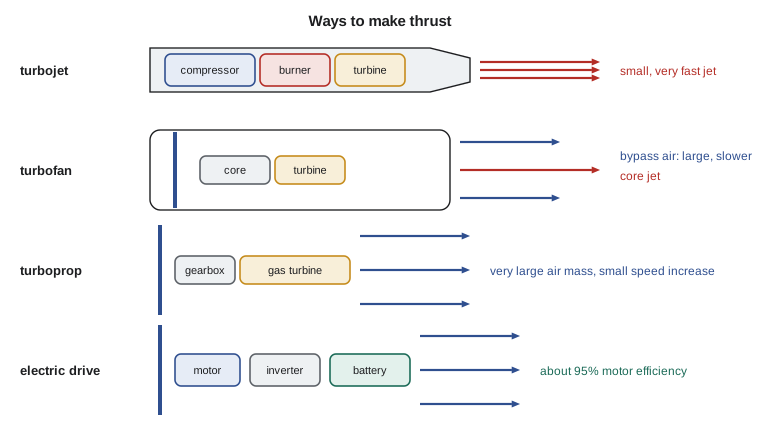
The turbojet uses all of its turbine's excess energy to accelerate a hot, fast exhaust jet. It is simple and light but noisy and inefficient below supersonic speeds, so it survives mainly in missiles and some military aircraft. The turbofan adds a large fan at the front, driven by the turbine. Most of the air the fan moves bypasses the core and leaves through a separate nozzle at moderate speed. The bypass ratio, the mass of bypass air divided by the mass of core air, is 9 to 12 in the latest airliner engines. High bypass ratios mean high propulsive efficiency and low noise, and they explain why modern engines have such large diameters.
The turboprop takes the idea further: almost all the turbine's energy drives a propeller through a reduction gearbox, because the turbine spins at tens of thousands of rpm while the propeller turns at about 1000 to 2000 rpm. Turboprops are the most fuel-efficient choice below about 650 km/h (350 kt) and are common on regional airliners, bush planes and military transports. The turboshaft is mechanically similar but drives a helicopter rotor or, in the Tern's case, an electric generator. Above Mach 0.6 or so, propeller blade tips approach the speed of sound and efficiency drops, which is why faster aircraft use turbofans.
| Propulsor | Typical speed range | Strengths | Weaknesses |
|---|---|---|---|
| Piston engine and propeller | up to about 350 km/h | Cheap, efficient at small sizes | Heavy per kilowatt, needs aviation gasoline or diesel |
| Turboprop | up to about 650 km/h | Best fuel efficiency for regional speeds | Propeller noise and gearbox weight |
| High-bypass turbofan | Mach 0.7 to 0.86 | Efficient and quiet at airliner speeds | Large, complex, expensive |
| Turbojet or low-bypass turbofan | supersonic | Compact, high thrust per frontal area | Poor efficiency at subsonic speeds |
| Electric motor and propeller | up to about 400 km/h | Very efficient, quiet, simple, flexible placement | Batteries store little energy per kilogram |
| Rocket | any, including space | Works without air | Carries its own oxidizer; very high propellant use |
Measuring engine efficiency
For an engine that produces shaft power, such as a piston engine or turboprop, fuel use is measured by the power-specific fuel consumption: kilograms of fuel burned per kilowatt-hour of shaft power (or pounds per horsepower-hour). Modern turboprops achieve about 0.27 to 0.33 kg/kWh at cruise. For a jet, the thrust-specific fuel consumption (TSFC) is fuel flow divided by thrust, in units such as kg/(N·h) or lb/(lbf·h); a modern high-bypass turbofan at cruise runs near 0.5 lb/(lbf·h). Lower is better in both cases. Specific fuel consumption appears directly in the Breguet range equation in Lesson 8.
Overall efficiency multiplies the engine's thermal efficiency (how much of the fuel's chemical energy becomes useful mechanical power) by the propulsive efficiency (how much of that power becomes useful thrust power). A modern turbofan has a thermal efficiency of about 50 percent and a propulsive efficiency around 75 to 80 percent, giving an overall efficiency near 40 percent. Gas turbines are most efficient near full power; at low power settings their fuel consumption per kilowatt rises, which is one reason the Tern's turboshaft is sized to run near its best point in cruise while the battery handles the peaks.
Propellers
A propeller is a rotating wing. Each blade section is an airfoil meeting air that combines the aircraft's forward speed with the blade's rotational speed; the blade is twisted so each section meets the air at an efficient angle. Variable-pitch propellers change the blade angle in flight, using fine pitch for take-off and coarser pitch for cruise, much as a car changes gears. If an engine fails, the propeller can be feathered, turned edge-on to the airflow, to cut drag. The Tern's five-bladed composite propellers are large and turn slowly, about 1400 rpm, to keep noise down near communities and to keep blade tips well below the speed of sound.
Propeller efficiency, the thrust power divided by the shaft power, \(\eta_{prop} = TV/P\), is about 0.80 to 0.88 in cruise for a well-matched propeller. It falls at low speed because the propeller is doing work on the air without the aircraft moving much, and at very high speed because of compressibility at the blade tips.
Worked problem
Shaft power and energy for the Tern in cruise
In cruise the Tern needs about 5.1 kN of thrust at 105.6 m/s (Lesson 3). With a propeller efficiency of 0.82, find the shaft power required. Compare the mass of jet fuel and of batteries needed to supply that power for one hour, using a specific fuel consumption of 0.30 kg/kWh for a turboshaft generator and 250 Wh/kg for a battery pack with 90 percent conversion efficiency to the shaft.
Show solution
- Shaft power: \(P = TV/\eta_{prop} = 5100 \times 105.6/0.82 = 657\ \text{kW}\) for both propellers together.
- Fuel for one hour through a turboshaft: \(0.30 \times 657 = 197\ \text{kg}\) (ignoring generator and motor losses).
- Battery energy needed: \(657\ \text{kWh}/0.90 = 730\ \text{kWh}\); at 250 Wh/kg that is \(730\,000/250 = 2920\ \text{kg}\).
Answer: The batteries are about 15 times heavier than the fuel for the same hour of cruise, before allowing for reserves. Jet fuel stores about 43 MJ/kg (11,900 Wh/kg) of chemical energy; even after a turbine converts only about a quarter to a third of it to shaft power, it beats today's batteries by a wide margin. That is why the Tern carries batteries only for short, high-power phases and burns fuel for the long cruise. The program's simpler case with 2 kN of thrust shows the same ratio.
Electric and hybrid-electric propulsion
Electric motors are light, compact and remarkably efficient: about 95 percent of the electrical power becomes shaft power, against roughly 30 to 40 percent for small gas turbines and piston engines. They have few moving parts, produce no local emissions, are quiet, and can be placed almost anywhere on the airframe, because power travels through cables rather than shafts. Designers exploit this freedom with distributed propulsion: many small motors along the wing, or ducted fans blended into the body.
The problem is energy storage. Today's best lithium-ion cells store about 250 to 300 Wh/kg, and a complete battery pack, with its structure, cooling and protection, stores less. Jet fuel stores about 40 times more per kilogram. Batteries also stay just as heavy when they are empty, so a battery-electric aircraft does not get lighter as it flies, unlike a fuel-burning one. These facts limit battery-electric aircraft to short flights with small payloads: trainers, air taxis and short commuter hops.
Hybrid-electric designs combine the two. In a series hybrid like the Tern, a gas turbine drives a generator; electrical power goes to the motors and, when there is a surplus, to the battery. In a parallel hybrid, an engine and a motor both drive the same propeller shaft. Hybrids allow the turbine to be sized for cruise rather than take-off and to run at its most efficient setting, while the battery supplies the extra power for take-off, climb and go-around. They also offer a path toward lower emissions as batteries improve or as sustainable fuels replace fossil fuel.
Other options: hydrogen and sustainable fuels
Hydrogen stores about 120 MJ/kg, nearly three times as much as jet fuel, and burns to water. It can power gas turbines directly or feed fuel cells that make electricity for motors. Its weakness is volume: even as a liquid at −253 °C it needs about four times the tank volume of jet fuel for the same energy, and the insulated tanks are heavy. Sustainable aviation fuels, made from waste oils, crop residues or captured carbon dioxide and hydrogen, are chemically similar to jet fuel and can be blended into it with no change to aircraft. They are expensive and produced in small quantities today, but they are the most practical near-term way to cut aviation's carbon dioxide emissions.
Common mistakes
MistakeThinking a faster exhaust jet is always better.
InsteadFor a given thrust, a slower, larger air flow is more propulsively efficient; the ideal exhaust speed is close to flight speed.
MistakeComparing batteries and fuel by energy alone.
InsteadAccount for conversion efficiencies, reserves and the fact that batteries do not get lighter as they discharge.
MistakeAssuming turboprops are old-fashioned.
InsteadBelow about 650 km/h, turboprops are the most fuel-efficient gas-turbine propulsors.
MistakeMixing up TSFC and power-specific fuel consumption.
InsteadJets are rated per unit thrust; turboprops and piston engines per unit shaft power.
MistakeForgetting propeller efficiency when converting shaft power to thrust.
InsteadThrust power is shaft power times propeller efficiency, typically 0.8 to 0.88 in cruise.
Summary and key terms
- Air-breathing propulsors make thrust by accelerating air: \(T = \dot{m}(V_e - V_0)\).
- Propulsive efficiency \(2/(1 + V_e/V_0)\) favors moving a large mass of air slowly, which is why propellers and high-bypass fans are efficient.
- Gas turbines run on the Brayton cycle; turbojets, turbofans, turboprops and turboshafts are variations on it.
- Engine fuel use is measured by thrust-specific or power-specific fuel consumption; overall efficiency is thermal times propulsive efficiency.
- Electric motors are efficient and flexible but limited by battery energy density; hybrids combine batteries for peak power with fuel for range.
- Hydrogen and sustainable aviation fuels are the main routes to lower-carbon flight beyond batteries.
- Thrust
- The forward force produced by accelerating air or exhaust backward.
- Propulsive efficiency
- Useful thrust power divided by the kinetic energy added to the air.
- Brayton cycle
- The thermodynamic cycle of a gas turbine: compression, constant-pressure heating and expansion.
- Bypass ratio
- The mass flow of air that bypasses the core of a turbofan divided by the core mass flow.
- Turboprop
- A gas turbine that drives a propeller through a reduction gearbox.
- Turboshaft
- A gas turbine that delivers shaft power to a rotor or generator.
- Thrust-specific fuel consumption
- Fuel mass flow per unit of thrust.
- Feathering
- Turning propeller blades edge-on to the airflow to minimize drag after an engine failure.
- Energy density
- Energy stored per unit mass (specific energy) or per unit volume.
- Series hybrid
- A powertrain in which an engine drives a generator that supplies electric motors and a battery.
Practice problems
Work each problem on paper first, then reveal the answer to check.
A jet takes in 50 kg/s of air at 200 m/s and exhausts it at 500 m/s. Find the thrust and propulsive efficiency.
Show answer
T = 50 × 300 = 15 kN; η_p = 2/(1 + 2.5) = 0.57.
A turbofan has a core mass flow of 40 kg/s and a bypass ratio of 10. What is the fan bypass mass flow?
Show answer
400 kg/s.
An aircraft needs 3 kN of thrust at 80 m/s with a propeller efficiency of 0.84. Find the shaft power.
Show answer
P = 3000 × 80/0.84 = 286 kW.
A turboprop burns 0.30 kg/kWh. How much fuel does it burn in 2 hours at 500 kW?
Show answer
0.30 × 500 × 2 = 300 kg.
A battery pack stores 220 Wh/kg. What mass stores 400 kWh?
Show answer
400 000/220 = 1818 kg.
In the program, raise the battery specific energy to 400 Wh/kg. How heavy is the one-hour battery now?
Show answer
About 716 kg, still more than nine times the 77 kg of fuel.
Lesson quiz · 5 questions
Score 60% or more to complete this lesson.
Create a free account to save your progress, take quizzes and earn a certificate.