
AERO-200 · Lesson 2 of 12 · 24 min
The atmosphere and standard atmosphere
On a July afternoon Sam Littlechild is planning a test flight of the Tern prototype from Wichita. The airport sits 406 m (1,333 ft) above sea level, the air temperature on the ramp is 35 °C, and the take-off distance chart in the draft flight manual is already pushing the runway limit. Sam asks Arjun to work out the density altitude. Arjun has never heard the term. By the end of this lesson he can explain why a hot day at a low airport makes an aircraft behave as if it were taking off from a mountain strip, and why every aircraft's performance is quoted in terms of an imaginary atmosphere that never exists on any real day.
Air is the medium every aircraft works in. Its density sets how much lift a wing produces and how much drag it suffers at a given speed. Its temperature sets the speed of sound and the power a turbine engine can deliver. Its pressure is what altimeters actually measure. All three change with height and with the weather, so engineers need a common reference against which designs, instruments and test results can be compared.
Layers of the atmosphere
Earth's atmosphere is about 78 percent nitrogen, 21 percent oxygen and 1 percent argon by volume, with small amounts of carbon dioxide and water vapor. Its composition is nearly constant up to about 80 km, but its temperature varies in a pattern that divides it into layers. In the troposphere, from the surface up to roughly 8 km at the poles and 16 km at the equator, temperature falls with height because the air is heated from below by the ground. Nearly all weather happens here, and most aircraft fly in it or just above it.
Above the troposphere lies the tropopause, where the temperature stops falling. In the stratosphere, from about 11 km to 50 km, temperature first stays nearly constant and then rises, because ozone absorbs ultraviolet sunlight. Airliners often cruise in the lower stratosphere, above most weather and turbulence. Above 50 km, the mesosphere cools again with height, and above about 85 km the thermosphere heats up dramatically but is so thin that the temperature has little practical meaning for a spacecraft. The boundary of space is often set at 100 km, the Kármán line, although some agencies use 80 km.
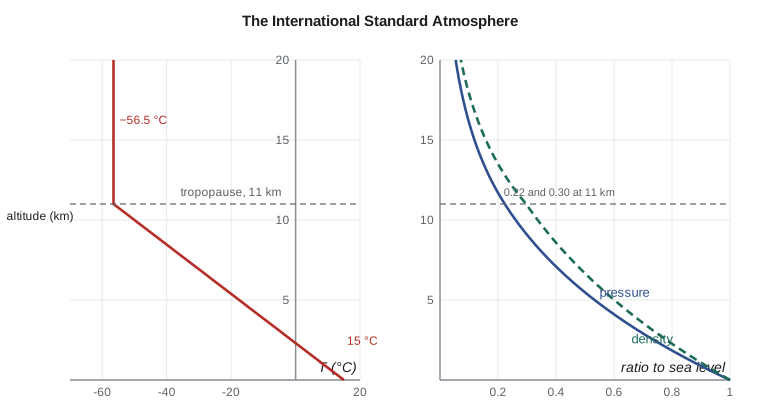
The International Standard Atmosphere
Real atmospheres vary from day to day and place to place. To compare aircraft and calibrate instruments, the International Civil Aviation Organization (ICAO) defines the International Standard Atmosphere, or ISA. It is a model of an average mid-latitude atmosphere with no moisture and no weather. Its sea-level values are a temperature of 15 °C (288.15 K), a pressure of 101.325 kPa (29.92 inches of mercury, or 1013.25 hPa) and a density of 1.225 kg/m³. In the troposphere the temperature falls by 6.5 °C per kilometer (about 2 °C per 1000 ft) up to 11 km (36,089 ft), where it reaches −56.5 °C. From 11 km to 20 km the temperature is constant.
| Quantity at ISA sea level | SI value | Common aviation value |
|---|---|---|
| Temperature | 288.15 K (15 °C) | 59 °F |
| Pressure | 101 325 Pa | 29.92 inHg, 1013.25 hPa |
| Density | 1.225 kg/m³ | 0.002377 slug/ft³ |
| Lapse rate in the troposphere | 6.5 K per km | about 1.98 °C per 1000 ft |
| Tropopause | 11 000 m, −56.5 °C | 36 089 ft |
| Speed of sound | 340.3 m/s | 661.5 kt |
Air in the atmosphere behaves very nearly as an ideal gas, so pressure, density and absolute temperature are linked by the equation of state \(p = \rho R T\), where \(R = 287.05\ \text{J/(kg·K)}\) for dry air. The second law the model needs is hydrostatic balance: pressure decreases with height because each layer of air must support the weight of the air above it, \(dp/dh = -\rho g\). Combining the two with the assumed temperature profile gives formulas for pressure and density at any height.
In the troposphere, where \(T = T_0 - Lh\) with \(L = 0.0065\ \text{K/m}\), integrating gives a power law. In the constant-temperature layer above 11 km, the same integration gives an exponential decay, with pressure halving roughly every 4.5 km.
Density follows from the equation of state once pressure and temperature are known. Engineers often use the density ratio \(\sigma = \rho/\rho_0\) as a single number that captures how thin the air is. At 3000 m, where the Tern cruises on short routes, \(\sigma \approx 0.74\); at 11 km, where airliners fly, \(\sigma \approx 0.30\).
Worked problem
ISA conditions at the Tern's cruise altitude
Find the ISA temperature, pressure and density at 3000 m (9843 ft).
Show solution
- Temperature: \(T = 288.15 - 0.0065(3000) = 268.65\ \text{K} = -4.5\ °\text{C}\).
- Pressure ratio: \(p/p_0 = (268.65/288.15)^{5.256} = 0.6919\), so \(p = 70.1\ \text{kPa}\).
- Density: \(\rho = p/(RT) = 70\,108/(287.05 \times 268.65) = 0.909\ \text{kg/m}^3\), so \(\sigma = 0.742\).
Answer: At 3000 m the air is about three-quarters as dense as at sea level. To produce the same lift at the same lift coefficient, the Tern must fly about 16 percent faster through the air, because lift depends on density times speed squared and \(1/\sqrt{0.742} = 1.16\).
# International Standard Atmosphere (troposphere and lower stratosphere)
import math
g0, R, T0, p0 = 9.80665, 287.05, 288.15, 101325.0
L = 0.0065                      # temperature lapse rate in the troposphere, K/m
T11, h11 = 216.65, 11000.0      # tropopause temperature and height

def isa(h):
    """Return T (K), p (Pa) and rho (kg/m^3) at geopotential height h in meters (0 to 20 km)."""
    if h <= h11:
        T = T0 - L * h
        p = p0 * (T / T0) ** (g0 / (R * L))
    else:
        T = T11
        p11 = p0 * (T11 / T0) ** (g0 / (R * L))
        p = p11 * math.exp(-g0 * (h - h11) / (R * T11))
    return T, p, p / (R * T)

print(" h (m)   h (ft)   T (C)    p (kPa)  rho (kg/m3)  sigma")
for h in (0, 406, 1500, 3000, 6000, 9000, 11000, 15000):
    T, p, rho = isa(h)
    print(f"{h:6d} {h/0.3048:8.0f} {T-273.15:7.1f} {p/1000:10.2f} {rho:10.4f} {rho/1.225:8.3f}")

# Density altitude on a hot day at the home airport
h, oat_c = 406, 35.0
T, p, _ = isa(h)
rho_hot = p / (R * (oat_c + 273.15))
# find the standard-atmosphere height with the same density by bisection
lo, hi = 0.0, 6000.0
for _ in range(60):
    mid = (lo + hi) / 2
    if isa(mid)[2] > rho_hot: lo = mid
    else: hi = mid
print(f"\nAt {h} m and {oat_c:.0f} C, density altitude = {lo:.0f} m ({lo/0.3048:.0f} ft)") h (m) h (ft) T (C) p (kPa) rho (kg/m3) sigma
0 0 15.0 101.33 1.2250 1.000
406 1332 12.4 96.54 1.1780 0.962
1500 4921 5.2 84.56 1.0581 0.864
3000 9843 -4.5 70.11 0.9091 0.742
6000 19685 -24.0 47.18 0.6597 0.539
9000 29528 -43.5 30.74 0.4663 0.381
11000 36089 -56.5 22.63 0.3639 0.297
15000 49213 -56.5 12.04 0.1937 0.158
At 406 m and 35 C, density altitude = 1187 m (3893 ft)Altimeters and altitudes
An aircraft altimeter is a barometer. It measures static pressure and converts it to a height using the ISA relationship. Because the real atmosphere rarely matches the ISA, pilots set a reference pressure on the altimeter. Near the ground they use the local altimeter setting reported by the airport, so that the altimeter reads the airport's elevation on landing. Above a transition altitude, all aircraft set the standard 29.92 inHg (1013.25 hPa), so that every aircraft's altimeter is wrong by the same amount and vertical separation is preserved. Their indicated heights are then called flight levels: FL 250 means 25,000 ft on a standard altimeter setting.
In the United States, the transition altitude is 18,000 ft everywhere: below it pilots use the local altimeter setting, and from 18,000 ft up (the bottom of Class A airspace) they set 29.92 inHg and fly flight levels.
Engineers and pilots distinguish several altitudes. Indicated altitude is what the altimeter shows. Pressure altitude is the height in the ISA that has the same pressure as the aircraft's location; it is what the altimeter shows when set to 29.92. Density altitude is the height in the ISA with the same density as the actual air. Aircraft performance, lift, drag, engine power and propeller thrust all depend on density, so density altitude is the one that governs take-off distance and climb rate.
Density altitude: the hot-day problem
On a hot day, air at a given pressure is less dense than standard, because density is inversely proportional to absolute temperature. The aircraft then performs as if it were at a higher altitude. Wings need more speed to lift off, propellers produce less thrust, and engines produce less power. High-elevation airports on hot days are the worst case: a summer afternoon in Denver or Calgary can produce density altitudes above 2500 m (8000 ft) on runways that sit around 1100 to 1700 m. Even Wichita, at 406 m, reaches a density altitude of about 1190 m (3890 ft) on a 35 °C afternoon, as the program shows.
Worked problem
Density altitude for Sam's test flight
The airport elevation is 406 m and the altimeter setting is standard, so the pressure altitude equals the elevation. The temperature is 35 °C. Find the actual air density and the density altitude.
Show solution
- Pressure at 406 m from the troposphere formula: \(p = 101.325(285.51/288.15)^{5.256} = 96.54\ \text{kPa}\).
- Actual density uses the actual temperature, \(T = 308.15\ \text{K}\): \(\rho = 96\,540/(287.05 \times 308.15) = 1.091\ \text{kg/m}^3\), against 1.178 kg/m³ on a standard day.
- Density altitude is the ISA height where the density is 1.091 kg/m³. The program finds it by bisection: about 1190 m (3890 ft), some 780 m above the field.
Answer: The Tern will need a longer take-off run than it would on a standard day, because its wing must reach a higher true airspeed for the same lift and its propellers give less thrust. Sam schedules the heavy-weight take-off tests for early morning, when the air is cooler and denser.
A useful rule of thumb in aviation is that density altitude rises about 120 ft for every degree Celsius above the ISA temperature at the airport's pressure altitude. For Wichita, where the ISA temperature at field elevation is about 12.4 °C, a 35 °C day is 22.6 °C above standard, so the density altitude is roughly 22.6 × 120 ≈ 2700 ft above the 1,333 ft field, about 4040 ft. The exact calculation in the program gives 3890 ft: close enough for a quick check.
Speed of sound, Mach number and temperature
The speed of sound in air depends only on temperature: \(a = \sqrt{\gamma R T}\), where \(\gamma = 1.4\) is the ratio of specific heats. At ISA sea level, \(a = 340\ \text{m/s}\) (661 kt); at the tropopause, where the air is −56.5 °C, it falls to 295 m/s (573 kt). The ratio of an aircraft's true airspeed to the local speed of sound is the Mach number, \(M = V/a\). Below about Mach 0.3 the air behaves as if it were incompressible, which simplifies analysis. Airliners cruise near Mach 0.78 to 0.85, where compressibility matters a great deal; the Tern cruises at about Mach 0.32, comfortably in the nearly incompressible range.
Temperature also limits engine power. A gas turbine's output depends on how much air mass flows through it each second, which falls as density falls. Many turbine engines are flat rated: they can produce their full rated power up to a certain temperature or altitude, but above it power falls. Electric motors are less sensitive to air density, but their cooling and the battery's temperature are not, which is one of the problems Prairiewind Aerospace's powertrain team must solve for both a Kansas winter and a 35 °C summer day.
Real atmospheres: wind, humidity and turbulence
The ISA ignores wind, humidity and turbulence, but real aircraft meet all three. Humid air is slightly less dense than dry air at the same temperature and pressure, because water vapor molecules are lighter than nitrogen and oxygen, so humid days also hurt performance a little. Wind changes ground speed and therefore range and runway distance: a headwind shortens the take-off ground roll, a tailwind lengthens it. Wind shear near the ground and turbulence at altitude impose loads on the structure, which Lesson 6 treats as gust loads. Icing occurs when an aircraft flies through cloud containing supercooled water droplets, a serious hazard for aircraft like the Tern that fly at lower altitudes in cold climates.
Because the real atmosphere varies so much, aircraft performance charts give values at ISA and at temperatures above and below it, such as ISA + 20 °C. Flight test data are reduced to standard conditions so that a test flown on a cold January morning can be compared fairly with one flown in July. Sam's flight test group spends a large part of its time on exactly this correction work.
Common mistakes
MistakeUsing sea-level density at cruise altitude.
InsteadDensity at 3000 m is only about 74 percent of the sea-level value, and at 11 km about 30 percent; always compute it for the flight condition.
MistakeUsing Celsius in the equation of state.
InsteadUse absolute temperature in kelvin: \(p = \rho R T\) with T in K.
MistakeTreating pressure altitude and density altitude as the same thing.
InsteadThey are equal only when the temperature is standard; on hot days density altitude is higher.
MistakeExpecting the speed of sound to depend on pressure.
InsteadFor an ideal gas it depends only on temperature, \(a = \sqrt{\gamma R T}\).
MistakeAssuming the ISA describes today's weather.
InsteadThe ISA is a reference model; actual temperature, pressure, humidity and wind must be measured and corrected for.
Summary and key terms
- Temperature falls with height in the troposphere, stays constant in the lower stratosphere and varies further up; the Kármán line at 100 km is a common boundary of space.
- The ISA is a reference atmosphere: 15 °C, 101.325 kPa and 1.225 kg/m³ at sea level, falling 6.5 °C per km to −56.5 °C at 11 km.
- Air obeys \(p = \rho R T\) and hydrostatic balance \(dp/dh = -\rho g\); these give pressure and density at any height.
- Altimeters measure pressure; above the transition altitude all aircraft use 29.92 inHg and fly flight levels.
- Density altitude governs aircraft performance; hot days and high airports raise it.
- The speed of sound depends only on temperature; Mach number is true airspeed divided by the local speed of sound.
- Troposphere
- The lowest layer of the atmosphere, where temperature falls with height and weather occurs.
- Tropopause
- The boundary at the top of the troposphere; 11 km in the ISA.
- International Standard Atmosphere
- ICAO's reference model of temperature, pressure and density against height.
- Lapse rate
- The rate at which temperature falls with height; 6.5 K per km in the ISA troposphere.
- Density ratio
- Air density divided by the ISA sea-level density, σ = ρ/ρ₀.
- Pressure altitude
- The ISA height with the same pressure as the actual air.
- Density altitude
- The ISA height with the same density as the actual air.
- Flight level
- Altitude in hundreds of feet with the altimeter set to 29.92 inHg.
- Mach number
- True airspeed divided by the local speed of sound.
- Kármán line
- An altitude of 100 km often used as the boundary of space.
Practice problems
Work each problem on paper first, then reveal the answer to check.
Find the ISA temperature and density at 1500 m.
Show answer
T = 288.15 − 9.75 = 278.4 K (5.25 °C); p = 84.6 kPa; ρ = 1.058 kg/m³.
What is the ISA temperature at FL 300 (9144 m)?
Show answer
T = 288.15 − 0.0065(9144) = 228.7 K, about −44.4 °C.
Find the speed of sound at 11 km in the ISA.
Show answer
a = √(1.4 × 287.05 × 216.65) = 295 m/s.
An aircraft cruises at 230 m/s at 11 km. What is its Mach number?
Show answer
M = 230/295 = 0.78.
Use the rule of thumb to estimate the density altitude at a field with pressure altitude 1000 m (3281 ft) and temperature 30 °C.
Show answer
ISA at 1000 m is 8.5 °C, so the day is 21.5 °C hot: 3281 + 21.5 × 120 ≈ 5860 ft, about 1790 m.
In the program, change the temperature from 35 °C to 25 °C. How much does the density altitude fall?
Show answer
From about 1187 m to about 851 m (2791 ft), a drop of roughly 340 m.
Lesson quiz · 5 questions
Score 60% or more to complete this lesson.
Create a free account to save your progress, take quizzes and earn a certificate.