
AERO-200 · Lesson 10 of 12 · 21 min
Unmanned and electric aircraft
The Skiff is Prairiewind Aerospace's smaller and nearer-term product: a 24 kg cargo drone that can carry 5 kg of medical supplies or spare parts over 50 km or more. The company has built two versions. The first is an eight-rotor multicopter that takes off and lands vertically anywhere. The second, nicknamed the Skiff-W, has a fixed wing with four lift rotors for vertical take-off and a pusher propeller for cruise. Arjun is asked to compare them for a customer who wants to deliver supplies between a regional hospital and smaller clinics. The comparison brings together almost everything in this course: aerodynamics, propulsion, structures, performance and regulation, applied to aircraft with no pilot on board.
What unmanned aircraft are
An unmanned aircraft, commonly called a drone, is flown without a pilot on board, either by a remote pilot at a ground station or autonomously along a pre-programd route. Regulators often call the whole system, including the aircraft, the ground station, the command-and-control link and the people operating it, a remotely piloted aircraft system (RPAS) in Canada or an unmanned aircraft system (UAS) in the United States. Drones range from palm-sized toys to military aircraft with the wingspan of an airliner. Civil uses include photography and mapping, infrastructure inspection, agriculture, search and rescue, firefighting support, delivery and scientific research.
Removing the pilot changes the design problem. There is no cockpit, no life support and no need to limit maneuvers to what a person can tolerate, so drones can be smaller, cheaper and more specialized. In exchange, everything the pilot did must be done by sensors, software and a reliable radio or satellite link: knowing where the aircraft is, avoiding obstacles and other aircraft, handling failures and landing safely. The hardest problem for drones that fly beyond the operator's sight is detecting and avoiding other aircraft, which human pilots do by looking out of the window.
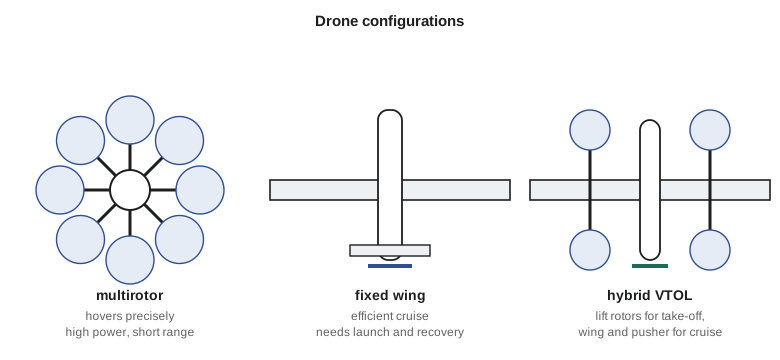
Multirotor, fixed-wing and hybrid configurations
Multirotors lift themselves with several fixed-pitch propellers and control their attitude by varying each motor's speed: speeding up the rear motors pitches the nose down, and speeding up the clockwise-spinning motors relative to the counterclockwise ones yaws the aircraft. They are mechanically simple, can hover precisely and need no runway. Their weakness is efficiency: they support their entire weight with rotor thrust at all times, instead of with a wing, so they use a great deal of power and have limited range and endurance.
Hovering power follows from momentum theory, the same idea behind propeller thrust in Lesson 5. A rotor of disk area \(A\) producing thrust \(T\) accelerates air downward through the disk. The ideal power is \(T^{3/2}/\sqrt{2\rho A}\); real rotors need more, expressed by a figure of merit \(FM\) of about 0.6 to 0.75 for good small rotors. The key insight is that power falls as disk area rises: big, slowly turning rotors hover more efficiently than small, fast ones, which is why helicopters have large rotors and why disk loading, thrust divided by disk area, is such an important design number.
Fixed-wing drones fly like small aircraft. Their wings provide lift with an L/D of 10 to 20, so they need far less power in cruise and can stay airborne for hours. They need a runway, a catapult or a hand launch to take off and a recovery net, parachute or landing strip to land. Hybrid vertical take-off and landing (VTOL) designs combine the two: separate lift rotors for take-off and landing and a wing and cruise propeller for forward flight. They carry the weight of both systems, but for missions longer than a few kilometers they usually win. Tilt-rotor and tilt-wing designs rotate the same propulsors between hover and cruise, saving weight at the cost of mechanical complexity.
Worked problem
Hover versus cruise power for the Skiff
The Skiff weighs 24 kg. The multicopter version has eight rotors of 0.75 m diameter with a figure of merit of 0.70. The fixed-wing version cruises at 25 m/s (90 km/h) with L/D = 12 and a propulsive efficiency of 0.65. Find the hover power of the multicopter and the cruise power of the fixed-wing version at sea level.
Show solution
- Weight and disk area: \(W = 235\ \text{N}\); \(A = 8 \times \pi(0.375)^2 = 3.53\ \text{m}^2\); disk loading \(= 67\ \text{N/m}^2\).
- Hover power: \(P = 235^{1.5}/(0.70\sqrt{2 \times 1.225 \times 3.53}) = 1754\ \text{W}\).
- Fixed-wing drag: \(D = W/(L/D) = 235/12 = 19.6\ \text{N}\).
- Cruise power: \(P = DV/\eta = 19.6 \times 25/0.65 = 755\ \text{W}\).
Answer: The fixed-wing version needs less than half the power of the multicopter's hover. With 960 Wh of usable battery energy, the multicopter can hover for about 33 minutes or fly perhaps 35 to 40 km in forward flight, while the fixed-wing version can fly for about 76 minutes and cover over 100 km. For the hospital-to-clinic routes, Arjun recommends the hybrid Skiff-W, which spends only a minute or two in hover at each end.
# Multirotor hover power versus fixed-wing cruise power for a 24 kg cargo drone
import math
m, g, rho = 24.0, 9.81, 1.225
W = m * g
# Hover by momentum theory: P = T^1.5 / sqrt(2 rho A) / FM
n_rotor, D_rotor, FM = 8, 0.75, 0.70
A = n_rotor * math.pi * (D_rotor / 2) ** 2
P_hover = W ** 1.5 / math.sqrt(2 * rho * A) / FM
print(f"Disk area {A:.2f} m^2, disk loading {W/A:.0f} N/m^2, hover power {P_hover:.0f} W")
# Fixed-wing cruise: P = D V / eta = W V /(L/D) / eta
LD, V, eta = 12.0, 25.0, 0.65
P_cruise = W * V / LD / eta
print(f"Fixed wing at {V*3.6:.0f} km/h, L/D {LD:.0f}: cruise power {P_cruise:.0f} W")
# Endurance and range with a 6 kg battery at 200 Wh/kg, 20% reserve
E = 6.0 * 200 * 0.8
print(f"Usable energy {E:.0f} Wh")
print(f"Multirotor: {E/P_hover*60:.0f} min hover; forward flight at {15*3.6:.0f} km/h about {E/(0.8*P_hover)*15*3.6:.0f} km if power falls 20% in cruise")
print(f"Fixed wing: {E/P_cruise*60:.0f} min, range {E/P_cruise*V*3.6:.0f} km")Disk area 3.53 m^2, disk loading 67 N/m^2, hover power 1754 W Fixed wing at 90 km/h, L/D 12: cruise power 755 W Usable energy 960 Wh Multirotor: 33 min hover; forward flight at 54 km/h about 37 km if power falls 20% in cruise Fixed wing: 76 min, range 114 km
Electric aircraft beyond drones
Electric propulsion is spreading to crewed aircraft too. Two-seat electric trainers are flying today for short training flights, where their low operating cost and quietness are attractive and their short endurance matters less. Electric vertical take-off and landing (eVTOL) air taxis, with many rotors driven by electric motors, aim to carry a pilot and up to four or five passengers over distances of 20 to 150 km within and between cities. Several companies are well into certification testing, and regulators have created new rules for this class of aircraft, often called powered-lift.
For commuter aircraft like the Tern, hybrid-electric and hydrogen-electric designs are under development, and retrofits that replace one turboprop engine on an existing aircraft with an electric or hydrogen fuel-cell powertrain have flown in demonstration. The limiting factor remains energy storage. Battery packs improve by a few percent per year, and new cell chemistries promise more, but the gap to the energy density of liquid fuels will remain large for years. That is why short, frequent routes in places like northern Canada, Scandinavia, Scotland and island chains such as Hawaii are seen as the first markets: the flights are short, fuel is expensive, and current aircraft are old.
| Category | Typical range | Status in 2026 | Main challenge |
|---|---|---|---|
| Small delivery and inspection drones | 10 to 100 km | Widely used; BVLOS rules emerging | Detect and avoid, airspace integration |
| Electric two-seat trainers | about 1 hour | Certified and flying in several countries | Endurance, battery life cycles |
| eVTOL air taxis | 20 to 150 km | In certification testing | Certification, infrastructure, cost |
| Hybrid-electric commuters | 300 to 1000 km | Prototypes and demonstrators | Battery mass, thermal management, certification |
| Hydrogen fuel-cell regional aircraft | 300 to 1000 km | Demonstrators | Hydrogen storage volume, fueling infrastructure |
Batteries and electric drivetrains
An electric drivetrain has four main parts: the battery, the power electronics (an inverter that turns the battery's direct current into the alternating current a motor needs), the motor and the propeller or rotor. Each loses a few percent of the energy passing through it, giving an overall battery-to-thrust efficiency of perhaps 0.70 to 0.80. Lithium-ion cells dominate today. Their specific energy, in watt-hours per kilogram, sets range; their specific power, in watts per kilogram, sets how quickly they can deliver energy for take-off and hover; and their cycle life, the number of charge and discharge cycles before capacity fades, sets operating cost.
Batteries bring their own hazards. A damaged or overheated lithium-ion cell can enter thermal runaway, in which the cell heats itself uncontrollably and can ignite neighboring cells. Aircraft battery packs therefore separate cells with barriers, monitor every cell's voltage and temperature, include venting and fire containment, and are tested to show that a failure of one cell cannot spread into a fire that threatens the aircraft. Cold also reduces the capacity a battery can deliver, an important point for the Skiff's winter operations in Kansas, where packs are kept warm before flight.
Regulating drones
In the United States, small drones under 55 lb (25 kg) flown commercially are governed by 14 CFR Part 107. The remote pilot must hold a remote pilot certificate, the drone must be registered (and broadcast its identity under the Remote ID rule), and flights must normally stay within visual line of sight, below 400 ft above ground level, in daylight or civil twilight unless lit and trained for night, and outside controlled airspace without authorization. Operations beyond these limits, including flight beyond visual line of sight (BVLOS), need a waiver, and drones of 55 lb or more need an exemption. The FAA proposed a new Part 108 in August 2025 to make routine BVLOS operations possible without case-by-case waivers; as of autumn 2026 the final rule was still under review and had not taken effect. Recreational flyers follow a separate exception that requires passing a free knowledge test.
Regulators set these rules by risk. A small drone flying over an empty field threatens almost no one; a heavy drone flying beyond sight over a town could hurt people on the ground or collide with a crewed aircraft. Risk depends on the drone's mass and kinetic energy, the population below, the airspace and how reliable the system is. Many authorities use a structured method called the Specific Operations Risk Assessment (SORA), developed by an international group of regulators, to decide what safeguards an operation needs.
Common mistakes
MistakeAssuming a multirotor is the best design for every drone mission.
InsteadMultirotors hover efficiently only for short flights; fixed-wing or hybrid VTOL designs cover longer distances on the same battery.
MistakeUsing small rotors to save weight without checking power.
InsteadHover power rises as disk area falls; larger, slower rotors usually save more energy than they cost in weight.
MistakeTreating drone rules as the same everywhere.
InsteadCanada and the United States use different weight bands, certificates and approval routes; operators must follow local rules.
MistakeIgnoring battery temperature.
InsteadCold reduces available capacity and power, and overheating can trigger thermal runaway; packs need thermal management.
MistakeAssuming electric aircraft will soon replace airliners.
InsteadBattery energy density limits electric flight to short ranges; long-haul flight will rely on fuels for decades.
Summary and key terms
- Unmanned aircraft systems include the aircraft, ground station, link and crew; their hardest problems are navigation, link reliability and detecting other aircraft.
- Multirotors are simple and hover precisely but use much more power than wings; hover power is \(T^{3/2}/(FM\sqrt{2\rho A})\).
- Fixed-wing drones cruise efficiently; hybrid VTOL designs combine vertical take-off with wing-borne cruise.
- Electric drivetrains are efficient but limited by battery specific energy, power, cycle life and thermal safety.
- eVTOL air taxis, electric trainers and hybrid-electric commuters are the leading electric aircraft classes.
- Drone rules are risk-based: weight, airspace, population below and BVLOS operation determine the certificates and approvals needed.
- Unmanned aircraft system
- An aircraft flown without a pilot on board, together with its ground station, links and crew.
- BVLOS
- Beyond visual line of sight: operation where the pilot cannot see the drone directly.
- Multirotor
- An aircraft lifted and controlled by several fixed-pitch rotors whose speeds are varied.
- Disk loading
- Rotor thrust divided by total rotor disk area.
- Figure of merit
- The ratio of ideal to actual hover power for a rotor.
- eVTOL
- An electric aircraft capable of vertical take-off and landing.
- Specific energy
- Energy stored per unit mass, such as Wh/kg.
- Thermal runaway
- Self-sustaining overheating of a battery cell that can spread to neighboring cells.
- SORA
- Specific Operations Risk Assessment, a method for deciding the safeguards a drone operation needs.
Practice problems
Work each problem on paper first, then reveal the answer to check.
A 5 kg quadcopter has four rotors of 0.40 m diameter and FM = 0.65. Find its hover power at sea level.
Show answer
T = 49.05 N, A = 0.503 m²; P = 49.05^1.5/(0.65√(2 × 1.225 × 0.503)) = 476 W.
If the rotors in the previous question were 0.50 m in diameter, what would the hover power be?
Show answer
A rises by 1.5625; power falls by √1.5625 = 1.25, to about 381 W.
A fixed-wing drone of 10 kg cruises at 20 m/s with L/D = 10 and η = 0.6. Find its cruise power.
Show answer
P = (98.1/10)(20)/0.6 = 327 W.
A battery stores 500 Wh with 20 percent kept in reserve. How long can the drone in the previous question fly?
Show answer
400/327 = 1.22 h, about 73 minutes.
Give two reasons why beyond-visual-line-of-sight drone operations are regulated more strictly than visual ones.
Show answer
The remote pilot cannot see and avoid other aircraft or obstacles directly, and the drone may fly over people and property far from the operator.
In the program, change the multicopter rotors to 0.60 m diameter. What happens to the hover power?
Show answer
Disk area falls to 2.26 m² and hover power rises to about 2190 W.
Lesson quiz · 5 questions
Score 60% or more to complete this lesson.
Create a free account to save your progress, take quizzes and earn a certificate.