
AERO-200 · Lesson 8 of 12 · 24 min
Aircraft performance basics
An airline sales director visits Prairiewind Aerospace and asks three questions about the Tern. How far can it fly with nine passengers? How fast does it climb on a hot day with one motor out? How long a runway does it need? These are performance questions, and they decide whether the aircraft can do the job customers want. Élise gives the questions to Arjun as a learning exercise, using the drag polar from Lesson 3 and the powertrain data from Lesson 5. This lesson covers the core ideas behind his answers: power required and available, climb, range and endurance, and take-off and landing.
Thrust required and power required
In steady level flight, thrust equals drag. Combining the lift equation with the drag polar gives the thrust required at any speed. At low speed, the lift coefficient must be high to support the weight, so induced drag dominates; at high speed, parasite drag dominates. The total drag curve therefore has a minimum, at the speed for maximum L/D found in Lesson 3. For propeller aircraft, power is more natural than thrust, because engines and motors produce shaft power. The power required is the drag times the speed, and it also has a minimum, at a lower speed than the minimum-drag speed.
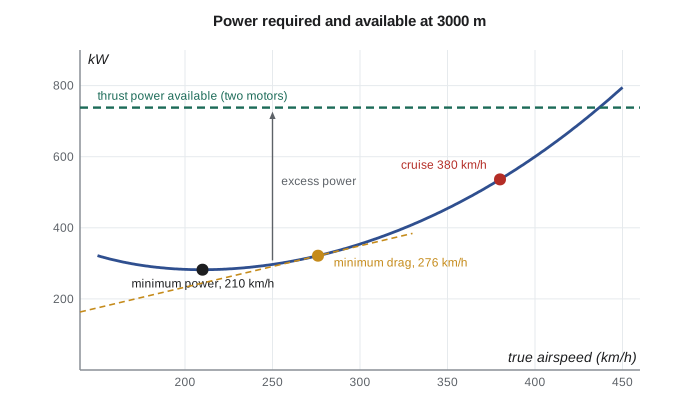
The minimum-power speed occurs where induced drag is three times parasite drag, at \(C_L = \sqrt{3C_{D0}/k}\). At that speed the aircraft uses the least energy per unit time, so it gives the longest endurance for a propeller aircraft or an electric one. The minimum-drag speed, where \(C_L = \sqrt{C_{D0}/k}\), gives the most distance per unit of energy for a propeller aircraft, because energy used per kilometer is proportional to drag. Neither is where airlines normally fly: they cruise faster than the best-range speed, trading a little efficiency for shorter trip times and therefore lower crew and ownership costs per trip.
# Power required, stall and best speeds, and Breguet range for the Tern
import math
rho, S, m, CD0, k = 0.9093, 28.0, 6500.0, 0.028, 0.0386
W = m * 9.81
def power_required(V):
    q = 0.5 * rho * V**2
    CL = W / (q * S)
    return q * S * (CD0 + k * CL**2) * V
print(" V (km/h)  P_req (kW)")
for kmh in (180, 220, 260, 300, 340, 380, 420):
    print(f"{kmh:8d} {power_required(kmh/3.6)/1000:10.0f}")
V_mp = (2 * W / (rho * S) * math.sqrt(k / (3 * CD0))) ** 0.5
V_md = (2 * W / (rho * S) * math.sqrt(k / CD0)) ** 0.5
print(f"Minimum power speed {V_mp*3.6:.0f} km/h (best endurance), minimum drag speed {V_md*3.6:.0f} km/h (best range, propeller)")

# Breguet range for a propeller aircraft: R = (eta/c) * (L/D) * ln(W0/W1)
eta, c_kg_per_J = 0.82, 0.30 / 3.6e6       # propeller efficiency; specific fuel consumption 0.30 kg/kWh
LD = 0.5 / math.sqrt(k * CD0)               # maximum L/D
W0, fuel = m, 900.0
R = eta / (c_kg_per_J * 9.81) * LD * math.log(W0 / (W0 - fuel))
print(f"Max L/D {LD:.1f}; Breguet range with {fuel:.0f} kg fuel: {R/1000:.0f} km")
# Electric aircraft: range does not depend on a weight change
e, eta_t, m_b = 250 * 3600, 0.80, 1120.0
R_e = e * m_b * eta_t * LD / (m * 9.81)
print(f"Battery-electric range with {m_b:.0f} kg of cells: {R_e/1000:.0f} km") V (km/h) P_req (kW)
180 291
220 283
260 305
300 354
340 431
380 536
420 672
Minimum power speed 210 km/h (best endurance), minimum drag speed 276 km/h (best range, propeller)
Max L/D 15.2; Breguet range with 900 kg fuel: 2274 km
Battery-electric range with 1120 kg of cells: 192 kmClimb performance
Excess power, the difference between power available and power required, is what lets an aircraft climb. Climbing at a rate \(RC\) raises the aircraft's potential energy at the rate \(W \times RC\), which must come from excess power. The best rate of climb is obtained near the speed where excess power is greatest, roughly the minimum-power speed for a propeller aircraft. The best angle of climb, important for clearing obstacles after take-off, occurs at a lower speed where excess thrust, not excess power, is greatest.
Climb performance falls with altitude because the air is thinner: power required at a given equivalent airspeed rises with true airspeed, and air-breathing engines lose power. The altitude where the best rate of climb falls to 0.5 m/s (100 ft/min) is the service ceiling. For multi-engine aircraft, the climb with one engine inoperative is often the critical case. Certification rules require a positive climb gradient with one engine out after take-off, and the Tern's batteries are partly sized for this: if one motor fails, the other must deliver enough power for the aircraft to climb away safely on a hot day.
Worked problem
One-motor-out climb on a hot day
After a motor failure just after take-off, the Tern weighs 6500 kg and flies at its best climb speed, where the power required is about 330 kW at the density altitude of the hot-day departure. The remaining motor can deliver 450 kW to its propeller at a propeller efficiency of 0.78 at this low speed. Find the rate of climb and the climb gradient at 200 km/h.
Show solution
- Thrust power available: \(P_{av} = 0.78 \times 450 = 351\ \text{kW}\).
- Excess power: \(351 - 330 = 21\ \text{kW}\). The power required here is higher than in level cruise because of the windmilling propeller's drag and the rudder and aileron needed to fly straight.
- Rate of climb: \(RC = 21\,000/63\,765 = 0.33\ \text{m/s}\), about 65 ft/min.
- Climb gradient: \(RC/V = 0.33/55.6 = 0.59\%\).
Answer: This is too low. Certification of a commuter twin typically requires a one-engine-out climb gradient of a little over 2 percent in the take-off configuration, so the engineers must either feather the failed propeller to cut drag, allow the remaining motor a higher emergency power rating for a few minutes, or reduce the maximum take-off weight on hot days. They choose the first two: an automatic feathering system and a five-minute 600 kW contingency rating, which raises the excess power to about 140 kW and the gradient to roughly 4 percent before counting the drag saved by feathering.
Range and the Breguet equation
How far an aircraft can fly depends on how efficiently it turns energy into distance. For a fuel-burning propeller aircraft, a classic result derived by Louis Breguet in the early twentieth century connects range to propeller efficiency, specific fuel consumption, lift-to-drag ratio and the fraction of the aircraft's weight that is fuel. The derivation assumes the aircraft flies at constant L/D and efficiency while it gets lighter as fuel burns.
Here \(c\) is the specific fuel consumption in kilograms of fuel per joule of shaft energy, \(W_0\) the initial weight and \(W_1\) the final weight. The equation shows the three ways to increase range: a more efficient propulsor (higher \(\eta/c\)), a cleaner aircraft (higher L/D) and a larger fuel fraction. A jet version replaces \(\eta/c\) with \(V/c_T\), where \(c_T\) is the thrust-specific fuel consumption; jets therefore achieve their best range at the speed that maximizes \(V \times L/D\), higher than the propeller aircraft's best speed.
Battery-electric aircraft do not get lighter as they fly, so the logarithm disappears. Range is proportional to battery specific energy, the battery's share of total mass, the efficiency of the whole drivetrain and L/D. The program compares the two for the Tern: 900 kg of fuel takes it over 2000 km at best L/D in the idealized calculation, while 1120 kg of batteries takes it under 200 km. That gap is the whole reason for the hybrid design.
Worked problem
Range of the Tern on fuel alone and on batteries alone
Using \(\eta_{prop} = 0.82\), \(c = 0.30\) kg/kWh, maximum L/D = 15.2 and a take-off mass of 6500 kg, estimate the Breguet range with 900 kg of fuel. Then estimate the battery-only range with 1120 kg of cells at 250 Wh/kg and an overall efficiency of 0.80.
Show solution
- Convert the fuel consumption: \(c = 0.30/3.6 \times 10^{6} = 8.33 \times 10^{-8}\ \text{kg/J}\).
- Weight ratio: \(\ln(6500/5600) = 0.149\).
- Breguet range: \(R = 0.82/(8.33 \times 10^{-8} \times 9.81) \times 15.2 \times 0.149 = 2.27 \times 10^{6}\ \text{m} \approx 2270\ \text{km}\).
- Battery range: \(R = (250 \times 3600)(0.80)(15.2)(1120/6500)/9.81 = 1.92 \times 10^{5}\ \text{m} \approx 190\ \text{km}\).
Answer: Real ranges are lower, because the aircraft spends time climbing and descending, does not cruise exactly at best L/D, and must keep reserves for diversions and holding, typically 30 to 45 minutes of flight. Even so, the factor of more than ten between fuel and batteries is real, and it explains why the Tern's batteries supply power only for take-off, climb and short legs, while the turbine generator handles cruise on the 680 km Denver route.
Endurance
Endurance is how long an aircraft can stay airborne. It matters for patrol, surveillance, training and holding while waiting to land. For propeller and electric aircraft, the best endurance comes from flying at the minimum-power speed, because energy is used at the slowest rate there. For jets, which burn fuel in proportion to thrust, the best endurance is at the minimum-drag speed. Drones designed for surveillance often have long, slender wings to push up L/D and fly slowly for many hours.
Take-off and landing
The take-off is divided into a ground roll, during which the aircraft accelerates to its rotation speed and lifts off, and an airborne segment to a screen height, usually 35 ft (10.7 m) for transport-category aircraft and 50 ft (15 m) for smaller ones. The ground roll depends on weight, wing area, maximum lift coefficient, thrust and air density. A simple estimate assumes the aircraft accelerates at a roughly constant average rate \(\bar{a}\) to a lift-off speed of about 1.2 times the stall speed, giving a ground roll of \(s = V_{LOF}^2/(2\bar{a})\).
Because lift-off speed squared is proportional to weight divided by density, the ground roll grows roughly with the square of weight and inversely with density, which is why hot, high and heavy conditions are so demanding. Runways that are wet, contaminated with snow or slush, uphill or gravel-covered lengthen the run further. For multi-engine aircraft, certification takes the engine failure case into account: the take-off distance must allow the crew either to continue after an engine failure at the decision speed or to stop on the remaining runway.
Landing is similar in reverse. The aircraft approaches at a reference speed of about 1.23 to 1.3 times its stall speed in the landing configuration, crosses the screen height, flares and touches down, then brakes to a stop using wheel brakes, propeller reverse or ground spoilers. Landing distance grows with approach speed squared, which is why high-lift flaps are so valuable. For a commuter aircraft aiming to use short northern or rural strips, the Tern's landing distance and its performance on gravel are among the most important numbers in its specification.
| Performance question | What it depends on most | How the Tern improves it |
|---|---|---|
| Range | L/D, propulsive efficiency, specific fuel consumption, fuel fraction | Turbine generator for cruise, clean high-aspect-ratio wing |
| Rate of climb | Excess power divided by weight | Battery boost for take-off and climb |
| One-engine-out climb | Remaining power and drag of the failed propeller | Automatic feathering, contingency motor rating |
| Take-off distance | Weight, wing area, C_L,max, thrust, density | Fowler flaps and high take-off power |
| Landing distance | Approach speed, braking, reverse thrust | Low stall speed with flaps; reversible-pitch propellers |
Common mistakes
MistakeAssuming best range and best endurance occur at the same speed.
InsteadFor propeller aircraft, best endurance is at minimum power and best range at minimum drag, about 1.32 times faster.
MistakeApplying the Breguet equation to battery-electric aircraft.
InsteadBatteries do not get lighter; electric range has no logarithm and is proportional to battery mass fraction and specific energy.
MistakeTreating excess thrust and excess power as the same.
InsteadBest angle of climb comes from maximum excess thrust; best rate of climb from maximum excess power.
MistakeForgetting reserves when quoting range.
InsteadRegulations require fuel or energy reserves for diversions and holding; practical range is much less than the ideal Breguet value.
MistakeIgnoring runway conditions in take-off and landing estimates.
InsteadHot, high, heavy, wet, contaminated or sloping runways all change the required distances.
Summary and key terms
- Power required has a minimum at the minimum-power speed (best endurance) and the drag curve at the minimum-drag speed (best propeller range).
- Rate of climb equals excess power divided by weight; ceilings occur where excess power falls to a small fixed value.
- One-engine-out climb is a critical certification case for multi-engine aircraft.
- The Breguet equation links range to propulsive efficiency, specific fuel consumption, L/D and the logarithm of the weight ratio.
- Battery-electric range is proportional to specific energy, battery mass fraction, efficiency and L/D, with no weight-change benefit.
- Take-off and landing distances grow with weight and approach speed squared and shrink with air density.
- Power required
- The power needed to overcome drag in level flight at a given speed, D × V.
- Power available
- The thrust power the propulsion system can deliver.
- Excess power
- Power available minus power required; it produces climb or acceleration.
- Rate of climb
- Vertical speed in a climb, equal to excess power divided by weight in steady flight.
- Service ceiling
- The altitude where the maximum rate of climb falls to 0.5 m/s (100 ft/min).
- Breguet range equation
- A relation giving cruise range from efficiency, L/D and the fuel weight fraction.
- Endurance
- The time an aircraft can remain airborne on a given energy load.
- Screen height
- The height an aircraft must clear at the end of the take-off distance or at the start of the landing distance.
- Decision speed
- The speed by which the crew must decide to continue or abort a take-off after an engine failure.
Practice problems
Work each problem on paper first, then reveal the answer to check.
For C_D0 = 0.025 and k = 0.04, find C_L for minimum drag and for minimum power.
Show answer
Minimum drag: √(0.025/0.04) = 0.79; minimum power: √(3 × 0.025/0.04) = 1.37.
An aircraft of 2000 kg has 40 kW of excess power. Find its rate of climb.
Show answer
RC = 40 000/19 620 = 2.04 m/s, about 400 ft/min.
Find the Breguet range for η = 0.85, c = 0.28 kg/kWh, L/D = 14 and W₀/W₁ = 1.20.
Show answer
c = 7.78 × 10⁻⁸ kg/J; R = 0.85/(7.78 × 10⁻⁸ × 9.81) × 14 × ln 1.2 = 2.84 × 10⁶ m, about 2840 km.
By what factor does the ground roll change if take-off weight rises by 10 percent, other things equal?
Show answer
Roughly 1.1² = 1.21, about 21 percent longer.
Why do jets achieve best range at a higher speed than propeller aircraft?
Show answer
Jet fuel flow is proportional to thrust, so range per kilogram of fuel depends on V × L/D, which peaks above the minimum-drag speed.
In the program, raise the battery specific energy to 400 Wh/kg. What is the battery-only range?
Show answer
About 307 km.
Lesson quiz · 5 questions
Score 60% or more to complete this lesson.
Create a free account to save your progress, take quizzes and earn a certificate.