
AERO-200 · Lesson 4 of 12 · 21 min
Airfoils and wings
The Tern's wing is the single most important part of the aircraft. It must lift 6.5 metric tons in cruise with little drag, lift the same weight at a low enough speed to land on a 1000 m gravel strip, hold the fuel tanks, battery modules and motor mounts, and survive gusts and hard landings for 30 years. Élise asks Arjun to sit in on a meeting where the aerodynamics group presents three candidate airfoil sections. To follow the discussion he needs to understand what an airfoil is, how its shape controls lift and stall, and why a real wing produces less lift than the airfoil tests suggest.
Airfoil geometry
An airfoil is the cross-sectional shape of a wing, seen as if the wing were sliced from front to back. Its leading edge is rounded; its trailing edge is sharp. The straight line joining them is the chord line, and its length is the chord \(c\). The mean camber line runs halfway between the upper and lower surfaces; its maximum distance from the chord line is the camber. The maximum distance between the upper and lower surfaces is the thickness, usually quoted as a percentage of chord. A symmetric airfoil has no camber and is used on tails and aerobatic aircraft; most wings use cambered airfoils, which produce lift even at zero angle of attack.
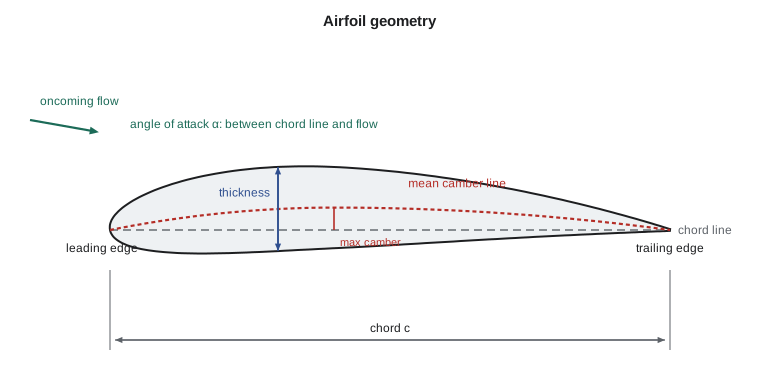
Airfoils were cataloged systematically in the 1930s by the US National Advisory Committee for Aeronautics. Its four-digit series encodes the shape directly: the NACA 2412 has a maximum camber of 2 percent of chord, located at 40 percent of chord, and a maximum thickness of 12 percent. Later series added sections designed to keep the boundary layer laminar over more of the surface, reducing skin friction. Modern aircraft use custom airfoils designed by computer for their particular Reynolds number, Mach number and lift requirements. Thicker airfoils, around 15 to 18 percent at the root, give a deeper wing box for strength and fuel volume at the cost of slightly more drag.
Pressure distribution and lift
As air flows around an airfoil at a positive angle of attack, it accelerates over the curved upper surface, especially near the leading edge, and its pressure falls well below the free-stream value. On the lower surface the flow is slower and the pressure slightly above free stream. Engineers express local pressure as a pressure coefficient, \(C_p = (p - p_\infty)/q_\infty\), so that \(C_p = 1\) at the stagnation point where the flow comes to rest, and negative values mean suction. Plots of \(C_p\) around the airfoil show a strong suction peak just behind the leading edge on the upper surface, which provides most of the lift.
For a two-dimensional airfoil, engineers quote the section lift coefficient \(c_l\), lower case, based on lift per unit span \(L'\) and chord. Thin-airfoil theory, developed in the 1920s, predicts that \(c_l\) rises linearly with angle of attack with a slope of \(2\pi\) per radian, about 0.11 per degree, for any thin airfoil. Camber shifts the line so that lift is zero at a small negative angle, the zero-lift angle \(\alpha_{L0}\). Wind-tunnel tests confirm the slope is close to \(2\pi\) for real airfoils at moderate angles.
Stall
The straight-line relationship ends at the stall. As angle of attack increases, the pressure rise toward the trailing edge on the upper surface becomes steeper. The slow-moving air in the boundary layer cannot climb this pressure hill and eventually separates from the surface, leaving a turbulent wake. Lift stops increasing and falls; drag rises sharply. The highest value reached is the maximum lift coefficient, \(c_{l,\max}\), typically 1.3 to 1.7 for a clean airfoil at the angle of 14 to 18 degrees. Thin airfoils tend to stall abruptly from the leading edge; thicker ones stall more gently from the trailing edge forward.
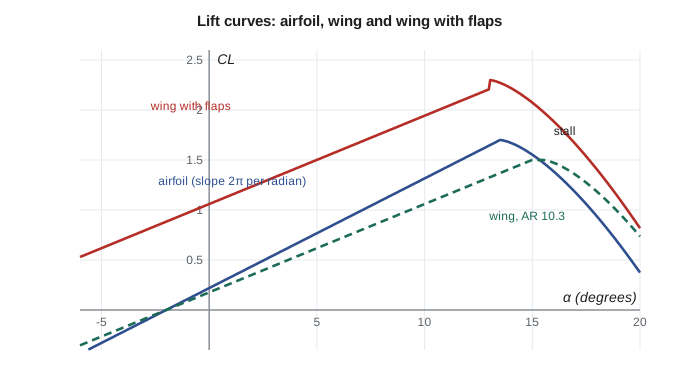
Stall is a function of angle of attack, not speed. A wing stalls at the same critical angle whether the aircraft is slow and level or fast and pulling hard in a turn. In level flight, however, angle of attack rises as speed falls, so pilots see stall happen at a particular stall speed for each weight and flap setting. Aircraft have a stall warning system that alerts the crew a few knots above the stall, and certification rules require stall behavior that is predictable and recoverable.
High-lift devices
An aircraft that cruises efficiently has a relatively small wing, which would demand a very high landing speed. High-lift devices solve the problem by temporarily changing the wing's shape. Plain flaps hinge the trailing edge downward, adding camber. Slotted flaps also open a gap that lets high-energy air from beneath the wing flow over the flap and keep the boundary layer attached. Fowler flaps slide backward as well as down, increasing wing area. Leading-edge slats open a slot at the front of the wing, letting it reach higher angles of attack before stalling. A large airliner with triple-slotted flaps and slats can reach \(C_{L,\max}\) near 3.
The Tern uses single-slotted Fowler flaps. The aerodynamics group expects a clean maximum lift coefficient of 1.5, rising to 1.9 at 15 degrees of flap and 2.3 at 35 degrees. Because stall speed varies with the inverse square root of \(C_{L,\max}\), going from 1.5 to 2.3 cuts the stall speed by about 19 percent, and landing distance roughly with its square.
From airfoil to wing: finite-span effects
A real wing has tips. Air leaks around them from the high-pressure lower surface to the low-pressure upper surface, forming the trailing vortices described in Lesson 3. The vortices induce a downward velocity, the downwash, over the wing. Each section of the wing therefore sees the oncoming air at a slightly smaller effective angle than the geometric angle of attack. The result is a lower lift-curve slope for the whole wing and the induced drag we met earlier. Prandtl's lifting-line theory, developed during the First World War, gives the correction.
Here \(a_0 = 2\pi\) per radian is the airfoil slope and \(a\) is the wing slope. For the Tern's aspect ratio of 10.3 with \(e = 0.80\), the wing's slope is about 5.1 per radian, roughly 80 percent of the airfoil value. A low-aspect-ratio wing, such as a delta wing with \(AR = 2\), has less than half the airfoil slope and must fly at large angles of attack to produce lift.
Worked problem
Lift slope, cruise angle and stall speeds for the Tern
The Tern's wing uses a cambered airfoil with \(\alpha_{L0} = -2°\), aspect ratio 10.3 and \(e = 0.80\). Find the wing lift-curve slope, the angle of attack needed for the cruise \(C_L\) of 0.45, and the stall speeds at sea level at 6500 kg with \(C_{L,\max}\) of 1.5 (clean) and 2.3 (landing flaps).
Show solution
- Wing slope: \(a = 6.283/(1 + 6.283/(\pi \times 0.80 \times 10.3)) = 5.06\ \text{per radian} = 0.0882\ \text{per degree}\).
- Cruise angle: \(\alpha = \alpha_{L0} + C_L/a = -2° + 0.45/0.0882 = 3.1°\) relative to the chord line.
- Clean stall speed: \(V_S = \sqrt{2(63\,765)/(1.225 \times 28 \times 1.5)} = 49.8\ \text{m/s}\), about 179 km/h or 97 kt.
- With landing flaps: \(V_S = \sqrt{2(63\,765)/(1.225 \times 28 \times 2.3)} = 40.2\ \text{m/s}\), about 145 km/h or 78 kt.
Answer: In cruise the wing needs only about 3° of angle of attack, so designers often build the wing onto the fuselage at a small incidence angle so the cabin floor is level in cruise. The landing stall speed of 78 kt sets the approach speed, typically 1.23 times the stall speed for modern certification, about 96 kt.
# From airfoil to wing: thin-airfoil lift slope corrected for finite span
import math
a0 = 2 * math.pi            # airfoil lift slope per radian (thin-airfoil theory)
alpha_L0 = math.radians(-2.0)   # zero-lift angle of a cambered section
AR, e = 10.3, 0.80

a = a0 / (1 + a0 / (math.pi * e * AR))     # finite-wing lift slope
print(f"Airfoil slope {a0:.2f}/rad, wing slope {a:.2f}/rad ({math.radians(1)*a:.4f} per degree)")
print(" alpha(deg)  CL_airfoil  CL_wing  induced angle (deg)")
for deg in (0, 2, 4, 6, 8, 10):
    al = math.radians(deg)
    cl = a0 * (al - alpha_L0)
    CL = a * (al - alpha_L0)
    ai = CL / (math.pi * e * AR)
    print(f"{deg:9d} {cl:11.3f} {CL:9.3f} {math.degrees(ai):12.2f}")

# Stall speed with and without flaps
m, S, rho0 = 6500.0, 28.0, 1.225
for name, CLmax in (("clean", 1.5), ("flaps 15", 1.9), ("flaps 35", 2.3)):
    Vs = math.sqrt(2 * m * 9.81 / (rho0 * S * CLmax))
    print(f"Stall speed, {name:<9}: {Vs*3.6:5.0f} km/h ({Vs*1.94384:4.0f} kt)")

# Reynolds number of the wing in cruise
rho, V, c, mu = 0.9093, 105.6, 2.7, 1.69e-5
print(f"Cruise Reynolds number on a {c} m chord: {rho*V*c/mu:.2e}")Airfoil slope 6.28/rad, wing slope 5.06/rad (0.0882 per degree)
alpha(deg) CL_airfoil CL_wing induced angle (deg)
0 0.219 0.176 0.39
2 0.439 0.353 0.78
4 0.658 0.529 1.17
6 0.877 0.706 1.56
8 1.097 0.882 1.95
10 1.316 1.059 2.34
Stall speed, clean : 179 km/h ( 97 kt)
Stall speed, flaps 15 : 159 km/h ( 86 kt)
Stall speed, flaps 35 : 145 km/h ( 78 kt)
Cruise Reynolds number on a 2.7 m chord: 1.53e+07Planform: taper, sweep and twist
The shape of the wing seen from above is its planform. An elliptical lift distribution along the span gives the least induced drag for a given span, which is why the Second World War Spitfire had an elliptical wing. Elliptical wings are hard to build, so most aircraft use a tapered wing whose chord shrinks from root to tip; a taper ratio of about 0.4 to 0.5 comes close to elliptical loading and also reduces structural weight, because less lift acts far out on the span where bending moments are largest.
Sweep, angling the wing backward, delays shock waves at high subsonic speed because the airfoil effectively sees only the component of flow perpendicular to the leading edge. Jet airliners use sweep angles of 25 to 35 degrees. Sweep has costs: it reduces maximum lift, encourages tip stall and makes the structure heavier. The Tern, flying at Mach 0.32, has no sweep. Twist, or washout, sets the tip at a lower angle of incidence than the root so that the root stalls first. The ailerons near the tips then keep working during the stall, giving the pilot roll control when it is most needed.
| Wing feature | Main benefit | Main cost |
|---|---|---|
| High aspect ratio | Less induced drag, better L/D | Heavier, more flexible structure; less internal volume |
| Taper | Near-elliptical lift, lighter structure | Tips can stall early without washout |
| Sweep | Higher critical Mach number | Lower maximum lift, tip stall, heavier |
| Washout (twist) | Root stalls first; ailerons keep working | Slightly more induced drag in cruise |
| Winglets | Less induced drag for a given span | Added weight and wing bending moment |
Arjun watches the aerodynamics group pick an airfoil 17 percent thick at the root and 13 percent at the tip, with a moderate taper and 2.5 degrees of washout. The thicker root gives the structures team the depth they want for the wing box (Lesson 6). The choice gives up a little cruise drag for better low-speed behavior and more room for battery modules, a typical compromise for an aircraft meant to operate from short northern strips.
Common mistakes
MistakeThinking a wing stalls at a particular speed.
InsteadA wing stalls at its critical angle of attack; the stall speed depends on weight, load factor and flap setting.
MistakeUsing the airfoil lift slope of 2π for a whole wing.
InsteadA finite wing has a lower slope, a₀/(1 + a₀/(πeAR)), because of downwash.
MistakeConfusing camber with thickness.
InsteadCamber is the curvature of the mean line; thickness is the separation of the surfaces.
MistakeAssuming flaps only increase lift.
InsteadFlaps also increase drag and pitching moment, which helps on approach but hurts climb.
MistakeUsing degrees directly in c_l = 2π(α − α_L0).
InsteadThe slope 2π is per radian; convert angles or use 0.11 per degree.
Summary and key terms
- An airfoil is described by its chord, camber and thickness; cambered airfoils lift at zero angle of attack.
- Thin-airfoil theory gives a lift slope of 2π per radian, about 0.11 per degree, up to the stall.
- Stall happens when the upper-surface boundary layer separates at the critical angle of attack; \(V_S = \sqrt{2W/(\rho S C_{L,\max})}\).
- Flaps and slats raise \(C_{L,\max}\) to lower stall and landing speeds.
- Finite wings have downwash, a lower lift slope and induced drag; higher aspect ratio reduces both effects.
- Taper, sweep and washout shape the lift distribution, the critical Mach number and the stall pattern.
- Airfoil
- The cross-sectional shape of a wing.
- Chord
- The straight-line distance from leading edge to trailing edge.
- Camber
- The maximum distance between the mean camber line and the chord line.
- Zero-lift angle
- The angle of attack at which a cambered airfoil produces no lift.
- Pressure coefficient
- C_p = (p − p∞)/q∞, a dimensionless measure of local pressure.
- Stall
- Loss of lift caused by boundary-layer separation beyond the critical angle of attack.
- Maximum lift coefficient
- The highest lift coefficient a wing reaches before stall.
- Fowler flap
- A flap that slides backward and down, adding area and camber.
- Downwash
- The downward velocity induced at the wing by the trailing vortices.
- Washout
- Twisting a wing so the tip is at a lower incidence than the root.
- Taper ratio
- Tip chord divided by root chord.
Practice problems
Work each problem on paper first, then reveal the answer to check.
What are the camber, its location and the thickness of a NACA 4415 airfoil?
Show answer
4 percent camber at 40 percent chord, 15 percent thickness.
A thin airfoil has α_L0 = −3°. Estimate c_l at α = 5°.
Show answer
c_l ≈ 0.11 × 8 = 0.88 (more exactly 2π × 8π/180 = 0.877).
Find the lift slope of a wing with AR = 6 and e = 0.85, using a₀ = 2π.
Show answer
a = 6.283/(1 + 6.283/(π × 0.85 × 6)) = 4.51 per radian.
A 1100 kg aircraft has S = 15 m² and C_L,max = 1.6. Find its sea-level stall speed.
Show answer
V_S = √(2 × 10 791/(1.225 × 15 × 1.6)) = 27.1 m/s, about 53 kt.
By what fraction does stall speed fall if flaps raise C_L,max from 1.5 to 2.1?
Show answer
V_S scales with 1/√C_L,max: √(1.5/2.1) = 0.845, a 15.5 percent reduction.
In the program, raise the aspect ratio to 14. What happens to the wing lift slope?
Show answer
It rises to about 5.33 per radian (0.093 per degree), closer to the airfoil value.
Lesson quiz · 5 questions
Score 60% or more to complete this lesson.
Create a free account to save your progress, take quizzes and earn a certificate.