
AERO-200 · Lesson 1 of 12 · 23 min
The aerospace industry and its careers
Prairiewind Aerospace is a small company in Wichita, Kansas, with an ambitious plan. Its 60 engineers, technicians and business staff are designing the Tern, a nine-passenger commuter aircraft with a hybrid-electric powertrain. A battery pack and two electric motors drive the propellers, and a small turbine generator recharges the pack in flight and extends the range. The target market is short regional routes such as Wichita to Denver, about 680 km, where today's aircraft are old, fuel-hungry and expensive to run. Alongside the Tern, the company builds a 24 kg cargo drone called the Skiff for delivering parts and medical supplies, and it supplies wing structures to larger manufacturers to pay the bills while the Tern is certified.
Through this course we follow four people at the company. Élise Fournier is the chief engineer. Marcus Webb leads the structures group. Sam Littlechild is a test pilot and flight test engineer. Arjun Mehta is a second-year engineering student on a co-op work term, and like you he is meeting most of these ideas for the first time. Each lesson takes one part of the Tern or Skiff program and uses it to introduce a branch of aerospace engineering: the atmosphere, aerodynamics, propulsion, structures, stability, performance, spaceflight, unmanned aircraft, regulation and design. Later courses in the program go deep into each branch. This one shows how they fit together.
What the aerospace industry makes
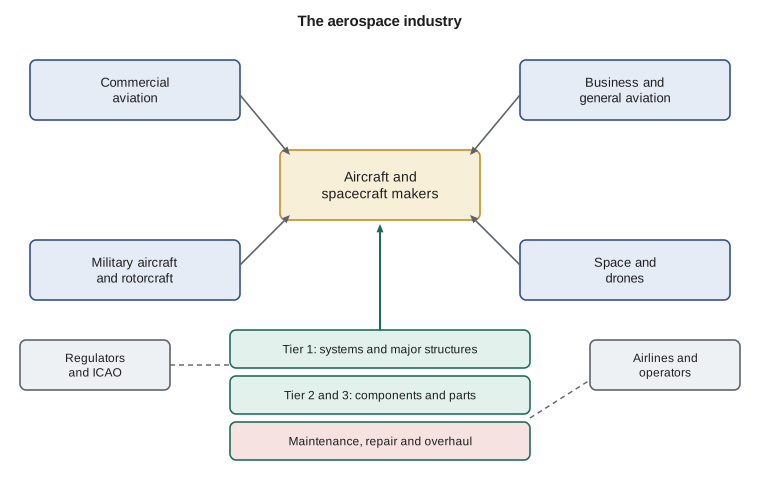
Aerospace covers everything that flies in the atmosphere (aeronautics) and everything that operates beyond it (astronautics). The industry is usually divided into a few large segments. Commercial aviation builds airliners, regional aircraft and the engines and systems inside them. Business and general aviation builds business jets, piston and turboprop aircraft for training, private flying, charter and bush operations. Rotorcraft covers helicopters and, increasingly, vertical-lift aircraft with many rotors. Defense builds military aircraft, missiles and their support systems. Space builds launch vehicles, satellites, spacecraft and the ground systems that control them. A fast-growing segment builds drones of every size, from 250 g camera drones to cargo aircraft weighing hundreds of kilograms.
Beneath the aircraft makers sits a long supply chain. Tier 1 suppliers build major systems such as landing gear, avionics suites, wings or engines. Tier 2 and Tier 3 suppliers make components and parts: machined fittings, wiring harnesses, composite panels, fasteners, sensors. After an aircraft is delivered, the maintenance, repair and overhaul (MRO) sector keeps it flying for 25 to 40 years. MRO is a huge employer in its own right, because every aircraft needs inspections, engine overhauls, component repairs and modifications throughout its life. Airlines, airports, air navigation service providers and regulators complete the system.
The United States has the world's largest aerospace industry. It builds airliners, business jets, general aviation aircraft, military aircraft, helicopters, engines and avionics, and it dominates launch services and satellite manufacturing. Wichita calls itself the air capital of the world: it hosts large plants building business jets, general aviation aircraft and fuselage sections for airliners, along with a university research institute that tests aircraft structures. Other major clusters are in Washington, California, Texas, Florida, Connecticut and Georgia. NASA leads civil aeronautics and space research, and commercial companies now carry out much of the launch and spacecraft work that NASA once did itself.
The industry runs on long cycles. A new airliner takes ten years or more from first sketch to first delivery and may stay in production for 30 years. A small company like Prairiewind Aerospace hopes to certify the Tern in about six years. Cash is tight during development because money flows out for years before any aircraft is sold. That is why many aerospace start-ups also do contract work, as Prairiewind Aerospace does with wing structures, and why partnerships with established suppliers matter so much.
Why aerospace engineering is different
Every branch of engineering balances performance, cost and safety. Aerospace engineering is distinctive because weight matters so much. An extra kilogram of structure on the Tern means a kilogram less of passengers or fuel on every flight for decades. An extra kilogram on a launch vehicle's upper stage can cost tens of kilograms of propellant at lift-off. So aerospace engineers work with smaller safety margins than, say, bridge designers, and they compensate with rigorous analysis, testing, inspection and quality control. A building might use a factor of safety of two or three on its loads; aircraft structures are typically designed for 1.5 times the largest load expected in service, and every assumption behind that number is checked.
Safety is the second defining feature. Commercial aviation is one of the safest ways to travel, and that record was built by learning from every accident. Each failure is investigated, the cause is published, and the lessons go into design standards, maintenance programs and pilot training. An aerospace engineer's work is reviewed by colleagues, by the company's own airworthiness office and by the regulator before an aircraft carries passengers. Lesson 11 describes that process.
The third feature is integration. An aircraft is a system of systems: aerodynamics, structures, propulsion, flight controls, electrical power, hydraulics, avionics, cabin systems and software must all work together, and a change to one affects the others. Making the Tern's battery pack 50 kg heavier, for example, raises the wing loading and the stall speed, which lengthens the take-off run, which may push the design over a runway-length requirement, which in turn might call for bigger flaps. Engineers who understand how the pieces connect are especially valuable.
Careers in aerospace
Aerospace employs engineers from almost every discipline. Aerospace and mechanical engineers work in aerodynamics, structures, propulsion and design. Electrical and computer engineers design power systems, avionics, sensors and flight software. Materials and chemical engineers develop alloys, composites, coatings and propellants. Manufacturing and industrial engineers plan production lines and tooling. Software engineers write flight control laws and ground-station software. Systems engineers manage requirements, interfaces and verification across the whole aircraft. Many roles combine engineering with business: program management, supplier quality, customer support and certification.
| Role at Prairiewind Aerospace | What the work involves | Typical background |
|---|---|---|
| Aerodynamicist | Wing and fuselage shape, drag estimates, wind tunnel and flight test analysis | Aerospace or mechanical engineering |
| Stress engineer | Loads, strength and fatigue analysis of structure; test planning | Aerospace, mechanical or civil engineering |
| Powertrain engineer | Motors, batteries, turbine generator, thermal management | Electrical, mechanical or aerospace engineering |
| Avionics and software engineer | Flight displays, autopilot, flight control software, data buses | Electrical, computer or software engineering |
| Flight test engineer | Test plans, instrumentation, data reduction, safety of test flights | Aerospace engineering, often with pilot training |
| Certification engineer | Showing compliance with airworthiness rules and working with the regulator | Any engineering discipline plus regulatory knowledge |
| Manufacturing engineer | Tooling, assembly sequence, composites processes, quality | Mechanical, manufacturing or materials engineering |
Technicians and technologists are just as important. Aircraft maintenance engineers (AMEs) in Canada and airframe and powerplant (A&P) mechanics in the United States hold licenses to sign for maintenance work. Avionics technicians, composite technicians, machinists, inspectors and test technicians build and maintain the aircraft. Pilots, air traffic controllers and dispatchers operate the system. Many engineers start their careers on the shop floor or in flight test and say it was the best way to learn how aircraft really work.
In the United States, a professional engineering license is less common in aerospace manufacturing than in civil engineering, because federal aviation rules, not state engineering laws, govern aircraft design approval. Instead, the FAA appoints experienced engineers as designated engineering representatives (DERs) or as members of a company's organization designation authorization (ODA) unit. These people approve certain technical data on the FAA's behalf. Becoming one takes years of experience and a strong record of compliance work.
The industry also depends on people who choose it as a long-term career. Experienced engineers retire every year, and companies of every size report difficulty hiring people who understand both the engineering and the regulations. Co-op terms like Arjun's are one of the main routes in: students who have worked in an aerospace company graduate with experience, references and a better sense of which branch they enjoy.
How a program makes money
Engineers make better decisions when they understand the economics behind them. An airline buying a commuter aircraft compares operating cost per seat-kilometer with the fares it can charge. The main cost groups are energy (fuel or electricity), crew, maintenance, ownership (the cost of buying or leasing the aircraft, plus insurance) and fees such as landing and navigation charges. A small change in fuel burn or maintenance hours, multiplied over thousands of flights a year, decides whether an aircraft sells.
Two measures are standard. Available seat-kilometers (ASK) is the number of seats multiplied by the distance flown. Revenue passenger-kilometers (RPK) counts only seats filled with paying passengers. Their ratio is the load factor. Dividing the cost of a trip by the ASK gives the cost per available seat-kilometer, or CASK, the number airlines use to compare aircraft. Small aircraft have a high CASK, because crew, fees and ownership costs are shared among few seats. That is the problem the Tern is trying to solve: lower energy and maintenance costs should make short routes viable that larger aircraft serve poorly.
Worked problem
Cost per seat-kilometer on the Denver route
Prairiewind Aerospace's market study assumes the Tern flies the 680 km route to Denver with nine seats and a 70 percent load factor. Adding up energy, crew, maintenance, ownership and fees gives a trip cost of about 5,180 US dollars. Find the available seat-kilometers, the CASK and the break-even fare.
Show solution
- Available seat-kilometers per trip: \(\text{ASK} = 9 \times 680 = 6120\) seat-km.
- Cost per available seat-kilometer: \(\text{CASK} = 5180/6120 = 0.85\) dollars per seat-km.
- Passengers carried: \(9 \times 0.70 = 6.3\) on average, so the break-even fare is \(5180/6.3 \approx 820\) dollars.
Answer: The break-even fare only covers costs if about seven of nine seats are full on every flight. If the hybrid powertrain cut energy and maintenance costs by a third, the break-even fare would fall by roughly 15 percent. Numbers like these drive the whole design: every kilogram and every maintenance hour shows up in the fare.
# Seat-kilometer economics for a nine-seat commuter on a 650 km route
# Illustrative numbers for Prairiewind Aerospace's market study
route_km = 680
seats = 9
load_factor = 0.70          # fraction of seats filled on average
trips_per_day = 4           # one-way flights per aircraft per day
days_per_year = 300

block_hours = route_km / 380 + 0.4      # cruise at about 380 km/h plus taxi, climb and descent
costs = {
    "energy": 2.10 * route_km,          # fuel or electricity, per trip
    "crew": 450 * block_hours,
    "maintenance": 380 * block_hours,
    "ownership": 1.6e6 / (trips_per_day * days_per_year),  # yearly lease and insurance spread over trips
    "fees": 600,                       # landing, navigation and airport charges per trip
}
trip_cost = sum(costs.values())
ask = seats * route_km                 # available seat-kilometers per trip
rpk = ask * load_factor                # revenue passenger-kilometers per trip
print(f"Block time per trip: {block_hours:.2f} h")
for k, v in costs.items():
    print(f"  {k:<12}{v:10.0f}")
print(f"Trip cost: {trip_cost:.0f}")
print(f"Cost per available seat-km (CASK): {trip_cost/ask:.3f}")
print(f"Break-even fare per passenger: {trip_cost/(seats*load_factor):.0f}")Block time per trip: 2.19 h energy 1428 crew 985 maintenance 832 ownership 1333 fees 600 Trip cost: 5179 Cost per available seat-km (CASK): 0.846 Break-even fare per passenger: 822
The program shows why ownership and crew costs dominate on short routes: they barely change with distance, so a short trip spreads them over few seat-kilometers. Try changing the load factor to 0.5 or the route to 300 km and watch the break-even fare climb. Real airline cost models are far more detailed, but they rest on exactly these ideas.
Environmental pressure and the next generation of aircraft
Aviation produces roughly 2 to 3 percent of global carbon dioxide emissions, and its share is expected to grow as other sectors cut emissions faster. Airlines and manufacturers have committed to net-zero carbon emissions by 2050 through more efficient aircraft, sustainable aviation fuels made from waste or captured carbon, better air traffic management, and new propulsion: battery-electric, hybrid-electric and hydrogen. Noise near airports and contrails at altitude are also concerns.
Battery-electric aircraft are limited by the low energy stored per kilogram of battery, as Lesson 5 shows, so they suit short flights and small aircraft. Hybrid-electric designs like the Tern use batteries for take-off and climb, when power demand is highest, and a fuel-burning generator for cruise. Hydrogen stores far more energy per kilogram than jet fuel but takes up much more volume, even as a cryogenic liquid. Each option changes the aircraft's shape, weight and systems, which is why this is an exciting time to enter the field.
Common mistakes
MistakeThinking aerospace jobs are only for aerospace engineers.
InsteadAircraft and spacecraft need electrical, computer, software, materials, manufacturing and systems engineers as much as aerodynamicists.
MistakeAssuming the aircraft maker does most of the work.
InsteadSuppliers build a large share of every aircraft, and the maintenance sector keeps it flying for decades after delivery.
MistakeJudging an aircraft only by its speed or range.
InsteadOperators buy aircraft on cost per seat-kilometer, reliability and maintenance cost; small savings repeated over thousands of flights decide sales.
MistakeTreating weight as a minor detail.
InsteadEvery kilogram of structure replaces payload or fuel for the aircraft's whole life, so aerospace design is weight-driven.
MistakeBelieving safety comes from large safety factors alone.
InsteadAerospace safety relies on analysis, testing, inspection, quality systems and learning from every accident, with modest design factors.
Summary and key terms
- Aerospace covers aeronautics and astronautics, with segments for commercial, business and general aviation, rotorcraft, defense, space and drones.
- Manufacturers depend on tiered suppliers, and the maintenance, repair and overhaul sector keeps aircraft flying for decades.
- Aerospace engineering is weight-driven, safety-critical and highly integrated.
- Careers span every engineering discipline as well as technicians, pilots and regulators; delegated engineers approve designs on the regulator's behalf.
- Operators judge aircraft by cost per available seat-kilometer (CASK); load factor is RPK divided by ASK.
- Pressure to cut emissions is driving new propulsion such as hybrid-electric, battery-electric and hydrogen aircraft.
- Aeronautics
- The science and engineering of flight within the atmosphere.
- Astronautics
- The science and engineering of flight beyond the atmosphere.
- Tier 1 supplier
- A company that designs and builds a major system or structure for an aircraft maker.
- MRO
- Maintenance, repair and overhaul: the sector that keeps aircraft airworthy after delivery.
- Available seat-kilometer (ASK)
- One seat flown one kilometer, whether or not it is filled.
- Revenue passenger-kilometer (RPK)
- One paying passenger flown one kilometer.
- Load factor
- The fraction of available seats filled, RPK divided by ASK.
- CASK
- Cost per available seat-kilometer, the trip cost divided by ASK.
- Hybrid-electric aircraft
- An aircraft whose propulsors are driven partly or wholly by electric motors fed by both batteries and a fuel-burning generator.
- Sustainable aviation fuel
- Jet fuel made from waste, biomass or captured carbon, with lower life-cycle emissions than fossil fuel.
Practice problems
Work each problem on paper first, then reveal the answer to check.
List four segments of the aerospace industry and give an example of a product from each.
Show answer
Commercial aviation (regional airliner), business and general aviation (training aircraft), defense (fighter or patrol aircraft), space (satellite or launch vehicle); drones and rotorcraft are also accepted.
An aircraft with 19 seats flies a 400 km trip at a 65 percent load factor. Find ASK and RPK.
Show answer
ASK = 19 × 400 = 7600 seat-km; RPK = 0.65 × 7600 = 4940 passenger-km.
The trip in the previous question costs 6,080 currency units. Find the CASK.
Show answer
CASK = 6080/7600 = 0.80 per seat-km.
Explain why weight matters more for an aircraft than for a truck.
Show answer
Lift must equal weight, so extra weight raises drag and energy use on every flight, and structure weight directly reduces the payload and fuel the aircraft can carry.
In the program, cut the energy cost per kilometer by 40 percent. What happens to the break-even fare?
Show answer
On the Denver route the energy cost per trip falls by about 40 percent, and the break-even fare drops by roughly 85 to 90 currency units, about 11 percent.
Give two reasons why an aerospace start-up might take on contract manufacturing work.
Show answer
It brings in cash during the long, costly development period, and it builds manufacturing skills, quality systems and supplier relationships the main program will need.
Lesson quiz · 5 questions
Score 60% or more to complete this lesson.
Create a free account to save your progress, take quizzes and earn a certificate.