
ACCT-321 · Lesson 8 of 12 · 27 min
Multinational transfer pricing: arm's length and section 482
Lessons 6 and 7 treated transfer pricing as an internal management problem: how to set prices that lead divisions to good decisions and allow fair evaluation. When divisions sit in different countries, a new consideration overwhelms the others. The transfer price determines how much of the group's profit is taxed in each country, and tax authorities everywhere insist that it be set as if the parties were unrelated. This lesson explains the arm's length principle, the methods tax authorities accept, the US rules in section 482 of the Internal Revenue Code, documentation and penalties, and the tension between tax-driven and management-driven transfer prices. Tax facts are stated as of October 2026; ACCT-212 covers the accounting for income taxes and the global minimum tax in more depth.
Cormorant Europe
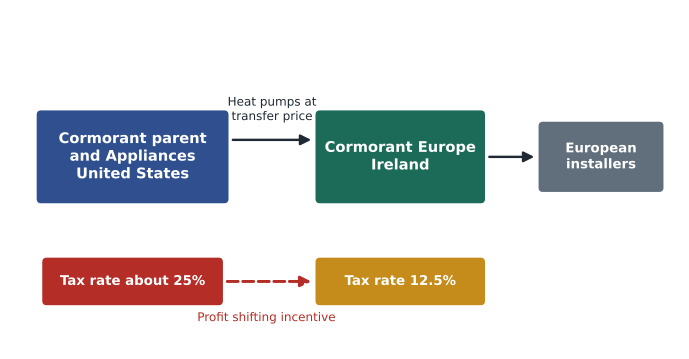
Cormorant Europe Ltd. is an Irish subsidiary that distributes Cormorant's heat pumps in the European Union. In 2027 it expects to buy 10,000 heat pumps from Appliances, which makes them in Columbus at a full cost of $1,300 each, and to resell them to European installers. Cormorant Europe resells them for an average of $1,800 and incurs $300 a unit of its own selling and distribution costs, so the illustrative combined pre-tax profit on the heat pumps, across both countries, is $2,000,000. The question is how much of that profit belongs in the United States and how much in Ireland.
Why taxes change the transfer pricing problem
Corporate income tax rates differ between countries. Cormorant's combined federal and state rate is about 25 percent, illustratively, while Ireland's standard rate on trading income is 12.5 percent for groups below the global minimum tax threshold; groups with consolidated revenue of €750 million or more pay at least 15 percent under Ireland's Pillar Two rules. Every dollar of profit moved from the higher-tax country to Ireland saves the difference in rates. If Cormorant were free to choose, it would set a low transfer price on heat pumps sold to Ireland, keeping profit there, and a high price on anything Ireland sold back.
# Effect of the transfer price on Cormorant's group tax (illustrative rates; thousands)
units = 10_000                 # heat pumps sold by Appliances to Cormorant Europe
rate_parent, rate_ireland = 0.25, 0.125
group_pre_tax = 2_000          # combined pre-tax profit on the heat pumps
for tp in (1_380, 1_400, 1_420):
    parent = (tp - 1_300) * units / 1000      # Appliances' profit: cost 1,300 a unit
    europe = group_pre_tax - parent
    tax = parent * rate_parent + europe * rate_ireland
    print(f"TP {tp}: US profit     {parent:>6,.0f}  Ireland profit {europe:>6,.0f}  group tax {tax:>6,.1f}")
print(f"Each $20 off the TP shifts {20 * units / 1000:,.0f} of profit and saves {20 * units / 1000 * (rate_parent - rate_ireland):,.0f} of tax")TP 1380: US profit 800 Ireland profit 1,200 group tax 350.0 TP 1400: US profit 1,000 Ireland profit 1,000 group tax 375.0 TP 1420: US profit 1,200 Ireland profit 800 group tax 400.0 Each $20 off the TP shifts 200 of profit and saves 25 of tax
A $20 reduction in the transfer price moves $200,000 of profit to Ireland and reduces group tax by $25,000. At the median arm's length price of about $1,422 worked out below, profit would split roughly $1,220,000 to the United States and $780,000 to Ireland. Across many products and years, the amounts add up quickly, which is exactly why tax authorities scrutinize transfer prices and why the rules described below exist. Profit shifting through transfer prices, especially of intangibles such as patents and brands, was the central concern of the OECD's base erosion and profit shifting (BEPS) project, which began in 2013 and has reshaped international tax rules since.
The arm's length principle
Nearly every country, including Canada, the United States and Ireland, requires that transfer prices between related parties satisfy the arm's length principle: the price must be the one that unrelated parties would have agreed to in comparable circumstances. The principle is set out in Article 9 of the OECD Model Tax Convention and elaborated in the OECD Transfer Pricing Guidelines for Multinational Enterprises and Tax Administrations, most recently consolidated in 2022 with later updates. Applying it requires a comparability analysis: identifying the characteristics of the controlled transaction, the functions each party performs, the assets it uses and the risks it assumes, the contractual terms, the economic circumstances and the business strategies, and then finding uncontrolled transactions that are comparable.
In the United States, section 482 of the Internal Revenue Code gives the Internal Revenue Service (IRS) power to allocate income, deductions and credits among related parties to clearly reflect income and prevent tax evasion. The detailed rules are in Treasury Regulations sections 1.482-1 to 1.482-9. They follow the arm's length standard and are broadly consistent with the OECD Guidelines, though they differ in terminology and in some methods, notably the comparable profits method and the commensurate-with-income standard for intangibles.
Transfer pricing methods for tax
The OECD Guidelines describe five main methods, and tax authorities generally require the most appropriate method for the circumstances. Traditional transaction methods compare prices or gross margins directly; transactional profit methods compare net profits.
| Method | What is compared | Typical use at Cormorant |
|---|---|---|
| Comparable uncontrolled price (CUP) | Price charged in comparable transactions between unrelated parties | Motors, which Components also sells outside at $110 |
| Resale price | Gross margin earned by a reseller on comparable purchases | Cormorant Europe as a distributor of heat pumps |
| Cost plus | Gross markup over cost earned by comparable suppliers | Contract manufacturing or routine services |
| Comparable profits method (CPM) or TNMM | Net profit relative to costs, sales or assets of comparable companies | Testing Cormorant Europe's operating margin |
| Profit split | Division of combined profit by relative contributions | Jointly developed technology with unique contributions from both parties |
Worked problem
A resale price test for Cormorant Europe
Comparable independent distributors of heating equipment in Europe earn gross margins of 18 to 24 percent, with a median of 21 percent. Cormorant Europe resells heat pumps for an average of $1,800. What transfer price would the resale price method support at the median, and what range is acceptable?
Show solution
- Median gross margin: 21% of $1,800 = $378.
- Transfer price at the median: $1,800 − $378 = $1,422.
- Range: at a 24% margin, $1,800 − $432 = $1,368; at an 18% margin, $1,800 − $324 = $1,476.
- A transfer price between $1,368 and $1,476 falls within the arm's length range; prices outside it invite adjustment, often to the median.
Answer: About $1,422 at the median, with an acceptable range of roughly $1,368 to $1,476.
The example shows that the arm's length principle rarely gives a single right answer. It defines a range, and companies have some room to choose within it. Choosing a price at the bottom of the range for sales into Ireland is legal tax planning; choosing one below the range is not. In practice, tax authorities often challenge prices at the edge of the range, and the burden of supporting the comparables falls on the taxpayer.
Documentation and penalties
In the United States, section 6662(e) imposes a 20 percent penalty on the underpayment attributable to a substantial valuation misstatement, which includes a net section 482 transfer price adjustment exceeding the lesser of $5 million and 10 percent of gross receipts. Section 6662(h) raises the penalty to 40 percent for a gross valuation misstatement, where the net adjustment exceeds the lesser of $20 million and 20 percent of gross receipts. The penalty can be avoided if the taxpayer had contemporaneous documentation, in existence when the return was filed, showing a reasonable application of a specified method, and provides it to the IRS within 30 days of a request.
# Section 6662(e) and (h) penalties for a larger group (illustrative)
gross_receipts = 300_000_000
adjustment = 12_000_000          # net section 482 adjustment by the IRS
rate = 0.21
substantial = min(5_000_000, 0.10 * gross_receipts)
gross = min(20_000_000, 0.20 * gross_receipts)
underpayment = adjustment * rate
pct = 0.40 if adjustment > gross else 0.20 if adjustment > substantial else 0
print(f"Substantial threshold: {substantial:,.0f}; gross threshold: {gross:,.0f}")
print(f"Underpayment: {underpayment:,.0f}; penalty rate {pct:.0%}; penalty {underpayment * pct:,.0f}")
print("Penalty if contemporaneous documentation was in place: 0")Substantial threshold: 5,000,000; gross threshold: 20,000,000 Underpayment: 2,520,000; penalty rate 20%; penalty 504,000 Penalty if contemporaneous documentation was in place: 0
For this larger group the penalty is $504,000, 20 percent of the $2,520,000 underpayment, unless documentation was in place. Because the $12 million adjustment exceeds $5 million but not $20 million, the 20 percent rate applies. A smaller company such as Cormorant itself, with consolidated revenue under $100 million, would face the 10 percent of gross receipts test instead, so its threshold could be well below $5 million.
Beyond penalties, the main risk is double taxation. If one country adjusts a transfer price upward and the other does not make a corresponding downward adjustment, the same profit is taxed twice. Tax treaties provide a mutual agreement procedure (MAP) under which the two countries' competent authorities try to resolve such cases, and many treaties now include arbitration. Companies can reduce uncertainty in advance with an advance pricing arrangement (APA), an agreement with one or more tax authorities on the method for future transactions, typically for three to five years.
Country-by-country reporting and BEPS
Following BEPS Action 13, large multinational groups must file a country-by-country report showing, for each country in which they operate, revenue, profit before tax, income tax paid and accrued, employees, capital and tangible assets. The threshold is consolidated group revenue of €750 million under the OECD standard, which the United States applies as US$850 million. Groups also prepare a master file describing the global business and transfer pricing policies, and local files for each country, though requirements vary by jurisdiction. Cormorant is below the threshold, but its competitors may not be, and the reports let tax authorities spot profit that sits in low-tax countries with few employees or assets.
The global minimum tax under Pillar Two, which the United States has not adopted; under the OECD side-by-side arrangement released on 5 January 2026, US-parented groups are exempt from the income inclusion rule and the undertaxed profits rule for fiscal years beginning on or after 1 January 2026, reduces but does not eliminate the incentive to shift profit. A group in scope that books profit in a country with a 12.5 percent rate pays top-up tax to bring its effective rate to 15 percent, so the saving shrinks rather than disappears. ACCT-212 covers the accounting.
Customs duties and other conflicts
Income tax is not the only consideration. When goods cross a border, customs duties are usually charged on the declared value, which is often the transfer price. A high transfer price on imports raises duties in the importing country while lowering income tax there; a low price does the reverse. Customs and tax authorities in the same country may therefore push in opposite directions, and companies must be consistent in what they tell each. Other factors include currency controls that limit the repatriation of profits, political risk, local partners' interests in joint ventures and government price regulation, all of which can favor higher or lower transfer prices in particular countries.
Tax prices and management prices
The transfer price that best serves tax compliance is often not the one that best serves management control. A tax-driven price might leave Cormorant Europe with a routine distributor's margin, around 2 to 4 percent of sales on a net basis, and all residual profit in the United States, even though Europe's managers are building a market whose value will show up in future years. Evaluated on that profit, the European managers would look mediocre regardless of performance, and if their bonuses depended on it, they would have reason to resist investments that help the group.
Companies respond in two broad ways. Some keep one set of transfer prices for both purposes, accepting some distortion in performance evaluation for simplicity and consistency, and because tax authorities may treat differences between internal and tax prices as evidence that the tax price is not arm's length. Others keep separate management accounts, adjusting divisional results to a management transfer price, or evaluating managers on measures, such as sales growth, gross margin before transfer price or market share, that are not affected by the tax price. Surveys of multinationals suggest most use the same price for both purposes, with adjustments at the evaluation stage rather than a second set of prices.
Common mistakes
MistakeThinking the arm's length principle gives a single correct price.
InsteadIt defines a range; the company chooses within it and must support its choice.
MistakeAssuming low-tax pricing is acceptable if the company is below the BEPS thresholds.
InsteadThe arm's length principle and penalty rules apply to all related-party transactions, regardless of size.
MistakePreparing transfer pricing documentation only when an audit begins.
InsteadDocumentation must exist when the return is filed to avoid section 6662(e) penalties.
MistakeIgnoring customs when setting a transfer price for imported goods.
InsteadThe transfer price is often the customs value, so income tax and duty effects pull in opposite directions.
MistakeEvaluating foreign managers on profit determined by a tax-driven transfer price.
InsteadAdjust for management purposes or use measures unaffected by the tax price.
Summary and key terms
- Across borders, transfer prices allocate taxable profit between countries, so tax considerations often dominate.
- Tax authorities require the arm's length principle: prices unrelated parties would agree in comparable circumstances.
- Section 482 and its regulations give the IRS power to reallocate income; they follow the arm's length standard.
- Methods include CUP, resale price, cost plus, net margin methods and profit split; the most appropriate one applies.
- Penalties of 20 or 40 percent apply to large adjustments unless contemporaneous documentation was in place.
- APAs and mutual agreement procedures reduce uncertainty and double taxation; country-by-country reports expose profit in low-tax countries.
- Customs, currency controls and management evaluation can all conflict with tax-driven transfer prices.
- Section 482
- The Internal Revenue Code provision allowing the IRS to allocate income among related parties.
- Comparable profits method
- A US method that compares a tested party's operating profit with that of comparable companies.
- Arm's length principle
- The rule that related-party prices should equal those unrelated parties would agree in comparable circumstances.
- Comparability analysis
- Analysis of the functions, assets, risks, terms and circumstances of a transaction to find comparable uncontrolled transactions.
- Comparable uncontrolled price method
- A method that sets the transfer price by reference to prices in comparable unrelated transactions.
- Resale price method
- A method that deducts a comparable gross margin from the reseller's selling price.
- Cost plus method
- A method that adds a comparable gross markup to the supplier's cost.
- Profit split method
- A method that divides combined profit according to each party's relative contribution.
- Advance pricing arrangement
- An agreement with tax authorities on the transfer pricing method for future transactions.
- Mutual agreement procedure
- A treaty process under which tax authorities resolve double taxation.
- Country-by-country report
- A report by large groups of revenue, profit, tax and activity in each country.
- Contemporaneous documentation
- Transfer pricing documentation prepared by the filing deadline to support the prices used.
Practice problems
Work each problem on paper first, then reveal the answer to check.
Rerun the tax program with a transfer price of $1,350. Profit in each country and group tax?
Show answer
US 500; Ireland 1,500; group tax 312.5.
Comparable distributors earn gross margins of 20 to 26 percent. At a resale price of $1,800, what is the arm's length range?
Show answer
$1,332 to $1,440.
Rerun the penalty program with gross receipts of $40,000,000. Which rate applies and what is the penalty?
Show answer
Substantial threshold $4,000,000 and gross threshold $8,000,000; the 40 percent rate applies; penalty $1,008,000.
What does a comparability analysis examine?
Show answer
Characteristics of the transaction, functions, assets, risks, contractual terms, economic circumstances and business strategies.
Why might customs authorities and tax authorities in the same country prefer different transfer prices?
Show answer
A higher import price raises duty but lowers income tax; a lower price does the reverse.
What is an advance pricing arrangement, and why would a company seek one?
Show answer
An agreement with tax authorities on future transfer pricing methods; it reduces uncertainty and dispute risk.
How does Pillar Two change the incentive to shift profit to Ireland for a group in scope?
Show answer
Top-up tax raises the effective rate to 15 percent, so the saving shrinks but does not vanish.
Why might a group use the same transfer price for tax and management purposes?
Show answer
Simplicity, consistency, and because differences may suggest the tax price is not arm's length.
Name two measures that could evaluate Cormorant Europe's managers without relying on a tax-driven transfer price.
Show answer
Sales growth and market share (also gross margin before transfer price, customer measures).
What happens if one country adjusts a transfer price and the other does not make a corresponding adjustment?
Show answer
Double taxation; the mutual agreement procedure may resolve it.
Lesson quiz · 5 questions
Score 60% or more to complete this lesson.
Create a free account to save your progress, take quizzes and earn a certificate.