
ACCT-321 · Lesson 12 of 12 · 27 min
Capstone: designing a management control system
This final lesson brings the course together by designing a management control system for a real decision facing Cormorant. Lessons 1 to 3 set out the purposes, frameworks and structures of control and the role of budgets; lessons 4 and 5 developed financial measures of investment center performance; lessons 6 to 8 dealt with transfer pricing at home and abroad; lessons 9 and 10 broadened measurement to strategy, operations and sustainability; and lesson 11 tied measures to rewards. A management control system is not a collection of these tools but a package whose parts must fit the strategy, the structure, the people and each other. The capstone shows how to put a package together, test it with numbers and anticipate how managers will respond.
A design process
There is no formula for designing a control system, but a disciplined process helps. The steps below draw on the frameworks of lesson 1, especially Merchant and Van der Stede's objects of control and Simons' levers of control, and on the contingency view that the right design depends on circumstances.
| Step | Key questions | Tools from this course |
|---|---|---|
| 1. Understand strategy and key uncertainties | What must go right? What could go wrong? Where is the strategy most uncertain? | Strategy maps (lesson 9); levers of control (lesson 1) |
| 2. Define structure and responsibility | Who decides what? What type of responsibility center fits each unit? | Responsibility centers, controllability (lesson 2) |
| 3. Choose results measures and targets | Which measures reflect each unit's contribution? How are targets set? | ROI, RI, EVA (lessons 4 and 5); budgets (lesson 3); scorecards and non-financial measures (lessons 9 and 10) |
| 4. Set prices for internal exchanges | How are goods and services between units priced, at home and abroad? | Transfer pricing (lessons 6 to 8) |
| 5. Link rewards | How do measures affect pay and careers? What gaming will result? | Incentive design (lesson 11) |
| 6. Add action, personnel and cultural controls | What behavior must be required or prohibited? What skills and values are needed? | Objects of control (lesson 1) |
| 7. Check fit and side effects | Do the parts reinforce each other? What will managers do in response? | Every lesson's mistakes and behavioral sections |
The case: the Comfort Plan
In 2027, Cormorant plans to launch the Comfort Plan, a subscription offering in which Services installs a Cormorant heat pump in a homeowner's house, keeps ownership of the equipment and charges a monthly fee of $60 that covers the heat pump, maintenance and repairs for a 10-year contract. The board sees the plan as a way to accelerate the heat pump strategy, since many homeowners are put off by the up-front cost, and to build recurring revenue. Services will buy heat pumps from Appliances at a transfer price of $2,000, market price to dealers less the dealer selling costs avoided, and spend $1,200 on installation, so each contract requires $3,200 of capital. Annual maintenance averages $120. Services plans 5,000 contracts in 2027. The task is to design the control system for the Comfort Plan and to adjust Cormorant's existing system where necessary.
Step 1: strategy and key uncertainties
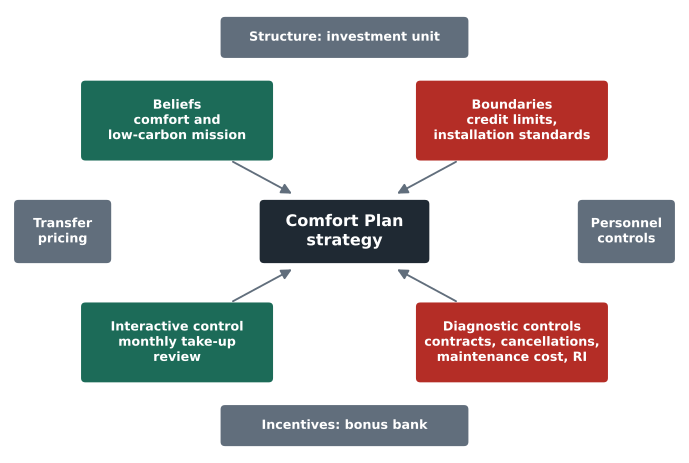
The Comfort Plan's success depends on four uncertainties: whether homeowners will sign up at $60 a month; whether they will keep paying for ten years, which depends on customer satisfaction and credit quality; whether the heat pumps' reliability will keep maintenance costs near $120 a year; and whether Services can recruit enough certified technicians. Simons' framework suggests matching levers to these. The beliefs system should express Cormorant's commitment to customers' comfort and to the low-carbon transition. Boundary systems should set credit limits, approval rules and standards for installations. Diagnostic controls should track contracts signed, cancellation rates, maintenance cost per unit and installation quality against targets. And because take-up is the most uncertain element of the strategy, it should be the subject of an interactive control system: a monthly review in which senior management and Services' managers discuss what customers, competitors and installers are saying and adjust the offering.
Step 2: structure and responsibility
Services is currently a profit center, evaluated on controllable margin, because its assets are small. The Comfort Plan changes that: 5,000 contracts a year at $3,200 each adds $16 million of capital in the first year, four times Services' existing invested capital. Following lesson 2, a unit that makes significant investment decisions should be an investment center, accountable for the capital it uses. The Comfort Plan could be set up as a separate investment center within Services, so its results do not obscure the existing installation and maintenance business, with its own general manager reporting to the head of Services.
Step 3: results measures
The obvious financial measure for an investment center is residual income or EVA. But lesson 5 showed that conventional depreciation makes new assets look unprofitable in their early years, and the Comfort Plan is a pure case of this.
# Services' Comfort Plan: one leased heat pump over a 10-year contract ($ per unit, illustrative)
cost = 2_000 + 1_200            # transfer price from Appliances plus installation
fee, upkeep, life, r = 720, 120, 10, 0.10
cash = fee - upkeep
annuity = (1 - (1 + r) ** -life) / r
npv = cash * annuity - cost
print(f"Annual cash flow {cash}; NPV at 10% {npv:,.1f}")
nbv, pv_ri = cost, 0.0
for year in range(1, life + 1):
    dep = cost / life
    ri = cash - dep - r * nbv
    pv_ri += ri / (1 + r) ** year
    if year in (1, 2, 5, 10):
        print(f"Year {year:>2}: straight-line RI {ri:7.1f}")
    nbv -= dep
print(f"PV of straight-line RI {pv_ri:,.1f}")
charge = cost / annuity
print(f"Annuity capital charge {charge:.1f}; level economic profit {cash - charge:.1f} every year")
units = 5_000
print(f"2027 plan of {units:,} units: year-1 RI {units * (cash - cost / life - r * cost) / 1000:,.0f} thousand; NPV {units * npv / 1000:,.0f} thousand")Annual cash flow 600; NPV at 10% 486.7 Year 1: straight-line RI -40.0 Year 2: straight-line RI -8.0 Year 5: straight-line RI 88.0 Year 10: straight-line RI 248.0 PV of straight-line RI 486.7 Annuity capital charge 520.8; level economic profit 79.2 every year 2027 plan of 5,000 units: year-1 RI -200 thousand; NPV 2,434 thousand
Each contract has a positive NPV of $486.70 at a 10 percent cost of capital, and the present value of its residual income equals its NPV, as lesson 5 showed. But with straight-line depreciation and a capital charge on net book value, residual income is negative in years 1 and 2, and the 2027 plan of 5,000 contracts would reduce Services' residual income by $200,000 in its first year. A manager evaluated on annual RI would sign fewer contracts than the strategy requires. Using an annuity capital charge, the economic depreciation approach, gives a level economic profit of $79.20 per contract every year, whose present value also equals the NPV, so the manager's measure is positive from the start.
Financial measures alone are not enough. The scorecard for the Comfort Plan should include leading indicators for each uncertainty: contracts signed and the conversion rate from quotes; cancellations and payment arrears; maintenance cost per unit and heat pump failure rates; certified technicians and first-time fix rate; and net promoter score. Sustainability measures should include the estimated emissions avoided by heat pumps replacing gas furnaces and water heaters. Because Cormorant owns the leased heat pumps, their electricity use also enters its scope 3 inventory as downstream leased assets, a reporting consequence the design should anticipate.
Step 4: transfer pricing
Services buys heat pumps from Appliances. If Appliances has spare capacity, the general rule of lesson 6 says the minimum transfer price is variable cost; if it is selling all it can make to dealers, the minimum is market price less savings, the $2,000 proposed. Because Appliances is expanding heat pump capacity under the strategy, it is likely to have idle capacity in the early years, so $2,000 may overstate the company's incremental cost and make the Comfort Plan look worse than it is. Two options are a two-part tariff, with Services paying Appliances' variable cost per unit plus a fixed fee for reserved capacity (lesson 7), or an analysis at the company level for the investment decision while keeping $2,000 for evaluation. Since both divisions are in the United States, tax considerations do not affect the choice, but if the Comfort Plan expanded to Europe, Cormorant Europe's transfer prices would need to meet the arm's length standard (lesson 8).
Step 5: incentives
The Comfort Plan's contracts run for ten years, but a general manager's tenure may be three or four. An annual bonus on Comfort Plan profit would reward signing contracts regardless of credit quality, with the cancellations arriving after the manager has moved on. Lesson 11's tools address this. A bonus bank, with declared bonuses based on the annuity-based economic profit and adjusted for actual cancellations and arrears, defers payment until the contracts prove sound. Scorecard objectives, such as cancellation rate and net promoter score, carry part of the bonus. And a clawback or deferral provision applies if contract values are later found to have been overstated. Installers and sales staff, whose incentives drive day-to-day behavior, should be rewarded for completed installations that pass quality inspection and for contracts that stay in force for a year, not for contracts signed.
Step 6: action, personnel and cultural controls
Results controls work only for outcomes that can be measured promptly. For the Comfort Plan, credit approval rules, installation standards and safety procedures are action controls: they specify what must be done because the consequences of failure, such as an unsafe installation or a portfolio of bad credits, are serious and appear late. Personnel controls include technician certification, which is also a scorecard measure, and careful hiring for the general manager role. Cultural controls build on Services' existing reputation for customer care. Internal audit should review contract approvals and the data behind cancellation and maintenance statistics, since these drive both the bonus bank and external reporting.
Step 7: fit and side effects
The last step is to test the package as a whole, at the company level as well as for the Comfort Plan. A dashboard that brings together financial, scorecard and carbon measures helps senior management see whether the system is sending consistent signals.
# Cormorant 2026 control dashboard: financial, scorecard and carbon results by division ($000)
rate, carbon_price = 0.10, 100
div = {  # segment margin, invested capital, scope 1+2 tonnes, scorecard result (Components and Services illustrative)
    "Appliances": (3_000, 20_000, 6_000, 0.923),
    "Components": (1_800, 15_000, 4_100, 0.960),
    "Services":   (  900,  4_000, 3_300, 1.035),
}
print(f"{'Division':<11}{'ROI':>7}{'RI':>7}{'Carbon':>8}{'RI after carbon':>17}{'Scorecard':>11}")
for name, (income, capital, tonnes, sc) in div.items():
    ri = income - rate * capital
    carbon = tonnes * carbon_price / 1000
print(f"{name:<11}{income / capital:>7.1%}{ri:>7,.0f}{carbon:>8,.0f}{ri - carbon:>17,.0f}{sc:>11.1%}")Division ROI RI Carbon RI after carbon Scorecard Appliances 15.0% 1,000 600 400 92.3% Components 12.0% 300 410 -110 96.0% Services 22.5% 500 330 170 103.5%
The dashboard shows how the measures can point in different directions. Appliances has the highest RI but the weakest scorecard, consistent with lesson 9's warning that it may be harvesting the gas water heater business. Components' RI turns negative after a $100-per-metric ton carbon charge, which would make it a target for investment in energy efficiency. Services has the strongest scorecard and high ROI, but its ROI will fall sharply as Comfort Plan capital arrives, which is one more reason to evaluate the plan on residual income with an annuity charge rather than ROI. A good control system does not reduce these signals to a single number; it makes the trade-offs visible and gives managers reasons to act on them.
Finally, the design should anticipate side effects. Appliances might resist supplying Services at less than dealer prices, or favor dealers, so the transfer pricing policy and an arbitration process must be agreed in advance. Dealers might see the Comfort Plan as competition, so the beliefs and boundary systems should address channel conflict. Services' existing managers might feel the Comfort Plan receives attention and capital at their expense. And the whole package should be reviewed after a year, because the key uncertainties will by then be partly resolved and the controls should change with them.
Worked problem
Choosing the evaluation measure for the Comfort Plan
The head of Services proposes evaluating the Comfort Plan general manager on ROI. The chief financial officer proposes RI with straight-line depreciation. The controller proposes economic profit with an annuity capital charge. Using the program's figures for a single contract, compare the three in year 1.
Show solution
- ROI with straight-line depreciation: income $720 − $120 − $320 = $280 on opening capital of $3,200 = 8.75%, below the 10% cost of capital.
- RI with straight-line depreciation: $280 − $320 = −$40.
- Economic profit with an annuity charge: $600 − $520.80 = $79.20.
- All three measures have the same present value over the contract (for ROI, in the sense that NPV is positive), but only the annuity measure signals the contract's value from year 1.
Answer: Economic profit with an annuity charge, combined with a bonus bank, best aligns the manager with the plan's positive NPV.
Common mistakes
MistakeTreating the control system as a set of separate tools.
InsteadDesign the package so the parts reinforce each other and fit the strategy.
MistakeEvaluating a long-lived investment business on annual ROI or straight-line RI.
InsteadUse economic depreciation or annuity charges, multi-year measures and bonus banks.
MistakeRewarding sales staff for contracts signed.
InsteadReward contracts that stay in force and installations that pass inspection.
MistakeUsing diagnostic controls for the most uncertain part of the strategy.
InsteadMake strategic uncertainties the focus of interactive control.
MistakeDesigning the system once and leaving it.
InsteadReview the package as uncertainties resolve and strategy changes.
Summary and key terms
- A management control system is a package; its parts must fit the strategy, structure, people and each other.
- A seven-step process: strategy and uncertainties, structure, results measures, transfer prices, incentives, other controls, and fit.
- Simons' levers match beliefs, boundaries, diagnostic and interactive controls to strategic uncertainties.
- The Comfort Plan has positive NPV but negative straight-line RI in early years; an annuity capital charge fixes the signal.
- Transfer prices should reflect the supplier's capacity; tax rules matter only across borders.
- Long-lived contracts call for deferred, multi-year incentives and rewards for contracts that last.
- Dashboards make trade-offs visible; systems should be reviewed as circumstances change.
- Control package
- The set of controls operating together in an organization, which should be designed as a whole.
- Contingency approach
- The view that the best control system depends on the organization's circumstances.
- Strategic uncertainty
- An uncertainty that could undermine the current strategy or create new opportunities.
- Annuity capital charge
- A level annual charge whose present value equals the asset's cost, giving level economic profit.
- Economic depreciation
- Depreciation that reflects the decline in an asset's value, so that profit measures signal value creation.
- Downstream leased assets
- The scope 3 category for emissions from assets a company owns and leases to others.
- Channel conflict
- Tension between a company and its intermediaries when the company sells directly.
- Subscription model
- A business model in which customers pay a recurring fee for use of a product or service.
- Control dashboard
- A display combining financial and non-financial measures for senior management review.
Practice problems
Work each problem on paper first, then reveal the answer to check.
Rerun the Comfort Plan program with a monthly fee of $55. NPV and year-1 RI?
Show answer
NPV $118.1; year-1 RI −$100.0.
What monthly fee gives an NPV of zero?
Show answer
About $53.40 a month: annual cash flow must equal the $520.80 annuity charge, plus $120 of upkeep, or $640.80 a year.
Rerun the program with a 12-year contract and a $60 fee. NPV and annuity charge?
Show answer
NPV $888.2; annuity charge $469.6.
Why should the Comfort Plan be an investment center?
Show answer
Its manager makes large investment decisions; it should be accountable for the capital it uses.
Rerun the dashboard with a carbon price of $50. Components' RI after carbon?
Show answer
$95,000.
Which of the Comfort Plan's uncertainties should be the focus of interactive control, and why?
Show answer
Customer take-up, because it is the most uncertain part of the strategy.
Give one action control and one personnel control for the Comfort Plan.
Show answer
Credit approval rules; technician certification.
Why might a $2,000 transfer price overstate the company's cost in the early years?
Show answer
Appliances may have idle capacity, so the company's incremental cost is variable cost.
Why reward installers for contracts still in force after a year rather than contracts signed?
Show answer
It discourages signing poor-quality contracts that are later canceled.
What side effects should Cormorant anticipate from the Comfort Plan?
Show answer
Transfer price disputes, channel conflict with dealers and resentment among existing Services managers.
Lesson quiz · 5 questions
Score 60% or more to complete this lesson.
Create a free account to save your progress, take quizzes and earn a certificate.