
ACCT-321 · Lesson 2 of 12 · 30 min
Organizational structure, decentralization and responsibility centers
Control systems are built on top of an organizational structure. Before anyone can set a budget, measure a division's return or design a bonus, someone has to decide who is responsible for what. This lesson looks at how organizations divide up decision rights, why many choose to decentralize, the four kinds of responsibility center that result, and the controllability principle that governs how managers should be evaluated. ACCT-102 introduced responsibility centers briefly; here we examine the design choices behind them and the measurement problems they create.
Organizational structures
A functional structure groups activities by specialty: manufacturing, marketing, finance, engineering. It captures economies of scale and deep expertise, and it suits a single-business firm in a stable market. Its weakness is coordination: no one below the chief executive is responsible for the profit of a product line, and decisions that cross functions must travel up the hierarchy. A divisional structure groups activities by product, customer or region, with each division containing most of the functions it needs. Division managers can be held responsible for profit, which sharpens accountability and speeds decisions, at the cost of some duplication and possible conflict between divisions.
A matrix structure overlays the two, with staff reporting to both a functional manager and a product or project manager. It tries to capture both expertise and responsiveness but blurs accountability and can create conflict. Network or virtual structures rely heavily on outside partners for manufacturing, logistics or development, leaving the core organization to coordinate. Many large companies combine elements: Cormorant has three product divisions, but finance, information technology, legal and human resources are run centrally as shared services, and the Irish subsidiary is a separate legal entity organized by region.
Why decentralize?
Decentralization is the delegation of decision-making authority to lower levels of the organization. The degree of decentralization is a matter of extent, not a yes-or-no choice: a division manager may be free to set prices and hire staff but need head-office approval for capital projects above a limit.
The benefits are well established. Managers closer to customers and operations have better information about local conditions, and decentralization lets them act on it without passing it up the hierarchy, where it can be lost or delayed. Decisions are faster. Senior managers are freed to focus on strategy. Junior managers gain experience that prepares them for senior roles. Many people are more motivated when they have real authority. These benefits are greatest in organizations facing diverse markets, fast change and complex products.
The costs are equally real. Managers may pursue their own unit's interests at the expense of the whole, a problem called goal incongruence or dysfunctional decision making. Functions are duplicated across divisions. Divisions may compete with one another for customers or resources. Head office has less direct knowledge of what is happening and must rely more on reports, which managers can manipulate. Much of this course is about the measurement and incentive tools that try to keep the benefits of decentralization while limiting its costs.
| Benefits | Costs |
|---|---|
| Better use of local information | Goal incongruence between units and the organization |
| Faster response to customers and markets | Duplication of functions and systems |
| Senior managers freed for strategy | Competition and conflict between divisions |
| Management development and motivation | Greater reliance on reported measures that can be gamed |
Responsibility centers
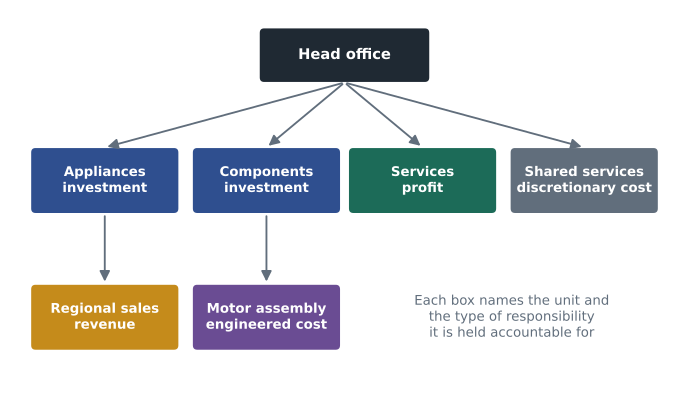
A responsibility center is a part of the organization whose manager is accountable for a specified set of activities. The type of center depends on which financial results the manager can influence and is held accountable for. A cost center manager is accountable for costs only. An engineered cost center, such as a production department, has a clear relationship between inputs and outputs, so standard costs and flexible budgets (ACCT-222) can measure efficiency. A discretionary expense center, such as research, legal or human resources, has no clear input–output relationship; budgets are set by management judgment and the main control is spending against budget, which says little about efficiency or effectiveness.
A revenue center manager is accountable mainly for revenues, as in a regional sales office; the risk is that managers chase volume at any price or margin, so revenue centers are often given some responsibility for selling costs or for gross margin. A profit center manager is accountable for both revenues and costs, and therefore for profit. An investment center manager is accountable for profit and for the assets used to earn it, and often has authority over capital investment. Investment centers are evaluated with measures that relate profit to capital, such as ROI, residual income and economic value added, the subject of lessons 4 and 5.
| Center | Manager accountable for | Typical measures | Cormorant example |
|---|---|---|---|
| Engineered cost center | Costs of producing outputs | Standard cost variances, cost per unit | Motor assembly line in Components |
| Discretionary expense center | Spending on activities without clear outputs | Spending against budget, service levels | Head-office legal department |
| Revenue center | Revenues, sometimes selling costs | Sales against target, price and mix variances | Western Canada sales office |
| Profit center | Revenues and costs | Contribution, controllable margin, segment margin | Services division |
| Investment center | Profit and invested capital | ROI, residual income, EVA | Appliances and Components divisions |
The classification depends on authority, not on the unit's activities. A division that cannot set its own prices because head office negotiates all national accounts is closer to a cost center than a true profit center, whatever its organization chart says. A common source of frustration is a mismatch between authority and accountability: managers held responsible for profit but denied the authority to change prices, product mix or staffing.
The controllability principle
The controllability principle holds that managers should be held accountable only for the results they can control. It rests on fairness and on motivation: evaluating people on outcomes they cannot influence exposes them to risk without improving their decisions, and they may respond by setting easy targets, spending time on excuses or leaving. In practice, few results are entirely controllable. Merchant and Van der Stede identify several types of uncontrollable factors. Economic and competitive factors include changes in interest rates, exchange rates, customer demand and competitors' actions. Acts of nature include fires, floods, storms and pandemics. Interdependence arises when a unit's results depend on other units, as when Appliances' delivery performance depends on Components supplying motors on time.
Several techniques remove or reduce the effect of uncontrollable factors. Variance analysis separates volume, price and efficiency effects (ACCT-222), so that a manager is evaluated on efficiency even when volume falls for reasons beyond her control. Flexible budgets adjust cost allowances to actual activity. Relative performance evaluation compares a unit's results with those of similar units or competitors facing the same conditions, filtering out common shocks. Subjective, ex post adjustments let superiors modify results for events they judge uncontrollable. Each technique has costs. Relative evaluation needs a valid comparison group and can discourage cooperation. Subjective adjustments depend on the superior's judgment and can be seen as unfair or biased.
# Relative performance evaluation: remove a market-wide shock from a sales target
target_growth = 0.06          # Appliances' budgeted unit growth
industry_growth_budget = 0.04 # industry growth assumed when the target was set
industry_growth_actual = -0.02
actual_growth = 0.01
shock = industry_growth_actual - industry_growth_budget
adjusted_target = target_growth + shock
print(f"Market shock: {shock:+.1%}")
print(f"Adjusted target: {adjusted_target:+.1%}")
print(f"Actual growth: {actual_growth:+.1%}")
print("Beat adjusted target" if actual_growth >= adjusted_target else "Missed adjusted target")Market shock: -6.0% Adjusted target: +0.0% Actual growth: +1.0% Beat adjusted target
Appliances missed its original 6 percent growth target by a wide margin, growing only 1 percent. But the industry shrank by 2 percent when 4 percent growth had been assumed, a market shock of minus 6 percentage points. The adjusted target is zero growth, and Appliances beat it. Relative performance evaluation removes the common shock, though it raises a question of its own: should managers also be rewarded or penalized for how well they anticipated and responded to the shock?
Some organizations deliberately hold managers accountable for partly uncontrollable results. The argument is that managers can often influence how much an uncontrollable factor affects their unit, for example by hedging currency exposure, diversifying suppliers or preparing for storms, and that holding them responsible encourages them to do so. The principle is better stated as: hold managers accountable for results they can influence, after removing factors they clearly cannot.
Segment reporting for internal control
Internal reports for profit and investment centers usually follow a layered format that separates costs by controllability and traceability. Contribution margin is sales minus variable costs. Controllable margin, sometimes called short-run performance margin, deducts the fixed costs the division manager controls, such as divisional staff salaries, advertising and discretionary spending. Segment margin, or divisional contribution, deducts further fixed costs traceable to the division but not controllable by its manager, such as depreciation on assets bought by head office or the salary of the division manager. Head-office costs allocated to divisions come last, if at all.
Each layer answers a different question. Controllable margin is the best measure of the manager's performance. Segment margin is the best measure of the division's economic performance, its contribution to covering common costs and earning a profit, and is the right basis for deciding whether to keep or close the division. Profit after allocated head-office costs reflects an arbitrary allocation and should not be used to evaluate either.
# Cormorant's 2026 divisional performance report (illustrative, thousands)
div = {
    #             sales   variable  ctrl fixed  traceable non-ctrl  allocated HQ
    "Appliances": (40_000, 26_000, 8_500, 2_500, 800),
    "Components": (24_000, 14_400, 5_800, 2_000, 600),
    "Services":   (12_000,  6_600, 4_000,   500, 400),
}
print(f"{'':<11}{'Contrib.':>9}{'Ctrl margin':>12}{'Segment':>9}{'After HQ':>9}")
tot = [0, 0, 0, 0]
for name, (s, v, cf, nc, hq) in div.items():
    cm = s - v
    ctrl = cm - cf
    seg = ctrl - nc
    after = seg - hq
    for i, x in enumerate((cm, ctrl, seg, after)):
        tot[i] += x
    print(f"{name:<11}{cm:>9,}{ctrl:>12,}{seg:>9,}{after:>9,}")
print(f"{'Total':<11}{tot[0]:>9,}{tot[1]:>12,}{tot[2]:>9,}{tot[3]:>9,}")Contrib. Ctrl margin Segment After HQ Appliances 14,000 5,500 3,000 2,200 Components 9,600 3,800 1,800 1,200 Services 5,400 1,400 900 500 Total 29,000 10,700 5,700 3,900
The report shows Appliances with a contribution margin of $14,000,000, a controllable margin of $5,500,000 and a segment margin of $3,000,000 (figures in thousands in the program). Components shows $3,800,000 controllable margin and $1,800,000 segment margin; Services $1,400,000 and $900,000. Together the divisions contribute $5,700,000 toward the $1,800,000 of head-office costs, leaving $3,900,000. The divisional segment margins of $3,000,000, $1,800,000 and $900,000 become the operating income figures used for ROI and residual income in lesson 4.
Worked problem
Is Services worth keeping?
After allocated head-office costs of $400,000, Services shows a profit of $500,000. A director suggests that because Services is the smallest contributor after allocations, it should be sold. Which figure matters for the keep-or-sell decision, and what is it?
Show solution
- Allocated head-office costs of $400,000 would mostly remain if Services were sold; they are common costs.
- The relevant measure is segment margin, $900,000, the amount Services contributes to common costs and profit.
- Selling Services would reduce company profit by about $900,000 unless the sale price or freed resources make up for it.
- The decision also needs strategic considerations: Services supports Appliances sales and customer relationships.
Answer: Use segment margin of $900,000, not profit after allocations; on these figures Services should be kept.
Allocating head-office costs
Whether to allocate head-office and shared-service costs to divisions is a perennial debate. Arguments for allocation include reminding managers that these costs exist and must be covered, encouraging divisions to monitor and question central costs, and approximating what the division would pay if it bought the services outside. Arguments against include that allocations are arbitrary, uncontrollable by divisional managers, and can distort decisions if managers treat allocated fixed costs as if they were avoidable.
A middle path is to charge divisions for services they use and can control, based on usage, such as information technology help-desk calls, legal hours or payroll transactions processed, and to leave general corporate costs, such as the chief executive's office and investor relations, unallocated. Usage-based chargebacks, at a rate set in advance, encourage divisions to use services wisely and give the shared-service center a revenue figure against which to manage its costs. The rate should normally be based on budgeted cost at practical capacity, as ACCT-222 explains for support departments, so that divisions are not charged for idle capacity or for the service center's inefficiency.
Worked problem
A usage-based chargeback
Cormorant's information technology group budgets $2,400,000 of costs for 2026 and expects practical capacity of 30,000 support hours. During the year Appliances uses 11,000 hours, Components 8,000 and Services 7,000; the group's actual costs are $2,520,000. How much is charged to each division, and what happens to the rest?
Show solution
- Charge rate: $2,400,000 ÷ 30,000 hours = $80 per hour, set in advance.
- Charges: Appliances 11,000 × $80 = $880,000; Components $640,000; Services $560,000, a total of $2,080,000.
- Unused capacity of 4,000 hours, or $320,000, stays with head office, as the cost of capacity no one used.
- The spending overrun of $120,000 ($2,520,000 − $2,400,000) stays with the information technology group as its responsibility.
Answer: Divisions are charged $880,000, $640,000 and $560,000; idle capacity and the overrun are not passed on.
Shared services and centers of excellence
Large organizations increasingly consolidate transactional activities such as accounts payable, payroll and information technology support into shared-service centers, sometimes in lower-cost locations, and some outsource them entirely. A shared-service center is usually run as a cost center with service-level agreements, or sometimes as a profit center selling to internal customers at market-based prices. The control issues mirror those of transfer pricing (lessons 6 to 8): what price to charge, whether divisions may buy outside, and how to measure the center's efficiency and quality. Centers of excellence, by contrast, concentrate specialized expertise, such as data analytics or tax, and are usually managed as discretionary expense centers.
Structure, segments and external reporting
Internal responsibility centers often, but not always, match the operating segments a public company reports externally. Under ASC 280, which ACCT-311 covers, operating segments are identified by the management approach: the components whose results the chief operating decision maker reviews regularly, and ASU 2023-07 now requires disclosure of significant segment expenses provided to that decision maker. Internal reports therefore shape external disclosure.
Common mistakes
MistakeCalling a unit a profit center when its manager cannot set prices or choose its product mix.
InsteadMatch the type of responsibility center to the authority the manager actually has.
MistakeEvaluating a division manager on profit after allocated head-office costs.
InsteadUse controllable margin for the manager and segment margin for the division.
MistakeUsing profit after allocations to decide whether to close a division.
InsteadUse segment margin; most allocated common costs remain if the division closes.
MistakeCharging divisions actual shared-service costs, including idle capacity and overruns.
InsteadCharge a predetermined rate based on budgeted cost at practical capacity.
MistakeTreating the controllability principle as absolute.
InsteadHold managers accountable for results they can influence, removing clearly uncontrollable effects.
Summary and key terms
- Functional, divisional, matrix and network structures distribute decision rights differently.
- Decentralization uses local information and speeds decisions but risks goal incongruence and duplication.
- Cost, revenue, profit and investment centers differ in what the manager is accountable for.
- Engineered cost centers have clear input–output relationships; discretionary expense centers do not.
- The controllability principle limits accountability to results managers can influence; variance analysis, flexible budgets and relative evaluation remove uncontrollables.
- Controllable margin measures the manager; segment margin measures the division.
- Usage-based chargebacks at budgeted rates encourage sensible use of shared services.
- Decentralization
- Delegating decision-making authority to lower levels of an organization.
- Responsibility center
- A part of an organization whose manager is accountable for specified activities.
- Engineered cost center
- A cost center with a clear relationship between inputs and outputs.
- Discretionary expense center
- A cost center whose outputs cannot be measured in financial terms, budgeted by judgment.
- Revenue center
- A responsibility center whose manager is accountable mainly for revenues.
- Profit center
- A responsibility center whose manager is accountable for revenues and costs.
- Investment center
- A responsibility center whose manager is accountable for profit and invested capital.
- Controllability principle
- The rule that managers should be evaluated only on results they can influence.
- Controllable margin
- Contribution margin less fixed costs controllable by the segment manager.
- Relative performance evaluation
- Comparing a unit's results with those of peers facing similar conditions.
Practice problems
Work each problem on paper first, then reveal the answer to check.
List two benefits and two costs of decentralization.
Show answer
Benefits: better local information, faster decisions (also management development, senior time for strategy). Costs: goal incongruence, duplication (also inter-division conflict, reliance on gameable reports).
A research department has a $4 million budget and no clear output measure. What type of center is it?
Show answer
A discretionary expense center.
Why might a revenue center be given responsibility for gross margin?
Show answer
To stop managers chasing volume at any price or margin.
Rerun the segment program with Services' controllable fixed costs at $4,300,000. What is its segment margin?
Show answer
$600,000 (thousands: 600).
Which figure should be used to evaluate the Appliances manager?
Show answer
Controllable margin, $5,500,000.
Rerun the relative evaluation program with actual industry growth of +1%. Adjusted target?
Show answer
+3.0%; actual growth of 1% misses it.
Give an example of interdependence as an uncontrollable factor at Cormorant.
Show answer
Appliances' deliveries depend on Components supplying motors on time.
In the chargeback example, why is the $320,000 of unused capacity not charged to divisions?
Show answer
Divisions did not cause it; charging it would penalize them for capacity they did not use and hide the cost.
What is the risk of subjective ex post adjustments?
Show answer
They depend on the superior's judgment and can be seen as unfair or biased.
A division can set prices but head office controls all capital spending. Profit or investment center?
Show answer
A profit center, since the manager does not control investment.
Lesson quiz · 5 questions
Score 60% or more to complete this lesson.
Create a free account to save your progress, take quizzes and earn a certificate.