
ACCT-321 · Lesson 3 of 12 · 27 min
Budgeting for control and its behavioral effects
Budgets are the most widely used formal control in organizations of every size. ACCT-102 showed how to build a master budget and ACCT-222 how to analyze variances. This lesson asks a different question: what do budgets do to the people who prepare them and are judged against them? A budget is a plan, but it is also a target, a commitment, a basis for rewards and a weapon in negotiations over resources. The same document serving all these purposes creates predictable tensions and predictable games.
The purposes of budgets
Budgets serve at least six purposes. They support planning, forcing managers to think ahead about sales, costs, capacity and cash. They coordinate the activities of different units, so that Components plans to build as many motors as Appliances plans to need. They communicate senior management's priorities. They motivate, by setting targets for managers to strive toward. They provide a benchmark for evaluating performance. And they authorize spending, giving managers permission to commit resources up to an amount.
The trouble is that these purposes conflict. For planning and coordination, a budget should be the most likely outcome, an unbiased forecast. For motivation, research suggests a target should be challenging. For evaluation, managers prefer targets they are confident of meeting, because missing them carries penalties. For authorization, managers want generous amounts. When one number tries to serve all four, managers bias it toward whichever purpose most affects them, usually evaluation and rewards. Some organizations separate the numbers: a forecast for planning, a stretch target for motivation, and a lower threshold for bonuses.
How difficult should targets be?
Goal-setting research, much of it associated with Edwin Locke and Gary Latham, finds that specific, difficult goals lead to higher performance than vague or easy goals, provided people accept the goals and receive feedback. Beyond some point, though, goals become so difficult that people reject them, give up, or turn to manipulation to meet them. Budget targets in practice are usually set to be highly achievable. Merchant and Van der Stede report that many companies aim for targets that a competent manager will achieve most of the time, often cited as eight or nine years in ten, and use bonus schedules that reward performance above target to supply the stretch.
Highly achievable targets have advantages. They make the plan a more reliable basis for coordination and commitments to investors and lenders. They reduce the incentive to manipulate results, since a manager who expects to make target has less reason to cut corners. They protect managers from failure in bad years and maintain their confidence. They also give senior managers a signal: when a unit misses a highly achievable target, something serious has gone wrong. The cost is lower motivation for some people, which is why the bonus schedule usually continues to reward performance above target.
Top-down and participative budgeting
In top-down budgeting, senior managers set targets and pass them down. It is fast, ensures targets reflect strategy and can stretch units, but it ignores local knowledge and may produce targets that lower-level managers do not accept. In bottom-up or participative budgeting, the managers who will be held accountable prepare their own budgets, which are then reviewed and negotiated. Participation uses local information, increases acceptance and commitment, and develops managers' planning skills.
Participation has its own dangers. Managers with better information than their superiors, an information asymmetry, may use participation to build in slack. The negotiation can take a long time. And participation that is not genuine, where senior managers ask for input but then impose their own figures, can do more damage than no participation at all. Most organizations use a mix: top-down guidelines and targets for the company as a whole, followed by participative development of unit budgets within them, then negotiation to reconcile the two.
Budget slack
Budget slack, or padding, is the deliberate understatement of revenues or overstatement of costs in a budget so that it is easier to meet. Managers create slack to protect themselves against uncertainty, to make sure they earn bonuses, to look good, and to have resources available for things they want to do without asking. Slack is not always harmful: a modest buffer can absorb shocks and allow experimentation. But large or hidden slack misleads planners, ties up resources and rewards managers for negotiating skill rather than performance.
Slack is hard to detect directly, because only the manager knows what is truly achievable. Indirect signs include a unit that consistently beats its budget by similar margins, costs that rise just before the budget is set, and revenue forecasts that fall well below trends in the market. Comparing budgets with independent forecasts, benchmarks or past performance helps. So does a planning culture in which honest forecasts are not punished.
# Components: budgeted versus actual controllable margin, 2022-2026 (thousands)
years = [2022, 2023, 2024, 2025, 2026]
budget = [3_200, 3_350, 3_500, 3_600, 3_700]
actual = [3_520, 3_690, 3_820, 3_950, 3_800]
over = []
for y, b, a in zip(years, budget, actual):
    pct = (a - b) / b
    over.append(pct)
    print(f"{y}: budget {b:,}  actual {a:,}  beat by {pct:5.1%}")
avg = sum(over) / len(over)
print(f"Average beat: {avg:.1%}; years beaten: {sum(p > 0 for p in over)} of {len(over)}")2022: budget 3,200 actual 3,520 beat by 10.0% 2023: budget 3,350 actual 3,690 beat by 10.1% 2024: budget 3,500 actual 3,820 beat by 9.1% 2025: budget 3,600 actual 3,950 beat by 9.7% 2026: budget 3,700 actual 3,800 beat by 2.7% Average beat: 8.3%; years beaten: 5 of 5
Components beat its controllable margin budget in all five years, by about 10 percent in each of the first four and by 2.7 percent in 2026, an average of 8.3 percent. A consistent pattern like this is a classic sign of slack, although it could also reflect genuine improvement that the budget process failed to anticipate. The 2026 result, the lowest beat, may show that head office began to squeeze the slack out, or simply that 2026 was a harder year. A controller would look at the reasons behind each year's beat before concluding.
Budget games
Managers play a range of budget games. Sandbagging is understating what can be achieved. The ratchet effect describes how this year's actual results become next year's starting point, so a manager who performs very well is punished with a harder target; anticipating this, managers may deliberately hold back performance in good years. The hockey stick is a forecast that shows poor results in the near term and a sharp improvement later, often beyond the manager's tenure. Use-it-or-lose-it spending happens when unspent budget is withdrawn at year end, prompting a rush of spending in the last months. Managers may also shift revenues or costs between periods, through channel stuffing, delayed maintenance or early recognition, to hit targets in the period that matters for their bonus.
| Game | Description | Possible countermeasure |
|---|---|---|
| Sandbagging | Understating what can be achieved | Benchmarks, independent forecasts, truth-inducing schemes |
| Ratchet effect | Holding back performance to avoid harder future targets | Targets based on market or peers, not only last year's actual |
| Hockey stick | Back-loading improvements beyond the forecast horizon | Rolling forecasts, tracking of past forecast accuracy |
| Use it or lose it | Year-end spending to protect next year's budget | Carry-forward of unspent funds, zero-based reviews |
| Period shifting | Pulling sales forward or pushing costs back | Multi-period bonus measures, audit of cut-offs, deferrals |
Truth-inducing schemes
If the problem is that managers have private information and an incentive to understate it, one response is to design rewards so that honest forecasting pays best. A truth-inducing scheme, sometimes called the Soviet incentive scheme or Weitzman scheme, rewards a manager both for the level of the forecast and for performance relative to the forecast, with a penalty for falling short that is larger than the reward for the forecast itself, which in turn is larger than the reward for exceeding it.
# A truth-inducing bonus scheme (Weitzman type), bonus in thousands
b1, b2, b3 = 0.004, 0.002, 0.006   # forecast reward, overshoot reward, shortfall penalty
actual = 5_500                      # the controllable margin the manager expects
def bonus(forecast, actual):
    gap = actual - forecast
    return b1 * forecast + (b2 * gap if gap >= 0 else b3 * gap)
for f in (5_000, 5_250, 5_500, 5_750, 6_000):
    print(f"Forecast {f:,}: bonus {bonus(f, actual):5.1f}")
best = max(range(4_500, 6_501, 50), key=lambda f: bonus(f, actual))
print("Best forecast:", f"{best:,}")Forecast 5,000: bonus 21.0 Forecast 5,250: bonus 21.5 Forecast 5,500: bonus 22.0 Forecast 5,750: bonus 21.5 Forecast 6,000: bonus 21.0 Best forecast: 5,500
With an expected actual of $5,500,000, forecasting exactly $5,500,000 gives the highest bonus, $22,000. Forecasting low earns less because each dollar of forecast is worth more than each dollar of overshoot; forecasting high earns less because the shortfall penalty is steepest. The scheme works neatly on paper but is rarely used in its pure form, because outcomes are uncertain, managers may not understand it, and it can seem complex and manipulative. Its lesson is general, though: reward accurate forecasting, and do not punish managers for honest information.
Using budgets in evaluation
Anthony Hopwood's study in 1972 distinguished three styles of using budgets to evaluate managers. In a budget-constrained style, superiors focus mainly on whether the manager met the budget in the short run. In a profit-conscious style, superiors look at the manager's contribution to long-run effectiveness, using budget data flexibly. In a non-accounting style, budget data play little part. Hopwood found the budget-constrained style associated with higher job tension, poorer relations with colleagues and more manipulation of accounting data. Later research has refined this, finding that the effect depends on task uncertainty: a rigid emphasis on budgets is more harmful where outcomes are highly uncertain and less so in routine settings.
The practical lesson is that how budgets are used matters as much as how they are set. Flexible budgets that adjust for actual activity (ACCT-222), discussion of the reasons for variances rather than mechanical penalties, and attention to long-term indicators alongside the budget all reduce the dysfunctional effects.
Beyond budgeting and rolling forecasts
Critics argue that the annual fixed budget is so loaded with conflicting purposes and games that it does more harm than good. The Beyond Budgeting movement, led by Jeremy Hope and Robin Fraser from the late 1990s, proposed abandoning fixed annual budgets in favor of relative targets (against peers or competitors), rolling forecasts used only for planning, dynamic resource allocation on demand, and decentralized decision making within clear values and boundaries. The Swedish bank Handelsbanken, which abandoned budgets in the 1970s, is the best-known example; the Norwegian energy company Equinor, formerly Statoil, replaced its traditional budget with a process called Ambition to Action.
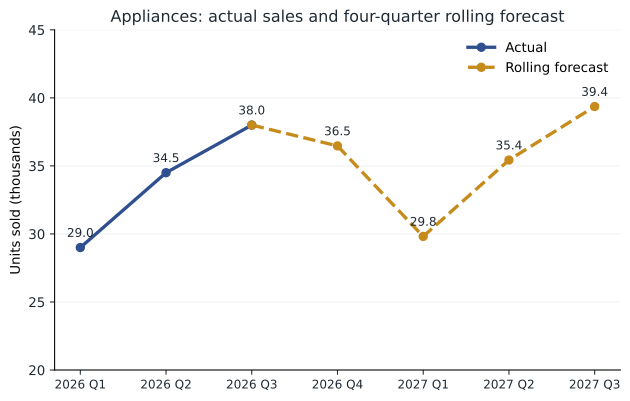
Few organizations have abandoned budgets entirely, but many have adopted parts of the approach, particularly rolling forecasts. A rolling forecast extends a fixed number of periods ahead, often four to six quarters, and is updated every quarter, so the planning horizon never shrinks as the year progresses. Because it is separated from targets and rewards, it can be a more honest view of the future.
# A four-quarter rolling forecast for Appliances unit sales (thousands of units)
history = {"2026Q1": 29.0, "2026Q2": 34.5, "2026Q3": 38.0}
season = {"Q1": 0.85, "Q2": 1.00, "Q3": 1.10, "Q4": 1.05}   # seasonal indexes
base = sum(v / season[k[-2:]] for k, v in history.items()) / len(history)
print(f"Deseasonalized run rate: {base:.1f}")
growth = 0.01   # assumed quarterly growth
quarters = ["2026Q4", "2027Q1", "2027Q2", "2027Q3"]
for i, q in enumerate(quarters, start=1):
    f = base * (1 + growth) ** i * season[q[-2:]]
print(f"{q}: {f:5.1f}")Deseasonalized run rate: 34.4 2026Q4: 36.5 2027Q1: 29.8 2027Q2: 35.4 2027Q3: 39.4
The forecast removes seasonality from the three quarters of actual sales to find a run rate of about 34,400 units per quarter, applies 1 percent quarterly growth and puts the seasonality back. It projects about 36,500 units in the fourth quarter, dropping to about 29,800 in the first quarter of 2027 before recovering. Next quarter, when actual fourth-quarter sales are known, the forecast will roll forward to include the third quarter of 2027.
Worked problem
Separating the numbers
Appliances' management believes controllable margin of $5,500,000 is the most likely outcome for 2027, that $6,000,000 is achievable with an excellent year, and that $5,000,000 would be met nine years in ten. How might Cormorant use these figures for different purposes?
Show solution
- Planning, cash and production budgets use the most likely figure, $5,500,000, for coordination.
- The bonus threshold could be set at $5,000,000, a highly achievable target that limits manipulation.
- The bonus schedule continues to rise up to $6,000,000 or beyond, supplying the stretch.
- Senior managers communicate the $6,000,000 as an aspiration, not a commitment.
Answer: Use the most likely figure for planning, the highly achievable figure as the bonus threshold, and the stretch figure as an aspiration.
Budgets in public and not-for-profit organizations
In governments and many not-for-profit organizations, the budget is a legal authorization to spend, approved by a legislature or board, and spending beyond it may be unlawful. Federal agencies operate under appropriations enacted by Congress, and the Antideficiency Act prohibits obligating funds beyond them. Use-it-or-lose-it behavior is common where annual appropriations expire at fiscal year end. ACCT-412 covers public sector and not-for-profit accounting in detail.
Common mistakes
MistakeUsing one budget number for planning, motivation, evaluation and authorization.
InsteadRecognize the conflicts; consider separate forecasts, stretch goals and bonus thresholds.
MistakeSetting targets so hard that most managers miss them.
InsteadHighly achievable targets with rewards for exceeding them limit manipulation and keep commitment.
MistakeAssuming participation always improves budgets.
InsteadParticipation helps acceptance and uses local knowledge but invites slack where information is asymmetric.
MistakeBasing next year's target only on this year's actual results.
InsteadThis creates a ratchet effect; use market, peer or independent benchmarks too.
MistakeUsing budgets rigidly to evaluate managers in uncertain environments.
InsteadUse flexible budgets and discuss the reasons behind variances.
Summary and key terms
- Budgets serve planning, coordination, communication, motivation, evaluation and authorization, which often conflict.
- Specific, difficult goals motivate, but highly achievable budget targets limit manipulation and support planning.
- Participative budgeting uses local knowledge but invites slack when managers know more than their superiors.
- Budget games include sandbagging, the ratchet effect, hockey sticks, use-it-or-lose-it spending and period shifting.
- Truth-inducing schemes reward accurate forecasts with a steep penalty for shortfalls.
- A budget-constrained evaluation style is associated with tension and manipulation, especially under uncertainty.
- Beyond Budgeting and rolling forecasts separate planning from targets and rewards.
- Budget slack
- Deliberate understatement of revenues or overstatement of costs to make a budget easier to meet.
- Participative budgeting
- A process in which the managers held accountable help prepare their own budgets.
- Ratchet effect
- Basing future targets on past actual results, which discourages strong performance.
- Sandbagging
- Understating what can be achieved to secure an easy target.
- Highly achievable target
- A target that a competent manager will meet most of the time.
- Truth-inducing scheme
- A bonus formula that makes honest forecasting the best strategy.
- Rolling forecast
- A forecast extended by one period each period, keeping a constant horizon.
- Beyond Budgeting
- An approach that replaces fixed annual budgets with relative targets, rolling forecasts and dynamic resource allocation.
- Budget-constrained style
- An evaluation style that emphasizes meeting the budget in the short run.
- Information asymmetry
- A situation in which one party has better information than another.
Practice problems
Work each problem on paper first, then reveal the answer to check.
Why can a single budget number not serve planning and motivation equally well?
Show answer
Planning needs an unbiased most-likely figure; motivation calls for a challenging target.
Give two advantages of highly achievable targets.
Show answer
More reliable plans and less incentive to manipulate (also protection in bad years, a clear warning signal when missed).
Rerun the slack program with 2026 actual of 4,050. Average beat?
Show answer
About 9.7 percent.
What is the ratchet effect, and how can it be reduced?
Show answer
Next year's target rises with this year's actual, discouraging effort; base targets also on market or peer benchmarks.
In the truth-inducing scheme, why must b3 exceed b1?
Show answer
Otherwise the manager gains by over-forecasting, since the shortfall penalty would not outweigh the forecast reward.
Rerun the truth-inducing program with an expected actual of 5,250. Best forecast?
Show answer
5,250.
Name one company associated with Beyond Budgeting.
Show answer
Handelsbanken (or Equinor, formerly Statoil).
What did Hopwood find about the budget-constrained style?
Show answer
It was associated with higher job tension, poorer relations and more data manipulation.
How does a rolling forecast differ from an annual budget?
Show answer
It keeps a constant horizon by adding a period each period and is usually separated from targets and rewards.
A department spends heavily in the last month of the year. What game is likely, and what might reduce it?
Show answer
Use-it-or-lose-it spending; allow carry-forward of unspent funds.
Lesson quiz · 5 questions
Score 60% or more to complete this lesson.
Create a free account to save your progress, take quizzes and earn a certificate.