
ACCT-321 · Lesson 7 of 12 · 27 min
Transfer pricing II: capacity, negotiation and dual pricing
Lesson 6 introduced the general rule: the minimum transfer price is incremental cost plus opportunity cost. It applied the rule to two clean cases, one with plenty of idle capacity and one at full capacity. Real situations are messier. A selling division may be partly constrained, so some internal units displace outside sales and others do not. The buying division's alternatives may be uncertain. And when neither market price nor cost gives a satisfactory answer, companies turn to negotiation, dual pricing or two-part tariffs. This lesson works through each of these, still with Cormorant's motors, and closes with the behavioral side of transfer pricing: disputes, arbitration and the cost to the organization of managers' time spent arguing about internal prices.
The 2027 capacity squeeze
For 2027, Components expects outside demand for motors to rise to 220,000 units at $110, because a large North American appliance maker has signed a supply agreement. Components' practical capacity remains 300,000 motors a year. Appliances still needs 100,000 motors. Together, the two sources of demand total 320,000 units, so Components is short by 20,000. If it supplies all 100,000 motors to Appliances, it can sell only 200,000 outside, giving up 20,000 outside sales. The question for Cormorant is whether to transfer all, some or none of Appliances' requirement, and at what price.
From the company's point of view, the answer is clear. Each motor used by Appliances supports a water heater or heat pump that earns an average of $230 of contribution before the motor's cost, far more than the $50 of contribution, $110 less $60, that Components earns on an outside sale, or $45 after $5 of selling costs. Even buying motors from an outside supplier at $110 would leave Appliances with $120 per unit. So Appliances should get 100,000 motors from somewhere. The real choice is between making them inside, and giving up 20,000 outside sales, or buying 20,000 from outside suppliers. Making inside costs the company $60 plus $45 of lost contribution, $105, for each displaced unit; buying outside costs $110. Making inside is better by $5 a unit, the avoided selling cost.
Applying the general rule with partial capacity
With partial capacity, the general rule gives a blended minimum. The first 80,000 motors come from idle capacity and have no opportunity cost, so their minimum is $60. The remaining 20,000 displace outside sales, so their minimum is $60 plus $45, or $105. The minimum total Components should accept for the whole order is 80,000 × $60 plus 20,000 × $105, and the minimum average transfer price is that total divided by 100,000.
# Minimum transfer price when Components is partly constrained (2027 scenario)
capacity = 300_000
external = 220_000      # outside demand at $110
internal = 100_000      # Appliances' requirement
var_cost, market, saving = 60, 110, 5
idle = max(0, capacity - external)
from_idle = min(internal, idle)
displaced = internal - from_idle
opp = market - var_cost - saving          # contribution lost per outside sale given up
total_min = from_idle * var_cost + displaced * (var_cost + opp)
print(f"Idle capacity: {idle:,} units; motors from idle capacity: {from_idle:,}; outside sales displaced: {displaced:,}")
print(f"Opportunity cost per displaced unit: ${opp}")
print(f"Minimum total for the order: ${total_min:,.0f}; per unit: ${total_min / internal:.2f}")
for ext in (150_000, 200_000, 220_000, 250_000, 300_000):
    idle = max(0, capacity - ext); d = internal - min(internal, idle)
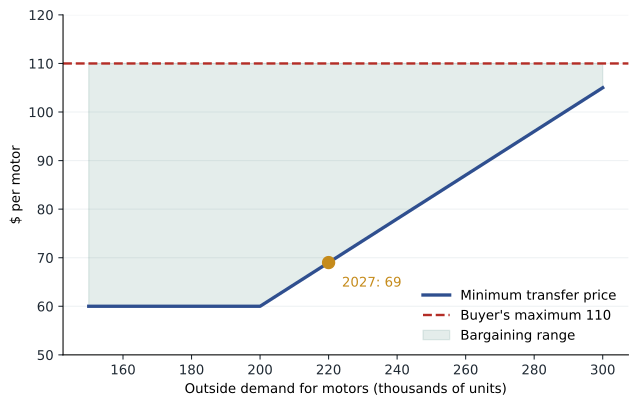
print(f" outside demand {ext:>7,}: minimum transfer price ${(internal * var_cost + d * opp) / internal:6.2f}")Idle capacity: 80,000 units; motors from idle capacity: 80,000; outside sales displaced: 20,000 Opportunity cost per displaced unit: $45 Minimum total for the order: $6,900,000; per unit: $69.00 outside demand 150,000: minimum transfer price $ 60.00 outside demand 200,000: minimum transfer price $ 60.00 outside demand 220,000: minimum transfer price $ 69.00 outside demand 250,000: minimum transfer price $ 82.50 outside demand 300,000: minimum transfer price $105.00
The program also shows how the minimum moves as outside demand changes. With outside demand of 200,000 or less, Components has enough idle capacity for the whole order, and the minimum is the $60 variable cost. With outside demand of 300,000, every internal unit displaces an outside sale, and the minimum is $105, market price less savings. Between those points, the minimum rises steadily. This is the main reason a single fixed transfer price rarely stays right for long: the correct price depends on how busy the selling division is, which changes from year to year and even month to month.
| Outside demand (units) | Idle capacity for transfers | Displaced outside sales | Minimum transfer price | Appliances' maximum |
|---|---|---|---|---|
| 150,000 | 150,000 | 0 | $60.00 | $110 |
| 200,000 | 100,000 | 0 | $60.00 | $110 |
| 220,000 | 80,000 | 20,000 | $69.00 | $110 |
| 250,000 | 50,000 | 50,000 | $82.50 | $110 |
| 300,000 | 0 | 100,000 | $105.00 | $110 |
Worked problem
Partial capacity with a lower outside offer
In 2027, an outside supplier offers Appliances motors at $100. Components has 80,000 units of idle capacity and the rest of the order would displace outside sales. What should the company do, and what transfer price range would lead the divisions to do it?
Show solution
- Cost to the company of making the first 80,000 internally: $60 each, against $100 outside. Make them.
- Cost of making the last 20,000 internally: $60 + $45 = $105 each, against $100 outside. Buy them.
- Best plan: 80,000 inside and 20,000 outside. Cost to the company: 80,000 × $60 + 20,000 × $100 = $6,800,000, against $6,900,000 for making all 100,000 inside ($6,000,000 plus $900,000 of lost outside contribution) and $10,000,000 for buying all 100,000 outside.
- Transfer prices that achieve this: any price between $60 and $100 for the first 80,000 units; no internal transfer for the last 20,000, since Components' minimum ($105) exceeds Appliances' maximum ($100).
Answer: Split the order. A single transfer price for all 100,000 units cannot produce the best result; a price per tranche, or negotiation, can.
The example shows why companies with capacity-constrained suppliers often use negotiated prices or volume-based schedules rather than a single price. A single price of $69, the blended minimum, would lead Appliances to buy all 100,000 internally, costing the company $5 a unit on the last 20,000 compared with buying them outside at $100 and letting Components sell those motors outside at $110 less $5 of selling cost.
Negotiated transfer prices
Under negotiated transfer pricing, head office lets the divisions bargain, typically within a range defined by the general rule. The selling division will not accept less than its minimum, and the buying division will not pay more than its maximum. If the range exists, a deal is possible and should be good for the company; if not, no transfer should take place. Negotiation has real advantages. It preserves autonomy, it uses the divisions' private information about costs, capacity and outside alternatives, and the resulting price is one both managers have agreed to, so neither can later blame it for poor results.
Negotiation also has costs. It takes time and can sour relationships between divisions. The outcome depends on bargaining skill and power, not only on economics, so the resulting profits may say more about negotiating ability than about performance. Divisions may misrepresent costs or outside offers to gain an advantage. And if the negotiation fails, a transfer that would benefit the company may not happen at all. Companies usually set rules to manage these risks: negotiations must be completed by a deadline, both parties must have access to cost and market information, and an arbitrator, often the controller or a senior executive, settles disputes that cannot be resolved.
A useful principle in negotiation is to split the gain. In 2027, the combined gain from the transfer is the difference between Appliances' maximum of $110 and Components' minimum of $69, or $41 a unit, $4,100,000 for the order. A price of $89.50 would split this equally. Cormorant's current price of $90 is close to that, which may be one reason the managers have not argued much about it.
Dual pricing
Dual pricing uses two transfer prices: the selling division is credited with one price, usually market or market less savings, and the buying division is charged another, usually variable or full cost. The aim is to give the selling division the profit it would earn selling outside, so it is motivated to supply internally, while letting the buying division see a cost that reflects the company's true incremental cost, so it makes goal-congruent decisions. The difference between the two prices is recorded in a head office account and eliminated on consolidation.
# Dual pricing and a two-part tariff for 100,000 motors (thousands)
units = 100_000
var_cost = 60
fixed = 7_500                     # Components' annual fixed manufacturing cost
share = units / 300_000           # Appliances' share of capacity reserved
credit, charge = 105, 85
comp_profit = (credit - var_cost) * units / 1000
appl_cost = charge * units / 1000
print(f"Dual pricing: Components credited {credit * units / 1000:,.0f}, Appliances charged {appl_cost:,.0f}")
print(f"Difference eliminated at head office: {(credit - charge) * units / 1000:,.0f}")
fee = fixed * share * 1.10        # fixed fee covering reserved capacity plus a 10% return
print(f"Two-part tariff: ${var_cost} per motor plus fixed fee {fee:,.0f}")
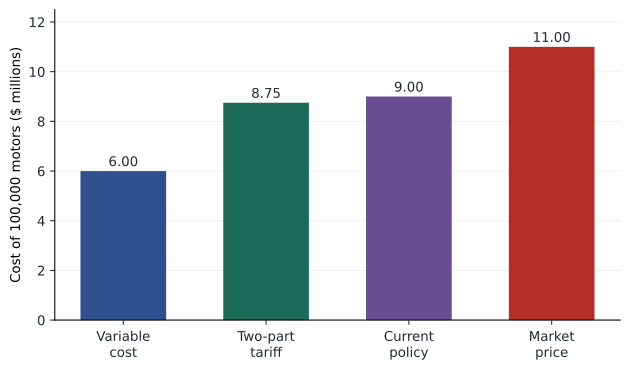
print(f"Appliances' total cost under the tariff: {var_cost * units / 1000 + fee:,.0f} (average ${(var_cost * units / 1000 + fee) * 1000 / units:.2f})")Dual pricing: Components credited 10,500, Appliances charged 8,500 Difference eliminated at head office: 2,000 Two-part tariff: $60 per motor plus fixed fee 2,750 Appliances' total cost under the tariff: 8,750 (average $87.50)
Under Cormorant's dual pricing proposal, Components would be credited $105 per motor and Appliances charged $85. Both divisions report higher profits than they would under any single price, and the sum of divisional profits exceeds company profit by $2,000,000, which head office absorbs. That is dual pricing's main weakness. Because both divisions look good, neither has much incentive to control costs or challenge the arrangement. Divisional profits no longer add up to company profit, which confuses performance evaluation and can make managers complacent. Dual pricing is used, but less often than the textbook attention to it suggests, and usually for a limited time or a specific purpose, such as encouraging a new internal supply relationship.
Two-part tariffs
A two-part tariff, sometimes called the fixed-fee-plus-variable-cost method, charges the buying division variable cost for each unit transferred plus a periodic fixed fee that covers the seller's fixed costs related to capacity reserved for the buyer, often with a return on those costs. The buyer then sees the true incremental cost of each extra unit, so its short-run decisions are goal congruent, while the seller recovers its fixed costs and earns a profit. The fixed fee is typically set annually, based on the capacity the buyer reserves.
For Cormorant, Appliances reserves one-third of Components' capacity. A fixed fee of one-third of the $7,500,000 fixed cost plus a 10 percent return is $2,750,000 a year, and Appliances pays $60 per motor on top. Its total cost for 100,000 motors is $8,750,000, or an average of $87.50. The tariff works well when the buying division can estimate its needs in advance and when capacity reservation is meaningful. It works less well when needs fluctuate or when the seller has many internal customers whose demands interact.
Comparing the methods
| Method | Goal congruence | Evaluation | Autonomy | Simplicity |
|---|---|---|---|---|
| Market price | Good if market competitive | Good | Good | Good |
| Variable cost | Good with idle capacity | Poor for seller | Limited | Good |
| Full cost (plus markup) | Often poor | Fair | Limited | Good |
| Negotiated | Good if range exists | Depends on bargaining | Very good | Poor |
| Dual pricing | Good | Poor; profits do not add up | Fair | Fair |
| Two-part tariff | Good | Fair to good | Fair | Fair |
Disputes, arbitration and the cost of arguing
Transfer prices are among the most common sources of conflict in decentralized companies. Each dollar added to the transfer price adds a dollar to one division's profit and subtracts it from the other's, so managers have strong incentives to argue, especially when bonuses depend on divisional profit (lesson 11). Some conflict is healthy because it surfaces information about costs and markets. Too much wastes management time, damages cooperation and can lead managers to avoid internal transactions altogether.
Companies limit the damage in several ways. A clear written policy that states the method, how prices will be updated and how disputes will be resolved removes much of the room for argument. An arbitration process with a respected arbitrator and binding decisions prevents deadlock. Evaluating managers partly on company-wide results, through bonus pools or share-based awards, softens the zero-sum character of the transfer price. And some companies treat divisions that trade heavily with each other as a single profit center for evaluation, or move the supplying unit to cost-center status, accepting less decentralization in exchange for less conflict.
Common mistakes
MistakeUsing one minimum transfer price when the seller is partly constrained.
InsteadBlend: idle units at variable cost, displaced units at variable cost plus opportunity cost.
MistakeAssuming a single blended price produces the best decision in every tranche.
InsteadCheck each tranche separately; the best plan may split the order.
MistakeTreating dual pricing as costless.
InsteadDivisional profits exceed company profit, which weakens cost control and confuses evaluation.
MistakeSetting a two-part tariff fixed fee from actual usage after the fact.
InsteadBase the fee on capacity reserved in advance, so the buyer sees only variable cost per unit.
MistakeLetting negotiation run without a deadline or arbitrator.
InsteadSet rules: information access, a deadline and binding arbitration.
Summary and key terms
- When the seller is partly constrained, the minimum transfer price blends idle units at variable cost and displaced units at variable cost plus opportunity cost.
- For Cormorant in 2027, the blended minimum is $69; it rises from $60 to $105 as outside demand grows.
- A single price may not produce the best plan when the buyer has a mid-range outside offer; per-tranche prices or negotiation can.
- Negotiation preserves autonomy and uses local information, but needs a range, a deadline and arbitration.
- Dual pricing credits the seller and charges the buyer different prices; the difference is absorbed at head office.
- A two-part tariff charges variable cost per unit plus a fixed fee for reserved capacity.
- Clear policy, arbitration and company-wide incentives reduce transfer pricing disputes.
- Partial capacity
- A situation in which some internal transfers use idle capacity and others displace outside sales.
- Blended minimum transfer price
- The weighted average of minimum prices for units from idle capacity and units that displace outside sales.
- Bargaining range
- The interval between the seller's minimum and the buyer's maximum transfer price.
- Dual pricing
- Crediting the seller with one transfer price and charging the buyer another.
- Two-part tariff
- A transfer price of variable cost per unit plus a periodic fixed fee for reserved capacity.
- Arbitration
- Settlement of a transfer pricing dispute by a third party, usually a senior manager.
- Gain from internal trade
- The difference between the buyer's maximum and the seller's minimum, times units transferred.
- Capacity reservation
- An agreement by which a buying division reserves part of a seller's capacity in advance.
- Head office elimination account
- An account that absorbs the difference between dual transfer prices on consolidation.
Practice problems
Work each problem on paper first, then reveal the answer to check.
Outside demand is 240,000 and internal demand 100,000 with capacity 300,000. Minimum transfer price?
Show answer
(60,000 × $60 + 40,000 × $105) / 100,000 = $78.
Rerun the blended program with capacity 320,000. Minimum transfer price at 220,000 outside demand?
Show answer
$60, because there is enough idle capacity.
What is the gain from internal trade in 2027 at a maximum of $110 and a blended minimum of $69?
Show answer
$41 a unit, $4,100,000 for 100,000 units.
Under dual pricing with credit $110 and charge $60 for 100,000 units, how much does head office absorb?
Show answer
$5,000,000.
Rerun the dual pricing program with a 20 percent return on the fixed fee. Fixed fee and average cost?
Show answer
Fixed fee $3,000,000; average cost $90.00.
Why might a single transfer price of $69 lead to a poor decision when an outside supplier offers $100?
Show answer
Appliances would buy all 100,000 inside, but the last 20,000 cost the company $105 each to make inside.
Give two advantages and two disadvantages of negotiated transfer prices.
Show answer
Advantages: autonomy, use of local information. Disadvantages: time, results depend on bargaining power.
Why do divisional profits not add up to company profit under dual pricing?
Show answer
The seller is credited more than the buyer is charged; the difference sits in a head office account.
When does a two-part tariff work best?
Show answer
When the buyer can estimate its needs in advance and capacity reservation is meaningful.
Name three ways to reduce transfer pricing disputes.
Show answer
A clear written policy, binding arbitration and company-wide incentives (also treating trading divisions as one profit center).
Lesson quiz · 5 questions
Score 60% or more to complete this lesson.
Create a free account to save your progress, take quizzes and earn a certificate.