
ACCT-321 · Lesson 6 of 12 · 29 min
Transfer pricing I: methods and the general rule
When one division of a decentralized company supplies goods or services to another, the price charged for the transfer becomes revenue for the selling division and cost for the buying division. A transfer price does not change the company's total profit from a given set of transactions: it simply divides that profit between the divisions. But because divisions are evaluated on their own profit, ROI or residual income, the transfer price affects how managers decide what to buy, sell and produce, and therefore it can change the company's total profit after all. ACCT-102 introduced the idea briefly. This lesson sets out the objectives of a transfer pricing system, the main methods, and a general rule that tells us the minimum price a selling division should accept. Lesson 7 turns to capacity constraints, negotiation and dual pricing, and lesson 8 to transfers across national borders, where taxes dominate.
Cormorant's internal transfers
Components makes electric motors used in Appliances' water heaters and heat pumps. Components' standard variable cost is $60 per motor, made up of materials, direct labor and variable overhead. Its fixed manufacturing costs are $7,500,000 a year at a practical capacity of 300,000 motors, or $25 per unit, so full cost is $85. Components sells motors to outside manufacturers at $110, and incurs $5 per motor of selling and shipping costs on outside sales that it avoids on internal transfers. Appliances buys 100,000 motors a year. Its water heaters and heat pumps sell to dealers at an average of $400 a unit, and its other variable costs, excluding the motor, average $170, so at the current transfer price its variable cost is $260 a unit, the $26,000,000 of variable costs in its 2026 segment report. Cormorant's current policy transfers motors at $90, roughly full cost plus a markup, which produced the $9,000,000 of internal sales in Components' 2026 results in lesson 2.
What a transfer pricing system should do
A good transfer pricing system serves four objectives. Goal congruence: managers acting in their own divisions' interests should also act in the company's interest. Performance evaluation: the transfer price should allow a fair assessment of each division's contribution. Autonomy: divisions should be free to make their own decisions, which is the point of decentralization. Administrative simplicity: the system should be easy to understand and operate. For multinational companies, a fifth objective, compliance with tax and customs rules in each country, often overrides the others (lesson 8). No single method satisfies all objectives in all situations, which is why transfer pricing remains one of the most debated topics in management accounting.
The main methods
Market-based transfer prices use the price at which the product is sold in an outside market, sometimes adjusted for costs that are avoided on internal transfers, such as selling and shipping costs. Cost-based transfer prices use a measure of the selling division's cost: variable cost, full cost, or cost plus a markup. Negotiated transfer prices are set by bargaining between the divisions, within limits set by head office. Some companies use dual pricing, crediting the seller with one price and charging the buyer another (lesson 7).
| Method | Cormorant price | Main advantage | Main disadvantage |
|---|---|---|---|
| Market price | $110 | Objective; treats divisions as independent businesses | Needs a competitive market; ignores avoided costs |
| Market price less savings | $105 | Reflects avoided selling and shipping costs | Still needs a competitive market |
| Variable cost | $60 | Leads to good short-run decisions when there is idle capacity | Selling division earns no contribution; poor for evaluation |
| Full cost | $85 | Simple; covers the seller's fixed costs | Treats fixed costs as variable for the buyer; may cause poor decisions |
| Full cost plus 10% | $93.50 | Gives the seller a profit | Same distortion as full cost; markup is arbitrary |
| Negotiated | Between limits | Preserves autonomy; uses local information | Time-consuming; depends on bargaining power |
# How the transfer price splits profit on 100,000 motors (thousands); company total unchanged
units = 100_000
var_cost = 60          # Components' variable cost per motor
other_var = 170        # Appliances' average other variable cost per unit
price = 400            # Appliances' average selling price per unit
for label, tp in [("Variable cost", 60), ("Full cost", 85), ("Current policy", 90),
                  ("Full cost + 10%", 93.5), ("Market less savings", 105), ("Market", 110)]:
    comp = (tp - var_cost) * units / 1000
    appl = (price - other_var - tp) * units / 1000
print(f"{label:<20} TP {tp:>6.2f} Components {comp:>7,.0f} Appliances {appl:>7,.0f} Total {comp + appl:>7,.0f}")Variable cost TP 60.00 Components 0 Appliances 17,000 Total 17,000 Full cost TP 85.00 Components 2,500 Appliances 14,500 Total 17,000 Current policy TP 90.00 Components 3,000 Appliances 14,000 Total 17,000 Full cost + 10% TP 93.50 Components 3,350 Appliances 13,650 Total 17,000 Market less savings TP 105.00 Components 4,500 Appliances 12,500 Total 17,000 Market TP 110.00 Components 5,000 Appliances 12,000 Total 17,000
At every transfer price the two divisions together earn $17,000,000 of contribution on the 100,000 units, the $230 difference between Appliances' average selling price and Appliances' other variable costs, minus Components' $60 variable cost, times 100,000 units. The transfer price only shifts that contribution. At variable cost, Components earns nothing and Appliances everything; at market price, Components earns $5,000,000 and Appliances $12,000,000. At the current $90 price, Appliances earns $14,000,000, its 2026 contribution margin from lesson 2. If the divisions' decisions did not depend on the transfer price, its level would not matter to the company. They do depend on it, and that is the problem.
Market-based transfer prices
When a competitive outside market exists for the transferred product, market price is usually the best transfer price. It lets each division be evaluated as if it were an independent business, preserves autonomy, and generally leads to goal-congruent decisions: if the buying division cannot make a profit paying market price, the company would do better to sell the product outside. The conditions for this result are demanding, though. The market should be perfectly or highly competitive, so that the selling division can sell all it wants at the market price and the buying division can buy all it wants. Market prices must be available and reliable for the specific product. And the divisions must be independent, with no significant interdependence.
In practice, outside markets are often imperfect. The product may be specialized, so no comparable market exists. Market prices may fluctuate or be temporarily depressed. Outside suppliers may quote low prices to win business they cannot sustain. And internal transfers usually avoid some costs, so the relevant market price is market less savings, $105 for Cormorant. Even then, market-based pricing remains the default in many companies for standard products.
Cost-based transfer prices
Cost-based transfer prices are common because cost information is readily available and many transferred products have no outside market. Variable cost leads to good short-run decisions when the seller has idle capacity, because it represents the true incremental cost to the company. But it gives the selling division no contribution toward its fixed costs or profit, which makes it useless for evaluating the seller and demotivating for its manager. Full cost recovers fixed costs but turns the seller's fixed costs into variable costs from the buyer's point of view, so the buyer may reject transfers that would benefit the company. Full cost plus a markup gives the seller a profit but compounds the distortion, and the markup is arbitrary.
Two refinements reduce the problems. Using standard cost rather than actual cost prevents the seller from passing its inefficiencies to the buyer: if Components' actual variable cost rises to $66 because of waste, Appliances still pays based on $60, and the variance stays with Components. And separating the fixed and variable elements, as in the two-part tariff discussed in lesson 7, lets the buyer face the true incremental cost on each unit while the seller recovers its fixed costs through a fixed periodic charge.
The general rule
A useful starting point for any transfer pricing problem is the general rule, sometimes called the opportunity cost approach. The minimum transfer price that leaves the selling division no worse off is its incremental cost per unit plus its opportunity cost per unit, the contribution it gives up by transferring the unit internally rather than using its capacity in the next best way.
The maximum transfer price the buying division will accept is the lower of its outside purchase price and the net revenue it earns from the final product. If the minimum is below the maximum, a transfer is good for the company, and any price between the two will leave both divisions willing to trade. If the minimum exceeds the maximum, the transfer should not take place.
Worked problem
The general rule with idle capacity
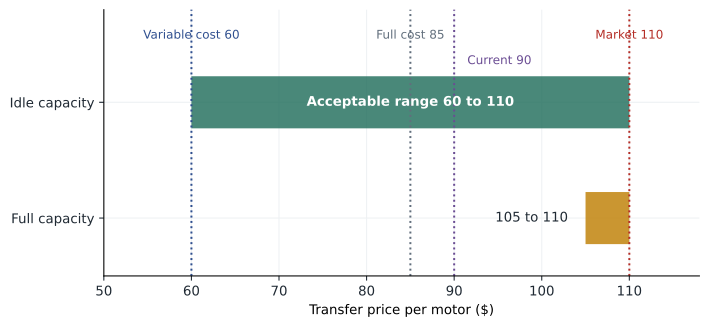
Components has enough idle capacity to make all 100,000 motors without giving up any outside sales. What is the minimum transfer price, and the maximum Appliances would pay?
Show solution
- Incremental cost: variable cost of $60 per motor; no selling costs on internal transfers.
- Opportunity cost: zero, because no outside sales are given up.
- Minimum transfer price: $60 + $0 = $60.
- Maximum: the lower of Appliances' outside price of $110 and its net revenue of $230 per unit from the final product, so $110.
Answer: Any price between $60 and $110 benefits both divisions; the company gains $50 for every motor made internally rather than bought at $110.
Worked problem
The general rule at full capacity
Suppose instead Components is operating at full capacity, selling every motor it can make to outside customers at $110. What is the minimum transfer price now?
Show solution
- Incremental cost: $60 per motor.
- Opportunity cost: the contribution lost on each outside sale given up, $110 − $60 − $5 = $45.
- Minimum transfer price: $60 + $45 = $105, which equals market price less savings.
- Appliances' maximum is $110, so transfers between $105 and $110 still benefit the company, by the $5 of avoided selling cost.
Answer: Minimum $105. At full capacity, market price less savings is the goal-congruent transfer price.
When transfer prices cause bad decisions
The real test of a transfer pricing system is whether it leads managers to make decisions that are good for the company. Suppose an outside supplier offers Appliances motors at $95, a volume price below the $110 market price, while Components has idle capacity. From the company's point of view, internal production costs only $60 per motor in incremental cost, so buying outside at $95 would cost the company $35 per motor. What Appliances does depends on the transfer price.
# Appliances is offered motors by an outside supplier at $95. Components has idle capacity.
units, var_cost, outside = 100_000, 60, 95
for tp in (110, 90, 60):
    appliances_buys = "inside" if tp <= outside else "outside"
    company_cost = (var_cost if appliances_buys == "inside" else outside) * units
    print(f"TP {tp}: Appliances buys {appliances_buys}; company pays {company_cost:,.0f} for motors")
loss = (outside - var_cost) * units
print(f"Cost to the company if Appliances buys outside: {loss:,.0f}")TP 110: Appliances buys outside; company pays 9,500,000 for motors TP 90: Appliances buys inside; company pays 6,000,000 for motors TP 60: Appliances buys inside; company pays 6,000,000 for motors Cost to the company if Appliances buys outside: 3,500,000
At a transfer price of $110, Appliances buys outside, and the company pays $3,500,000 more for motors than it needs to. At $90 or $60, Appliances buys inside. The general rule shows why: with idle capacity, the minimum transfer price is $60, and Appliances' maximum is now $95, so any price from $60 to $95 would lead to the right decision. A rigid market-price rule, set at $110, causes a dysfunctional decision because the market price no longer reflects either division's alternatives.
Companies respond to such problems in several ways. Head office can override the decision, requiring Appliances to buy inside, at the cost of autonomy. It can let the divisions negotiate, with the general rule defining the bargaining range. It can set the transfer price at market less savings when capacity is full and at a negotiated or cost-based price when there is idle capacity. Or it can accept occasional suboptimal decisions as the price of autonomy, intervening only when the stakes are large.
Transfer pricing in service and shared-service settings
Transfers are not limited to physical products. Cormorant's Services division installs Appliances' heat pumps and charges Appliances for warranty repairs. Information technology, legal and engineering groups provide services to divisions, which raises the same questions as the shared-service chargebacks in lesson 2. For services, outside market prices are often available, such as hourly rates for technicians or contract engineering, but quality, availability and confidentiality differences make comparisons harder, and cost-based prices with service-level agreements are common.
What companies actually do
Surveys of practice in North America and elsewhere have consistently found that cost-based methods, especially full cost or full cost plus a markup, are the most common for domestic transfers, followed by market-based and negotiated methods. Many companies use more than one method, depending on the product and whether an outside market exists. Large multinationals often use one set of transfer prices for tax purposes and another, or adjusted figures, for internal performance evaluation, a practice lesson 8 examines.
Common mistakes
MistakeThinking the transfer price changes total company profit on given transactions.
InsteadIt only divides profit; it changes total profit only by changing decisions.
MistakeUsing full cost as the minimum transfer price when there is idle capacity.
InsteadThe minimum is incremental cost plus opportunity cost, here $60.
MistakeUsing actual cost transfer prices that pass the seller's inefficiencies to the buyer.
InsteadUse standard cost so variances stay with the responsible division.
MistakeApplying market price rigidly when the market price does not reflect the divisions' alternatives.
InsteadUse the general rule to check the range of goal-congruent prices.
MistakeIgnoring costs avoided on internal transfers.
InsteadUse market price less savings, such as selling and shipping costs avoided.
Summary and key terms
- A transfer price divides profit between divisions but affects decisions and therefore total profit.
- Objectives include goal congruence, fair evaluation, autonomy, simplicity and, internationally, tax compliance.
- Market-based prices work well when a competitive outside market exists; adjust for costs avoided internally.
- Cost-based prices are common; use standard rather than actual costs, and beware treating fixed costs as variable.
- The general rule: minimum transfer price equals incremental cost plus opportunity cost.
- With idle capacity the minimum is variable cost; at full capacity it is market price less savings.
- Rigid rules can cause dysfunctional decisions, such as buying outside when internal production is cheaper for the company.
- Transfer price
- The price charged when one division supplies goods or services to another.
- Market-based transfer price
- A transfer price based on the outside market price, sometimes less avoided costs.
- Cost-based transfer price
- A transfer price based on variable cost, full cost or cost plus a markup.
- Negotiated transfer price
- A transfer price set by bargaining between divisions.
- General rule
- The minimum transfer price equals incremental cost plus opportunity cost per unit.
- Opportunity cost
- The contribution forgone by using capacity for an internal transfer rather than its next best use.
- Market price less savings
- The market price minus costs avoided on internal transfers.
- Dysfunctional decision
- A decision that benefits a division but harms the company as a whole.
- Standard cost transfer price
- A cost-based price using standard rather than actual cost.
- Autonomy
- Divisions' freedom to make their own decisions.
Practice problems
Work each problem on paper first, then reveal the answer to check.
Components' variable cost rises to $64. With idle capacity, what is the minimum transfer price?
Show answer
$64.
At full capacity with variable cost $64, market price $110 and avoided costs $5, minimum transfer price?
Show answer
$64 + ($110 − $64 − $5) = $105.
Rerun the split program with the current policy price at $95. Components' and Appliances' contribution?
Show answer
Components 3,500; Appliances 13,500; total 17,000.
Why does full cost as a transfer price risk poor decisions?
Show answer
The seller's fixed costs become variable costs to the buyer, who may reject transfers that benefit the company.
What conditions make market price the best transfer price?
Show answer
A competitive outside market with reliable prices, where divisions can buy and sell all they want.
Rerun the outside-supplier program with an outside offer of $80. At a transfer price of $90, what happens and what is the cost to the company?
Show answer
Appliances buys outside; the company pays $20 more per motor, $2,000,000.
Why use standard cost rather than actual cost?
Show answer
So the seller's inefficiencies stay with the seller and are not passed to the buyer.
What is the maximum transfer price Appliances will accept?
Show answer
The lower of its outside purchase price and its net revenue from the final product.
A buyer's maximum is $90 and the seller's minimum is $95. Should the transfer happen?
Show answer
No; the company is better off with the buyer purchasing outside.
Name two ways a company can respond when a transfer price causes a bad decision.
Show answer
Head office override, negotiation within the general rule range (also changing the method, accepting it as the price of autonomy).
Lesson quiz · 5 questions
Score 60% or more to complete this lesson.
Create a free account to save your progress, take quizzes and earn a certificate.