
ACCT-321 · Lesson 4 of 12 · 30 min
Measuring investment center performance I: return on investment and residual income
An investment center manager controls both profit and the assets used to earn it. Evaluating such a manager on profit alone would ignore the capital tied up: a division earning $3,000,000 on $20,000,000 of assets is doing better than one earning the same profit on $40,000,000. Measures for investment centers therefore relate profit to capital. ACCT-102 introduced the two classic measures, return on investment and residual income, in a few paragraphs. This lesson works through them in depth: how they are calculated, how they decompose, the choices that change their values, and above all the behavior they encourage. Lesson 5 extends the analysis to economic value added and the problem of measuring assets.
Return on investment
Return on investment is operating income divided by invested capital. It is widely used because it is easy to understand, comparable across divisions of different sizes and with external benchmarks such as industry returns, and consistent with how investors think about returns.
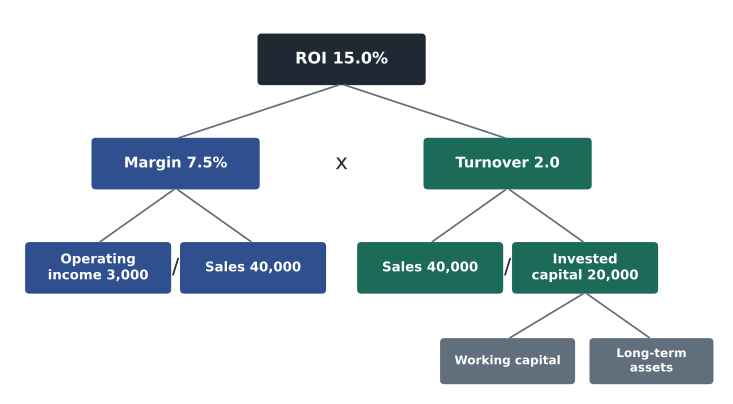
The DuPont method, developed at the DuPont company early in the twentieth century, splits ROI into two drivers. Return on sales, or margin, measures how much operating income each dollar of sales generates. Investment turnover measures how many dollars of sales each dollar of invested capital supports. ROI is their product, so a division can improve ROI by raising margin, by raising turnover, or both.
# ROI, DuPont analysis and residual income for Cormorant's divisions, 2026 (thousands)
rate = 0.10   # required rate of return set by head office
div = {"Appliances": (40_000, 3_000, 20_000),
       "Components": (24_000, 1_800, 15_000),
       "Services":   (12_000,   900,  4_000)}
print(f"{'':<11}{'Margin':>8}{'Turnover':>9}{'ROI':>7}{'RI':>7}")
for name, (sales, oi, assets) in div.items():
    margin, turnover = oi / sales, sales / assets
    roi = margin * turnover
    ri = oi - rate * assets
print(f"{name:<11}{margin:>8.1%}{turnover:>9.2f}{roi:>7.1%}{ri:>7,.0f}")Margin Turnover ROI RI Appliances 7.5% 2.00 15.0% 1,000 Components 7.5% 1.60 12.0% 300 Services 7.5% 3.00 22.5% 500
All three divisions earn the same 7.5 percent margin, so the differences in ROI come entirely from turnover. Services, an asset-light business, turns its $4,000,000 of assets three times a year and earns 22.5 percent. Appliances turns its assets twice and earns 15 percent. Components, with heavy machinery and tooling, turns its assets 1.6 times and earns 12 percent. Residual income at a 10 percent required rate is $1,000,000 for Appliances, $500,000 for Services and $300,000 for Components.
Worked problem
Ways to raise Appliances' ROI to 18 percent
Appliances' ROI is 15 percent: margin 7.5 percent, turnover 2.0, sales $40,000,000, invested capital $20,000,000. Show three ways it could reach 18 percent.
Show solution
- Raise margin with turnover unchanged: 18% ÷ 2.0 = 9.0% margin, operating income $3,600,000 on the same sales.
- Raise turnover with margin unchanged: 18% ÷ 7.5% = 2.4 turnover, so invested capital must fall to $40,000,000 ÷ 2.4 = $16,666,667, for example by cutting inventory and receivables.
- Raise sales to $45,000,000 with the same 7.5% margin and capital of $18,750,000: operating income $3,375,000 ÷ $18,750,000 = 18%.
- Each route has different implications: price and cost actions for margin, working capital management for turnover.
Answer: Margin of 9 percent, turnover of 2.4, or a combination such as $45,000,000 sales on $18,750,000 of capital.
Measuring income and capital
ROI looks precise, but its value depends on choices about both the numerator and the denominator. For income, most companies use operating income before interest and taxes, because division managers usually do not control financing and tax decisions, which are made centrally. Some use controllable margin (lesson 2) to evaluate the manager and segment margin to evaluate the division. Including allocated head-office costs lowers ROI but adds no information about the manager.
For capital, the choices include total assets available, total assets employed (excluding idle assets that head office has told the division to hold), and net assets, which deduct current liabilities from total assets on the grounds that suppliers' credit is a free source of funds the division manager can influence. Using net assets encourages managers to stretch payables, which may or may not be good for the company. Most companies use an average of opening and closing balances, because income is earned over the whole year; using opening balances is simpler but lets managers time investments near year end. Lesson 5 examines the further question of whether assets should be measured at gross book value, net book value or current cost.
| Choice | Options | Effect on behavior |
|---|---|---|
| Income | Operating income, controllable margin, segment margin, net income | Including uncontrollable items weakens the link to the manager's decisions |
| Capital | Total assets, assets employed, net assets | Net assets encourage managing payables; excluding idle assets avoids penalizing managers for head-office decisions |
| Timing | Opening, closing or average balances | Opening balances invite year-end timing of investments |
| Asset valuation | Net book value, gross book value, current cost | Net book value makes old assets look attractive (lesson 5) |
The fundamental problem with ROI
ROI encourages managers to maximize a ratio, which is not the same as maximizing value for the company. A manager evaluated on ROI will reject any project whose return is below the division's current ROI, even if that return is above the company's cost of capital. The project would add value for the company, but it would lower the division's average return. Conversely, a manager may dispose of assets earning more than the cost of capital but less than the division's current ROI, raising the ratio while destroying value. This is the classic goal congruence problem with ROI, and it is most severe in the highest-performing divisions.
# Would each division manager accept the project? ROI versus residual income
rate = 0.10
divisions = {   # current operating income, assets; project income, investment
    "Appliances": (3_000, 20_000, 260, 2_000),
    "Services":   (  900,  4_000, 180, 1_000),
    "Components": (1_800, 15_000,  95, 1_000),
}
for name, (oi, a, pi, pa) in divisions.items():
    roi_now, roi_new = oi / a, (oi + pi) / (a + pa)
    ri_change = pi - rate * pa
    print(f"{name}: project ROI {pi/pa:.1%}; division ROI {roi_now:.1%} -> {roi_new:.2%}; "
          f"RI change {ri_change:+,.0f}")
    by_roi = "accept" if roi_new > roi_now else "reject"
    by_ri = "accept" if ri_change > 0 else "reject"
print(f" ROI-evaluated manager would {by_roi}; RI-evaluated manager would {by_ri}")Appliances: project ROI 13.0%; division ROI 15.0% -> 14.82%; RI change +60 ROI-evaluated manager would reject; RI-evaluated manager would accept Services: project ROI 18.0%; division ROI 22.5% -> 21.60%; RI change +80 ROI-evaluated manager would reject; RI-evaluated manager would accept Components: project ROI 9.5%; division ROI 12.0% -> 11.84%; RI change -5 ROI-evaluated manager would reject; RI-evaluated manager would reject
The Appliances project returns 13 percent, above the 10 percent required rate, but below the division's current 15 percent. Taking it would lower division ROI to 14.82 percent, so a manager evaluated on ROI would reject it, while residual income rises by $60,000 and an RI-evaluated manager would accept it. Services shows the same conflict even more sharply: an 18 percent project is rejected under ROI because the division already earns 22.5 percent. In Components the conflicts disappear: its 9.5 percent project is below both the division's ROI and the required rate, so both measures reject it, correctly.
Residual income
Residual income is operating income minus a capital charge equal to the required rate of return times invested capital. It measures the income a division earns above the minimum its capital must earn.
Because residual income increases whenever a project earns more than the required rate, it solves the goal congruence problem in the example above. Any project with a positive net present value at the required rate will, over its life, add to residual income in present value terms, a link that lesson 5 develops. Residual income also lets head office apply different required rates to divisions with different risks, so that a riskier division must earn more to show a positive result.
Residual income has its own weaknesses. It is an absolute amount, so larger divisions tend to show larger residual income, making comparisons between divisions of different sizes difficult; many companies compare each division's residual income with its own target rather than with other divisions. It depends on the required rate, which head office must set and justify. And it shares ROI's dependence on accounting measures of income and assets, with all the problems of depreciation and historical cost that lesson 5 discusses.
| Feature | ROI | Residual income |
|---|---|---|
| Form | Percentage | Dollar amount |
| Comparability across sizes | Easy | Difficult; larger divisions show larger RI |
| Goal congruence with value creation | Weak: rejects projects above cost of capital but below current ROI | Strong: accepts any project above the required rate |
| Risk adjustment | Only through different targets | Different required rates per division |
| Familiarity to managers | High | Lower |
| Dependence on accounting choices | High | High |
Worked problem
Risk-adjusted required rates
Cormorant's treasurer proposes required rates of 9 percent for Components, a mature business with stable demand, 10 percent for Appliances and 12 percent for Services, which depends on volatile renovation spending. Recompute residual income.
Show solution
- Components: $1,800,000 − 9% × $15,000,000 = $450,000.
- Appliances: $3,000,000 − 10% × $20,000,000 = $1,000,000.
- Services: $900,000 − 12% × $4,000,000 = $420,000.
- Risk adjustment narrows the apparent gap between Components and Services; Appliances still leads.
Answer: RI becomes $450,000 for Components, $1,000,000 for Appliances and $420,000 for Services.
Setting targets and evaluating trends
Whichever measure is used, the performance target matters as much as the measure. Comparing Components' 12 percent ROI with Services' 22.5 percent says little, because the businesses have very different capital intensity. A fairer evaluation compares each division with its own budgeted ROI or residual income, with its own past trend, and with external benchmarks for similar businesses. Budgeted targets should reflect the assets the division is expected to hold and the investments it is expected to make, so that a manager who undertakes an approved expansion is not penalized for the temporary fall in ROI it causes.
Many companies use several measures together. A division might be evaluated on residual income against budget for the bonus, with ROI reported for comparison with industry, and with non-financial measures (lessons 9 and 10) to guard against short-term thinking. The single-measure systems examined in this lesson are useful teaching devices, but few well-run companies rely on one number.
Short-term thinking
Both ROI and residual income measure performance one period at a time. A manager can raise either in the short run by cutting discretionary spending on research, training, maintenance or advertising, which reduces current expenses but may harm future results. A manager close to retirement or expecting a transfer has a particular incentive to do so. Investments with long payback periods, which reduce current income through depreciation and start-up costs before they earn returns, look unattractive. Remedies include evaluating managers over several years, adding non-financial measures of the health of the business, reviewing discretionary spending against plans, adjusting the accounting measures (lesson 5) and paying part of compensation in deferred or long-term forms (lesson 11).
Worked problem
A manager near retirement
The Components manager plans to retire in 18 months. Cutting the maintenance budget by $400,000 and the training budget by $200,000 for the next year would raise operating income by $600,000. Assuming invested capital is unchanged, what happens to Components' ROI and residual income, and what should head office do?
Show solution
- New operating income: $1,800,000 + $600,000 = $2,400,000.
- ROI: $2,400,000 ÷ $15,000,000 = 16.0 percent, up from 12.0 percent.
- Residual income at 10 percent: $2,400,000 − $1,500,000 = $900,000, up from $300,000.
- Both measures improve, yet the cuts may raise future breakdowns and reduce skills; head office should review discretionary spending against plan and use maintenance and training indicators.
Answer: ROI rises to 16 percent and RI to $900,000, even though value may be destroyed.
Evidence from practice
Surveys over several decades have found that most large companies use ROI or a similar return measure for divisional evaluation, and that a substantial minority use residual income or economic value added, often alongside ROI. Research on the behavioral effects has documented the underinvestment problem predicted above, particularly in high-ROI divisions, and shown that companies switching from ROI to residual-income-type measures tend to dispose of more underperforming assets and invest more selectively. ACCT-421 returns to these measures in the context of strategic performance management and capital investment decisions.
Common mistakes
MistakeComparing ROI across divisions with very different capital intensity.
InsteadCompare each division with its own target, trend and industry benchmarks.
MistakeAssuming a project with ROI above the cost of capital will be accepted by an ROI-evaluated manager.
InsteadIt is rejected if it lowers the division's average ROI; residual income avoids this.
MistakeUsing net income after interest and taxes for divisional ROI.
InsteadUse operating income; financing and tax decisions are usually made centrally.
MistakeRanking divisions of different sizes by residual income.
InsteadResidual income is an absolute amount; compare each division with its own target.
MistakeTreating a rise in ROI from cutting maintenance or training as good performance.
InsteadCheck discretionary spending and long-term indicators before concluding.
Summary and key terms
- ROI equals operating income divided by invested capital and is the product of margin and turnover.
- ROI depends on choices about income, capital, timing and asset valuation.
- ROI-evaluated managers reject projects above the cost of capital but below current ROI, and may dispose of value-creating assets.
- Residual income deducts a capital charge at the required rate and encourages all projects earning more than that rate.
- Residual income favors large divisions in comparisons and depends on the required rate chosen.
- Risk-adjusted required rates let head office demand more from riskier divisions.
- Both measures can encourage short-term thinking; multi-period evaluation and non-financial measures help.
- Return on investment (ROI)
- Operating income divided by invested capital.
- Return on sales
- Operating income divided by sales; the margin in the DuPont formula.
- Investment turnover
- Sales divided by invested capital.
- DuPont method
- Decomposition of ROI into margin times turnover.
- Residual income (RI)
- Operating income minus the required rate of return times invested capital.
- Required rate of return
- The minimum return a division's capital must earn, often based on the cost of capital.
- Goal congruence
- Alignment between a manager's incentives and the organization's goals.
- Net assets
- Total assets minus current liabilities, one choice of invested capital.
- Assets employed
- Total assets less idle assets held at head office's direction.
- Underinvestment problem
- Rejection of value-creating projects because they would lower a division's ROI.
Practice problems
Work each problem on paper first, then reveal the answer to check.
A division has sales of $10,000,000, operating income of $1,200,000 and invested capital of $8,000,000. Margin, turnover and ROI?
Show answer
12 percent, 1.25, 15 percent.
Residual income for that division at 11 percent?
Show answer
$1,200,000 − $880,000 = $320,000.
Rerun the ROI program with Components' assets at $12,000,000. ROI and RI?
Show answer
ROI 15.0 percent; RI 600.
Rerun the project program with the Appliances project earning $320,000. What do the two managers do?
Show answer
Project ROI 16 percent; division ROI rises to 15.09 percent, so both accept; RI rises by 120.
Why is ROI's underinvestment problem worst in the best-performing divisions?
Show answer
Their high current ROI means more value-creating projects fall below it.
A manager disposes of a machine earning 11 percent when the division earns 14 percent and the required rate is 10 percent. Effect on ROI and RI?
Show answer
ROI rises, RI falls; the disposal destroys value.
Give one argument for using net assets as invested capital.
Show answer
Suppliers' credit is a source of funds the manager can influence.
Why do companies usually use average rather than opening balances?
Show answer
Income is earned over the year, and opening balances invite year-end timing of investments.
What is the main weakness of residual income for comparing divisions?
Show answer
Larger divisions tend to show larger residual income.
Name two ways to reduce short-term thinking under ROI or RI.
Show answer
Multi-year evaluation and non-financial measures (also deferred compensation, reviewing discretionary spending).
Lesson quiz · 5 questions
Score 60% or more to complete this lesson.
Create a free account to save your progress, take quizzes and earn a certificate.