
ACCT-321 · Lesson 5 of 12 · 29 min
Measuring investment center performance II: economic value added and asset measurement
Lesson 4 showed that residual income aligns managers' investment decisions with value creation better than ROI does. But both measures still rest on accounting income and accounting assets, and accounting rules were designed for external reporting, not for evaluating managers. This lesson looks at economic value added, a residual income measure that adjusts accounting numbers to approximate economic profit, and at the stubborn problem of how to measure the assets in the denominator or capital charge. It closes by linking residual income to net present value, which explains why, in principle, maximizing the present value of residual income is the same as maximizing shareholder value.
Economic value added
Economic value added, or EVA, is a version of residual income popularized and trademarked by the consulting firm Stern Stewart and Company in the 1990s. It is defined as net operating profit after taxes minus a charge for all the capital employed, at the weighted average cost of capital.
EVA differs from basic residual income in three ways. It is measured after taxes, so the capital charge uses an after-tax cost of capital. The capital charge uses the company's weighted average cost of capital, the blended required return of lenders and shareholders, rather than a rate set by head office. And it adjusts accounting income and capital for items that, in the advocates' view, distort economic reality. Stern Stewart identified more than 160 possible adjustments; in practice companies use a handful.
Common adjustments
The most common adjustment treats research and development as an investment rather than an expense. Accounting standards mostly require research to be expensed immediately, which penalizes managers in the year they spend for benefits that arrive later. For EVA, R&D is capitalized and amortized over its expected useful life; current spending is added back to NOPAT, the amortization deducted, and the unamortized balance added to capital. Similar treatment can apply to brand-building advertising, employee training and restructuring costs.
Other common adjustments include removing goodwill amortization or impairment from NOPAT and adding back cumulative written-off goodwill to capital, so that managers remain accountable for the full price of acquisitions; treating deferred taxes as equity-like by using cash taxes; adding back non-recurring charges; and deducting non-interest-bearing current liabilities, such as trade payables and accrued liabilities, from capital, because suppliers' credit is not capital provided by investors. Lease adjustments, once an important EVA correction, matter less since IFRS 16 and ASC 842 brought most leases onto lessees' balance sheets, although the two standards still differ in how operating lease costs flow through income (ACCT-212).
| Adjustment | NOPAT effect | Capital effect | Purpose |
|---|---|---|---|
| Capitalize R&D | Add back expense, deduct amortization (after tax) | Add unamortized R&D | Stop penalizing investment in the year it occurs |
| Goodwill | Add back amortization or impairment | Add back cumulative write-offs | Keep managers accountable for acquisition prices |
| Deferred taxes | Use cash taxes | Treat deferred tax liability as equity | Reflect economic tax cost |
| Non-recurring charges | Add back | Add back if capitalizable | Avoid big-bath distortions |
| Non-interest-bearing current liabilities | None | Deduct | Charge only investor-supplied capital |
# Economic value added for Appliances, 2026 (thousands, illustrative)
tax = 0.25                       # illustrative combined income tax rate
oi = 3_000                       # operating income before interest and taxes
rd_expensed, rd_amortization = 1_200, 900   # treat R&D as an asset amortized over 3 years
total_assets, nibcl = 20_000, 3_000         # non-interest-bearing current liabilities
rd_unamortized = 2_000
# weighted average cost of capital (after tax)
w_d, k_d, w_e, k_e = 0.40, 0.054, 0.60, 0.106
wacc = w_d * k_d * (1 - tax) + w_e * k_e
nopat = oi * (1 - tax) + (rd_expensed - rd_amortization) * (1 - tax)
capital = total_assets - nibcl + rd_unamortized
eva = nopat - wacc * capital
print(f"WACC: {wacc:.2%}")
print(f"Adjusted NOPAT: {nopat:,.0f}")
print(f"Capital employed: {capital:,.0f}")
print(f"Capital charge: {wacc * capital:,.0f}")
print(f"EVA: {eva:,.0f}")WACC: 7.98% Adjusted NOPAT: 2,475 Capital employed: 19,000 Capital charge: 1,516 EVA: 959
With 40 percent debt at a 5.4 percent pre-tax cost and 60 percent equity at 10.6 percent, Cormorant's after-tax WACC is 7.98 percent. Appliances' NOPAT is $2,250,000 on reported operating income ($3,000,000 × 0.75), plus $225,000 for the after-tax effect of capitalizing R&D ($300,000 × 0.75), for an adjusted NOPAT of $2,475,000. Capital employed is total assets of $20,000,000 less $3,000,000 of non-interest-bearing current liabilities, plus $2,000,000 of unamortized R&D, or $19,000,000. The capital charge is about $1,516,000, leaving EVA of about $959,000. Appliances is creating value, but less than the pre-tax residual income of $1,000,000 in lesson 4 suggested, because EVA charges for the R&D investment and uses after-tax figures.
Worked problem
The effect of capitalizing R&D on a cutting decision
The Appliances manager considers cutting next year's R&D from $1,200,000 to $600,000. Under reported accounting, operating income would rise by $600,000. Under EVA, with R&D amortized over three years, how much does next year's NOPAT change, ignoring the capital charge?
Show solution
- Under EVA, the expense added back falls by $600,000, but next year's amortization falls by only one third of the cut, $200,000.
- Net pre-tax effect on adjusted operating profit: +$200,000, not +$600,000.
- After tax at 25 percent: +$150,000 to NOPAT.
- The capital charge also falls slightly because less R&D is capitalized, but the benefit to EVA from cutting is far smaller than under reported income.
Answer: NOPAT rises by only about $150,000, so EVA reduces the reward for cutting R&D.
Market value added
Market value added, or MVA, is the difference between the market value of a company's debt and equity and the capital investors have put into it. In theory, MVA equals the present value of all expected future EVA. A company that is expected to earn returns above its cost of capital trades at a premium to invested capital; one expected to earn less trades at a discount. MVA applies only to the whole company, or to divisions that are separately listed, so it cannot evaluate divisions directly, but it provides the conceptual link between divisional EVA and shareholder value.
EVA in practice
Companies that adopted EVA in the 1990s, such as Coca-Cola, Briggs and Stratton, and in Canada several firms in the resource and industrial sectors, typically linked it to bonuses through a bonus bank, which carries forward part of each year's bonus and lets negative EVA claw it back, to encourage a long-term view (lesson 11). Research on adoption has found that firms adopting residual income measures tend to dispose of more underperforming assets, cut back on unproductive investment and return more cash to shareholders, consistent with the theory. Critics argue that EVA's benefits depend heavily on the bonus design and management commitment, that its many adjustments make it complex and hard for managers to understand, and that the trademarked branding adds little to the old idea of residual income. Use of the term has declined, but residual income measures with selected adjustments remain common.
How should assets be measured?
ROI, residual income and EVA all need a figure for capital, and how assets are valued affects the results. The most common basis is net book value: historical cost less accumulated depreciation. It is consistent with the financial statements and easy to obtain. Its weakness is that, as assets age and are depreciated, net book value falls while income may stay constant, so ROI rises automatically. A division with old, fully depreciated equipment can show a spectacular ROI that reflects the age of its assets, not its manager's skill, and a manager may avoid replacing old assets because a new machine would drive ROI down.
# ROI on net book value versus gross book value for one asset (thousands)
cost, life, cash = 10_000, 5, 3_000      # constant cash income before depreciation
dep = cost / life
print("Year  Income  Opening NBV  ROI on NBV  ROI on gross")
for y in range(1, life + 1):
    income = cash - dep
    nbv = cost - dep * (y - 1)
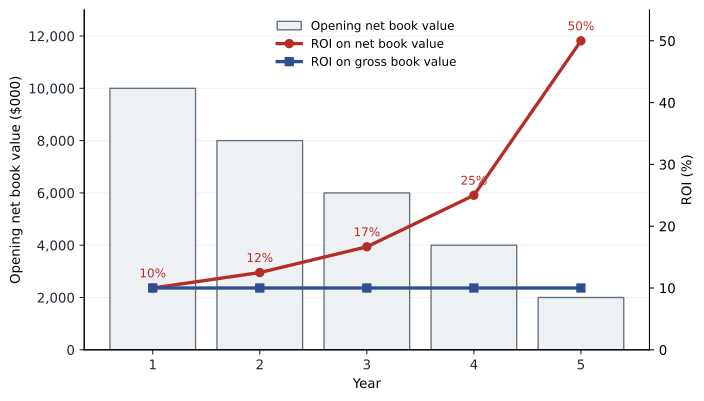
print(f"{y:>4}{income:>8,.0f}{nbv:>13,.0f}{income / nbv:>12.1%}{income / cost:>14.1%}")Year Income Opening NBV ROI on NBV ROI on gross 1 1,000 10,000 10.0% 10.0% 2 1,000 8,000 12.5% 10.0% 3 1,000 6,000 16.7% 10.0% 4 1,000 4,000 25.0% 10.0% 5 1,000 2,000 50.0% 10.0%
The asset earns the same $1,000,000 of income every year. On net book value at the start of each year, its ROI rises from 10 percent to 50 percent over five years. On gross book value, original cost, it stays at 10 percent. A manager evaluated on net book value ROI has a strong incentive to keep old assets and avoid replacing them.
Gross book value, original cost before depreciation, removes the aging effect, but it overstates the capital tied up in old assets and still reflects historical prices. Replacement cost or current cost values assets at what it would cost to replace them today, which makes divisions with old and new assets comparable and gives a capital charge that reflects current economic conditions; it is, however, harder to estimate and can be subjective. Annuity or compound-interest depreciation charges less depreciation early and more later, so that, for an asset with constant cash flows, ROI stays constant over its life; it is theoretically appealing but rarely used in practice because it differs from external reporting.
| Basis | Advantages | Disadvantages |
|---|---|---|
| Net book value | Consistent with financial statements; simple | ROI rises as assets age; discourages replacement |
| Gross book value | Removes the aging effect on ROI | Overstates capital in old assets; historical prices |
| Replacement or current cost | Comparable across asset ages; current economics | Hard to estimate; subjective |
| Annuity depreciation | Constant ROI for constant cash flows | Differs from external reporting; unfamiliar |
Worked problem
Comparing two divisions with assets of different ages
Division X has equipment that cost $10,000,000 five years ago, with net book value of $3,000,000; replacement cost is $14,000,000. Division Y bought similar equipment last year for $12,000,000; net book value is $10,800,000 and replacement cost $12,500,000. Each earns operating income of $1,500,000. Compare ROI on net book value and on replacement cost.
Show solution
- X on net book value: $1,500,000 ÷ $3,000,000 = 50.0 percent.
- Y on net book value: $1,500,000 ÷ $10,800,000 = 13.9 percent.
- X on replacement cost: $1,500,000 ÷ $14,000,000 = 10.7 percent.
- Y on replacement cost: $1,500,000 ÷ $12,500,000 = 12.0 percent.
Answer: On net book value X looks far better; on replacement cost Y is slightly better, because X's apparent advantage reflects old, depreciated assets.
Linking residual income to net present value
A powerful theoretical result, associated with Preinreich and Lücke and later with Ohlson's residual income valuation model, is that the present value of a project's residual income over its life, using the same discount rate as the capital charge and with each year's charge based on opening book value, equals the project's net present value. This holds for any depreciation method, provided the accounting is clean, meaning all gains and losses pass through income. It means that, in principle, a manager who maximizes the present value of residual income is maximizing value.
# Present value of residual income equals the project's NPV (thousands)
r, invest, cash, n = 0.10, 1_000, 450, 3
npv = sum(cash / (1 + r) ** t for t in range(1, n + 1)) - invest
dep = invest / n
pv_ri, book = 0, invest
for t in range(1, n + 1):
    ri = (cash - dep) - r * book          # income minus charge on opening book value
    pv_ri += ri / (1 + r) ** t
    print(f"Year {t}: income {cash - dep:6.1f}  charge {r * book:6.1f}  RI {ri:6.1f}")
    book -= dep
print(f"NPV of cash flows: {npv:.1f}")
print(f"PV of residual income: {pv_ri:.1f}")Year 1: income 116.7 charge 100.0 RI 16.7 Year 2: income 116.7 charge 66.7 RI 50.0 Year 3: income 116.7 charge 33.3 RI 83.3 NPV of cash flows: 119.1 PV of residual income: 119.1
The project costs $1,000,000 and returns $450,000 a year for three years. Its NPV at 10 percent is $119,100. With straight-line depreciation, residual income is $16,700 in year 1, $50,000 in year 2 and $83,300 in year 3; discounted at 10 percent, these sum to the same $119,100. Note the timing: residual income is low early and high later. A manager evaluated on year 1 residual income alone sees only $16,700 from a project that creates $119,100 of value, and a project with a large positive NPV but heavy early depreciation could even show negative residual income at first. This is why multi-period evaluation and long-term incentives (lesson 11) matter even when the measure is residual income.
Inflation and foreign operations
Two further complications deserve a brief mention. Under inflation, historical-cost asset values understate the current capital tied up, so ROI and residual income on net book value overstate returns, more so for divisions with older assets; current-cost measures address this. For foreign divisions, results must be translated into the parent's currency, and exchange rate movements affect both income and capital. Many companies evaluate foreign division managers in local currency, against local budgets, to remove exchange rate effects they cannot control, while evaluating the division's economic contribution in the parent's currency. ACCT-311 covers the translation rules, and lesson 8 the tax effects of transfer prices between countries.
Common mistakes
MistakeCalling any residual income measure EVA.
InsteadEVA is after tax, uses WACC on all capital and adjusts accounting income and capital.
MistakeCharging capital on total assets including trade payables.
InsteadDeduct non-interest-bearing current liabilities; suppliers' credit is not investor capital.
MistakeComparing divisions on net book value ROI when their assets differ in age.
InsteadUse gross book value, replacement cost or trend comparisons.
MistakeAssuming a project with positive NPV will show positive residual income every year.
InsteadRI is often low or negative early; only its present value matches NPV.
MistakeUsing every possible EVA adjustment.
InsteadUse a few material, understandable adjustments that change behavior.
Summary and key terms
- EVA is NOPAT minus WACC times capital employed, with adjustments to accounting income and capital.
- Common adjustments capitalize R&D, add back goodwill write-offs, use cash taxes and deduct non-interest-bearing current liabilities.
- Capitalizing R&D reduces the short-term reward for cutting it.
- MVA, market value less invested capital, equals the present value of expected future EVA.
- Net book value makes ROI rise as assets age and discourages replacement; gross book value and replacement cost reduce the distortion.
- The present value of residual income equals NPV, so maximizing it over time aligns with value creation.
- Single-period residual income can still understate valuable projects early in their lives.
- Economic value added (EVA)
- Net operating profit after taxes minus the weighted average cost of capital times capital employed.
- NOPAT
- Net operating profit after taxes, before financing costs.
- Weighted average cost of capital (WACC)
- The blended after-tax required return of a company's lenders and shareholders.
- Market value added (MVA)
- Market value of debt and equity minus invested capital.
- Net book value
- Historical cost minus accumulated depreciation.
- Gross book value
- Historical cost before depreciation.
- Replacement cost
- The current cost of replacing an asset's service capacity.
- Annuity depreciation
- A method charging less depreciation early so that ROI stays constant for constant cash flows.
- Clean surplus
- Accounting in which all gains and losses pass through income.
- Bonus bank
- A scheme that banks part of each bonus and allows later losses to claw it back.
Practice problems
Work each problem on paper first, then reveal the answer to check.
NOPAT is $5,000,000, capital employed $40,000,000 and WACC 9 percent. EVA?
Show answer
$1,400,000.
Rerun the EVA program with unamortized R&D of $3,000,000. Capital employed and EVA?
Show answer
Capital employed 20,000; EVA about 879.
Why are non-interest-bearing current liabilities deducted from capital?
Show answer
They are supplied by trade creditors, not investors, and carry no explicit cost of capital.
A division spends $900,000 on R&D, amortized over three years for EVA. What is the year 1 pre-tax adjustment if prior spending was zero?
Show answer
Add back $900,000, deduct $300,000 amortization: +$600,000.
Rerun the NBV program with a life of 4 years. ROI on net book value in year 4?
Show answer
20.0 percent: income falls to $500,000 a year because depreciation is $2,500,000, and opening net book value in year 4 is $2,500,000.
Why does net book value ROI discourage asset replacement?
Show answer
A new asset has high book value, so ROI falls even if the asset is more productive.
What is market value added?
Show answer
Market value of debt and equity minus invested capital.
Rerun the NPV program with annual cash of $500,000. NPV and PV of RI?
Show answer
Both about 243.4.
Under what condition does the PV of residual income equal NPV?
Show answer
Clean surplus accounting, a capital charge at the discount rate on opening book value.
Give one criticism of EVA.
Show answer
Complex adjustments that managers find hard to understand (or benefits depend on bonus design; adds little to residual income).
Lesson quiz · 5 questions
Score 60% or more to complete this lesson.
Create a free account to save your progress, take quizzes and earn a certificate.