
ROOF-340 · Lesson 1 of 12 · 23 min
How the exam is built
▶ Video coming soon A video version of this lesson is on the way.
On Wednesday evening, October 21, Dana Renaud pushed two tables together in the Ridgecap lunchroom, set down a box of doughnuts and a stack of photocopied roof plans, and waited for her study group. Luca Moretti came first, still in his work boots. Luca had been on Crew 2 for four years and was in the last stretch of his apprenticeship. Rory Quintero and Keisha Grant came in behind him. Neither of them was anywhere near the end of their training, but Dana had told them they could sit in. "Most people start studying for this in the last three months," she said. "You two get to start three years early. That's not a punishment. That's a head start."
Dana had run a study group like this every fall for six years, since she noticed that good roofers were failing their final test for reasons that had nothing to do with how well they roofed. Some had never seen a question written the way the test writes them. Some spent forty minutes on one calculation and ran out of time. Some had worked for ten years on one kind of roof and had forgotten everything about the others. "The test is not hard because roofing is hard," she said. "It's hard because it covers the whole trade, and none of us does the whole trade every week."
This course is the last in the roofer program. It reviews the trade from end to end, the way a final test does, and it shows how to prepare for that test and what comes after it. This first lesson explains how the test is put together, because a plan to pass it starts with knowing what is on it.
The Red Seal Roofer exam
In Ontario, Roofer is a Red Seal trade with the trade code 449A. The final test for an apprentice who has finished training is the Certificate of Qualification exam set by Skilled Trades Ontario. For a Red Seal trade, that exam is the Interprovincial Red Seal exam, so passing it earns both the Ontario Certificate of Qualification and the Red Seal endorsement, which is recognized in every province and territory that has the trade. Roofer is a voluntary trade in Ontario: a person does not need the certificate to work as a roofer, and the certificate does not have to be renewed. Many employers, owners and union and non-union contractors still treat it as the proof that a roofer knows the whole trade.
The Red Seal Roofer exam has 125 multiple-choice questions. Each question has four answers, marked A to D, and exactly one is correct. Skilled Trades Ontario allows four hours for a Certificate of Qualification exam, and the pass mark is 70 in 100. On a 125-question exam, 70 in 100 is 87.5 questions, so a candidate needs 88 correct answers to pass. Results are posted to the candidate's Skilled Trades Ontario portal, usually within 15 business days, with an e-mail when they are ready and a paper copy by mail.
| Feature | Red Seal Roofer exam (as of November 2026) |
|---|---|
| Questions | 125 multiple choice, four answers each, one correct |
| Time allowed in Ontario | 4 hours |
| Pass mark | 70 in 100 (88 correct answers out of 125) |
| Based on | The Red Seal Occupational Standard (RSOS) for Roofer |
| Where | A Skilled Trades Ontario exam location, on paper or on a computer, as the booking confirms |
| Results | On the Skilled Trades Ontario portal, usually within 15 business days |
Candidates bring government photo identification and leave phones, watches, smart devices, hats and wallets outside the exam room. Whether a calculator is allowed, and which kind, is stated in the exam confirmation; candidates should read it rather than assume. Accommodations for a disability or a learning need are requested when the exam is booked.
Exam day
The exam is written at a Skilled Trades Ontario location, and the booking confirmation says where, when to arrive and whether the exam is on paper or on a computer. Candidates who arrive late may not be admitted, so Dana's advice is to find the building the week before and arrive half an hour early. On a paper exam, answers go on a separate answer sheet, and a candidate who skips a question must be careful to keep the answers lined up with the right numbers. On a computer exam, questions can usually be flagged and returned to before submitting.
There is no penalty for a wrong answer on a Red Seal exam: a blank scores the same as a wrong answer, so every question should be answered, even if the last few are a careful guess.
Who can write it
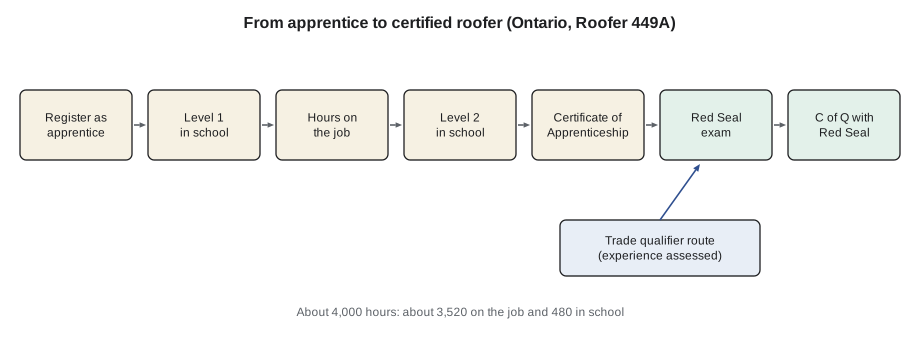
An apprentice becomes eligible after completing the apprenticeship. Ontario's Roofer apprenticeship is about 4,000 hours: about 3,520 hours of on-the-job training and about 480 hours of in-school training, delivered in two levels. When the sponsor signs off the hours and the in-school levels are complete, the apprentice receives a Certificate of Apprenticeship and can book the exam. A worker who has learned the trade without a registered apprenticeship can apply as a trade qualifier: Skilled Trades Ontario assesses documented experience and, if it is accepted, the worker writes the same exam.
Luca had finished his Level 2 classes the previous winter, and Dana had signed off his last hours at the end of October. He planned to book the exam for January, after the season ended and before spring work started. "January is a good month," Dana said. "Your body isn't wrecked, and your head isn't full of a job."
Where the questions come from
Every Red Seal exam is built from the Red Seal Occupational Standard, a national document that describes what a journeyperson in the trade does. It is written and reviewed by working tradespeople from across the country, and it breaks the trade into major work activities, then tasks, then sub-tasks. The roofer standard currently in use was published in 2022. It splits the trade into six major work activities, and the exam's questions are divided among them by a published weighting.
| Major work activity | Weight | Approximate questions | What it covers |
|---|---|---|---|
| A. Performs common occupational skills | 18 in 100 | 23 | Safety, tools and equipment, organizing work, communication and mentoring |
| B. Prepares roof and deck | 14 in 100 | 18 | Preparing a roof for replacement; preparing the deck |
| C. Installs low slope roofing | 31 in 100 | 38 | Low-slope components (insulation, barriers, boards) and membranes |
| D. Installs steep slope roofing | 13 in 100 | 17 | Common steep-slope work, shingles, tile, pre-formed metal |
| E. Waterproofs and damp-proofs surfaces | 10 in 100 | 12 | Waterproofing and damp-proofing below and above grade |
| F. Assesses, maintains and repairs roof | 14 in 100 | 17 | Assessing condition; maintaining and repairing low- and steep-slope roofs |
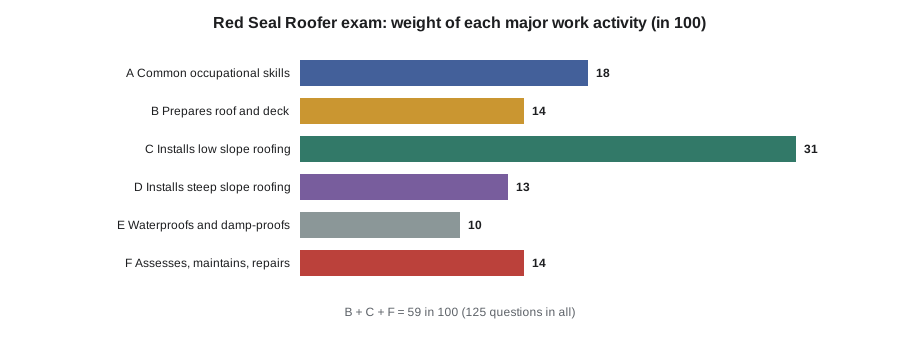
Two things stand out in that table. First, low-slope roofing is almost a third of the exam on its own, and with deck preparation and repair it is more than half. A roofer who has spent years on shingles needs to spend real time on membranes, insulation and low-slope details. Second, the trade's common skills, mostly safety and tools, are nearly a fifth of the exam. Those are the questions people expect to get right without studying, and they are exactly the questions that are lost to a careless reading of the stem.
Worked problem
How many questions does each activity carry?
The low-slope activity is weighted at 31 in 100 of a 125-question exam. About how many questions is that? How many questions can a candidate miss in the whole exam and still pass?
Show solution
- Low-slope questions = 0.31 × 125 = 38.75, so about 38 or 39. The published count is 38.
- Pass mark = 0.70 × 125 = 87.5, rounded up to 88 correct answers.
- Questions that can be missed = 125 − 88 = 37.
Answer: About 38 low-slope questions, and a candidate can miss up to 37 questions in total and still pass. That sounds like a lot until you notice it is fewer than the low-slope questions alone.
What the questions are like
Red Seal questions are written to test whether a candidate can do the work, not whether they can recite a definition. Most fall into three groups. Knowledge questions ask for a fact the trade needs: a minimum, a name, a sequence. Application questions describe a situation on a job and ask what to do, or what to do first. Calculation questions give the numbers from a job and ask for an area, a quantity, a length, a slope or a clearance. All of them use the vocabulary of the occupational standard, so a candidate who knows the trade by its slang may not recognize a question about it at first.
The questions are written to be read carefully. A word such as first, most, best, least, except or not changes the answer, and the wrong answers, called distractors, are usually things a person who half-knows the topic would choose. Lesson 2 shows how to read a question and how to work through one that is not obvious.
Red Seal publishes a general exam preparation guide and sample questions for many trades. They show the style of the questions and are worth working through. The real exam questions are kept secure, and nobody who has seen them is allowed to share them. A study group or a course that claims to have the real questions is selling something it should not have, and studying from it is a good way to learn wrong answers.
Time
Time is the part of the exam candidates plan least. A long exam has a pace, and a candidate who does not know the pace either rushes or runs out.
Worked problem
Setting a pace
The Red Seal Roofer exam has 125 questions in 4 hours. How much time is there per question? If Luca answers every question on a first pass at 1.5 minutes each, how much time is left to review flagged questions?
Show solution
- Total time = 4 × 60 = 240 minutes.
- Time per question = 240 ÷ 125 = 1.92 minutes, just under 2 minutes.
- First pass = 125 × 1.5 = 187.5 minutes.
- Time left = 240 − 187.5 = 52.5 minutes.
Answer: About 1.9 minutes per question. A first pass at 1.5 minutes a question leaves about 52 minutes to return to the hard ones, which is the cushion Dana recommends.
Most questions take far less than the average. A safety question that the candidate knows takes twenty seconds. A takeoff with three steps takes four minutes. The average only works if the quick ones stay quick and the slow ones are not allowed to swallow the time for ten others.
What the exam does not test
No written exam can watch a roofer lay a straight course of shingles or weld a clean seam. What it can test is whether the roofer knows why the work is done the way it is, what the minimums are, what can go wrong and what to do when it does. That is why roofers who are excellent with their hands sometimes do poorly on written tests: much of what they know lives in their hands and their eyes, and they have never had to put it into words. The cure is to practise putting it into words, which is what the review lessons in this course do.
The exam also cannot test the code for every place a roofer might work. National exams stick to principles, to common minimums and to the makers' and industry's standard practice. Where a question depends on a rule, it is a rule that applies broadly, and the candidate is expected to know that local codes and the manufacturer's instructions govern a real job.
"Here's the thing," Dana said, closing her binder. "You know more than you think. Luca has done more low-slope roofs than half the people who write this exam. But he's never had to say why the base sheet goes down before the cap in words, under a clock, with four answers that all sound sort of right. That's the skill we're practising for the next eight weeks."
Common mistakes
MistakeAssuming the exam is mostly about the kind of roofing you do every day.
InsteadStudy by the published weightings: low-slope work is the largest single share.
MistakeSpending ten minutes on one hard question early in the exam.
InsteadAnswer what you can, flag the hard ones, and come back with the time you saved.
MistakeStudying from "real exam questions" passed around online.
InsteadUse official sample questions, the standard and the makers' instructions; leaked or invented "real" questions teach wrong answers.
MistakeReading the question quickly because it looks easy.
InsteadRead every word; first, best, except and not change the answer.
MistakeLeaving booking details, identification and calculator rules to the last day.
InsteadRead the exam confirmation carefully as soon as it arrives.
Summary and key terms
- In Ontario, Roofer (449A) is a voluntary Red Seal trade; the Certificate of Qualification exam is the Red Seal Roofer exam.
- The exam has 125 four-answer multiple-choice questions, four hours in Ontario, and a pass mark of 70 in 100, which is 88 correct answers.
- Eligibility comes from a completed apprenticeship of about 4,000 hours, or through the trade qualifier route.
- Questions are built from the 2022 Red Seal Occupational Standard: common skills 18, roof and deck 14, low slope 31, steep slope 13, waterproofing 10, assessment and repair 14, in 100.
- Questions test knowledge, application and calculation in the standard's vocabulary.
- There are about 1.9 minutes per question; a planned pace leaves time to review.
- Red Seal endorsement
- A seal on a provincial certificate showing the holder passed the interprovincial exam; recognized across Canada.
- Certificate of Qualification
- The certificate Skilled Trades Ontario issues when a candidate passes the trade exam.
- Red Seal Occupational Standard
- The national document describing what a journeyperson in a trade does; the source of the exam's questions.
- Major work activity
- One of the large divisions of the trade in the occupational standard, each with a weight on the exam.
- Trade qualifier
- An experienced worker without a completed apprenticeship who is assessed and allowed to write the exam.
- Distractor
- A wrong answer on a multiple-choice question, written to look right to someone who half-knows the topic.
Practice problems
Work each problem on paper first, then reveal the answer to check.
How many correct answers are needed to pass a 125-question exam at 70 in 100?
Show answer
0.70 × 125 = 87.5, so 88.
About how many questions does the steep-slope activity carry at 13 in 100 of 125?
Show answer
0.13 × 125 = 16.25; the published count is 17.
What two documents does a candidate get in Ontario on passing the Red Seal Roofer exam?
Show answer
One Certificate of Qualification with the Red Seal endorsement on it.
Which three major work activities together make up 59 in 100 of the exam?
Show answer
B (roof and deck, 14), C (low slope, 31) and F (assess and repair, 14).
A candidate has used 150 minutes and answered 85 questions. Is the pace on track?
Show answer
85 × 1.92 = 163 minutes would be the average, so yes, slightly ahead.
Lesson quiz · 5 questions
Score 60% or more to complete this lesson.
Create a free account to save your progress, take quizzes and earn a certificate.