
ROOF-340 · Lesson 2 of 12 · 25 min
A study plan that works
▶ Video coming soon A video version of this lesson is on the way.
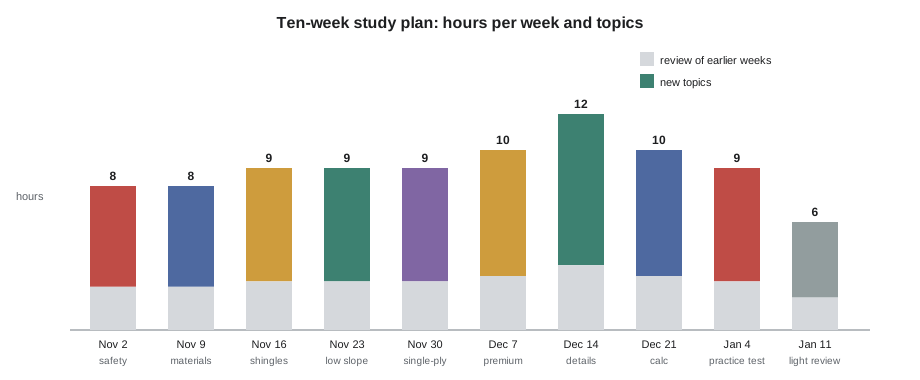
At the second session, on Wednesday, October 28, Dana handed Luca a sheet of paper with a calendar on it. It ran from the first week of November to the week of his exam, which he had booked for Tuesday, January 19, 2027. Each week had a number of hours and a list of topics in it. "This is the plan," she said. "It's yours now. Change it if you need to, but write the change down. A plan in your head is a wish."
Rory looked at the hours. "Nine hours a week? On top of work?"
"In November, when the days are short and the season's ending, yes," Dana said. "In December, when you're laid off for two weeks, more. The people who fail aren't the ones who don't know enough. They're the ones who studied for three nights in the last week and hoped."
This lesson shows how to build a study plan from the exam's weightings, how to study so that it sticks, how to read and answer multiple-choice questions, and how to manage the day of the exam itself.
Start from the weightings
A study plan answers two questions: how much time there is, and where it should go. The total time is set by the calendar: the number of weeks before the exam multiplied by the hours a week that are realistic around work and family. Where it goes starts with the exam's weightings from lesson 1, because they show how many marks each part of the trade is worth.
Worked problem
Dividing 90 hours by the weightings
Luca has ten weeks and plans about nine hours a week, 90 hours in all. Divide the hours among the six major work activities by their weights.
Show solution
- A common skills: 0.18 × 90 = 16.2 hours.
- B roof and deck: 0.14 × 90 = 12.6 hours.
- C low slope: 0.31 × 90 = 27.9 hours.
- D steep slope: 0.13 × 90 = 11.7 hours.
- E waterproofing: 0.10 × 90 = 9.0 hours.
- F assess and repair: 0.14 × 90 = 12.6 hours.
- Check: 16.2 + 12.6 + 27.9 + 11.7 + 9.0 + 12.6 = 90.0 hours.
Answer: About 16, 13, 28, 12, 9 and 13 hours. This is the starting point. Luca then moves hours from what he knows well to what he does not.
The weightings are only the starting point because nobody starts from zero. Luca has four years on Crew 2, almost all of it on low-slope roofs: modified bitumen, some built-up, some single-ply repair. He has done very little steep-slope work since his first summer, no tile, no slate, and only one waterproofing job. Dana had him rate each area from 1 (shaky) to 5 (could teach it), and then moved hours toward the low ratings.
| Area | Luca's rating | Hours by weight | Hours in his plan |
|---|---|---|---|
| A Common skills | 4 | 16 | 13 |
| B Roof and deck | 4 | 13 | 10 |
| C Low slope | 5 | 28 | 20 |
| D Steep slope | 2 | 12 | 20 |
| E Waterproofing | 1 | 9 | 15 |
| F Assess and repair | 3 | 13 | 12 |
| Total | 90 | 90 |
Notice that low-slope roofing, his strongest area, still gets the most hours after steep slope. Strong areas are worth many marks, and they are the ones where a confident candidate loses points by not reading carefully. The goal for a strong area is not to learn it again but to test it hard, find the gaps and fix them.
Spread it out
Ten hours of study spread over five evenings is worth far more than ten hours in one weekend. Memory researchers call this the spacing effect: material that is reviewed at growing intervals, a day later, then a few days later, then a week later, is remembered much longer than material crammed at once. A study plan builds spacing in on purpose. Each week has new topics and a short review of the topics from the week before and the week before that.
The best way to review is to test yourself, not to reread. Rereading notes feels productive because the material looks familiar, but recognizing something on a page is not the same as being able to recall it under pressure. Closing the book and writing down what you remember, answering practice questions, explaining a detail out loud to someone else, or sketching a section from memory and then checking it all force recall, and recall is what the exam asks for.
- Flash cards for minimums, numbers and terms: minimum slopes, flashing heights, lap widths, fall protection heights, temperatures. One fact per card, question on one side, answer on the other. Cards you get right move to a pile reviewed less often; cards you miss stay in the daily pile.
- Practice questions in sets of 20 or 25, timed, then marked. Every wrong answer goes into an error log (lesson 11).
- Sketches of details from memory: a base flashing at a parapet, a valley, an eave with drip edge and ice barrier, a curb with a cricket. Then check them against the makers' details and the earlier courses.
- Calculation drills using the formulas on a one-page sheet: areas, pitch factors, squares, quantities, slopes, clearances, thermal movement, heat loss (lesson 10).
- Teaching: explaining a topic to a study partner. Dana pairs people with different strengths: Luca explained low-slope details to Keisha, and Keisha explained valleys and step flashing to Luca.
Reading a multiple-choice question
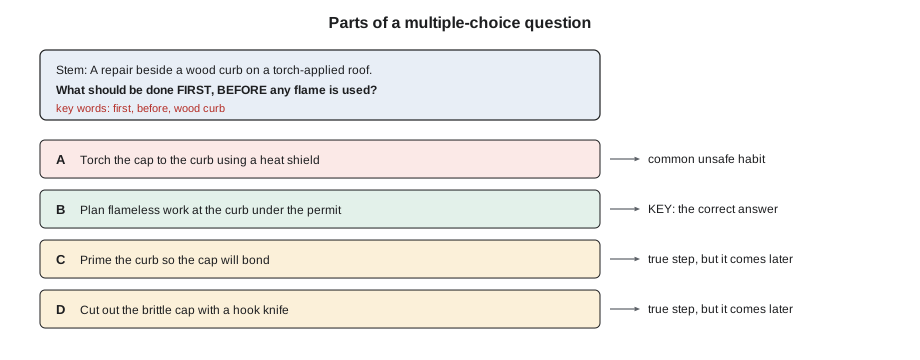
Every multiple-choice question has a stem, which is the question or the situation, and four options: one key, which is the correct answer, and three distractors. Good distractors are not silly. They are the answers a person would give if they remembered the rule wrong, mixed up two similar rules, did the calculation with a common slip, or chose something that is true but does not answer the question that was asked.
Dana's method for reading a question has four steps, and she made the group say them out loud until they were bored of them:
- Read the stem twice before looking at the options. Underline or note the key words: the material, the situation, and any word such as first, best, most, least, except, not or minimum.
- Answer it in your head before reading the options. If your answer is there, it is probably right; read the others anyway to make sure none is better.
- Eliminate options that are clearly wrong. With two left, ask which one actually answers the question asked, for this situation.
- Mark and move if it is still not clear after a minute or two. Pick your best answer now, flag it, and come back later with fresh eyes and the time saved on easy questions.
Questions that ask what to do first are about sequence and safety. If one option is to make the situation safe, stop the work or protect people, and the situation involves a hazard, that option is usually first. Questions that use except or not ask for the one option that is false; a quick way to handle them is to mark each option true or false and choose the odd one out.
Worked problem
Working through a question
Practice question: "A roofer arriving to repair a torch-applied modified bitumen roof finds that the old cap sheet at a wood curb is dry and brittle. What should be done first?" Options: (A) torch the new cap sheet to the curb, using a heat shield; (B) check the hot work permit requirements and plan flameless work at the curb; (C) prime the curb so the cap will bond; (D) cut out the brittle cap sheet with a hook knife.
Show solution
- Key words: "torch-applied", "wood curb", "first".
- Recall: torch flame must not be used on or next to wood or other combustibles; the area near curbs is a flameless zone (ROOF-210).
- A is unsafe at a wood curb, even with a shield. C and D are real steps, but they come after the method is chosen.
- B is the step that decides how the rest is done safely.
Answer: B. Options C and D are distractors built on true steps that come later; A is built on a common unsafe habit.
Practice under real conditions
At least two full-length practice tests belong in the plan, the last one about a week before the exam, timed, in one sitting, with no phone and no notes. The point is not only the score. A full-length test shows how a candidate's concentration holds up over hours, whether the pace plan works, and which kinds of questions take too long. Dana booked the Ridgecap office for a full practice test on Sunday, November 15, a dry run about nine weeks out, and planned a second for early January.
Worked problem
Is a practice score good enough?
Luca scores 41 out of 60 on his first practice set. What is that in 100? If he wrote the real exam at that rate, how many of 125 questions would he get right?
Show solution
- Score = 41 ÷ 60 = 0.683, about 68.3 in 100.
- At that rate on the exam: 0.683 × 125 = 85.4, about 85 correct.
- Pass needs 88.
Answer: About 68 in 100, or about 85 correct out of 125, three short of a pass. That is normal for a first practice set eight weeks out, and it shows exactly how many marks he has to find.
Practice scores should be read with some caution. Questions a candidate writes or collects are rarely as varied as the real exam, and a candidate who has answered the same practice set three times will score well on it without knowing more. Fresh questions, from more than one source, give a truer picture.
Where to find study material
The best study material is the material the trade already uses:
- The occupational standard itself, which lists every task and sub-task the questions come from. Reading it as a checklist and marking each line 'I could explain this' or 'I could not' is one of the best ways to find gaps.
- Official sample questions and the general exam preparation guide published by the certifying body.
- The in-school course notes and textbooks, and courses like the ones in this program.
- Manufacturers' installation instructions and technical bulletins for the main systems: a shingle, a modified bitumen system, a TPO and an EPDM system, a metal roof. Many questions about laps, temperatures, fastening and details come straight from standard industry practice that every maker publishes.
- The CRCA's Canadian Roofing Reference Manual, and the code sections that apply to roofing.
Looking after the candidate
Study plans fail for ordinary reasons: a long week, a sick child, a job that runs late. A good plan has slack in it, so that a missed evening can be made up without wrecking the schedule. Dana builds in one spare evening every two weeks.
The week before the exam is not for new material. It is for light review, flash cards, one last look at the formula sheet, and sleep. Sleep matters more than one more evening of study, because memory is consolidated during sleep and tired people misread questions. The night before, pack identification, the confirmation, an approved calculator if allowed, and something to eat and drink for the breaks if they are permitted, and stop studying by early evening.
Nerves are normal and, in small amounts, useful. A candidate who freezes on the first hard question should take a slow breath, skip it, and answer three easy ones. Confidence comes back with the easy marks. Rory asked Priya Natt, who had passed her exam in 2019, what she remembered about the day. "The first ten questions felt impossible," Priya said. "Then I realized I'd just been reading too fast. I went back to the start, slowed down, and it was fine."
Studying with other people
Dana's group works because the people in it are different. A study partner who knows what you do not is the fastest way to fill a gap, and explaining something to them is the fastest way to find out whether you really know it yourself. Groups also keep people going in December, when the season is over and studying alone at the kitchen table is easy to put off. The danger of a group is that it turns into a social evening. Dana keeps hers to a fixed time, starts each session with ten timed questions, and ends it with each person saying out loud what they will study before the next one.
Rory found that the best thing he could do for Luca was to ask him the simple questions: why does the base sheet go down first, why does the cap's lap face away from the drain, what happens if the drain is set high. "Half the time I don't know the answer," Rory said. "But he has to explain it, and then we both know it."
Common mistakes
MistakeStudying only the areas you enjoy or already know.
InsteadDivide time by the weightings, then move hours toward weak areas.
MistakeRereading notes and calling it review.
InsteadTest yourself: cards, practice questions, sketches from memory, teaching.
MistakeCramming in the last week.
InsteadSpread study over weeks; review earlier topics as you go.
MistakePicking the first option that sounds right.
InsteadAnswer in your head first, read all four, and check which one answers the question asked.
MistakeTaking practice tests in short bursts with notes open.
InsteadDo at least one full-length, timed practice under exam conditions.
Summary and key terms
- Total study time comes from the calendar; its division starts from the exam weightings.
- Adjust the hours using an honest self-rating of each area, but keep testing strong areas.
- Spaced review and self-testing beat rereading and cramming.
- Read each stem twice, answer it in your head, eliminate, then mark and move if stuck.
- Practise with full-length timed tests and read practice scores with caution.
- Leave slack in the plan, avoid new material in the last week, and sleep.
- Spacing effect
- The finding that material reviewed at increasing intervals is remembered longer than material studied all at once.
- Self-testing
- Studying by recalling answers without looking, such as with cards or practice questions.
- Stem
- The question or situation in a multiple-choice question.
- Key
- The correct option in a multiple-choice question.
- Error log
- A record of every practice question missed, why, and the correct answer.
- Formula sheet
- A one-page summary of the calculations a candidate needs to be able to do.
Practice problems
Work each problem on paper first, then reveal the answer to check.
Divide 60 study hours by the weightings 18, 14, 31, 13, 10 and 14 in 100.
Show answer
10.8, 8.4, 18.6, 7.8, 6.0 and 8.4 hours.
A practice score is 52 out of 75. What is that in 100, and would it pass?
Show answer
52 ÷ 75 = 0.693, about 69.3 in 100; just under 70, so no.
Why is rereading notes a weak way to review?
Show answer
It builds familiarity, not recall.
How should a question with the word except be handled?
Show answer
Mark each option true or false and choose the false one.
What belongs in the last week before the exam?
Show answer
Light review, cards, the formula sheet, sleep; no new material.
Lesson quiz · 5 questions
Score 60% or more to complete this lesson.
Create a free account to save your progress, take quizzes and earn a certificate.