
ROOF-340 · Lesson 3 of 12 · 25 min
Review: safety
▶ Video coming soon A video version of this lesson is on the way.
Dana started the third session, on Wednesday, November 4, with a question instead of a lecture. "How many of the safety questions on the test do you think you'll get wrong?" Luca said none. Keisha said maybe one. Rory said none, then thought about it and said one. "Last year's group all said none," Dana said. "On their first practice set they got two out of three right. Safety is the area where everybody's sure and nobody's careful."
Safety questions are spread across the whole exam. Some sit in the common skills activity, which is close to a fifth of the marks, and others appear inside the questions about kettles, torches, tear-off and repairs. This lesson reviews the safety content of ROOF-110 and the safety rules from the later courses, in the order a roofer meets them on a job. Use it as a checklist: for each item, ask whether you could explain it, with the numbers, to an apprentice on their first day.
Falls
Falls are the leading cause of death in roofing, and fall protection is the safety topic most likely to appear in numbers on the exam. The rules differ by place, but the principles are the same everywhere: prevent the fall first, with guardrails, covers and barriers; restrain the worker so they cannot reach the edge; and only then arrest a fall that does happen, with a system that stops it before the worker hits anything and allows a rescue.
| Item | What to know |
|---|---|
| When protection is needed | Where a worker could fall more than 3 m, or into water, machinery or a hazardous substance (O. Reg. 213/91 s.26) |
| Order of choice | Guardrails first; then travel restraint; then fall-restricting or fall arrest systems; a safety net is another option (s.26.1) |
| Built-up roofing | On built-up roofing work, a barrier at least 2 m back from the edge can replace guardrails, with a raised warning line (s.207) |
| Training | Working at Heights training from an approved provider, refreshed every three years |
| Openings and skylights | Treated as openings: guarded, or covered with a secured cover that will carry the load |
| Fall arrest | Full-body harness, energy-absorbing lanyard or lifeline, anchor rated for the load, enough clearance, a rescue plan |
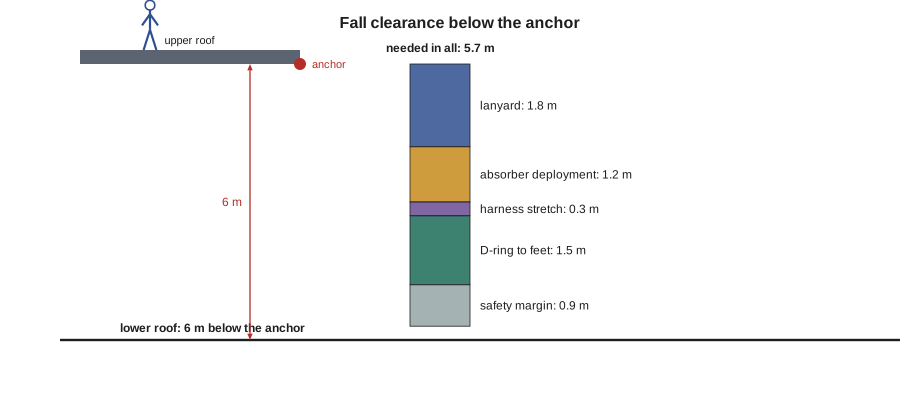
Fall clearance is a favourite calculation, because it is a real decision on every steep roof. Clearance is the distance needed below the anchor for the worker to stop without striking the lower level or an obstruction, and it adds up every part of the fall.
Worked problem
Fall clearance check
Luca is anchored at about D-ring height with a 1.8 m energy-absorbing lanyard. The absorber can deploy up to 1.2 m. Allow 0.3 m for harness stretch and D-ring shift, 1.5 m from the D-ring to his feet and a 0.9 m safety margin. The flat roof below is 6.0 m below the anchor. Is the clearance enough?
Show solution
- Required = 1.8 + 1.2 + 0.3 + 1.5 + 0.9 = 5.7 m.
- Available = 6.0 m.
- Margin = 6.0 − 5.7 = 0.3 m beyond the safety allowance.
Answer: Yes, 5.7 m is needed and 6.0 m is available. If the anchor were below his D-ring, the free fall would increase and the answer could change, which is a common twist in exam questions.
Rescue is part of fall protection. A worker hanging in a harness can lose consciousness from suspension trauma within minutes, so every fall arrest plan needs a way to reach and lower the worker quickly, without waiting for the fire department to arrive.
Ladders, hoists and loads
Most roofers climb a ladder several times a day, and ladder questions are easy marks if the numbers are known. An extension ladder is set at a slope of about 4 to 1, one unit out at the base for every four units of height to the support point, and extends about 1 m above the landing so the worker has something to hold while stepping on and off. It is secured top and bottom, set on firm footing, and kept well clear of overhead power lines.
Worked problem
Setting a ladder
The eave of the Westlane clinic is 4.8 m above the ground. How far out should the ladder's base be, and how long must the ladder be along its rails to reach the eave and extend 1 m above it?
Show solution
- Base distance = 4.8 ÷ 4 = 1.2 m.
- Length to the eave = √(4.8² + 1.2²) = √(23.04 + 1.44) = √24.48 = 4.95 m.
- Plus 1 m above the eave: 4.95 + 1.0 = 5.95 m.
Answer: The base goes 1.2 m out, and the ladder needs about 6.0 m of working length. An extension ladder's working length is less than its nominal length because of the overlap of the sections, so the nominal size must be larger.
Overhead power lines are a hazard for ladders, hoists, conveyors and cranes. Ontario requires that no part of equipment or a load come within 3 m of an energized line of up to 150,000 volts, with larger distances for higher voltages.
Material on a roof is a load on a structure that was designed for snow and people, not for pallets. Bundles and rolls are spread out, set over beams, columns or bearing walls where possible, and kept back from edges. Hoists and conveyors are set up, loaded and operated within their rated capacity by trained people, with the landing area protected and the area below barricaded.
Fire and hot work
Roofing fires are caused by torches, kettles, hot asphalt, hot-air welders and propane, and most of them start hidden, in a combustible cant, a wood nailer or old fibreboard, and show up after the crew has left. The exam questions on fire are about prevention, the fire watch and the right response.
- Hot work permits: the job is planned, combustibles are identified, flameless methods are chosen where needed, extinguishers are on the roof, and someone is assigned to watch.
- Flameless zones: no torching on or next to wood, at curbs, walls, cants and openings where flame can reach hidden combustibles; self-adhered or cold-applied material is used there instead, often in a band about 915 mm wide around details.
- Fire watch: after torching stops, a trained person watches and checks the work area, including with an infrared thermometer, for the period the fire code requires; Ridgecap's rule is two hours. Ridgecap also stops torching two hours before the end of the shift so the watch can be finished before the crew leaves.
- Kettles: set up by a competent operator, on level ground away from the building and from openings, with the lid closed when not drawing, the temperature kept below the asphalt's flash point and within its working range, and extinguishers at hand; propane cylinders upright, secured and kept back from the burner.
- Extinguishers: know the classes (A for ordinary combustibles, B for flammable liquids and gases, C for electrical) and the method: pull, aim at the base, squeeze, sweep.
Burns from hot asphalt are cooled with cool running water, for a long time, and the asphalt is left on the skin for medical staff to remove. Never peel it off and never use solvent on the skin.
Health hazards
| Hazard | What to know |
|---|---|
| Heat stress | Watch the humidex; water, rest and shade on a schedule; acclimatize new workers; know heat exhaustion from heat stroke, which is an emergency |
| Cold stress | Layers, warm breaks, dry clothing; watch for frostbite and hypothermia; slips on frost and ice |
| Noise | Ontario's limit is 85 dBA over 8 hours, with the allowed time halved for every 3 dB increase |
| Silica and dust | Cutting concrete, tile, slate or masonry; wet methods, vacuum shrouds and respirators |
| Asbestos | Possible in old felts, flashing cements, cants and coatings; test before disturbing; abatement by trained, qualified workers only |
| Solvents and adhesives | Read the safety data sheet; ventilation, no ignition sources, protect air intakes, gloves and eye protection |
| Sun | Long sleeves, hats with brims, sunscreen, shade breaks |
Worked problem
Noise exposure
A crew member runs a gas-powered saw that measures 91 dBA at the ear. Under Ontario's limit of 85 dBA for 8 hours with a 3 dB exchange rate, how long can he work at that level without hearing protection?
Show solution
- Increase above the limit = 91 − 85 = 6 dB.
- Number of halvings = 6 ÷ 3 = 2.
- Allowed time = 8 ÷ 2² = 8 ÷ 4 = 2 hours.
Answer: Two hours. In practice Ridgecap requires hearing protection for any use of the saw.
The right of a worker to know about hazards comes through WHMIS 2015: supplier labels, workplace labels and safety data sheets, and the exam expects a roofer to know where to find the safety data sheet for a primer or an adhesive and what its sections tell them.
The public, the building and the job
Roofing work happens over people who are not part of it: shoppers, tenants, students and drivers. Questions about protecting the public cover barricades and signs below the work, overhead protection at entrances, debris chutes or lowering debris in containers instead of dropping it, protecting air intakes from fumes and odours, and drying in the roof at the end of every day so that rain overnight does not get into the building.
Rights and duties also appear on the exam. Workers have the right to know about hazards, the right to participate in health and safety, and the right to refuse unsafe work. Supervisors must make sure work is done safely, train and equip workers, and take every reasonable precaution. An exam question that asks what a worker should do on finding an unsafe condition usually has the same answer as on a real roof: stop, protect others from it, and report it to the supervisor.
Practice questions in the exam style
Dana gave the group five questions to answer in five minutes. Try them before reading the answers.
- 1. What is the first choice of fall protection at an unguarded roof edge where guardrails can be installed? (Guardrails.)
- 2. A ladder reaches a support point 6.0 m up. How far out is its base? (1.5 m.)
- 3. Where should a flameless method be used on a torch-applied roof? (On and next to wood and other combustibles, at curbs, walls and openings.)
- 4. What should be done with hot asphalt stuck to a worker's skin? (Cool it with running water and leave it for medical staff to remove.)
- 5. A worker finds a skylight with no cover or guard in the work area. What should be done first? (Protect others from it, by guarding or covering it if equipped, and report it.)
Exam-style questions explained
These questions show how safety distractors are built. Work each one before reading the explanation.
Question. A roofer on a low-slope roof notices that the warning line has been moved closer to the edge by another trade. What should the roofer do first? (A) Keep working, since the line is still there; (B) stop work in that area and report it so the line can be reset; (C) move the line back alone without telling anyone; (D) finish the day and mention it tomorrow. Answer: B. A and D accept a hazard; C fixes the line but skips the report, so the cause is not found and the other trade may move it again.
Question. Which is the correct order for a fall protection plan? (A) Fall arrest, then travel restraint, then guardrails; (B) guardrails or other prevention, then travel restraint, then fall arrest; (C) training, then guardrails, then a safety monitor; (D) any method the worker prefers. Answer: B. Prevention comes before arrest. Training is essential but is not a step in the hierarchy.
Question. A propane cylinder for a torch is lying on its side on the roof. Why is that a problem? (A) It looks untidy; (B) liquid propane can reach the regulator and hose, producing a dangerous flare; (C) cylinders must be stored indoors; (D) it voids the warranty. Answer: B. Cylinders are kept upright and secured so the torch draws vapour, not liquid.
Question. Which sign points to heat stroke rather than heat exhaustion? (A) Heavy sweating; (B) thirst; (C) confusion and hot, possibly dry skin; (D) tiredness. Answer: C. Heat stroke is an emergency: call for emergency help and cool the worker immediately.
Rescue planning
Fall arrest systems are only half of a plan; the other half is getting the worker down. A rescue plan names who will do the rescue, with what equipment, and how quickly they can reach a suspended worker. On a house, it may be a ladder and a second worker trained to use it; on a commercial roof, a rescue kit with a descent device. The plan is practised, not just written, and the equipment is on the roof whenever someone is working in fall arrest. Exam questions on rescue usually ask why it must be quick: a worker hanging in a harness can lose consciousness from suspension trauma within minutes, long before an emergency crew could arrive.
Common mistakes
MistakeTreating safety as easy marks and reading the questions quickly.
InsteadRead safety questions as carefully as calculations; the distractors are common habits.
MistakeForgetting that an anchor below the D-ring adds free fall.
InsteadMeasure clearance from the anchor, and add free fall when the anchor is low.
MistakeEnding the fire watch when the crew leaves.
InsteadStop torching early enough to complete the full fire watch.
MistakePeeling hot asphalt off a burn.
InsteadCool it with water and leave removal to medical staff.
MistakeChoosing fall arrest when guardrails are possible.
InsteadPrevent the fall first; arrest is the last line.
Summary and key terms
- Fall protection is needed where a fall could exceed 3 m; guardrails are the first choice, and Working at Heights training is required.
- Fall clearance adds lanyard, absorber deployment, harness stretch, body height and a margin, measured from the anchor.
- Ladders go at about 4 to 1 and extend about 1 m above the landing; keep 3 m from lines up to 150 kV.
- Hot work needs a permit, flameless zones at combustibles, a planned fire watch and the right extinguishers.
- Know heat and cold stress, noise limits (85 dBA, 3 dB exchange), silica, asbestos, solvents and WHMIS.
- Protect the public and the building, and stop, protect and report unsafe conditions.
- Travel restraint
- A system that keeps a worker from reaching a point where a fall could happen.
- Fall arrest
- A system that stops a fall that has started, before the worker strikes a lower level.
- Free fall
- The distance a worker falls before the fall arrest system begins to stop the fall.
- Suspension trauma
- Loss of circulation and consciousness that can occur when a worker hangs in a harness after a fall.
- Fire watch
- A period after hot work when a trained person watches and checks the area for smouldering fire.
- Exchange rate
- The noise increase, in decibels, that halves the allowed exposure time.
Practice problems
Work each problem on paper first, then reveal the answer to check.
A worker's fall clearance need is 5.7 m. The anchor is 5.4 m above the lower level. What should change?
Show answer
There is not enough clearance; use a higher anchor, a shorter lanyard or a self-retracting lifeline, or travel restraint.
A ladder reaches 7.2 m up. Where does its base go?
Show answer
7.2 ÷ 4 = 1.8 m out.
How long is the allowed exposure at 88 dBA under an 85 dBA, 3 dB limit?
Show answer
8 ÷ 2 = 4 hours.
Name three places where flameless methods are used.
Show answer
Wood curbs and nailers, walls and cants, openings and penetrations.
What does s.207 allow on built-up roofing work?
Show answer
A barrier at least 2 m from the edge in place of guardrails.
Lesson quiz · 5 questions
Score 60% or more to complete this lesson.
Create a free account to save your progress, take quizzes and earn a certificate.