
ROOF-340 · Lesson 8 of 12 · 24 min
Review: premium steep-slope roofing
▶ Video coming soon A video version of this lesson is on the way.
Nobody in the study group had much experience with premium roofs except Rory, who had spent three weeks in September and October on Crew 6 with Bram Vandersluis, and had come back talking about slate the way other people talk about cars. Dana let him lead the review, and Luca, who had never touched a slate, took the notes. "The thing about all of these," Rory said, "is that they're heavy, they last forever if you do them right, and they're ruined in a day if you walk on them wrong."
The steep-slope activity is a modest share of the exam, but tile and pre-formed metal have their own tasks in it, and many candidates lose marks on them because they have never installed them. This lesson reviews ROOF-230: choosing premium coverings, metal shingles and panels, standing seam, clay and concrete tile, slate, wood shakes and shingles, underlayments, wind, flashing, snow and repairs.
Choosing a premium covering
Premium coverings are chosen for long life, appearance, fire and hail resistance, and sometimes because a heritage building already has them. They differ in weight, minimum slope and cost per year of service, and the exam asks about all three. A heavy covering such as slate or clay tile on a house built for asphalt shingles needs a structural review before it goes on.
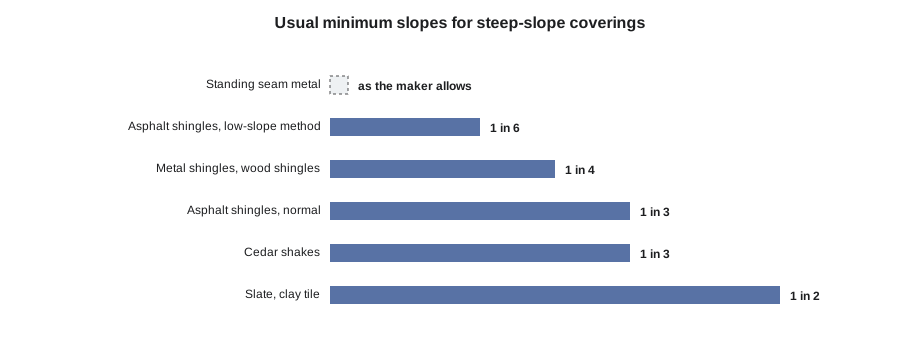
| Covering | Typical weight | Typical service life | Minimum slope (usual code value) |
|---|---|---|---|
| Asphalt shingles | 10 to 20 kg/m² | 20 to 30 years | 1 in 3; 1 in 6 with low-slope method |
| Metal shingles and panels | 5 to 10 kg/m² | 40 to 60 years | 1 in 4, or as the maker allows |
| Standing seam metal | 5 to 10 kg/m² | 40 to 60 years | as the maker allows |
| Clay or concrete tile | 40 to 90 kg/m² | 50 to 100 years | 1 in 2 for clay tile; concrete tile as the code and maker set |
| Natural slate | 35 to 80 kg/m² | 75 to 150 years | 1 in 2 |
| Wood shakes | 15 to 30 kg/m² | 25 to 40 years | 1 in 3 |
| Wood shingles | 10 to 20 kg/m² | 25 to 35 years | 1 in 4 |
Worked problem
Cost per year of service
A slate roof costs 85,000 dollars and is expected to last 100 years. An asphalt shingle roof on the same house costs 18,000 dollars and lasts 25 years. Which costs less per year of service? (Sample prices.)
Show solution
- Slate = 85,000 ÷ 100 = 850 dollars a year.
- Shingles = 18,000 ÷ 25 = 720 dollars a year.
Answer: The shingles, at 720 dollars a year against 850, in this example. The slate wins if it lasts longer, if the owner values appearance or heritage, or if replacing the shingles three more times costs more than today's price. Cost per year is one tool, not the whole decision.
Metal roofing
Metal roofs are steel (galvanized or aluminium-zinc coated, then painted), aluminium, copper or zinc. Thickness is given as a thickness in millimetres or a gauge; heavier metal resists denting and oil-canning. Exposed-fastener panels are screwed through the panel with sealing washers, which need checking and replacing over time. Metal shingles interlock and are fastened through concealed flanges. Metal must be cut with tools that do not burn the coating, such as shears or nibblers, not abrasive wheels, and filings must be swept off before they rust and stain the panels.
Standing seam roofs have no exposed fasteners in the field. The panels are held by clips that slide in the seams, so that each panel can expand and contract along its length while being fixed at one point, usually the ridge or the middle of the panel. Trim at the ends must allow the movement, or the panels will buckle or pull their clips. Seams are snapped together or mechanically seamed with a seaming tool, and panels are laid out square to the eave, not to a crooked rake.
Worked problem
Movement of a standing seam panel
A steel standing seam panel is 12 m long and fixed at its ridge end. Its temperature ranges over 80 °C during the year. With α = 11.7 × 10⁻⁶ per °C, how far does its eave end move?
Show solution
- ΔL = 11.7 × 10⁻⁶ × 12,000 mm × 80 = 11.2 mm.
Answer: About 11 mm. Fixing the panel at its midpoint instead halves the movement at each end.
Clay and concrete tile
Clay tile is fired clay, graded for frost resistance; in a freezing climate only the grade made for severe weathering is used. Concrete tile is made of cement and sand. Both come in flat, low-profile and high-profile shapes. Tiles are laid on battens or directly on the deck as the maker and the code allow, with counter-battens under the battens on many roofs so that water and air can move under them. Fastening is by nails, screws, clips or wire ties, with more fastening at eaves, rakes, ridges and in high wind or snow areas. Tile breaks under a careless foot: roofers walk on the lower third of each tile, where it is supported by the one below, or use walk boards.
Slate
Natural slate is graded by its expected life and its resistance to weathering, and ASTM C406 sets three grades, S1, S2 and S3, from longest to shortest service. Each slate is held by two nails of copper or stainless steel, driven so that the slate hangs on them, not so tight that the slate cracks. The headlap, the amount each slate covers the slate two courses below, is increased on lower slopes. The exposure is found from the slate's length and the headlap.
Worked problem
Slate exposure
A slate is 610 mm long and the headlap is 76 mm. What is the exposure?
Show solution
- Exposure = (length − headlap) ÷ 2 = (610 − 76) ÷ 2 = 267 mm.
Answer: 267 mm. The exposure is halved because each slate is covered by two courses.
Synthetic slate made of polymer or rubber is lighter and easier to install, but it does not look the same up close and has a much shorter record; on heritage buildings it is often not acceptable. Repairs to natural slate use a slate ripper to cut the old nails, a new slate of matching size and colour, and a copper strip or a hook to hold it without face-nailing.
Wood shakes and shingles
Wood shingles are sawn and have a smooth face; shakes are split and are thicker and rougher. Both are usually western red cedar, and both need air under and around them to dry. Shakes are laid with an interlayment of felt between courses, laid at twice the exposure above the butt line, to keep wind-driven snow and rain out; shingles are not interlaid. Both are spaced with gaps between pieces so they can swell when wet, and nailed with two corrosion-resistant nails, set back from the edges and above the exposure line so the next course covers them.
Underlayments and ice barriers
Premium roofs last longer than ordinary underlayments, so the underlayment must last too. High-temperature self-adhered membranes are used under metal roofs, which get hotter than shingles, because ordinary self-adhered membranes can soften and flow. Slip sheets separate metal from self-adhered membranes that would stick to it. Eave protection follows the same rules as for shingles (lesson 5), and on heavy coverings with long lives the full underlayment is often upgraded.
Wind, snow and ice
Wind lifts premium coverings the same way it lifts shingles, hardest at corners, eaves and rakes, and each covering has its own fastening rules and test ratings. Snow on a metal or slate roof can slide off all at once, dangerous to people below and destructive to gutters and lower roofs. Snow guards hold the snow so it melts in place or slides in small amounts. They are laid out in rows from the eave, with more rows on longer and steeper slopes, and their attachment and spacing follow the maker's tables for the snow load. Heat cable in gutters and valleys can reduce ice but does not fix the cause of ice dams, which is heat loss and poor ventilation.
Flashing premium roofs
Flashings on premium roofs must last as long as the roof, so they are made of long-lasting metal, usually copper, stainless steel or heavy painted steel, and chosen to be compatible with the covering and with each other (lesson 4). Slate and tile roofs use open metal valleys wide enough to carry the water, step flashings or soakers at walls, and counterflashings let into masonry. Where copper and other metals meet, the water should run from the less noble metal onto the copper, not from the copper onto the galvanized steel or aluminium. At St. Brendan's Church, the two galvanized valleys installed in 1958 had rotted, partly from copper runoff above them, and were replaced in copper.
Repairs and records
Repairs on premium roofs follow one rule: match what is there, with permanent methods. Slate is replaced with slate of the same size, thickness and colour, hung on hooks or copper strips; tile with the same profile; metal with the same gauge and finish. Caulking a cracked slate or a loose tile is not a repair. Every repair is recorded with photos and the location, because premium roofs are maintained for decades and the next roofer needs to know what was done.
Exam-style questions explained
Question. A standing seam roof shows buckled panels at its eave a year after installation, and the eave trim is screwed tight to the panels. What is the cause? (A) Panels fixed at the ridge could not move at the eave; (B) the clips were too far apart; (C) the metal was too thick; (D) the underlayment was wrong. Answer: A. Trim at the free end must let the panels move.
Question. A slate on a heritage roof has cracked. What is the correct repair? (A) Seal the crack with roofing cement; (B) remove the slate with a ripper and install a matching slate held by a copper strip or hook; (C) nail a new slate through its face; (D) cover it with a metal sheet. Answer: B. Repairs match the material and use permanent methods; face nails leak.
Question. Why are counter-battens used under tile battens? (A) To let water and air move under the battens and tiles; (B) to raise the tiles for appearance; (C) to replace underlayment; (D) to support snow guards. Answer: A. Water that gets past the tile must drain down the slope without being trapped behind battens.
Question. Which nails are used for natural slate? (A) Copper or stainless steel; (B) electro-galvanized steel; (C) aluminium; (D) bright steel. Answer: A. Slate outlasts ordinary steel nails by decades.
Walking on and protecting premium roofs
More premium roofs are damaged by roofers and other trades than by weather. Slate and tile break under a foot placed in the wrong spot; metal dents and scratches; wood shingles split. Crews use roof ladders hooked over the ridge, walk boards on brackets, and padded or soft-soled footwear where the maker recommends. Other trades, such as chimney sweeps, satellite installers and gutter cleaners, are a common source of broken slate, and service contracts on heritage buildings often include a walk-over after other trades have been on the roof.
Materials for premium roofs are also ordered differently. Natural slate and clay tile vary from batch to batch and from quarry to quarry, so a repair supply is often salvaged from the same roof or bought from a dealer who can match it. Copper ages from bright to brown to green, and new copper next to old will stand out for years. These are the kinds of practical points a review question on repairs may test.
Ice dams on premium roofs
Ice dams form when heat from the house melts snow on the upper roof and the water refreezes at the cold eave. On premium roofs they are especially damaging, because slate, tile and metal shed water but do not stop it backing up under pressure. The defence is the same as for shingles: an air-tight, well-insulated ceiling, balanced ventilation or a cold roof design, and eave protection under the covering. Heat cable and snow guards manage the symptoms; they do not remove the heat that causes the dam.
Common mistakes
MistakePutting slate or tile on a house without checking the structure.
InsteadHave the structure reviewed for the heavier covering.
MistakeFixing standing seam panels at both ends.
InsteadFix at one point and let clips slide; leave room in the trim.
MistakeNailing slates tight.
InsteadDrive nails so the slate hangs on them.
MistakeInterlaying wood shingles like shakes.
InsteadInterlay shakes; never interlay sawn shingles.
MistakeLetting copper drain onto galvanized steel.
InsteadArrange water to flow from the less noble metal onto the copper, or separate them.
Summary and key terms
- Premium coverings differ in weight, minimum slope, life and cost per year; heavy ones need a structural check.
- Metal: choose gauge and coating, cut without burning the coating, and let standing seam panels move on clips from one fixed point.
- Tile: frost-resistant grade, battens and counter-battens, proper fastening, and careful walking.
- Slate: graded by life, two nails each so it hangs, exposure = (length − headlap) ÷ 2.
- Wood: shakes are interlaid and spaced; shingles are spaced but not interlaid.
- Use high-temperature membranes under metal, snow guards where snow slides, long-life compatible flashings and matching repairs.
- Standing seam
- A metal roof whose panels join in raised seams over concealed clips.
- Oil-canning
- Visible waviness in flat areas of metal panels.
- Counter-batten
- A strip laid up the slope under the battens, so water and air can move beneath them.
- Headlap
- The overlap of a slate or tile over the course two below it.
- Interlayment
- Felt strips laid between courses of shakes.
- Snow guard
- A device fastened to a roof to hold snow from sliding off all at once.
Practice problems
Work each problem on paper first, then reveal the answer to check.
A slate is 508 mm long with a 76 mm headlap. What is the exposure?
Show answer
(508 − 76) ÷ 2 = 216 mm.
A steel panel 9 m long sees a 70 °C range. How far does it move at α = 11.7 × 10⁻⁶ per °C?
Show answer
11.7 × 10⁻⁶ × 9,000 × 70 = 7.4 mm.
A copper roof costs 120,000 dollars and lasts 80 years. What is its cost per year?
Show answer
1,500 dollars.
Why are high-temperature membranes used under metal roofs?
Show answer
Metal gets hot enough to soften ordinary self-adhered membranes.
Where do roofers step on a tile roof?
Show answer
On the lower part of each tile, where it is supported, or on walk boards.
Lesson quiz · 5 questions
Score 60% or more to complete this lesson.
Create a free account to save your progress, take quizzes and earn a certificate.