
ROOF-340 · Lesson 1 of 12 · 23 min
How the exam is built
▶ Video coming soon A video version of this lesson is on the way.
On Wednesday evening, October 21, Dana Renaud pushed two tables together in the Ridgecap lunchroom, set down a box of doughnuts and a stack of photocopied roof plans, and waited for her study group. Luca Moretti came first, still in his work boots. Luca had been on Crew 2 for four years and was in the last stretch of his apprenticeship. Rory Quintero and Keisha Grant came in behind him. Neither of them was anywhere near the end of their training, but Dana had told them they could sit in. "Most people start studying for this in the last three months," she said. "You two get to start three years early. That's not a punishment. That's a head start."
Dana had run a study group like this every fall for six years, since she noticed that good roofers were failing their final test for reasons that had nothing to do with how well they roofed. Some had never seen a question written the way the test writes them. Some spent forty minutes on one calculation and ran out of time. Some had worked for ten years on one kind of roof and had forgotten everything about the others. "The test is not hard because roofing is hard," she said. "It's hard because it covers the whole trade, and none of us does the whole trade every week."
This course is the last in the roofer program. It reviews the trade from end to end, the way a final test does, and it shows how to prepare for that test and what comes after it. This first lesson explains how the test is put together, because a plan to pass it starts with knowing what is on it.
Is there a journeyman roofer exam?
In the United States there is no single national exam that makes someone a journeyman roofer. Ohio does not license individual roofers, and it does not issue a state license to roofing contractors either; the Ohio Construction Industry Licensing Board licenses electrical, plumbing, HVAC, refrigeration and hydronics contractors, but not roofers. Instead, a roofer proves the whole trade in a few different ways, and most careers collect several of them.
| Credential | Who issues it | What it involves |
|---|---|---|
| Completion of a registered apprenticeship | The program sponsor, with ApprenticeOhio and the U.S. Department of Labor | Required on-the-job hours and classroom hours, then the program's own written and practical tests |
| Union journeyworker status | A local of the United Union of Roofers, Waterproofers and Allied Workers and its joint training committee | Usually a three- to five-year apprenticeship with classes at the local's training center |
| NRCA ProCertification | The National Roofing Contractors Association | An online eligibility exam and a hands-on performance exam for one roof system |
| Manufacturer credentials | Roofing manufacturers | Training and tests on their systems; often a condition of issuing their warranties |
| OSHA Outreach cards | OSHA-authorized trainers | The 10-hour and 30-hour construction safety courses |
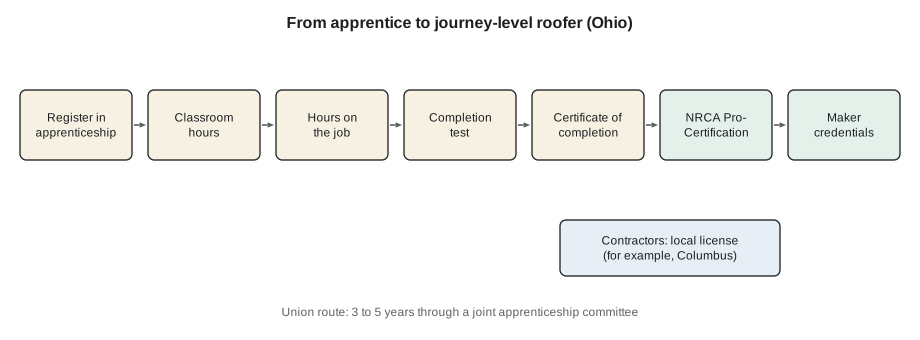
Ridgecap is an open-shop contractor. Its apprentices are in a registered apprenticeship through ApprenticeOhio, and Ridgecap is the sponsor. When an apprentice has the hours and the classroom time, the program ends with a completion test that Dana and Anjali Mukherjee wrote from the trade's standards and the program's work processes. Passing it, together with the hours, earns the certificate of completion of apprenticeship, which is recognized nationally. Some of Ridgecap's competitors are union shops, where apprentices train through the local of the United Union of Roofers, Waterproofers and Allied Workers and become journeyworkers when the joint apprenticeship committee says they have mastered the work.
Ridgecap's completion test
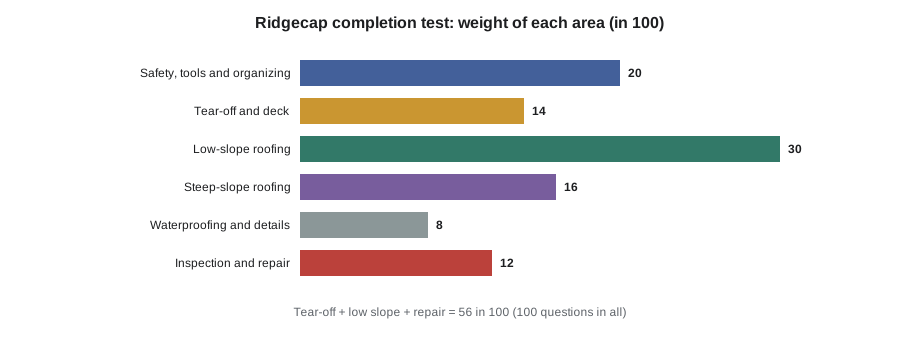
Ridgecap's written completion test has 100 multiple-choice questions, four answers each, with three hours to finish, and the pass mark is 70 in 100. A practical test on the yard mock-up follows: a section of low-slope roof with a curb and a parapet, and a small steep-slope panel with a valley and a sidewall. Dana built the written test the way national certification exams are built: she broke the trade into areas of work and gave each area a share of the questions based on how much of the job it is.
| Area of work | Weight | Questions | What it covers |
|---|---|---|---|
| Safety, tools and organizing work | 20 in 100 | 20 | Fall protection, ladders, fire, heat, hazardous materials, tools, planning |
| Tear-off and deck preparation | 14 in 100 | 14 | Removing old roofs, inspecting and repairing decks |
| Low-slope roofing | 30 in 100 | 30 | Insulation, barriers, built-up, modified bitumen, single-ply, low-slope details |
| Steep-slope roofing | 16 in 100 | 16 | Shingles, underlayment, flashing, ventilation, premium coverings |
| Waterproofing and details | 8 in 100 | 8 | Below-grade and plaza waterproofing, sheet metal, sealants |
| Inspection, maintenance and repair | 12 in 100 | 12 | Inspecting, surveying, maintaining and repairing roofs |
Worked problem
How many questions does each area carry?
Low-slope roofing is weighted at 30 in 100 of the 100-question test. How many questions is that? How many questions can a candidate miss and still pass?
Show solution
- Low-slope questions = 0.30 × 100 = 30.
- Pass mark = 0.70 × 100 = 70 correct answers.
- Questions that can be missed = 100 − 70 = 30.
Answer: Thirty low-slope questions, and a candidate can miss up to 30 questions in total and still pass. That is exactly the number of low-slope questions, which is why a shingle specialist cannot skip low-slope review.
NRCA ProCertification
NRCA ProCertification is a national certification for individual roofing workers, offered one roof system at a time: there are installer certifications for systems such as asphalt shingles, EPDM, modified bitumen, metal panel and metal shingle roofs, clay and concrete tile, and architectural metal flashings and accessories. A candidate first passes an online eligibility exam on that system. NRCA does not require a particular course before it, but it publishes study guides, checklists and job task analyses to prepare from. The candidate then takes a performance exam, in which a qualified assessor watches the candidate install the system and scores the work pass or fail, usually over three to five hours, at the contractor's shop, at a testing event or, for some systems, by video. A candidate who does not pass the performance exam can retake it once. Certifications are renewed every three years with documented work and training.
Luca planned to take the modified bitumen systems installer certification in the spring, after his completion test, because Ridgecap's commercial work is mostly modified bitumen and owners on public jobs had started asking for certified installers on the crew.
Manufacturer credentials and licenses
Roofing manufacturers train and test the contractors who install their systems, and many issue their best warranties only through contractors in their programs. Programs such as GAF's Master Elite, CertainTeed's ShingleMaster and SELECT ShingleMaster, Owens Corning's Platinum Preferred, Carlisle's authorized applicator program and Elevate's Red Shield licensed contractor program set conditions on the company, its insurance and its training, and some also credential individual installers. These are not trade certificates, but they decide what warranties a company can offer, so the people on the crew are often required to complete the maker's training.
Local licensing is separate again. In Columbus, contractors doing roofing on one- to three-family homes hold the city's home improvement limited contractor license. A bill introduced in the Ohio Senate in February 2025 would add roofing contractors to the trades licensed by the state board, with an exemption for small projects; when this course was written it was still in committee and had not become law.
The practical test
The written test is only half of Ridgecap's completion. The practical test is held on the yard mock-up over most of a day. The candidate is given a short specification and a drawing, the materials and the tools, and builds the two sections while Dana and another journeyworker watch. They score the work against a checklist: the layout and laps, the fastening and adhesion, the flashing heights and corner work, the seams and the clean-up, and the safety practice throughout, from ladder setup to fire watch. A candidate who fails one part of the practical test repeats that part, not the whole day.
The practical test checks the same things the written test asks about, but with the hands. That is why Dana runs her study group for both. "Half of the written questions are just the practical test in words," she said. "If you can explain what you're doing on the mock-up, you can answer the question about it."
What the written questions are like
Ridgecap's questions, like those on most certification exams, fall into three groups. Knowledge questions ask for a fact: a minimum, a name, a sequence. Application questions describe a situation on a job and ask what to do, or what to do first. Calculation questions give the numbers from a job and ask for an area, a quantity, a length, a slope or a clearance. Dana writes them in the language of the trade's standards and the makers' instructions, not in crew slang, because that is the language of codes, specifications and every certification exam a roofer will meet later.
A word such as first, most, best, least, except or not changes the answer, and the wrong answers, called distractors, are things a person who half-knows the topic would choose. Lesson 2 shows how to read a question and work through one that is not obvious. Dana keeps the real test locked in Glen's office. "If you've seen the questions, the test is worthless," she said. "To you and to me."
Time
Time is the part of the exam candidates plan least. A long exam has a pace, and a candidate who does not know the pace either rushes or runs out.
Worked problem
Setting a pace
Ridgecap's written test has 100 questions in 3 hours. How much time is there per question? If Luca answers every question on a first pass at 1.5 minutes each, how much time is left to review flagged questions?
Show solution
- Total time = 3 × 60 = 180 minutes.
- Time per question = 180 ÷ 100 = 1.8 minutes.
- First pass = 100 × 1.5 = 150 minutes.
- Time left = 180 − 150 = 30 minutes.
Answer: About 1.8 minutes per question. A first pass at 1.5 minutes a question leaves 30 minutes to return to the hard ones.
Most questions take far less than the average. A safety question that the candidate knows takes twenty seconds. A takeoff with three steps takes four minutes. The average only works if the quick ones stay quick and the slow ones are not allowed to swallow the time for ten others.
What the exam does not test
No written exam can watch a roofer lay a straight course of shingles or weld a clean seam. What it can test is whether the roofer knows why the work is done the way it is, what the minimums are, what can go wrong and what to do when it does. That is why roofers who are excellent with their hands sometimes do poorly on written tests: much of what they know lives in their hands and their eyes, and they have never had to put it into words. The cure is to practice putting it into words, which is what the review lessons in this course do.
The exam also cannot test the code for every place a roofer might work. National exams stick to principles, to common minimums and to the makers' and industry's standard practice. Where a question depends on a rule, it is a rule that applies broadly, and the candidate is expected to know that local codes and the manufacturer's instructions govern a real job.
"Here's the thing," Dana said, closing her binder. "You know more than you think. Luca has done more low-slope roofs than half the people who write this exam. But he's never had to say why the base sheet goes down before the cap in words, under a clock, with four answers that all sound sort of right. That's the skill we're practicing for the next eight weeks."
Common mistakes
MistakeAssuming the exam is mostly about the kind of roofing you do every day.
InsteadStudy by the published weightings: low-slope work is the largest single share.
MistakeSpending ten minutes on one hard question early in the exam.
InsteadAnswer what you can, flag the hard ones, and come back with the time you saved.
MistakeStudying from "real exam questions" passed around online.
InsteadUse official sample questions, the standard and the makers' instructions; leaked or invented "real" questions teach wrong answers.
MistakeReading the question quickly because it looks easy.
InsteadRead every word; first, best, except and not change the answer.
MistakeLeaving booking details, identification and calculator rules to the last day.
InsteadRead the exam confirmation carefully as soon as it arrives.
Summary and key terms
- There is no national journeyman roofer exam in the US, and Ohio does not license roofers or roofing contractors at the state level.
- Roofers prove the trade by completing a registered or union apprenticeship, by NRCA ProCertification, by manufacturer credentials and by OSHA Outreach training.
- Ridgecap's completion test has 100 questions in three hours with a pass mark of 70 in 100, plus a practical test.
- The test blueprint weights low slope 30, safety and tools 20, steep slope 16, tear-off and deck 14, inspection and repair 12, and waterproofing 8, in 100.
- NRCA ProCertification uses an online eligibility exam and a hands-on performance exam for one system at a time, renewed every three years.
- There are about 1.8 minutes per question; a planned pace leaves time to review.
- Registered apprenticeship
- An apprenticeship program approved by the state agency, with set hours, classroom time and a certificate of completion.
- Certificate of completion of apprenticeship
- The nationally recognized certificate issued when a registered apprentice completes the program.
- NRCA ProCertification
- NRCA's certification of individual roofers, one roof system at a time, by knowledge and performance exams.
- Performance exam
- A hands-on test in which an assessor watches and scores the candidate's installation.
- Test blueprint
- The plan that divides a test's questions among areas of work by weight.
- Distractor
- A wrong answer on a multiple-choice question, written to look right to someone who half-knows the topic.
Practice problems
Work each problem on paper first, then reveal the answer to check.
How many correct answers are needed to pass a 100-question test at 70 in 100?
Show answer
70.
How many questions does steep-slope roofing carry at 16 in 100 of 100?
Show answer
16.
What two parts does NRCA ProCertification have for each system?
Show answer
An online eligibility exam and a hands-on performance exam.
Which three areas of Ridgecap's test together make up 56 in 100?
Show answer
Tear-off and deck (14), low slope (30) and inspection and repair (12).
A candidate has used 120 minutes and answered 70 questions. Is the pace on track?
Show answer
70 × 1.8 = 126 minutes would be the average, so yes, slightly ahead.
Lesson quiz · 5 questions
Score 60% or more to complete this lesson.
Create a free account to save your progress, take quizzes and earn a certificate.