
ROOF-120 · Lesson 7 of 12 · 27 min
Membranes and plastics
▶ Video coming soon A video version of this lesson is on the way.
The Harbourside Distribution warehouse roof is so big that Rory could not see the far parapet through the summer haze. Crew 2 was there for a service call: a forklift driver had punctured the white TPO membrane at a skylight while helping a contractor, and a seam near the loading docks had opened. Dana set down a hot-air welder, a silicone roller and a seam probe. "Rubber, plastic, it all looks the same from the ground," she said. "Up here, you'd better know which one you're standing on, because the repair is completely different."
Single-ply membranes, liquid-applied membranes and many other plastic and rubber products have changed roofing over the past 50 years. This lesson explains the main membrane families (EPDM, TPO and PVC), how their seams are made, how they are held down, what they can and cannot touch, and the other plastics roofers handle every day: vapour retarders, underlayments, tapes, sealants and skylights.
What single-ply means
A single-ply membrane is one factory-made sheet, laid in a single layer, that forms the whole waterproofing of a low-slope roof. Sheets are made in wide rolls (often 3 m (10 ft) or wider) and joined on the roof with seams. Compared with built-up and mod-bit roofs, single-ply roofs are lighter, faster to install and need no kettles, and the white sheets reflect sunlight. Their weakness is that they have only one layer, so any puncture or bad seam is a leak, and they need careful protection from traffic and sharp objects.
Single-ply membranes fall into two chemical families, and the difference controls how they are seamed and repaired:
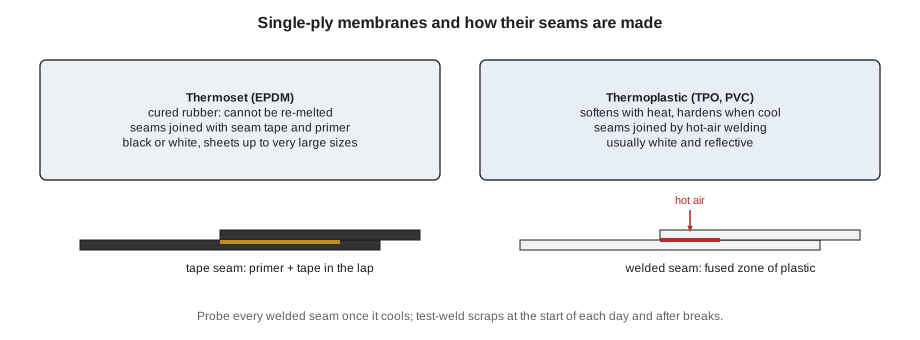
- Thermosets are cured (vulcanized) during manufacture, like a car tire. Once cured, they cannot be melted or welded. Seams must be glued or taped. EPDM is the main thermoset roofing membrane.
- Thermoplastics soften when heated and harden again when cooled, as many times as needed. Seams are joined by melting the two sheets together with hot air, forming a weld. TPO and PVC are the main thermoplastic membranes.
EPDM
EPDM (ethylene propylene diene monomer) is a synthetic rubber membrane, usually black, sometimes white. It has been used on roofs since the 1960s and has a long record of durability: it stays flexible in extreme cold, resists UV and ozone, and stretches several times its length before breaking. Common thicknesses are 1.14 mm and 1.52 mm (45 mil and 60 mil), and it comes in very large sheets, which means fewer seams. In North America it is usually made to ASTM D4637.
EPDM seams are made by cleaning and priming both surfaces, then pressing a strip of factory-made seam tape (a cured or semi-cured rubber adhesive tape) into the lap and rolling it firmly. Older roofs used liquid splice adhesive. The common causes of EPDM seam failure are dirty or unprimed laps, too little rolling pressure, and fish-mouths (wrinkles at the seam edge). EPDM does not tolerate oils, greases, solvents and petroleum products: they swell and soften it. Keep it away from kitchen exhaust grease, and never use asphalt products on it unless the manufacturer approves them.
TPO
TPO (thermoplastic polyolefin) is a white or light-coloured membrane with a polyester reinforcing scrim in the middle. It became popular in the 1990s and is now one of the most common commercial roof membranes. TPO has no added liquid plasticizers, so it does not shrink or become brittle from losing them, and its white surface reflects much of the sun's heat. Common thicknesses are 1.14, 1.52 and 2.03 mm (45, 60 and 80 mil). Many products sold in Canada are made to the US standard ASTM D6878.
The thickness that matters most is the part above the scrim, because that is the layer that wears away in the weather. Two membranes with the same total thickness can have different thicknesses over the scrim; the product data sheet tells you which is which. TPO seams are hot-air welded. Old, weathered TPO can be hard to weld because its surface has oxidized; it must be cleaned and sometimes scrubbed or treated with a special cleaner before a repair weld will hold, and repairs on very old TPO may need a different method approved by the manufacturer.
PVC
PVC (polyvinyl chloride) membranes are also thermoplastic and hot-air welded, and they have been used on roofs longer than TPO. Pure PVC is stiff, so roofing PVC contains plasticizers that make it flexible. PVC resists fire, grease, oils and many chemicals well, which makes it a common choice for restaurants and industrial roofs with exhaust fans. Canadian PVC membranes may be listed to CAN/CGSB-37.54; many also list ASTM D4434.
PVC's weak point is its plasticizer. If PVC touches asphalt, polystyrene insulation or some other plastics, the plasticizer can migrate out of the membrane, leaving it brittle and shrunken. PVC must be separated from those materials with a slip sheet or a compatible cover board. Even on its own, over many years the plasticizer slowly leaves, so very old PVC can shatter when bent in cold weather.
| Property | EPDM | TPO | PVC |
|---|---|---|---|
| Family | thermoset rubber | thermoplastic | thermoplastic |
| Usual colour | black (white available) | white or light | white, grey or tan |
| Seams | primer and seam tape | hot-air welded | hot-air welded |
| Cold flexibility | excellent | good | good when new; stiffens with age |
| Grease and oil resistance | poor | fair | good |
| Contact with asphalt | only if approved | only if approved | never without a separator |
| Contact with polystyrene | acceptable | acceptable with approved board | needs a separator |
Welding thermoplastic seams
A hot-air weld is made by blowing air hot enough to melt the surfaces of both sheets into the lap, then pressing them together with a roller so they fuse into one piece. Large flat seams are welded with a wheeled automatic (robotic) welder; details and repairs are welded with a hand welder and a silicone roller. A good weld depends on three settings working together: temperature, speed and pressure. Weather changes the right settings: a cold, windy day needs more heat or less speed than a hot, still one.
That is why welding crews follow a routine:
- Clean the seam area. Dirt, dust, water and old coatings all prevent fusion.
- Make test welds on scrap at the start of every day, after breaks and whenever the weather changes. Let them cool, then peel them apart by hand. A good weld tears the membrane itself or pulls the scrim out, rather than peeling apart cleanly at the joint.
- Weld the seam, keeping an even width. Many manufacturers require a continuous weld at least 38 mm (1-1/2 in) wide on automatic welded seams.
- Once the seam has cooled, probe every welded seam by running a blunt probe, such as a cotter-pin puller, along the edge with firm pressure. The probe will slip into any gap. Mark and repair every void the same day.
- Seal cut edges of reinforced sheets where the manufacturer requires it, so the scrim does not wick water.
Overheating is as bad as underheating. A burned weld is brittle and can crack beside the joint, and too much heat can scorch or thin the membrane. The welder should leave a small, even bead of melted material squeezed out along the seam edge.
Worked problem
How long will the seams take?
Glen is pricing a future replacement of the Harbourside roof: 9,000 m² of TPO in 3.05 m wide rolls, lapped 150 mm at the side seams. About how many metres of side seam will there be, and how long would a robotic welder running at 3 m per minute take to weld them?
Show solution
- Each sheet covers a strip 3.05 − 0.15 = 2.90 m wide.
- Total seam length ≈ area ÷ strip width = 9,000 ÷ 2.90 ≈ 3,103 m.
- Welding time = 3,103 ÷ 3 ≈ 1,034 minutes.
- In hours: 1,034 ÷ 60 ≈ 17.2 hours of actual welding.
Answer: About 17 hours of welding on the field seams alone, before end laps, flashings and details, which are slower hand work. Wider sheets mean fewer seams, which is one reason wide rolls are popular.
Worked problem
How many rolls?
For the same estimate, each roll is 3.05 m × 30.5 m, lapped 150 mm at the side seams. Ignoring end laps and flashings, how many rolls cover 9,000 m²?
Show solution
- Coverage per roll = 2.90 m × 30.5 m ≈ 88.45 m².
- Rolls = 9,000 ÷ 88.45 ≈ 101.8, so 102 rolls.
Answer: 102 rolls for the field, plus perimeter half sheets, flashings and waste.
Holding single-ply membranes down
Single-ply membranes are attached in one of three main ways, chosen by the designer from the manufacturer's tested systems:
- Mechanically attached: the sheet is fastened through the lap at each side seam with screws and plates into the deck, and the next sheet laps over and is welded or taped to cover the fasteners. It is quick and light, but the sheet between seams can flutter and billow in wind, which is why fastener spacing and sheet width are set by the wind design. A newer method, induction welding, fastens plates through the insulation first and then bonds the membrane to the tops of the plates with a magnetic heating tool, so there is no fastener row in the seam.
- Fully adhered: the sheet is glued to the insulation or cover board with bonding adhesive (a contact adhesive applied to both surfaces) or with low-rise foam or other adhesives. Adhered roofs do not flutter and resist wind well, but cost more and depend on good adhesion to a sound substrate.
- Ballasted: the sheet is laid loose and held down by the weight of river stone or concrete pavers, typically around 50 kg/m² (10 lb/ft²) or more. Ballasted roofs are fast to install and easy to take apart, but the structure must carry the weight, the stones are hard to work around when finding leaks, and the edges and corners need extra ballast or pavers.
Worked problem
The weight of ballast
A 600 m² EPDM roof on a school wing is to be ballasted with stone at 49 kg/m². What is the total weight of the ballast?
Show solution
- Weight = 600 × 49 = 29,400 kg.
- That is about 29.4 tonnes, or about 0.48 kPa (49 kg × 9.81 m/s² ≈ 481 N per square metre).
Answer: About 29.4 tonnes. The structure must be checked to carry it, which is why a ballasted roof cannot simply be added to a building designed for a light roof.
Liquid-applied membranes and coatings
Some waterproofing is applied as a liquid that cures into a seamless membrane. Liquid-applied systems are especially good at details with complicated shapes, such as clusters of pipes, odd-shaped curbs and drains, where cutting and welding sheets would be awkward.
- Reinforced liquid membranes: resins such as polymethyl methacrylate (PMMA), polyurethane or rubberized asphalt, applied in coats with a polyester fleece embedded between them. PMMA cures in less than an hour, even in cold weather, which makes it popular for flashings.
- Roof coatings: acrylic, silicone, polyurethane or asphalt-based coatings applied over an existing, sound roof to restore its surface, reflect sunlight or extend its life. A coating is not a fix for a wet or failing roof; the substrate must be dry, sound and clean, and wet insulation must be replaced first.
- Spray polyurethane foam roofs: foam insulation sprayed on the deck, which cures into a seamless, sloped surface and is then protected from UV with a coating.
Liquid systems are only as good as their surface preparation and their thickness. Each coat must reach the wet thickness the manufacturer specifies, which crews check with a wet-film gauge as they go. Temperature, humidity and dew all affect curing.
Other plastics on the roof
Roofers handle many other plastic and rubber products:
| Product | Typical material | What to know |
|---|---|---|
| Vapour retarder sheet | polyethylene, about 0.15 mm (6 mil) | seal every lap and penetration; UV breaks it down if left exposed |
| Synthetic underlayment | woven or spun polypropylene | light and strong; follow the maker's fastening and exposure limits |
| Self-adhered membranes and tapes | rubberized asphalt or butyl | need clean, dry, primed surfaces and minimum temperatures |
| Pipe boots and vent flashings | EPDM, TPO, PVC or plastic | match the boot to the membrane; rubber boots crack in UV over time |
| Skylight domes | acrylic or polycarbonate | are not walkable; guard or screen them as in ROOF-110 |
| Sealants | polyurethane, silicone, hybrid polymer, butyl | not interchangeable; check compatibility with the membrane |
| Walkway pads | rubber or the same thermoplastic as the membrane | protect the membrane on service routes |
Sealants deserve a closer look because they are so often misused. A sealant joint works only if it sticks to two sides and can stretch freely. A bead that sticks to three sides (two sides and the back of the joint) tears when the joint moves. Proper joints have a foam backer rod to control depth and stop three-sided adhesion, and a depth about half the width. Silicone and polyurethane sealants are not compatible with each other, and silicone cannot be painted or covered by most other sealants later. Above all, sealant is a maintenance item: exposed sealants need checking and redoing every few years.
Compatibility: what can touch what
Many membrane failures come from two materials that should never have met. Before any repair or tie-in, identify the existing membrane and check the manufacturer's compatibility list. The common incompatibilities are:
- PVC with asphalt, coal tar, polystyrene and some other plastics: plasticizer migration.
- EPDM with oils, greases, solvents and most asphalt products: swelling and softening.
- Polystyrene insulation with solvent-based adhesives, primers and sealants: the foam dissolves.
- TPO with PVC: they will not weld to each other.
- Silicone with almost everything that comes after it: nothing sticks to cured silicone except more silicone.
If you are not sure what a membrane is, there are clues. EPDM feels rubbery, stretches easily and has taped or glued seams. TPO and PVC have welded seams with a small bead at the edge. PVC is usually more supple and has a slight smell when heated; TPO feels slightly waxy. A small sample sent to the manufacturer or a lab settles any doubt. Dana's rule for the crew is simple: no repair until you know what you are repairing.
The Harbourside repair
At the skylight, Dana cleaned a wide area around the puncture, scrubbed the weathered TPO with the manufacturer's cleaner, made two test welds on scrap and peeled them, then welded a rounded patch over the hole with a hand welder and roller. The open seam near the docks had never been fully welded; she cut out the bad section, cleaned it and welded a cover strip over it, then had Rory probe every centimetre of the repair once it had cooled. "Round corners on every patch," she said. "Square corners lift. And probe it all, every time."
Common mistakes
MistakeUsing asphalt cement to patch EPDM or PVC.
InsteadIdentify the membrane and use the manufacturer's compatible repair method: tape and primer on EPDM, hot-air weld on TPO and PVC.
MistakeSkipping test welds because the welder worked yesterday.
InsteadMake and peel test welds at the start of each day, after breaks and when the weather changes.
MistakeWelding a seam and never probing it.
InsteadProbe every welded seam once it cools and repair every void.
MistakeLaying PVC directly on old asphalt or polystyrene.
InsteadInstall a separator or compatible cover board to stop plasticizer migration.
MistakeTreating sealant as a permanent repair.
InsteadUse proper flashings; design sealant joints with a backer rod and inspect them regularly.
Summary and key terms
- Single-ply roofs use one factory-made sheet, joined with seams, as the whole waterproofing.
- Thermosets such as EPDM are taped or glued; thermoplastics such as TPO and PVC are hot-air welded.
- EPDM is flexible rubber that hates oils; TPO is reflective with no added plasticizer; PVC resists grease but loses plasticizer and must be separated from asphalt and polystyrene.
- Welds depend on temperature, speed and pressure; test-weld daily and probe every seam.
- Membranes are mechanically attached, fully adhered or ballasted, as tested by the manufacturer and set by the wind design.
- Liquid-applied membranes suit complex details; coatings need a sound, dry roof.
- Check compatibility before every repair or tie-in.
- Single-ply membrane
- A single factory-made sheet that forms the whole waterproofing of a roof.
- Thermoset
- A material cured during manufacture that cannot be re-melted, such as EPDM.
- Thermoplastic
- A material that softens with heat and hardens when cooled, such as TPO and PVC.
- Scrim
- The reinforcing fabric inside a membrane.
- Plasticizer
- An additive that makes PVC flexible.
- Test weld
- A sample weld made on scrap and peeled apart to check the welder settings.
- Ballast
- Stone or pavers whose weight holds a loose-laid membrane in place.
- Backer rod
- A foam rod placed in a joint to control sealant depth and prevent three-sided adhesion.
Practice problems
Work each problem on paper first, then reveal the answer to check.
How are EPDM seams usually made?
Show answer
By cleaning and priming the lap and applying seam tape, then rolling it firmly.
Convert 1.52 mm to mils.
Show answer
1.52 ÷ 0.0254 ≈ 60 mil.
What does a good peel test on a weld look like?
Show answer
The membrane tears or the scrim pulls out instead of the weld peeling apart cleanly.
A 400 m² roof is ballasted at 50 kg/m². What does the ballast weigh?
Show answer
20,000 kg, or 20 tonnes.
Why must PVC be kept off asphalt?
Show answer
Plasticizer migrates out of the PVC, leaving it brittle and shrunken.
Lesson quiz · 5 questions
Score 60% or more to complete this lesson.
Create a free account to save your progress, take quizzes and earn a certificate.